

Climbing Aboard
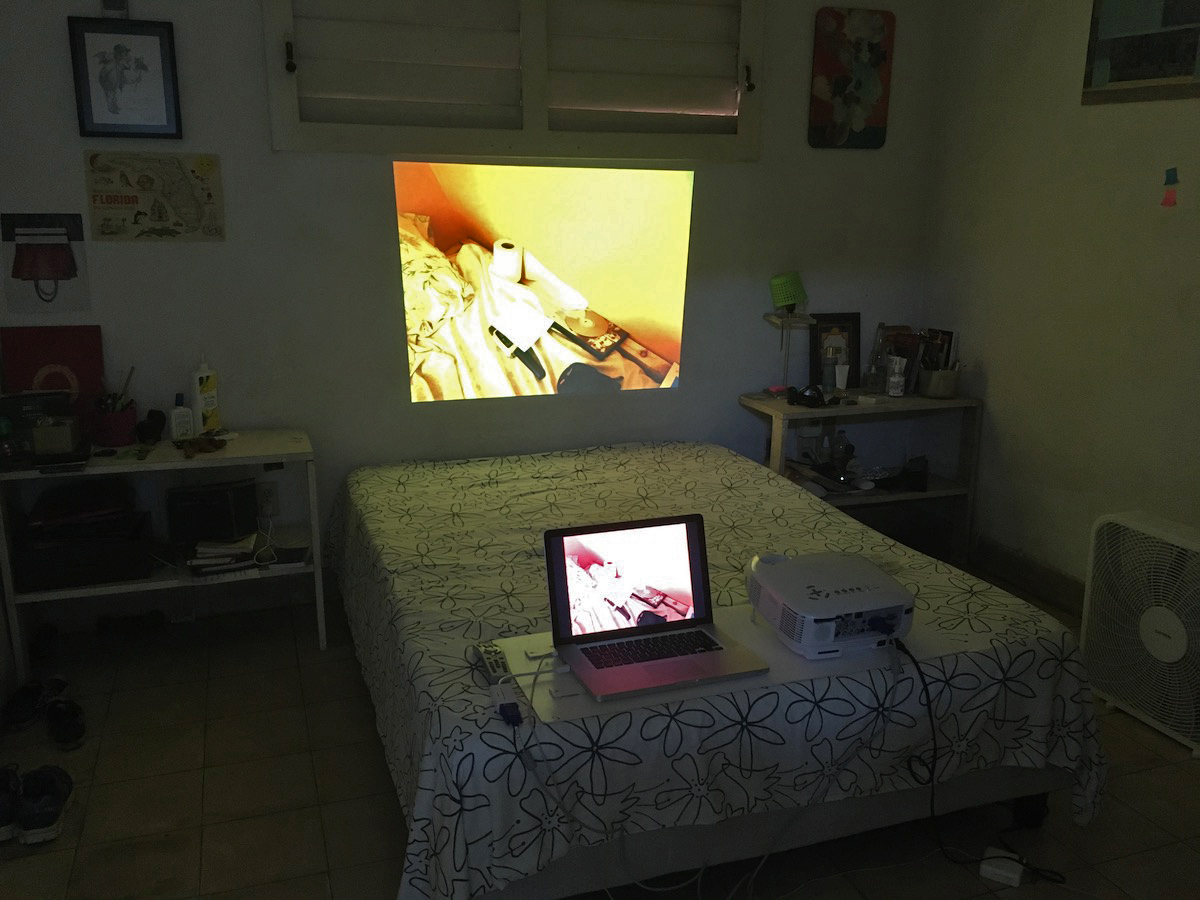
As 2019 draws to an end, I am in Havana, searching for the apartment of the cultural worker and independent curator Solveig Font. I feel my way through the dark hallway of a building located in the El Vedado neighbourhood. A label on the wall displaying the image of an orangutan, a syringe stuck in his bottom, and the words ‘Avecez Art Space’ (Sometimes Art Space) confirm that I have arrived at my destination. Solveig opens the door and, after customary greetings, I am finally in her ‘apartment-gallery’. She offers me a coffee — she has just finished breakfast — and I accept in an absent-minded manner, because my eyes and mind are turned towards the artworks among the sparse furniture and decorative works in our midst. A title appears on the wall of the dining-living room in adhesive vinyl, and reveals that Avecez Art Space is hosting the international group exhibition ‘A quién pueda interesar’ (To Whom it May Concern), bringing together Victoria Stanton, María Ezcurra, and Helena Martín Franco, three Montreal-based artists. Most of the works are exhibited in this central space, taking the form of photographs documenting three dinners organized by Stanton, as well as footballs cut up and flattened out by Ezcurra. One of the artworks is projected in Solveig’s bedroom: the projector is placed on the mattress and throws a moving image onto the wall behind the bed. The video Cada cama tiene su discurso (Every bed speaks its words) (2019) shows a series of conversations orchestrated by Martín Franco in other people’s beds.1The exhibition evokes the places and activities conducive to establishing relationships on large, medium, and small scales: football matches, dinners, and beds.
In Cuba, the term ‘apartment-gallery’ designates houses and apartments that either regularly or occasionally host solo or group exhibitions, workshops, conferences, or artist residencies. Sometimes these residential spaces have preserved their domesticity, as is the case with Havana-based Avecez Art Space and Estudio Figueroa-Vives. Sometimes they are stripped of this character to run as ‘private’ galleries — the most well-known example being El Apartamento, which is also in Havana. Though the rise of the apartment-gallery can be examined through the prism of the Cuban tradition of nineteenth-century salons (tertulias), which were imported from Spain and served as small home gatherings organized by writers and musicians, these new places for art are also deeply rooted in the contemporary Cuban sociopolitical context and its (post-)socialist condition.2
Beginning in 2015, apartment-galleries like Solveig Font’s became prominent in the Cuban scene on the occasion of the twelfth Havana Biennial. Their presence, however, was not an isolated phenomenon or occurrence, but can be traced back to the preceding Biennial in 2012.3 In the context of renewed diplomatic relations between Cuba and the United States at the very end of 2014,4 a large number of local artists, art historians, independent curators, and cultural workers transformed their homes, or the apartments and houses of others, into exhibition spaces.
Henceforth entrusted with a temporary or permanent artistic function, which has developed more or less on the fringes of state cultural institutions, over the last ten years apartment-galleries have become an inescapable point of reference in the Cuban artistic landscape. These spaces have even entered into a dynamic form of competition with Cuba’s official cultural sector. In an article from 2017 that draws a portrait of Cuba’s current art scene, the Cuban artist and researcher Celia Irina González writes:
[…] Promotion in the hands of public institutions is less dynamic than before — think of the Centro de Desarrollo de las Artes Visuales, Centro Provincial de Artes Plásticas y Diseño (Luz y Oficio), and Galería Habana — with the exception of the Centro de Arte Contemporáneo Wifredo Lam, whose main task is to organize the Havana Biennial, still considered a site of legitimation. The new spaces created by the artists themselves or independent managers have taken on this task more efficiently.5
However, despite the role that apartment-galleries play in the development of the Cuban art scene, scholarly writing about these spaces is rather scarce. This is partly due to the grey area into which they fall with respect to the authorities, a topic I will return to later in this chapbook. Aglutinador is one of the only apartment-galleries that has received sustained attention from journalists and researchers since its ‘opening’ in Havana in 1994.6 However, the vast majority of publications that have engaged with the space have provided only a minimal overview of Aglutinador’s activity, either reviewing the exhibitions it hosts or linking it to the practices and artistic paths of its founders, artists Sandra Ceballos and Ezequiel Suárez.
The first scholarly article to critically examine apartment-galleries as new ‘institutions’ was not published until 2017. In ‘Homebound: The Art of Public Space in Contemporary Cuba’, MIT Latin American Studies professor Paloma Duong highlights how these spaces challenge notions of private versus public space in Cuba through a comparative study that mainly brings together four apartment-galleries: Aglutinador,7 Xoho, Fanguito Estudio, and Cristo Salvador Galería.8 Even though Duong applies a broad definition of what she refers to as home-based or residential cultural scenes (which include exhibition sites but also a range of independent cultural centres that host literary meetings or film screenings), she focuses in most detail on the spaces whose activity centres on the visual arts.
Notwithstanding the relevance of Duong’s work to this chapbook, the researcher who has most extensively studied the relation between these spaces and the current Cuban art panorama is the Cuban art critic and independent curator Mailyn Machado. In her book trilogy Open Studios (2018),9 Machado examines contemporary Cuban art in terms of its institutional framework, focusing on the evolution and role that the artist’s workshop or studio has played in the development of the local art scene since the 1980s. For the purposes of my analysis, Open Studio i and iii are the most relevant. The first volume provides a detailed outline of the art system in the Cuban revolutionary project and of domestic spaces in state and individual initiatives in the face of a massive government disengagement beginning in the 1990s, as well as the ensuing and forced self-determination of artistic practice. In the third volume, Machado brings together interviews conducted with the owners (artists, art historians, cultural workers, collectors) of a number of artists’ studios, some of which fall into the category of apartment-galleries. These include El Apartamento and Estudio Figueroa-Vives, two of the examples to be discussed here. However, despite the wealth of information Machado has compiled and the very skilful narration of the volumes, absent from this trilogy is a transversal analysis of these artists' studios, emphasizing similarities, differences, and contradictions, and an exploration of their international activity. Rather, Machado focuses on the specificities of the Cuban national context and the roles of these spaces in it.
In light of these sources, as well as online articles about the activity of the apartment-galleries published in the Cuban independent press,10 it is evident that these spaces are vital in their local context. They provide alternative venues of exhibition and expression for Cuban artists. However, their international presence and activities remain largely unknown and have not been thoroughly examined. This country's sporadic and unsystematic dialogue with the international art scene makes it even more noteworthy that these apartment-galleries have such wide-ranging activities abroad.
In order to collect data, I visited and made observations of apartment-galleries in Havana in 2019 and 2023, and held conversations with their owners and individuals with links to them. These exchanges were followed by videoconferences and written communications. Access to these spaces’ private archives and the information collected on their websites completed this chapbook’s main avenue of research.
My initial focus here is on the changes that international artistic circuits have undergone since the end of the 1980s, in particular the rise of ‘emerging geo-aesthetic regions’,11 as I discuss below. These changes have favoured the insertion of ‘Cuban art’ in the ‘new geo-aesthetic maps of globally networked “artworlds”’,12 mainly shaped by re-Westernization processes or imperialistic worlding13 through which Cuban art came to be seen as a ‘periphery-asset’. I then present an analysis of the emergence and proliferation of apartment-galleries in Cuba subsequent to a series of economic reforms implemented in the country following the collapse of the Soviet Union in 1991. My attention turns thereafter to the origin of the Cuban ‘independent’ artist and the nature of their international exposure, looking in particular at three examples of Havana-based apartment-galleries that differ from each other in terms of their function, mission, goals, and configuration: El Apartamento, Estudio Figueroa-Vives, and Avecez Art Space. I explore the strategies they adopted in order to transcend their local physical boundaries and ask the following questions: How did these spaces manage to insert themselves into global art circuits in the absence of a local market and cultural institutions (museums and galleries) with a sustained international presence? Through which strategies and artistic circuits did such an insertion take place? How does the independent Cuban arts scene as a whole position itself within these circuits? To better describe their operation, I conceptualize their differences through three apartment-gallery types or models that I have coined: the ‘private gallery model’, the ‘museum model’, and the ‘laboratory model’. The chapbook ends with a discussion of the role of the Havana Art Weekend (launched in 2017), a non-state and, hence, non-official event created to direct international attention towards the local Cuban context, and in which apartment-galleries and artists’ studios have played a central role.14 By examining the interplay between apartment-galleries and the broader placement of the Cuban art scene within the international artworld, this study invites an overall reflection on the interplay between the local and global in discussions on ‘worlding’. It draws upon literary theorist Pheng Cheah’s observation that ‘the local both enters into and is traversed by the global’.15 For Cheah, there is an urgent need to unlink the notion of the ‘world’ from a spatial understanding caused by the conflation between ‘world’ and ‘global’ in the field of World Literature. Reflecting on the Cuban context, I argue that this approach may be the key to escaping the ‘tyranny of space’, and starting to think about the world as temporal and ‘something we carry while traversing the globe and negotiating its scales’.16
A New International Geography of Art: Cuban Art as a ‘Periphery-Asset’
The present-day possibility for Havana-based apartment-galleries to have international exposure is owing to a ‘new international geography of contemporary art’,17 which is to say, a restructuring of artworlds that began at the end of the 1980s. This geopolitical revisionism had an impact on the organization of the art market and art institutions on a global scale.
The ‘spatial turn’ of the social sciences during the 1960s, identified by the geographer Edward Soja, aimed in particular to deconstruct the geopolitical hierarchies associated with Modernity and grand narratives.18 The manifesto-like book Géoesthétique, edited by Kantuta Quirós and Aliocha Imhoff and published in 2014, attempted to identify the turn discussed by Soja in the field of art.19 It takes a particular interest in the representation of space within artistic practices and the ‘spatialization’ of art through exhibition curatorship and art history.
It is the phenomenon of spatialization that directs my attention here, namely the manner in which the works and artists travel and are valorized in international art circuits on the basis of their provenance. In the introduction, Quirós and Imhoff refer to art’s spatial turn as ‘geo-aesthetics’, a notion borrowed from Joaquín Barriendos.20 The researcher at the Instituto Nacional de Bellas Artes de México coined this term to describe the way in which spatial parameters add symbolic capital to contemporary art. Barriendos has most notably investigated the rise of the ‘new international geography of contemporary art’ in relation to the transformation of Latin America into an ‘emerging geo-aesthetic region’21 and the transformation of Latin American art into a ‘periphery-asset’22 through a commodification of its perceived marginal condition.
Following the logic of art’s spatial turn, Cuban art could be said to have become a periphery-asset based on its creation in an ‘emerging geo-aesthetic region’. Furthermore, when seen as a periphery-asset, Cuban art fits into the definition of global art as formulated by German art historian Hans Belting.23 Belting locates the emergence of this ‘type’ of art and its entry into the contemporary artworld in Paris, in 1989, with the exhibition ‘Les Magiciens de la Terre’ at the Centre Georges Pompidou.24 In an attempt to define ‘global art’, Belting evokes ‘world art’ and foregrounds both their relation and difference: ‘While world art remained synonymous with the art heritage of the “others”, global art by contrast crossed the boundaries and demanded acceptance as a contemporary practice on equal footing with Western Art.’25 In the past, Cuban art — much like Latin American art — was labelled as art of ‘Others’, regardless of whether it was contemporary or not. It was thus considered to be less developed, as well as of lower status and/or value in relation to Western art. Anthropologist Johannes Fabian has dubbed this the ‘denial of coevalness’ by Western institutions.26 Departing from this, more recent definitions of global art, such as Belting’s, suggest that current Cuban art production is not being refused coevalness anymore.
This new status of global art gained by being a ‘periphery-asset’ thus grants Cuban art a right of passage: it suggests the possibility of climbing aboard the contemporary art train thanks to the valorization of its marginal condition. As further noted by Belting, ‘Difference, with the label of a foreign culture, has become marketable and thus becomes an entrance ticket for newcomers on the art market.’27 By this logic, artists who want to benefit from exposure in contemporary art circuits must speak an ‘international language’,28 all the while being enjoined to foreground their difference.29
This condition opens the door to this much sought after insertion — an insertion or integration that goes against the grain, for example, of the structural changes that the Havana Biennial notably proposed during its first three editions. The 1989 one, in particular, represented an attempt to promote South-South dialogues through the creation of alternative contemporary art networks. 30 This may be understood as an effort to ‘re-worlding’: one where we understand ‘worlding’ both as ‘how a world is held together’31 and as a form of Relation, described by the Martinique-born French philosopher Édouard Glissant as a way of unlinking from spatial parameters. Glissant’s definition of the Relation is particularly pertinent as it stresses ‘the realized quantity of all the differences of the world, without one of them being excluded’.32 This theory, both a poetics and philosophy, thus challenges the idea of the universal33 and the notion of economic and cultural globalization. In other words, it contests the generalization of a single universal model on a global scale. Whereas globalization eradicates plurality to find unity, Relation finds the latter in the former.34 In Glissant’s thinking, difference is not conceived as a marketable label but is what allows us to be in each other’s presence.
Taking up Barriendos’ line of thought, Quirós and Imhoff further explain that the new narrative of a globalized cultural geography perpetuates the asymmetries and hierarchies of the contemporary art system.35 Despite, for example, the worldwide circulation of global art (as understood by Belting), the majority of art fairs are concentrated in Europe and the United States, which points to the absence or near absence of structural change.36 As the French sociologist and art market specialist Alain Quemin explains:
Not only is the location of ICAFs [international contemporary art fairs] limited to a very small geographical, and mainly western, space, but also participating galleries come from a small number of Western countries, 64, that is, one-third of the world’s nations. The USA, Germany, the UK, Italy, France and Spain sent no less than 55.5% of participating galleries, the USA on its own accounts for 20% while the five major European Union countries account for 35.5%.37
Consequently, the process of decentring/de-Westernization, attached to the spatial turn of art, looks more like a process of re-Westernization or imperialistic worlding, especially because it is mostly Western structures that drive it, explains Barriendos in an essay in which he examines the role in this re-Westernization of the International Council for Museums and Collections of Modern Art (ICMC) and the International Council of Museums (ICOM).38 In other words, these processes of decentring conceal yet another imperialist project of worlding. Indian scholar and Columbia University professor Gayatri Chakravorty Spivak has written extensively on the latter as a process that seeks to transform individuals and things into objects to be understood.39 Spivak also notes that worlding the worlds of others forces them to look at themselves through the eyes of the worlder (colonizer).40 These ‘worlding’ operations described by Spivak take us back to Glissant’s concept of Relation, in which the very possibility of ‘being in relation’ relies on what the philosopher calls the right to ‘opacity’.41 This is the right not to make oneself readable/transparent to someone trying to transform us into an object to be read or understood — someone who rejects what he or she cannot understand. Exercising one’s right to opacity is a form of resistance to worlding operations still underway, i.e. through the re-Westernization process denounced by Barriendos.
All sections of the international cultural scene appear to be affected by this geo-aesthetic turn, whether with regard to the commercial sector (private galleries and fairs) or the exhibition sector (museums, exhibition centres, and non-profit organizations). In the virtual absence of an internal art market and in their quest for visibility in circuits that are ‘welcoming’ to art from the periphery, Cuban artists and curators have had to — and still have to — find alternative and sometimes roundabout means through which to operate.
Domestic Space and Renewal of the Cuban Economy: The Origin of the ‘Independent’ Artist
Here, everybody is desperate to sell […].
After the demise of the Council for Mutual Economic Assistance (CMEA)43 in 1991, following the collapse of the Soviet Union, the Cuban government was obliged to implement a series of economic reforms.44 It was not possible to uphold the imperative of political stability without economic renewal;45 Cuba was therefore promoted as an investment destination.46 This renewal presented two recognizable characteristics of a transition to capitalism: first, the use of private markets and, second, a currency reform that saw free circulation of the US dollar in Cuba. Despite these changes, the government managed to maintain its official socialist ideology by keeping a monopoly on most means of production and on political activity via the Communist Party.47
Among the multiple liberalizing reforms of this period was the legalization of certain ‘private’ economic activities: for instance, opening small restaurants (paladares) and renting out rooms in one’s home.48 Back then, domestic space was thus, to a large extent, at the centre of the reforms implemented by the state as part of the ‘Special Period in the Time of Peace’.49 Until the end of the 1980s, above all ‘home’ had been the place of family celebrations, festivities, and gatherings,50 but with the constitutional reforms that took place in 1992, it became a site of economic activity, especially in connection with the rise of the cuentapropista (self-employed individual). At the start of the 1990s, cuenta propria work (self-employment) re-emerged — the legal provisions for its application had been in place since 1975.51 Cuban author and independent scholar Abel Sierra Madero explains that the cuentapropista is not, strictly speaking, an ‘independent’ entrepreneur because the state regulates and controls everything: from prices to imports and even supplies. The state is mainly concerned with limiting the growth of this self-employed worker by making them pay exorbitant taxes, among other things, to prevent individuals from developing an ownership mentality.52
At the time of these reforms, artists became a kind of cuentapropistas, notably because they had to come to terms with a state disengagement that began in the late 1980s. During these years, they were transformed into self-employed workers — a transition implemented by decree no. 106 in 1988 and ratified five years later by resolution no. 61.53 The latter authorizes artists to receive payments in US dollars for the sale of their works.54 They had thus become self-employed workers, meaning they were no longer required to have an institutional affiliation. Moreover, the state abandoned its previous system of artist support, namely the purchase of a part of their monthly production, and replaced it with a consignment system.55 The non-existence of private galleries, with only a handful of state-owned commercial galleries in charge of promoting and marketing artists, coupled with the absence of a grants, subsidies, and exhibition fees system, seriously hampered the practice of this ‘independent’ activity. Artists were left to their own devices, and the domestic sphere became the last and main resort for marketing and promoting their work.56
This was not only due to the limited number of official Cuban galleries, which could, in any case, represent only a finite number of artists, but also to these state-owned institutions’ inability, as a result of economic and bureaucratic restrictions, to be present in international circuits in a systematic manner. In fact, Cuba’s participation in international fairs began only in the 1990s.57 In their bachelor’s thesis, Liatna Rodríguez López and Lida Lilian Sigas Nieto focus on the marketing of Cuban art based on an analysis of institutional and independent management models, stating:
[It] is true and verifiable that the current institutional system to launch and effectively insert our artists into the international market circuit is limited. However, we also believe that the problem is mainly due to insufficient economic resources and the lack of autonomy to effectively implement insertion strategies that our institutions are capable of developing. Cuban artists seem to appreciate the professionalism of home gallery owners, the commitment they put into their management and the seriousness with which they fulfil their contracts. However, the limited sales activities do not meet their expectations and, as a result, they do not recognize the Cuban gallery as their true representative in the international market.58
After the triumph of the 1959 revolution, a small number of state art galleries were created, such as Galería INIT, at the hotel Habana Libre, and Galería Habana. State auctions were also organized, but they were mainly aimed at domestic buyers.59 The actual initial institutionalization of the infrastructure for the marketing of art in Cuba arrived only in 1978 with the setting up of the Fondo Cubano de Bienes Culturales (FCBC). This entity’s mission was mainly the acquisition, promotion, and marketing of visual arts in local and international contexts through public galleries such as Galería La Acacia and Galería Habana.60 For more than two decades, the FCBC managed the promotion of Cuban artists. The company Génesis, Galerías de Arte, created in 2001, took over some of the FCBC’s responsibilities, including commercial tasks and the coordination of Cuban galleries’ participation in international fairs, which was strongly affected by an increase in participation fees.61 In 2009, Cuban art historian Lizet Fraga wrote about the future of official Cuban galleries’ participation in the ARCOmadrid Contemporary Art Fair:
In a sign of the clear separation between institutional policies, the financial reality of our institutions, and the decision-making criteria of the officials who have the last word when it comes to defining Cuba’s presence in international fairs each year, there are currently disparate and extreme positions regarding future participation in ARCO.62
In light of this situation, the dissemination and marketing activity of the artists’ works was mainly carried out in and from their studios, most frequently in their homes. Machado states:
The negligence of institutions, the slump of public collections — also affected by economic indices — and the international market’s interest all contributed to the circulation of our aesthetic heritage abroad. However, in this period the purchase and sale of artworks did not become the main activity of the home studio. What distinguished domestic exchange from the artist’s pragmatic model was artistic promotion on the international circuit. The participation in exhibitions, conferences, and residencies, and contracts with foreign galleries managed by the studio, were what made the artist independent from the Cuban territory.63
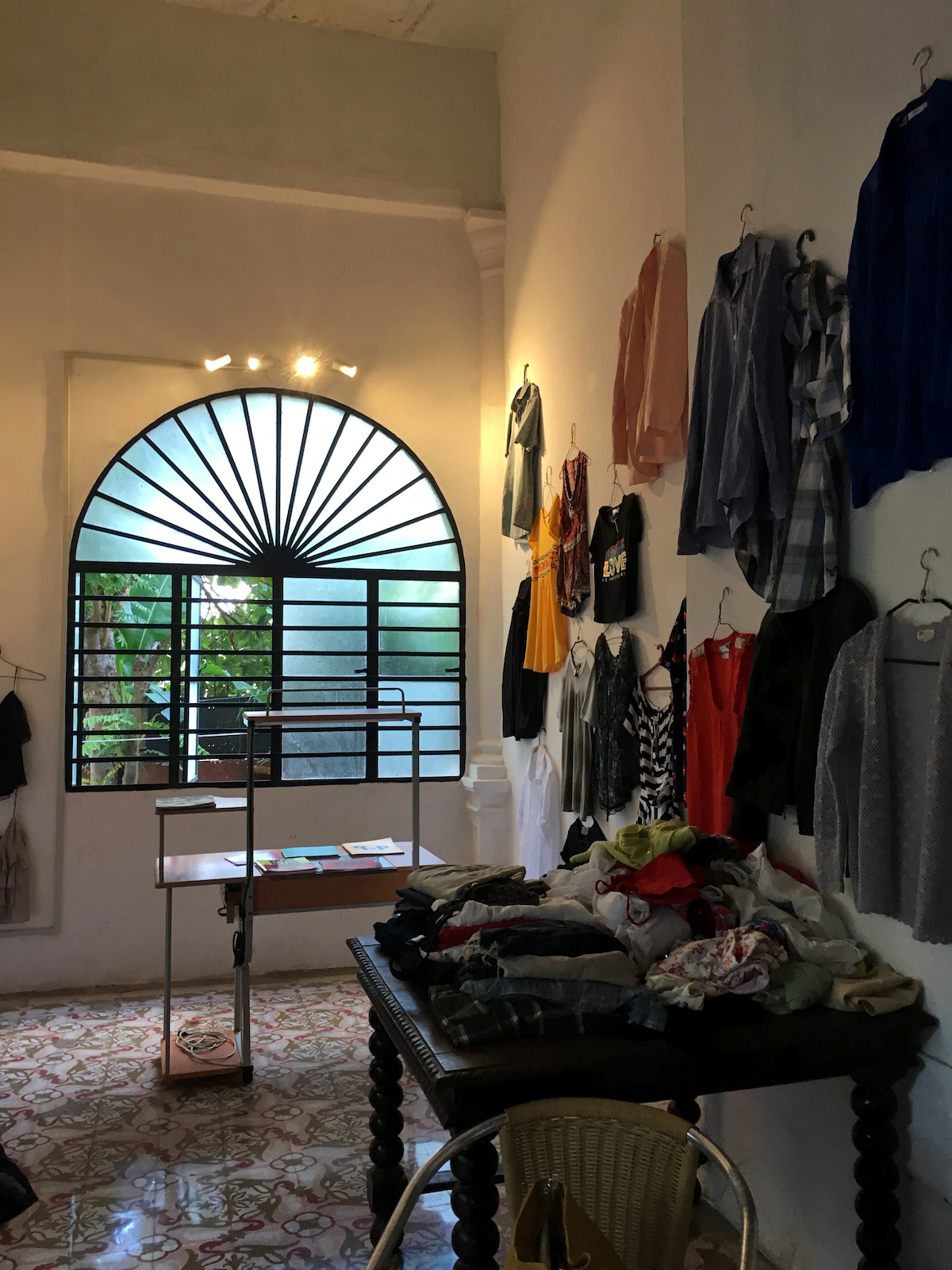
Due to artists’ forced self-determination, it is not surprising that a sort of institutionalization (co-opting the market function) of their studio was taking place. This institutionalization was to continue thanks to new economic reforms put in place in 2011, which also stimulated the proliferation of apartment-galleries, mainly via the legalization of the buying and selling of residential infrastructure. The market function is deeply embedded in these alternative art venues — even apartment-galleries that do not have commercial interest as a primary goal expect an economic return nevertheless. For instance, Estudio Figueroa-Vives sells artworks even though this space’s mission is not commercial. The same applies to Aglutinador, which barely operates like a private gallery.64 I visited this venue in December 2019. At the time, it was hosting the project ‘Disociación de la cultura: Si no vendes tu arte, vende tu ropa’ (Dissociation of Culture: If You Do Not Sell your Art, Sell Your Clothes), which was essentially a temporary thrift store selling recycled clothes at low prices (Figure 1). It is interesting to note that this apartment-gallery was founded in 1994, a couple of months before the fifth Havana Biennial’s inauguration and when the US dollar began to circulate freely in the country.65
The Legal Status of El Apartamento, Estudio Figueroa-Vives, and Avecez Art Space
To illustrate the variety of alternative art spaces in Havana, as well as the scope of their operations, I have selected three apartment-galleries that collectively offer three models for inserting the artists they represented into the international art scene: El Apartamento (the private gallery model), Estudio Figueroa-Vives (the museum model), and Avecez Art Space (the laboratory model). My analysis not only demonstrates that these venues are part of an alternative promotion and dissemination network to Cuban state channels, but also reveals the variety of components and sub-networks — and even the diversity of expressions and the complexity — of this broader infrastructure within which apartment-galleries came into existence. As Machado posits with reference to this alternative network during an interview with curator Cristina Vives: ‘Its legality is perhaps its only weak point, because in management terms, this circuit reveals the obsolescence of the mechanisms of state institutions.’66
It should be pointed out that apart from the aforementioned state galleries, which have the right to promote and market in their capacity as institutions, there are no private galleries in Cuba.67 Until 2021, there was still a legal ambiguity, if not regarding the legality of this type of space then at least with respect to their illegality; there was nothing in the law that explicitly prohibited their existence, even though private property is very restricted in Cuba and only allows a limited number of activities. However, in February 2021, the Clasificador Nacional de Actividades Económicas published a list of activities that cannot be conducted as self-employment (cuenta propia), including the running of commercial art galleries.68 Most of the apartment-galleries are in fact ‘managed’ by artists, who have the legal right to run an independent space, i.e. their own studio.
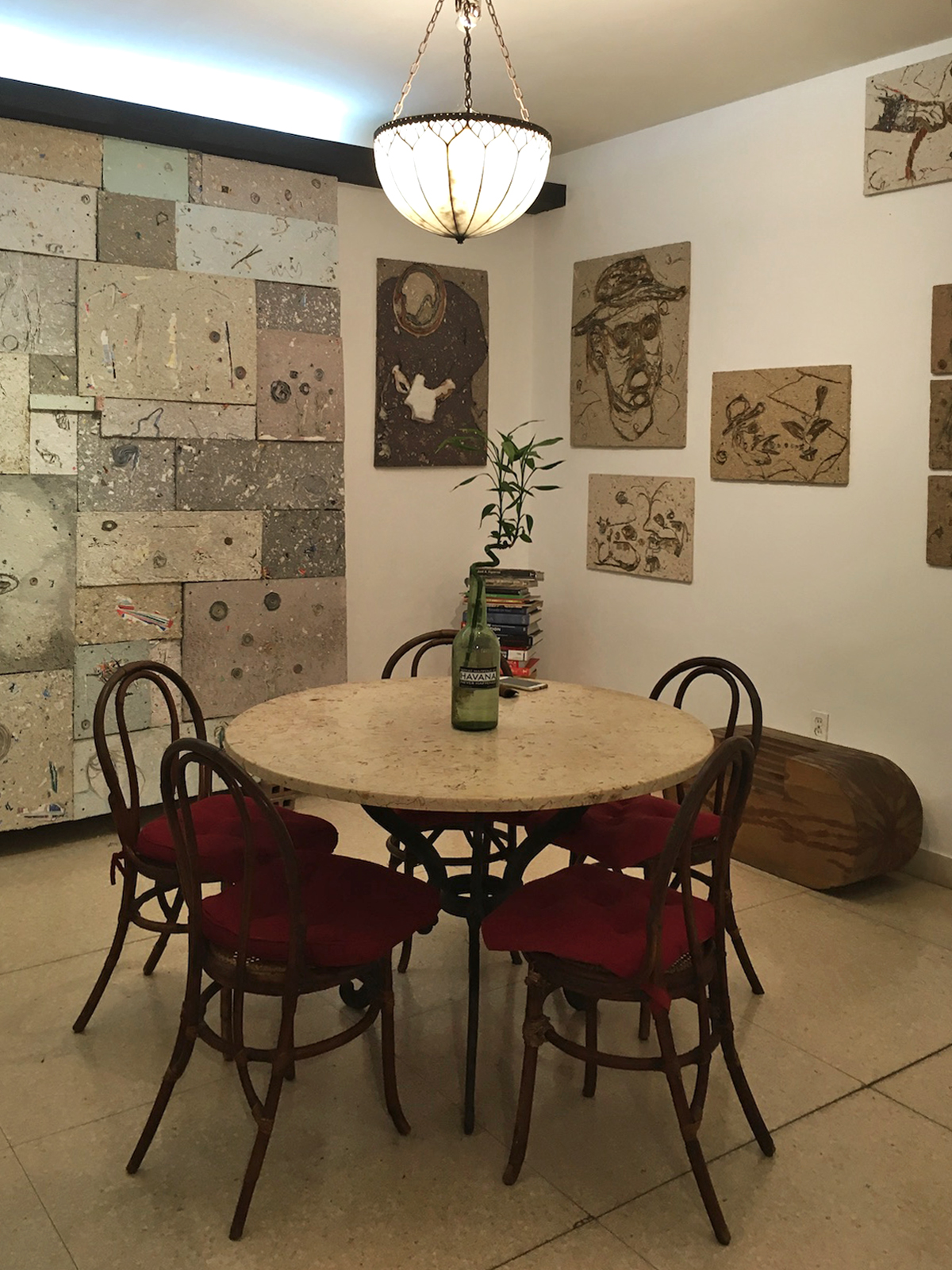
It is under this banner that the Estudio Figueroa-Vives has been operating since 1995: it is the studio and residence of the artist photographer José A. Figueroa (Figure 2). However, this apartment-gallery has been run as a public space since 2014, when it became associated with the Norwegian Embassy in Havana, which is headquartered in an adjacent building. Working collaboratively, they regularly present exhibitions that are usually organized by the artist’s partner, Cristina Vives — quoted above — and his daughter, Cristina Figueroa Vives, who jointly manage the photographer’s ‘studio’. While Estudio Figueroa-Vives’s status occupies a grey area from a legal point of view, other apartment-galleries, such as Avecez Art Space, operate in a way that is not sanctioned but, rather, ‘tolerated’ by the authorities.69
At first glance, a gallery like El Apartamento seems to be entirely situated in a zone of illegality. Fitting into what I have termed the private gallery model, El Apartamento (Figure 3) opened its doors in 2015, as part of the twelfth Havana Biennial, as a way to benefit, like so many other apartment-galleries and artist studios, from the international exposure offered by this event. Located in an apartment building unit stripped of its domestic character, the gallery is an initiative of the art historian and curator Liatna Rodríguez López, and Christian Gundín, its director and owner.
In the online publication Hypermedia Magazine, the art historian and art critic Jorge Peré published an article in 2020 that sparked a major debate on social media because of the importance he granted to this apartment-gallery in relation to others, and a competitive logic began to set in among them.70 His article focuses on the management model implemented by El Apartamento, which Peré describes as unique, especially in the absence of a clear legal framework. He writes: ‘Although it’s no secret that El Apartamento is a gallery designed with the profile of any private, self-run and commercially profitable gallery, the system [the Cuban government] prefers to refer to it as a “gallery-studio”, “studio-studio”, or any other disguised name.’71 The government refers to it as such, for this is the legal status claimed by El Apartamento for the authorities: that of an artists’ studio. The artists they ‘represent’, who are listed at the entrance and also on their website,72 use this venue to create and distribute their works, yet this does not negate the artists having their own studios elsewhere. The onsite staff managing the operations of this space, even organizing exhibitions, are considered, from a legal point of view, as assistants to these artists. Moreover, all the staff, including the director, pay taxes on their salaries as artists’ representatives (a fixed salary), as Gundín explains in an interview with Machado.73
Strategies of Insertion in International Arts Circuits
The ‘Private Gallery Model’ and ‘Museum Model’
The insertion strategies of my three case studies vary depending on the operation and goals of each space. Though El Apartamento organizes exhibitions on site, with vernissages open to all, its main mission remains that of representing artists and selling their work — what I am calling the ‘private gallery model’.74 According to Daleysi Moya Barrios, an art historian, curator, and art critic who works as a gallery assistant at El Apartamento, participation in international art fairs is one of their fundamental purposes.75 This is also a challenge, primarily because of the high costs of participation and the many tasks that must be completed using an unreliable Internet connection. Another element that confirms the centrality given to participation in fairs by El Apartamento is that this participation is not — nor can it become — an occasional affair, as their survival as a ‘gallery’ depends on it.76 According to Moya Barrios, engaging in dialogue with museums and other cultural venues is also an important aspect of their commercial activity. Over time, they have sold artworks to prestigious institutions such as the Museum of Modern Art in New York, Tate Modern in London, Pérez Art Museum Miami, Fundación María Cristina Masaveu Peterson in Madrid, and Espacio 23 in Miami.77
Estudio Figueroa-Vives appears to be distancing itself from the commercial ambitions of El Apartamento, because it would rather find its place on the museum exhibition circuit, although this does not prevent it from indirectly seeking market benefits.78 In an interview with Machado, Vives explains:
This is not a gallery, it’s a different format. But we sell art, and it sells very well. […] For many months, our economic activity has been low in terms of art sales; however, our studio continues to produce. It continues to produce books, projects, because it is not a gallery that depends on sales, but it is also a curatorial work. […] The support from Norway is only for exhibitions, there is no other kind of support, no salaries or anything like that, it doesn’t exist, and that’s what makes us very independent.79
Thus, while they may engage in commercial ventures, their main activity is the promotion of artists through local and international exhibitions, as well as through publications (catalogues are edited and published for each exhibition). This model of promotion is what I call a ‘museum model’,80 as global insertion occurs mainly through exhibitions in museums, such as the Los Angeles County Museum of Art (LACMA), Miami Dade College’s Museum of Art and Design, and the cultural centre La Térmica (Málaga, Spain).81
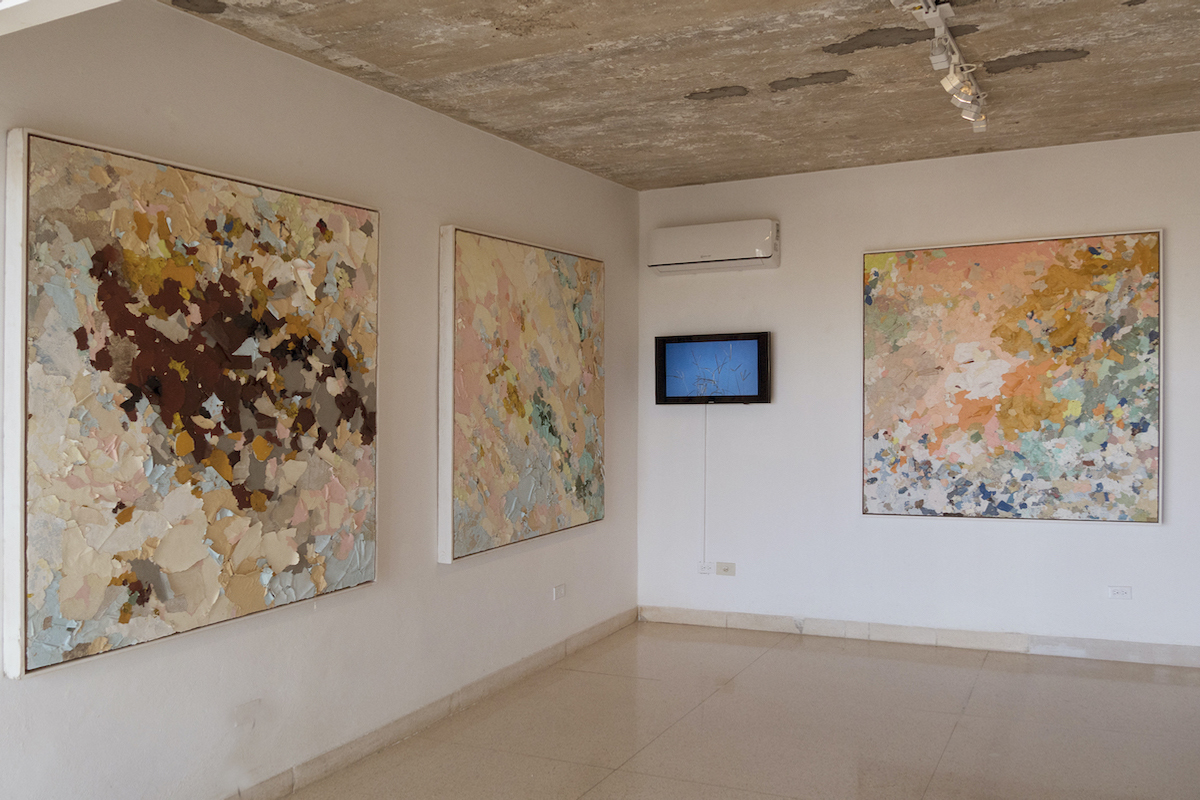
The importance that Estudio Figueroa-Vives puts on the development of a curatorial orientation for the exhibitions testifies to the different avenues taken by apartment-galleries. For example, as mentioned above, El Apartamento focuses greatly on participation in art fairs.82 The curatorial aspect of the exhibitions that they organize, though not secondary, is not what matters most. Even though fairs require a curatorial project as part of the application process, at a concrete level, these do not appear central to the selection process. In the case of El Apartamento, it is mostly during group exhibitions (Figure 4) that the curatorial reflection can be deepened; solo exhibitions (Figure 5), which make up the majority of the programme because they represent artists, aim primarily to foreground the works themselves and each artist individually.83
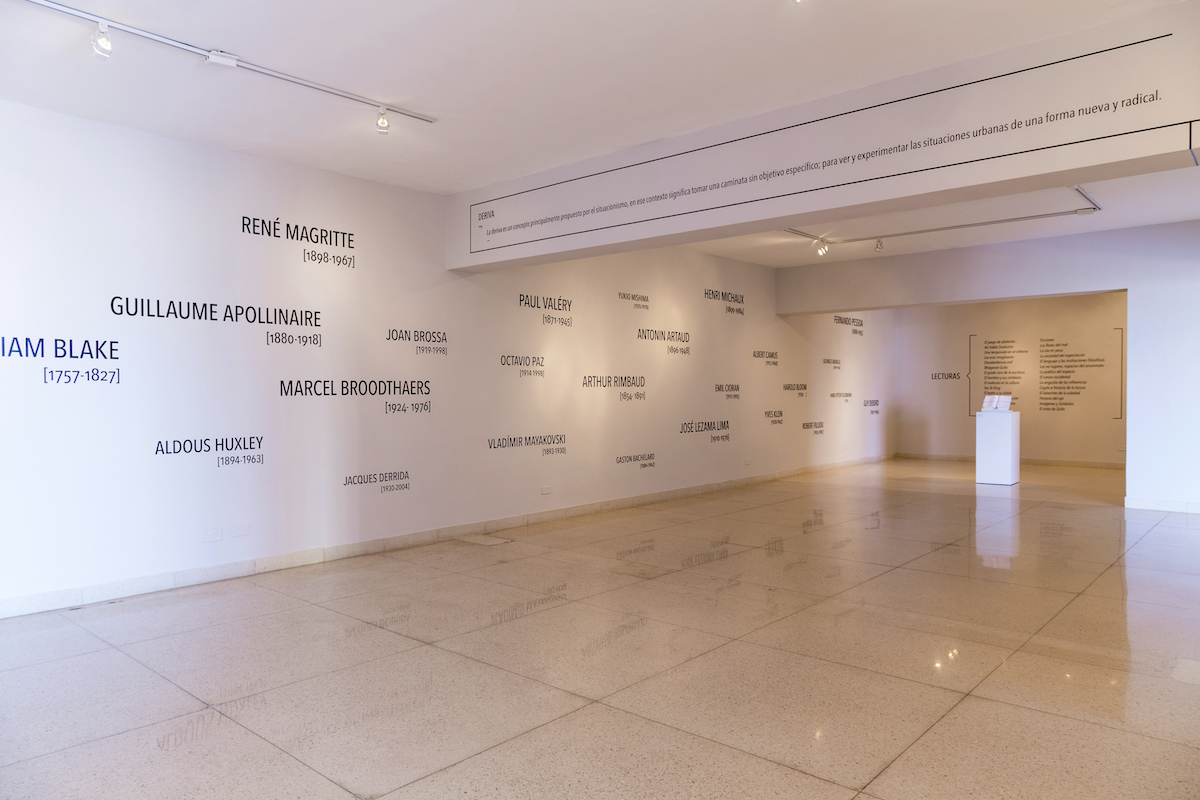
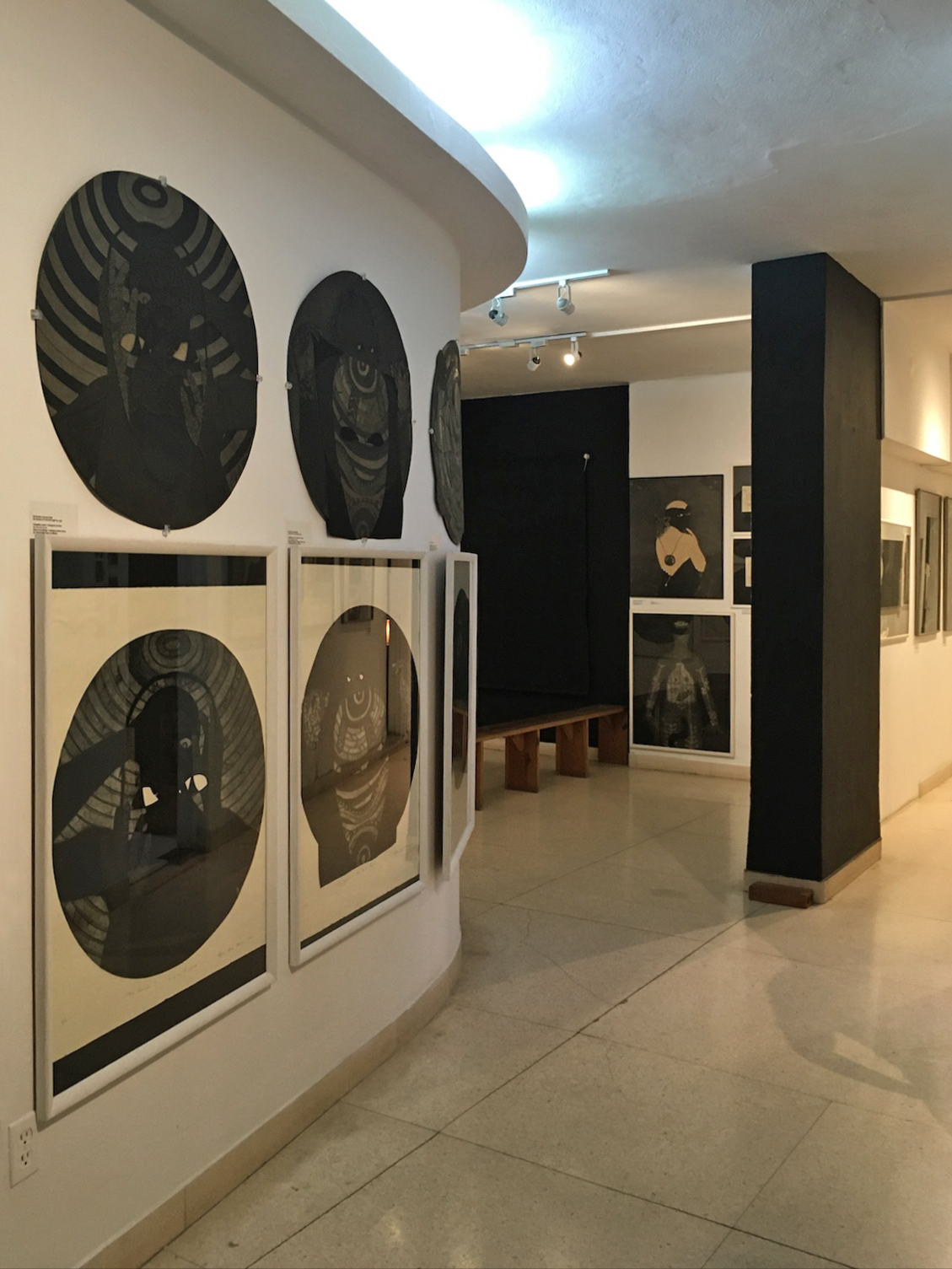
Back at Estudio Figueroa-Vives, a turning point occurred when it began its collaboration with the Norwegian Embassy in 2014, the year in which it formally identified itself as ‘Estudio Figueroa-Vives’ and began to sign its exhibitions under this name.84 In collaboration with the embassy, it set up large-scale exhibitions (i.e. with more significant financial means and an increased exhibition area) with a broader scope. Estudio has since become more ‘public’. For instance, it began organizing opening receptions that drew a large number of visitors. Moreover, Estudio is open at all times (though available only by appointment outside of opening nights, given that it is also a residential space). The exhibition space situated directly in the embassy is, however, freely accessible, without appointment, during the embassy’s opening hours. Within Havana, the longevity of this support and partnership makes it a rather unique collaboration. Other alternative spaces, such as Aglutinador, have only succeeded in ensuring sporadic financial support from foreign institutions for specific projects. In an interview that Sandra Ceballos granted to Rafael Díaz-Casas, she explains about her project P. E. R. R. O. awards — Propuesta Experimental de Respuesta Rápida Organizada:
We got support from the HIVOS foundation and the Prince Claus Foundation of the Netherlands. […] In this case the complex process was the selection, due to the number of artists in need of support. Those chosen in the first experiment were ones living outside Havana, with less market access. Every one of them was surprised when they were contacted, and they were thrilled. In addition to the monetary award, we published a catalogue to promote their work. This produced results for some, because their works were bought by the Rubin Collection in New York.85
The ‘Laboratory Model’
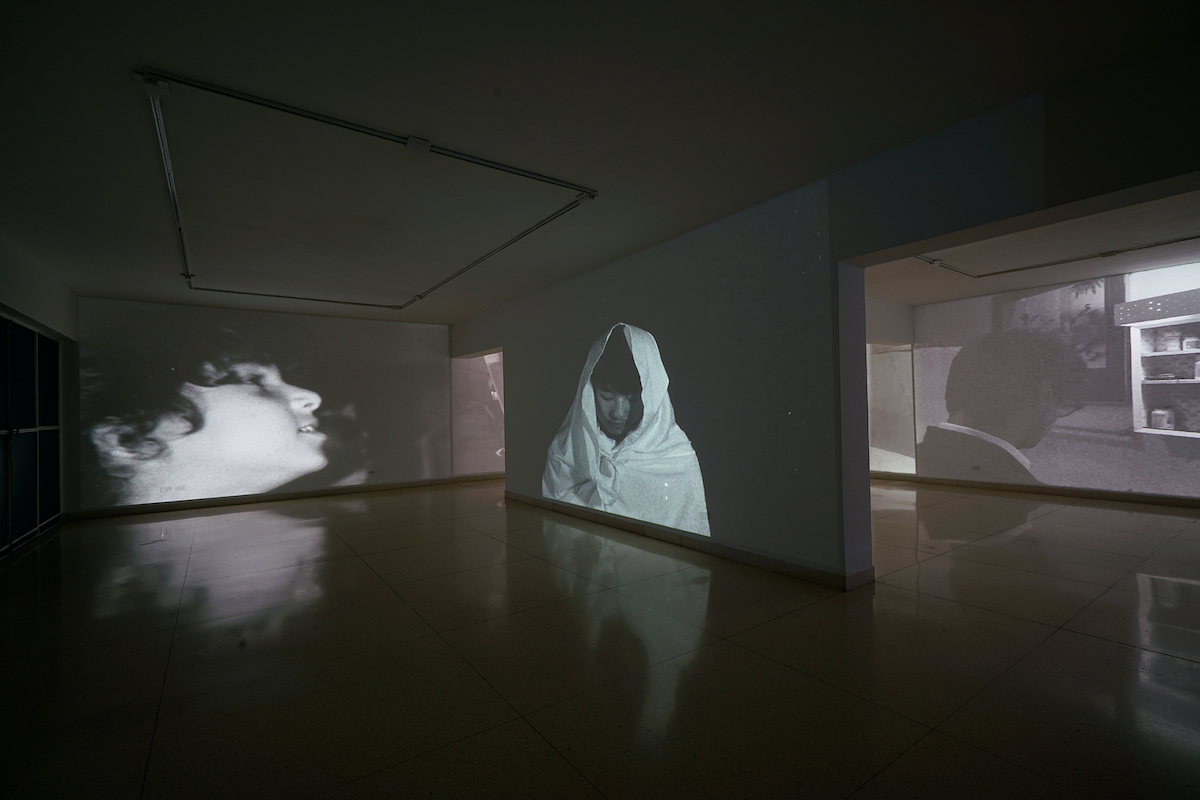
I will now examine a final apartment-gallery model, which is arguably the most experimental in terms of exhibition curating and refusing the perceived neutrality of the white cube. This approach, which I have termed the ‘laboratory model’, is the one best suited to give shape to and bring forth the connection between art and life. Avecez Art Space, much like Aglutinador, quintessentially embodies the spirit of a laboratory. Even its owner, Solveig Font, uses this word to describe the nature of her space’s activities. In a statement found in her private archives, she explains that ‘they claim to operate as a laboratory with the objective of showing finished works, but also processes and documentations of different artistic exercises that have taken place in this space’.86 Avecez Art Space differs from El Apartamento and even from Estudio Figueroa-Vives in that it proposes, for instance, a more extensive cohabitation with the works — Estudio Figueroa-Vives is composed of two units in the same building: one has been stripped of its domestic function and mostly has the aesthetics of a white cube (Figure 6); the other is the place where the Figueroa-Vives family lives, but which is also an exhibition space.
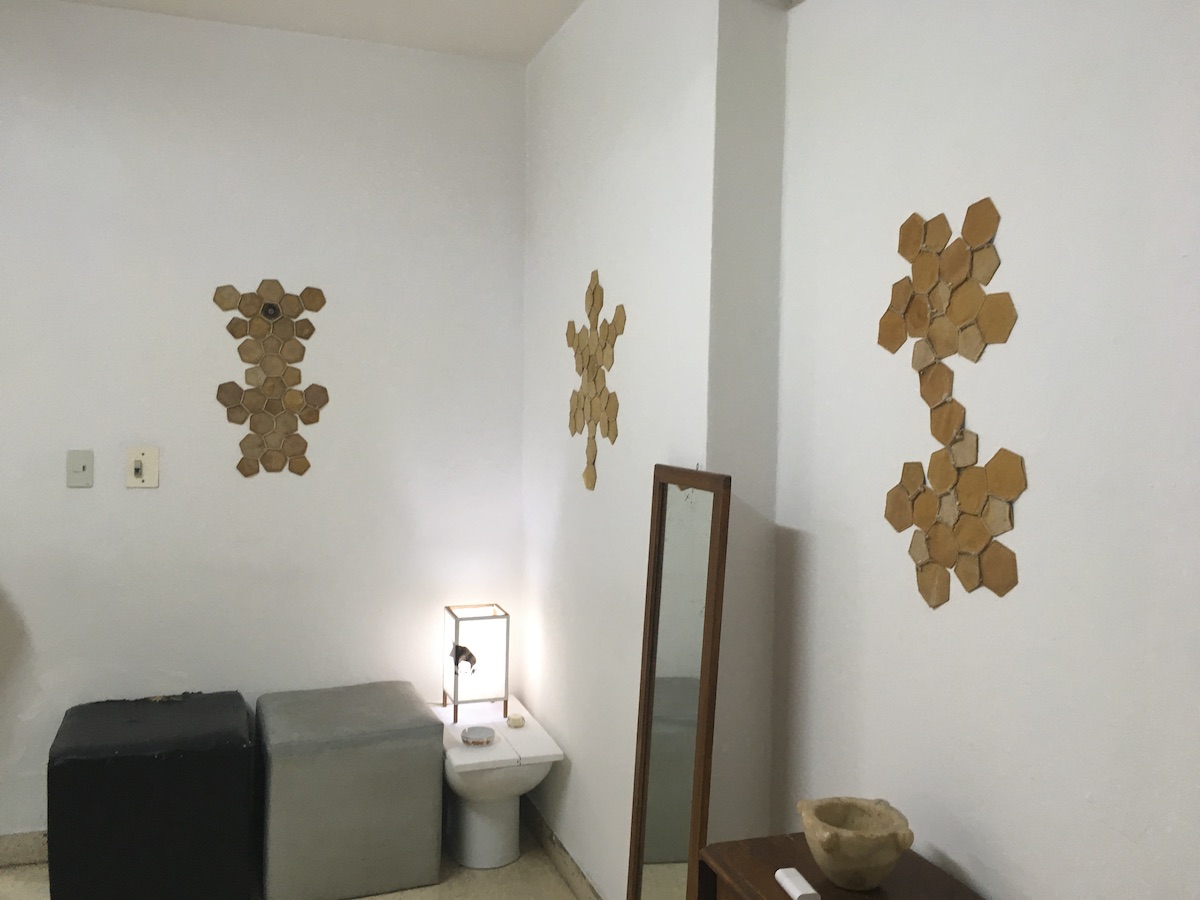
Since the ‘opening’ of Avecez Art Space in November 2014,87 this art and cultural space has presented mainly the works of local artists who are part of the owner’s circle of friends, as well as foreign artists.88 Aside from these exhibitions, it is known for hosting workshops and informal meetings. One of its most important international collaborations was a project that involved an artist-run centre in Montreal.89 Artist-run centres are non-profit organizations that promote a model of artistic production and dissemination that favours artistic experimentation and appears to be unique to Canada,90 although nothing prevents similar structures from existing under different names in other places worldwide. As an independent curator, Font was invited to put together a group exhibition for the first part of the ‘Montréal-Habana, Rencontres en art actuel’ event,91 held from 17 May to 14 June 2019 in several Montreal artist-run centres. As with Vives, Font’s personal projects can overlap with the work of the space she represents and are sometimes inseparable from it. The artist-run centre La Centrale Galerie Powerhouse hosted the exhibition ‘À qui de droit’, which brought together artists with whom Font often collaborates at home. Framed by a very austere set design reflecting her apartment-gallery, the exhibition gathered videos and installations, easy to transport and set up, some of which were in progress — exactly the kind of work she is accustomed to hosting in her laboratory-space. The exhibition I visited in Havana (Figures 7–9)
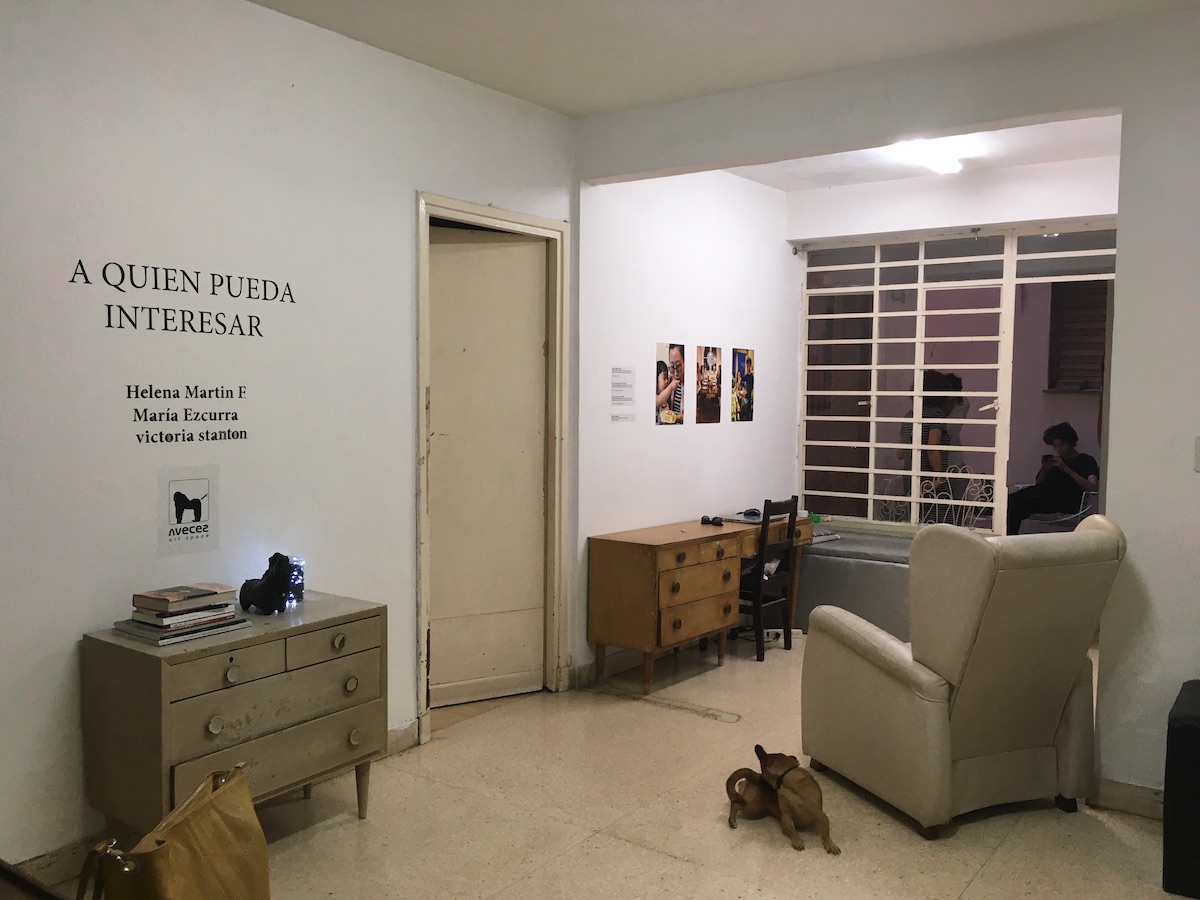
was the second version (using the same title) of the Montreal iteration and, consequently, part of the second half of the artistic exchange Montréal-Habana, Rencontres en art actuel.
The experimental aspiration that characterizes Avecez Art Space is not incompatible with a quest for international insertion. For instance, its choice of name, which translates as Sometimes Art Space, denotes the intention to be noticed abroad, simply by using other, perhaps more accessible networks (such as non-commercial ones). However, one has to wonder whether its evolution in accessible networks is a way of eventually accessing more prominent or commercial ones. I am thinking here of one of its last international projects — at a time when Avecez Art Space still had a physical location in Havana — namely the exhibition ‘Cada forma en el espacio es una forma de tiempo que se escapa’ (Each Form in Space is a Form of Time that Slips Away) in Madrid, in the studio of the Cuban artist Dagoberto Rodríguez, a member of the former artist collective Los Carpinteros.92 This was an exhibition in which the sense of experimentation was present in the works gathered for the occasion. The artists were not directly inspired by the concrete works of the Cuban-American artist Félix González-Torres, but by a sensibility and a posture emanating from his entire oeuvre.93 The exhibition opened on 27 February 2020, concurrent with the opening of the ARCOmadrid Contemporary Art Fair (26 February–1 March 2020). That year, the fair also paid tribute to González-Torres.
The Centres in the Margins
This chapbook has explored the reconfiguration of artworlds on the basis of emerging geo-aesthetic regions, enabling the insertion of global art as periphery-assets in artistic centres. One of my key findings is that the ‘new geography of art’ looks like the outcome of operations of imperialist worlding, as understood by Spivak. This revisionism misses the mark, for it is attached to spatial parameters and thus fails to reconfigure relationships in a non-hierarchical mode. In sum, it perpetuates the supremacy and dominance of Western institutions and their ways of doing, despite appearing at first to be more inclusive and ‘global’. Caught in this art geography, but also deeply shaped and affected by a very specific local context, Havana-based apartment-galleries multiply the strategies and contact networks that take part in it, for they are in ‘possession’ of a Cuban art made in Cuba.94 Inhabiting international circuits with different objectives, my three main case studies give concrete shape to this international insertion. Some wish to gain unrestricted access and sustained participation in art fairs; others aim to garner a reputation without forgoing the monetary rewards that this reputation can bring. A third model of the apartment-gallery takes artistic experimentation as a means of both providing a space for creative freedom for artists and curators and creating a label to otherwise achieve a form of established acceptance and obtain visibility in non-commercial circuits, but by banking on the (commercial) opportunities of that visibility.
One element seems to be clear: although Cuban artists have been able, since the 1990s, to market their work independently, they also needed to be represented, because the full weight of marketing and promotion fell on their shoulders. They needed to be framed by more flexible structures, which is exactly what apartment-galleries provide. These venues are subject to fewer bureaucratic hindrances, even if they get by one day at a time due to the grey areas and prohibitions that pertain to them. Cuban art as a global and periphery-art asset continues to fascinate, all of which is fuelled by this country’s singular political situation and an imaginary of difference — far from Glissant’s understanding and more in Belting’s sense — that intrigues and adds to its ‘value’.
The level of insertion that these spaces have attained is, moreover, directly linked to the status that their owners hold in Cuban society, as well as the level of their contacts. For example, I have chosen three spaces in one of the city’s historically most affluent neighbourhoods, El Vedado. This choice is transformed into a critical commentary on the inequalities that riddle the different strata of the Cuban population in a city where purchasing a property is the privilege of a few, as is the possibility of dedicating it exclusively to an activity other than a home. In a city with an ongoing housing crisis — for example, several generations live under one roof, or sometimes houses even collapse — owning or renting a residential property, especially in a very desirable neighbourhood, speaks volumes about the renters or buyers: either they inherited the property, or they have the means to buy or rent one. This is a paradigmatic example of a class and race dynamic that also operates in the margins, in addition to illustrating that there are various intersectional types of subalternity.
Font’s space has become a nomadic one since her exile to Spain in 2021.95 El Apartamento and Estudio Figueroa-Vives are striving to continue their work — though, judging by their websites, they seem to be slowing down their activity, at least in Cuba.96 This is partly due to the economic and political situation, which deteriorated considerably during the COVID-19 pandemic in this country and across the planet. For instance, the public health crisis deeply affected El Apartamento’s activity: several fairs have been cancelled in the last few years. However, restricted access to this space due to COVID-19-related measures or the impossibility of organizing exhibitions during the peak of the pandemic did not affect it as much as the global slowdown in commercial activity.
Epilogue: Havana Art Weekend
In the analysis developed in this chapbook, the focus has been on apartment-galleries’ aim of inserting Cuban art into international currents. With the Havana Art Weekend event, created in 2017, this directional flow was reversed.97 In parallel with an insertion into international circuits, this event sought to create a Cuban domestic circuit that could accommodate international visitors that was almost independent of the official state circuit.98
Havana Art Weekend was started by Direlia Lazo, a Cuban art historian and independent curator who lives in Miami. By drawing upon her contacts on the island — notably for the organization of the event — but also outside of it, she sought to attract international recognition of contemporary Cuban art and to valorize and highlight its ‘independent, even autonomous’ form. Havana Art Weekend thus became an alternative to the periodically unstable and state-run Havana Biennial, even if it still is (or was until very recently) a legitimizing institution.99 The second edition of Havana Art Weekend took place from 12–15 December 2019. As with the first one, it once again foregrounded Havana’s residential infrastructure: artists’ studios and apartment-galleries all hosted group exhibitions for the event. An essential aspect of this initiative was to have linked spaces that do not usually collaborate, and above all to bring them together in order to make the circuit that they form visible and tangible.
This event, through its name, intention, and sponsorship system, imitates international arts events, as well as the operating mode of the Global North. Returning to an earlier argument in this study, I would argue that the Havana Art Weekend may also be considered an example of how the Global North has ‘worlded’ the Global South, so the latter wants to continue engaging in a process of mimicry.100 Almost eighty years after Uruguay-born Joaquín Torres García created his emblematic 1943 América Invertida (Inverted America), a pen-and-ink drawing depicting an upside down map of South America, populations in Latin America (and elsewhere in the Global South) still need to look at themselves as their own ‘model’. Only in this way can the South become once and for all Latin America’s ‘North’. Beyond these concerns deeply rooted in the current regime of coloniality,101 Cubans’ behaviour is also motivated and driven by the disenchantment brought about by the failure of the Cuban revolutionary project. It represents a means of escape and a form of resistance to an established regime that seeks the absolute control of bodies and minds.
In December 2019, I had the opportunity to visit the group exhibition ‘Fin de temporada’ (Season’s End) at Estudio Figueroa-Vives.102 Some works from the previous exhibition ‘Torres y Tumbas’ (Towers and Tombs)103 were also still on display. As I walked from the living room to the dining room and to the rooms of the two apartments that make up the Estudio, I mainly came across prints, photographs, and installations by internationally renowned artists like Belkis Ayón and Alexandre Arrechea. As I was leaving the Estudio — the Norwegian Embassy was closed, since it was already 9 pm — some tourists arrived for a visit. To get there, they had taken a car, which they had ordered through an app based on Uber’s model called ‘Bajanda’ (in Cuban jargon this word means ‘to leave’). Bajanda was among the non-state ‘companies’ sponsoring the Havana Art Weekend.
Half-smile? Discouragement?
Emergence of a new (real) site of enunciation from the Global South?104
Notes
- Brochure for the group exhibition ‘A quién pueda interesar’, 1 November–8 December 2019, private archives of Solveig Font [accessed 6 December 2019]. ↵
- In my search for similar venues and exhibition models in other (post‑)socialist countries, I came across the phenomenon of ‘Apartment Art’, a term that describes the art movement originating in apartments used as exhibition spaces from the 1960s to1970s in the Soviet Union and China. Since 1989, these spaces have returned to the forefront, and Cuba has joined this movement. These spaces have undergone a similar evolution: from temporary exhibition spaces serving as meeting places to more sophisticated and multifunctional spaces in Russia, China, and Cuba. These spaces are the subject of an ongoing research project (2020–23), funded by the Social Sciences and Humanities Research Council (SSHRC), of which I am the principal investigator. This chapbook is one of its first outcomes. ↵
- During the eleventh Havana Biennial in 2012, these alternative spaces had already sought to ensure a certain visibility within the framework of this internationally orientated event, and even to reroute the circuit traced by the biennial. To view the invitation from artist Sandra Ceballos to visit these spaces, see <http://habanemia.blogspot.com/2012/06/muestras-privadas-en-estudios-galerias.html> [accessed 29 June 2022]. ↵
- This recovery had repercussions in all sectors of Cuban life, and was vividly expressed in the cultural sphere. At that time, a greater influx of tourists from the United States and a certain leniency on the part of the Cuban authorities, especially with regard to the exercise of so-called ‘private’ economic activities by Cubans, contributed to the beginning of a normalization process that turned out to be very short-lived, as did the revival of relations between the two countries. On this normalization process, see, Iván de la Nuez, ‘Apotheosis Now’, e-flux Journal, 68 (December 2015) <http://www.e-flux.com/journal/68/60645/apotheosis-now/> [accessed 12 May 2022]. ↵
- Celia Irina González, ‘Cultura autóctona: curaduría como proceso etnográfico en la escena del arte cubano actual’, Íconos - Revista de Ciencias Sociales, 59 (September 2017), p. 62; my translation <https://doi.org/10.17141/iconos.59.2017.2639>. ↵
- See, for example, Eugenio Valdés-Figueroa, ‘Trajectories of a Rumor: Cuban Art in the Postwar Period’, in Art Cuba: The New Generation, ed. by Holly Block (New York: Henry N. Abrams, 2001), pp. 17–24; Sylvia Spitta, ‘Sandra Ramos: la vida no cabe en una maleta’, Revista iberoamericana, 71.210 (January–March 2005), pp. 35–53; José Clemente Gascón Martínez, ‘Cuba y la caída del Muro: a río revuelto ganancia de pescadores. La agudización de la crisis del contexto histórico en los noventa y los continuos giros del discurso en el arte cubano contemporáneo’, Revista de la Asociación Aragonesa de Críticos de Arte, 24 (2013) <http://www.aacadigital.com/contenido.php?idarticulo=850> [accessed 12 May 2022]; Rafael Díaz-Casas, ‘In Conversation: Sandra Ceballos, Part 1’, Cuban Art News, 14 October 2014, <https://cubanartnewsarchive.org/2014/10/14/in-conversation-sandra-ceballos-part-1-the-intention-has-always-been-to-bring-people-together/> [accessed 12 May 2022]; Rafael Díaz-Casas, ‘Sandra Ceballos, Part 2’, Cuban Art News, 11 November 2014 <https://cubanartnewsarchive.org/2014/11/11/sandra-ceballos-part-2-aglutinador-laboratory-the-p-e-r-r-o-awards-and-the-1st-biennial-of-porno-art/> [accessed 12 May 2022]; Rafael Díaz-Casas, ‘In Conversation: Sandra Ceballos, Part 3’, Cuban Art News, 17 February 2015 <https://cubanartnewsarchive.org/2015/02/17/in-conversation-sandra-ceballos-part-3-aglutinador-mam-and-future-projects/> [accessed 12 May 2022]; Ernesto Santana Zaldívar, ‘La expresión leal de Espacio Aglutinador’, CubaNet (blog), 3 April 2019 <https://www.cubanet.org/destacados/la-expresion-leal-de-espacio-aglutinador/> [accessed 23 May 2022]; ‘In Havana, a New Vision for Espacio Aglutinador’, Cuban Art News, 10 October 2017 <https://cubanartnewsarchive.org/2017/10/10/in-havana-a-new-vision-for-espacio-aglutinador/> [accessed 23 May 2022]; Claudia González Marrero, ‘Espacio Aglutinador: arte visual y política cultural cubana’, Rialta Magazine, 19 January 2020 <https://rialta.org/espacio-aglutinador-y-la-relacion-del-arte-visual-con-la-politica-cultural-cubana-una-conversa-entre-sandra-ceballos-henry-eric-hernandez-y-claudia-gonzalez-marrero/> [accessed 23 May 2022]; Azucena Placencia, ‘Espacio Aglutinador: la aventura de resistir’, Diario de Cuba, 2 October 2014 <https://diariodecuba.com/cultura/1412234570_10638.html> [accessed 25 May 2022]. ↵
- Its owner, artist Sandra Ceballos, also refers to Aglutinador as Espacio Aglutinador (Unifying Space). See, for example, the website of this apartment-gallery: <https://www.espacioaglutinador.com/>. ↵
- Paloma Duong, ‘Homebound: The Art of Public Space in Contemporary Cuba’, ARTMargins, 6. 2 (2017), pp. 27–49 <https://doi.org/10.1162/ARTM_a_00175>. ↵
- Mailyn Machado, El circuito del arte cubano, Open Studio i (Leiden: Almenara, 2018); Mailyn Machado, Los años del participacionismo. Open Studio ii (Leiden: Almenara, 2018); Mailyn Machado, La institución emergente. Entrevistas. Open Studio iii (Leiden: Almenara, 2018). ↵
- More specifically, Hypermedia Magazine, Rialta Magazine, Diario de Cuba, and Cuban Art News. These papers and magazines cover Cuban national news in an alternative way from the so-called official press outlets. ↵
- Joaquín Barriendos, ‘Geopolitics of Global Art: The Reinvention of Latin America as a Geoaesthetic Region’, in The Global Art World: Audiences, Markets, and Museums, ed. by Hans Belting and Andrea Buddensieg (Ostfildern: Hatje Cantz Verlag, 2009), pp. 98–115. ↵
- Monica Juneja, ‘“A very civil idea…”: Art History, Transculturation, and World-Making — With and Beyond the Nation’, Zeitschrift für Kunstgeschichte, 81.4 (2018), pp. 461–85 (p. 462) <https://doi.org/10.1515/ZKG-2018-0036>. ↵
- Gayatri Chakravorty Spivak, ‘The Rani of Sirmur: An Essay in Reading the Archives’, History and Theory, 24.3 (October 1985), pp. 247–72 <https://doi.org/10.2307/2505169>. ↵
- The Havana Art Weekend’s third edition is set to take place from 16–20 November 2023. Following the announcement, a group of artists and intellectuals, led by Cuban artist Tania Bruguera and Cuba-American artist and writer Coco Fusco, released an open letter. The letter calls out the connections between the event and the Cuban government. It notes that ‘[…] the Cuban Ministry of Culture has approved the Havana Art Weekend to take place in November. This is meant to attract foreign art professionals and potential investors to the island and give them a preview of what awaits them at next year’s art biennial’. To read the letter, see, Maya Pontone, ‘Major Cuban Artists Call to Boycott State-Sponsored Cultural Events on the Island’, Hyperallergic, 29 August 2023 <https://hyperallergic.com/841346/major-cuban-artists-call-to-boycott-state-sponsored-cultural-events-on-the-island/> [accessed 2 September 2023]. ↵
- Pheng Cheah, ‘World against Globe: Toward a Normative Conception of World Literature’, New Literary History 45.3 (2014), pp. 303–29 (p. 304) <https://doi.org/10.1353/nlh.2014.0021>. ↵
- Juneja, ‘“A very civil idea…”’, p. 463. ↵
- Barriendos, ‘Geopolitics of Global Art’, p. 109. ↵
- Edward Soja, Postmodern Geographies: The Reassertion of Space in Critical Social Theory (London: Verso, 1989). ↵
- Géoesthétique, ed. by Kantuta Quirós and Aliocha Imhoff (Paris: Éditions B42, 2014). ↵
- Ibid., ‘Glissement de terrain’, pp. 5–28. ↵
- Barriendos, ‘Geopolitics of Global Art’. ↵
- Joaquín Barriendos, ‘Localizando lo idéntico / globalizando lo diverso. El “activo periferia” en el mercado global del arte contemporáneo’, Portal Iberoamericano de Gestión Cultural. Boletín de Gestión Cultural, 12 (June 2005), pp. 1–10. ↵
- Hans Belting, ‘Contemporary Art as Global Art: A Critical Estimate’, in The Global Art World: Audiences, Markets, and Museums, ed. by Hans Belting and Andrea Buddensieg (Ostfildern: Hatje Cantz Verlag, 2009), pp. 38–73. ↵
- Hans Belting, ‘From World Art to Global Art: View on a New Panorama’, in The Global Contemporary and the Rise of New Art Worlds, ed. by Hans Belting, Andrea Buddensieg, and Peter Weibel (Karlsruhe: ZKM; Cambridge, MA: MIT Press, 2013), pp. 178–85. ↵
- Ibid, p. 182. This definition of ‘global art’ as art from non-Western cultures relies, according to Monica Juneja, Professor of Global Art History at the University of Heidelberg, ‘on a European view of the art of the rest of the world.’ Mariachiara Gasparini, ‘Interview with Monica Juneja about Global Art History’, TRAFO–Blog for Transregional Research, 29 (blog) (2014) <https://trafo.hypotheses.org/567> [accessed 17 January 2023]. ↵
- Johannes Fabian, Time and the Other: How Anthropology Makes its Object (New York: Columbia University Press, 1983). ↵
- Belting, ‘Contemporary Art as Global Art’, p. 40. ↵
- Gerardo Mosquera, ‘El arte latinoamericano deja de serlo’, ARCO Latino, 1 (1996), pp. 7–10. ↵
- Caroline A. Jones, The Global Work of Art: World’s Fairs, Biennials, and the Aesthetics of Experience (Chicago: The University of Chicago Press, 2016); Caroline A. Jones and Steven Nelson, ‘Global Turns in US Art History’, Perspective, 2 (2015) <https://doi.org/10.4000/perspective.5969>. ↵
- Amy Bruce, ‘International Contemporaneity and Third Havana Biennial (1989)’, RACAR, 43.2 (2018), pp. 25–33 <https://doi.org/10.7202/1054380ar>. ↵
- Cheah, ‘World against Globe’, p. 322. ↵
- Édouard Glissant, Philosophie de la Relation (Paris: Gallimard, 2009), p. 42; my translation. ↵
- Édouard Glissant, Diawara Manthia, and Christopher Winks, ‘Édouard Glissant in Conversation with Manthia Diawara’, Nka: Journal of Contemporary African Art, 28.1 (Spring 2011), p. 9. ↵
- Ibid. ↵
- Quirós and Imhoff, ‘Glissement de terrain’, p. 15. ↵
- Despite new art fairs emerging in Asia (Dubai, Delhi, Seoul, and Hong Kong, for instance), Europe recorded the highest number of art fairs in 2022 according to the website Statista. See ‘Number of art fairs held in selected regions worldwide from 2019 to 2022’, Statista, 6 January 2023 <https://www.statista.com/statistics/1349818/number-art-fairs-worldwide-by-region/> [accessed 17 January 2023]. ↵
- Alain Quemin, ‘International Contemporary Art Fairs in a “Globalized Art Market”’, European Societies, 15.2 (2013), pp. 162–77 <https://doi.org/10.1080/14616696.2013.767927>. ↵
- Barriendos, ‘Geopolitics of Global Art’. ↵
- Gayatri Chakravorty Spivak, ‘Criticism, Feminism and the Institution’, Thesis Eleven, 10–11.1 (1985), pp. 175–87 <https://doi.org/10.1177/072551368501000113>. ↵
- Spivak, ‘The Rani of Sirmur’. ↵
- Glissant, Diawara, and Winks, ‘Édouard Glissant in Conversation with Manthia Diawara’. ↵
- Magela Garcés, ‘Conversación en La Catedral’, Hypermedia Magazine, 25 August 2020 <https://www.hypermediamagazine.com/hypermedia-review/conversacion-en-la-catedral/> [accessed 24 May 2022]; my translation. ↵
- The CMEA was a system of mutual aid between communist countries, and is also known as the socialist bloc. ↵
- Simon Reid-Henry, ‘Scientific Innovation and Non-Western Regional Economies: Cuban Biotechnology’s “Experimental Milieu”’, Environment and Planning A: Economy and Space, 40.8 (August 2008), pp. 1966–86 <https://doi.org/10.1068/a39157>. ↵
- 83.1 per cent of Cuba’s economic exchanges took place via the CAEM intermediary. See, Simon Reid-Henry, ‘The contested spaces of Cuban development: Post-socialism, post-colonialism and the geography of transition’, Geoforum, 38.3 (2007), pp. 445–55 <https://doi.org/10.1016/j.geoforum.2006.11.008>. ↵
- Reid-Henry, ‘Scientific Innovation and Non-Western Regional Economies’. ↵
- Reid-Henry, ‘The contested spaces of Cuban development’. ↵
- It took nearly twenty years for self-employment to stop being almost exclusively family-run pursuits: in 2010, Cubans were finally allowed to rent out their residential properties to a third party for self-employment-related activities. ↵
- This period, initiated by the Cuban government in 1992, was characterized by severe rationing. ↵
- Machado, El circuito del arte cubano. ↵
- Ileana Díaz, Zuleika Ferre, and Héctor Pastori, ‘Análisis del emprendimiento en Cuba a partir de encuestas de opinión’, Estudios del Desarrollo Social, 8.3 (December 2020) <http://scielo.sld.cu/pdf/reds/v8n3/2308-0132-reds-8-03-1.pdf> [accessed 15 May 2022]. ↵
- Abel Sierra Madero, ‘Del “socialismo real” al Estado mafioso postsocialista’, Hypermedia Magazine, 29 January 2021 <https://www.hypermediamagazine.com/columnistas/fiebre-de-archivo/cuba-revolucion-estado-mafioso-postcomunista/> [accessed 22 June 2022]. ↵
- Decree no. 106. See, ‘Gaceta Oficial de la República de Cuba Extraordinaria, La Habana, Viernes 5 de Agosto de 1988’ <http://www.ministeriodecultura.gob.cu/images/jdownloads/pol%C3%ADticas_p%C3%BAblicas/marco_normativo/decreto_ley_106.pdf> [accessed 22 June 2022]. ↵
- Resolution no. 61. See, ‘Resolución 61 de 1993 del Ministerio de Cultura, la cual despenaliza la tenencia de divisas por parte de los autores’ <https://cerlalc.org/laws_rules/resolucion-61-de-1993-del-ministerio-de-cultura-la-cual-despenaliza-la-tenencia-de-divisas-por-parte-de-los-autores/> [accessed 22 June 2022]. ↵
- Lizet Fraga, ‘Las ferias de arte: participación cubana; valoración y propuesta’ (unpublished Bachelor’s thesis, Universidad de La Habana, 2009). ↵
- That said, to be authorized to sell their artworks either in their houses or elsewhere, Cuban artists have to be members of the Registro Nacional del Creador (National Creator Registry). ↵
- Ibid. ↵
- Liatna Rodríguez López and Lida Lilian Sigas Nieto, ‘Coexistencia de dos vías fundamentales en la proyección de las artes plásticas cubanas en el mercado internacional: galerías comerciales institucionales y gestión independiente de los artistas’ (unpublished Bachelor’s thesis, Universidad de La Habana, 2009), p. 83; my translation. ↵
- Daymi Coll and Yali Romagoza, ‘Autonomía / Heteronomía en las Artes Plásticas. Notas para una historia de la Institución Arte en Cuba’ (unpublished Bachelor’s thesis, Universidad de La Habana, 2006). ↵
- Machado, El circuito del arte cubano. ↵
- Fraga, ‘Las ferias de arte’. ↵
- Ibid, p. 60; my translation. ↵
- Machado, El circuito del arte cubano, p.140; my translation. ↵
- It was founded by the artists Ezequiel Suárez and Sandra Ceballos in their house in El Vedado, with the purpose of organizing events and hosting individual and group exhibitions. In 1994, a few hours before its opening, the authorities prohibited Suárez from presenting his solo exhibition ‘El frente Bauhaus’ (The Bauhaus Front) at the Galería 23 y 12, a state-owned art venue. Following this incident, Suárez and his partner Ceballos decided to show the exhibition in their home. ↵
- Appartement-galleries have benefited greatly over the years from the Havana Biennial. This Biennial has historically attracted substantial international attention and many potential art buyers. ↵
- Machado, La institución emergente, p. 27; my translation. ↵
- Located in a former cinema in Havana’s Chinatown, Galleria Continua is the only international private gallery operating in Cuba. See, Rachel Spence, ‘Arte Continua Habana: how to run an international gallery in Cuba’, Financial Times, 1 December 2017 <https://www.ft.com/content/252cd1a4-d10f-11e7-947e-f1ea5435bcc7> [accessed 18 July 2022]. ↵
- Granma, ‘Cuba pasa de 127 a más de 2 000 actividades por cuenta propia legales, gran salto en favor de la economía y el empleo’, Granma, 12 February 2021 <https://www.granma.cu/cuba/2021-02-12/cuba-pasa-de-127-a-mas-de-2-000-actividades-por-cuenta-propia-legales-gran-salto-en-favor-de-la-economia-y-el-empleo-video-12-02-2021-13-02-42?page=2> [accessed 27 June 2022]. ↵
- Apartment-galleries have been in the government’s crosshairs since the approval of decree 349 in late 2018. This decree allows the government to decide whether or not to hold art events in non-institutional spaces, such as apartment-galleries, if they are deemed to be contrary to revolutionary values or good ‘morals’, for example. This measure has stirred a wave of frustration and discontent among artists and intellectuals. Cuban activist and artist Tania Bruguera told The Guardian that, ‘People in Cuba are very savvy, they know the fact this new law is saying the government can enter into your house, there are no more private spaces at all in Cuba now’, Daniel Bates, ‘“They Have No Idea What Democracy Is”: Tania Bruguera on Cuba’s Artist Crackdown’, The Guardian, 22 February 2019 <https://www.theguardian.com/artanddesign/2019/feb/22/tania-bruguera-cuba-artist-crackdown-decree-349> [accessed 18 July 2022]. ↵
- It is essential to add that Peré now works at El Apartamento. ↵
- Jorge Peré, ‘Made in Cuba: gestión y complot en al arte cubano reciente’, Hypermedia Magazine, 27 August 2020 <https://www.hypermediamagazine.com/hypermedia-review/made-in-cuba-gestion-y-complot-en-al-arte-cubano-reciente/> [accessed 18 May 2022]. ↵
- To access this list, see the gallery’s website, El Apartamento, <http://artapartamento.com/artistas> [accessed 6 May 2022]. ↵
- Machado, La institución emergente. ↵
- El Apartamento opened a permanent space in Madrid in 2023 as part of their efforts to represent artists from different locations and to expand their international reach. This information comes from an interview with a staff member of El Apartamento, Havana, 16 May 2023. ↵
- Interview via videoconference with Daleysi Moya Barrios, a staff member of El Apartamento, 21 June 2021. ↵
- The participation in ARCOmadrid Contemporary Art Fair, one of the most influential fairs in the world, remains a priority. They have been participating in it since 2017. For information about El Apartamento’s participation in the 2021 edition, see, ‘Galería El Apartamento propone catálogo diverso y representativo del arte cubano actual en ARCOmadrid’, Rialta, 10 July 2021 <https://rialta.org/galeria-el-apartamento-propone-catalogo-diverso-representativo-arte-cubano-actual-arcomadrid/> [accessed 17 January 2023]. ↵
- Email exchange between the autor and Daleysi Moya Barrios, 23 August 2023. ↵
- For example, their exhibition ‘Q & A. Nine contemporary Cuban Artists’ was presented at the Museum of Art + Design of Miami Dade College (30 November 2015–16 January 2017), in parallel to Art Basel Miami in 2016 (1–4 December 2017). For more on this exhibition, see the exhibition catalogue, ‘Q & A: Nine Contemporary Cuban Artists’, exh. cat. MDC Museum of Art + Design (2017) <https://estudiofigueroavives.com/wp-content/uploads/2020/05/Cat%C3%A1logo-Q-and-A.-MOAD.pdf> [accessed 18 July 2022]. ↵
- Machado, La institución emergente, p. 24; my translation. ↵
- For the exhibitions carried out on the international scene, see the gallery’s website, Estudio Figueroa-Vives, <https://estudiofigueroavives.com/en/exhibitions-in-other-spaces/> [accessed 16 July 2022]. ↵
- The curatorial work of Vives, who has previously worked for state institutions, was to become identified with the activity of this space. The same thing happened with Font, owner of Avecez Art Space. The boundaries are thus blurred between the activity of their respective spaces and their work as independent curators — probably a way to circumvent potential government censorship and legal provisions on non-state cultural initiatives. ↵
- Interview via videoconference with Daleysi Moya Barrios, a staff member of El Apartamento, 21 June 2021. ↵
- Ibid. ↵
- Machado, La institución emergente. ↵
- Díaz-Casas, ‘Sandra Ceballos, Part 2’. ↵
- ‘Statement de avecezartspace’, MS Word document, private archives of Solveig Font [accessed 6 December 2019]; my translation. ↵
- Avecez Art Space has left its physical location to become a nomadic space following the exile to Spain of its owner in 2021 in connection with her activism in Cuba. On the Instagram page of this ‘space’, the description reads: ‘Independent art space on the move!’ [Espacio de arte independiente en movimiento !]. See, ‘@avecezartspace’, Instagram <https://www.instagram.com/avecezartspace/>. ↵
- The exhibition ‘Sistema (operativo) de referencias’ ((Operative) References System) ‘officially’ inaugurated this space in 2014. Cuban curator Raquel Cruz Crespo brough together artists such as Amed Aroche, Yonlay Cabrera, Odey Curbelo, Julio Llópiz Casal, and the fictional presence of the late Italian artist Piero Manzoni to explore, through their works, the practice of appropriation in contemporary art. She also wanted to experiment with the format of the exhibition itself. The exhibition ended up in Font’s apartment in part due to the impossibility of finding a local state institution to host it. Cruz Crespo settled in Montreal in 2018. Thanks to her knowledge of the field and her contact network, she has been an invaluable resource in the research that led to the writing of this chapbook. ↵
- Font first visited Montreal in 2015 as part of the programme Échange Montréal-La Havane, which has been run since 2011 by the Regroupement des centres d’artistes autogérés du Québec (RCAAQ). Back then, she worked as a curator for Fábrica de Arte Cubano (FAC), a unique cultural centre in Havana whose infrastructure is owned by the government, but its management remains private. ↵
- Diane-Gabrielle Tremblay and Thomas Pilati, ‘Les centres d’artistes autogérés et leur rôle dans l’attraction de la classe créative’, Géographie, économie, société, 10.4 (2008), pp. 429–49 <https://doi.org/10.3166/ges.10.429-449>. ↵
- This event was an exchange project that sought to bring about a dialogue between artists and cultural workers from Cuba and Montreal, notably through the organization and presentation of exhibitions in Montreal and Havana. It took place in Montreal in 2019, from 14 May – 22 June, and in Havana from 31 October to 8 December. The project was spearhead by the Montreal-based artist and cultural worker Ximena Holuigue, who, after many years establishing personal and professional relationships in Cuba, wanted to build a permanent bridge between the cities of Montreal and Havana. See the project’s Facebook page <https://www.facebook.com/MontrealHabana2019> [accessed 19 September 2023]. ↵
- The artists who participated in this exhibition were Alina Aguila, Léster Álvarez, Benjamin del Castillo, Leandro Feal, Felipe Dulzaides, Orestes Hernández, Kiko Faxas, Reynier Leyva Novo, Julio César Llópiz Casal, José Manuel Mesías, Tatiana Mesa, Dagoberto Rodríguez, Ezequiel Suárez, and Irving Vera. ↵
- See the introductory text to this exhibition penned by Font, ‘Cada forma en el espacio es una forma de tiempo que se escapa’ <https://www.dagobertorodriguez.es/invitacion-cada-forma-en-el-espacio-es-una-forma-de-tiempo-que-se-escapa/> [accessed 27 July 2022]. ↵
- The departure of artists from these geo-aesthetic regions and their relocation to Western countries transforms their perception in the eyes of the market, art institutions, and the general public. When an artist no longer lives in one of these peripheral regions, a loss of ‘authenticity’ or even ‘legitimacy’ ensues. The loss of ‘legitimacy’ or ‘value’ of diasporic artists is one of the reflection avenues of my ongoing research project financed by the Fonds de recherche du Québec-Société et Culture (2022–26) on the situation of Latinx-Canadian artists vis-à-vis Montreal institutions. ↵
- On August 25 2023, Font curated the first exhibition at Avecez Art Space since it became a nomadic apartment-gallery. Titled ‘Currently Not Available In Your Country or Region’, it was a one-day show hosted by a friend of Font in her Madrid apartment. The curator invited twenty-three Cuban friends, including artists, curators, journalists, activists, and others, to choose an object that encapsulates their migratory process. They were invited to reflect on their conditions of exile and were offered a space in which to heal. See the Facebook page of Avecez Art Space for further details: <https://www.facebook.com/avecezartspace>. ↵
- Estudio Figueroa-Vives has not presented an exhibition at their venue since ‘Fin de temporada’ (Season’s End) in 2019. ↵
- See the website of the Havana Art Weekend <https://www.havanaartweekend.com/>. ↵
- Some of the events proposed during this week took place in state institutions, such as the visit of the Casa Museo Lezama Lima that the Cuban artist Yornel Martínez organized in the presence of its director. For images of this visit, see, Havana Art Weekend <https://www.havanaartweekend.com/deriva-yornel-martinez> [accessed 18 July 2022]. ↵
- The last edition of the Bienal de La Habana in 2021 was boycotted by a large number of artists and curators at the national and international level. They especially condemned the Cuban government’s hypocrisy for organizing this event while imprisoning artists. For the open letter signed by many of these artists and curators, see, ‘Open Letter: Why We Say NO to the 14th Havana Biennial and Ask You to Do the Same’, e-flux Announcements, 15 October 2021 <https://www.e-flux.com/announcements/426144/open-letter-why-we-say-no-to-the-14th-havana-biennial-and-ask-you-to-do-the-same/> [accessed 26 July 2022]. ↵
- Homi K. Bhabha, The Location of Culture (London: Routledge, 1994). ↵
- Coloniality is the regime/matrix of power implanted by the colonial enterprise, which has survived until today despite the processes of independence. ↵
- See exhibition’s brochure, ‘Fin de temporada 2’, <https://estudiofigueroavives.com/wp-content/uploads/2020/05/18.-Expo-Fin-de-Temporada.-2019.pdf> [accessed 18 July 2022]. ↵
- See exhibition’s brochure, ‘Torres & Tumbas. Belkis Ayón / Janis Lewin / José A. Figueroa’, <https://estudiofigueroavives.com/en/torres-y-tumbas-2/> [accessed 18 July 2022]. ↵
- Aliocha Imhoff and Kantuta Quirós, ‘Entretien avec Joaquin Barriendos’, Les Cahiers du Musée National d’Art Moderne, 122 (Winter 2012–13), pp. 106–19; my translation. ↵
© by the author(s)
Except for images or otherwise noted, this publication is licensed under a Creative Commons Attribution-ShareAlike 4.0 International License.© 2023 ICI Berlin Press