
Solar FigurationThinking the Human at the Scale of the Universe with Georges BatailleKirill Chepurin
Abstract
This essay reads Georges Bataille as a thinker of thresholds, crossings, and ephemeral solar forms, tracing figures of chance in his writing from the wildflower to the volcano to humanity as a planetary and cosmic movement. Dwelling with terms such as ‘figuration’, ‘precipice’, ‘threshold’, ‘signal’, and ‘voiding’, it probes what provisional obstacles and cross-scalar mediations can briefly refract or delay the Bataillean pull towards dissolution.
Keywords: Bataille, Georges; figuration; threshold; communication; humanity; cosmos; the sun
C’est l’infirme soleil en moi qui veut naître de ce qui est.
Terre où je m’endors, espace où je m’éveille, qui viendra quand vous ne serez plus là? (que deviendrai-je m’est d’une chaleur presque infinie).
To Write about Bataille
Taking a book off the shelf at random can be an act of divination. So, too, can joining a reading group. It seems in retrospect a kind of bibliomancy, at once chance and willed, that in January 2025 I decided to sign up for the Georges Bataille reading group at ICI Berlin. I had known Bataille only second-hand before. It is now May 2026, and I am writing this essay on Bataille — something I could not have foreseen. To engage in divination is to accept chance, to welcome it, to let it puncture you. And so I allowed my encounter with Bataille to Beginning of page[p. 55] chart a new trajectory in and for me. In the Bataillean spirit, I want to acknowledge the condition of community that made this encounter possible. Angelica, Filippo, Franco, Jasmine, Marietta, Nicolas, Tobi, and Verónica, as the core members of the reading group, have been no less than Georges himself part of this essay’s inspiration.
The thrust of this inspiration, born from our critical discussions as a group, has been for me in part to resist Bataille, not to let myself be simply consumed by his terms, even while acknowledging his pull on me. Bataille is a cosmic thinker, and his gravitational pull, I feel, is that of the modern universe itself, of the indifferent, decentred void of solar radiation, entropy, and galactic swirl. The movement of this infinite universe, with which Bataille seeks to write, cannot but overwhelm the confines of one’s discourse and one’s self, even of discourse and selfhood as such. Choosing to write about Bataille for a volume on scale seemed natural: his thinking is strikingly cross-scalar, approaching the human ‘at the measure of the universe’.1 His texts move playfully, with ease between erotic desire and solar force, the spider and the volcano, the human body and the celestial body. For him, the dark abyss of the heart is one with the geocosmic depths of the Earth and the skies, and desire within me erupts, flares up with the intensity of the sun above me, leaving the same desert in its wake.2 Humanity, as Bataille writes of it, emerges at once as a terrestrial and an extraterrestrial, solar being. This figure of the human speaks to me; it communicates with me, that is, in Bataillean vocabulary, it charges me with its fever. It resonates, too, with the traditions of thought that have occupied me for some time, from Gnosticism and mysticism to Romanticism and Russian Cosmism.
Yet, due to his cosmic pull and sheer contagious power, it is not easy to write about Bataille constructively, to do things with him, without either becoming a ‘Bataillean’ or repeating the obvious critiques of him. I want to resist, especially, the common image of Bataille as a Beginning of page[p. 56] thinker of transgression for transgression’s sake, of the mere sweeping-away of prohibitions and boundaries in festive or erotic violence. Perhaps this transgressive dimension simply speaks to me less right now, as I try to escape the violence in my home country. Perhaps I want this essay, too, to set however small a boundary, an obstacle, to the movement of transgression associated with Bataille. I think it is clear from his texts that, drawing on philosophy and anthropology of his time, he envisions a broader, more dialectical double movement in which human being and desire are defined equally by the (centripetal) setting up of limits and borders and the constant (centrifugal) temptation of their overstepping or violation. This is ultimately a runaway dialectic, as no boundary can withstand the forces of desire and death, and as the outside seeps into the circle of orderly life and unsettles it, while the inside tends ecstatically to erupt or spill out onto the outside. Transgression itself functions in Bataille as an unstable, fleeting bridge to the infinite — and my impulse here is to linger at this porous border, this threshold between order and disorder, profane and sacred, life and death, as well as terrestrial and extraterrestrial or divine.
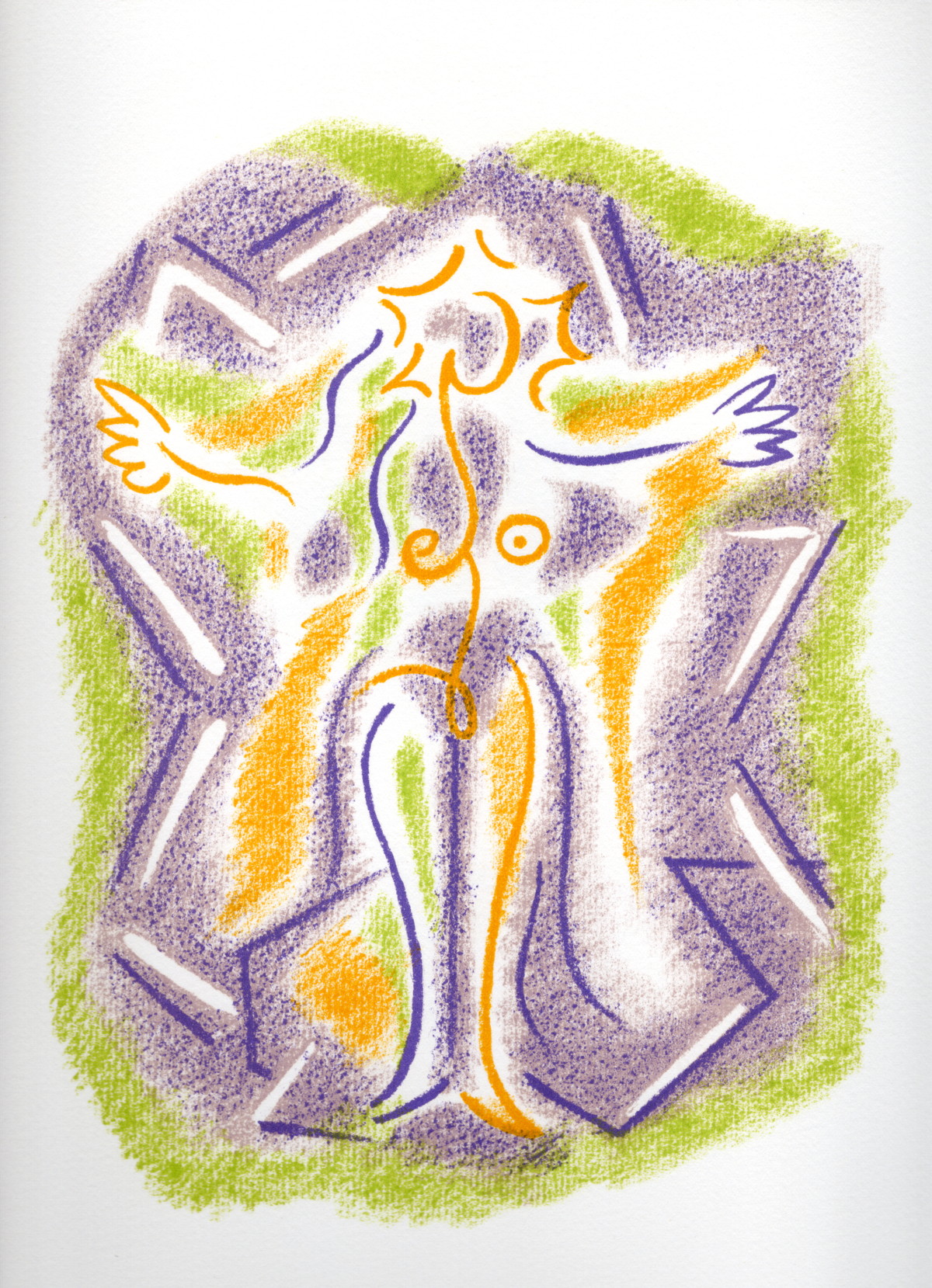
The Bataille of this essay, then, is a thinker of thresholds and crossings, of what is vanishing and evanescent, of punctures, signals, and divinatory events that, while opening onto the measureless divine or cosmic abyss, appear as finite — momentary, ephemeral — forms. These forms, as I conceive of them here, complicate the dichotomy between the small- and large-scale, since even planetary-scale movement, such as that of humanity as it encircles and technologically mediates the Earth, can be said to trace a figure of transience.3 I view André Masson’s drawing, placed as a visual epigraph above (Figure 1), as a symbol for the ambivalent, interim space this essay inhabits. The drawing evokes a state of transition or metamorphosis, which could be a star taking on a human form, or a human body emitting a radiance that transforms it into a star or an angel. The colours appear significant. Against the darker dotted background — the cosmic depths? — the star radiates yellow and white, the colours that our sun can appear to Beginning of page[p. 57] take when seen from Earth and from outer space. Green, too, though our eyes cannot perceive it in the sun, corresponds to the peak of the sun’s visible emission, even as, in the opposite direction, it also invokes cool paradisal shade. Blue, the colour of heaven but also the hottest stars in the universe, hints at transcending even the heat of the sun, approaching René Char’s ‘almost infinite heat’ (chaleur presque infinie). Something radiant is taking shape here, yet the direction and outcome of this process are uncertain. What are the forms and figures — poetic, geometric, spectral, angelic, human — that dwell in this uncertainty?
This moment of hesitation and transition, of infirm solar figuration or the feeble sun yet struggling to be born, might be the rare moment out of which one can write about Bataille if one is not simply to dissolve in him. In the following sections, what I want to do is set up some terms that are not necessarily Bataille’s own but that capture that fleeting moment — terms such as ‘figuration’, ‘precipice’, ‘threshold’, ‘signal’, or ‘voiding’ — and set them free along the trajectories of the Bataillean cosmos, tracing the turns they take and the scales they cross. The essay’s first part stays closer to the figures of chance in Bataille’s writing at the level of the fragment or the line; the second retraces these figures at the scale of humanity as a planetary and cosmic movement. Across both parts, I want to probe what provisional forms and cross-scalar mediations can briefly refract or delay the ultimate Bataillean movement towards dissolution. One can think of the vignettes that follow as small makeshift dams one might put in the way of a river, which briefly form vortices or divert the water’s course before being washed away. This is, in fact, what human life and writing are for Bataille, as they appear on this strange speck of a planet orbiting a merciless sun lost in the endless expanse: the human is at once an excessive cosmic addendum and a temporary obstacle to the death-bearing forces of the universe — ‘this obstacle that you are’ (v, p. 113).4Beginning of page[p. 58]
Part 1. The Writing of Chance
Écrire est rechercher la chance.
La chance anime les plus petites parties de l’univers : le scintillement des étoiles est son pouvoir, une fleur des champs son incantation.
La chaleur de la vie m’avait quitté, le désir n’avait plus d’objet : mes doigts hostiles, endoloris, tissaient toujours la toile de la chance.
À donner à la chance une angoisse si malheureuse, j’avais le sentiment de lui porter le fil qui manquait.
Heureux, j’étais joué, j’étais sa chose, elle était le soleil dans la brume étendue de mon malheur.
Je l’avais perdu mais connaissant les secrets des mots je maintiens entre elle et moi le lien de l’écriture.
La pointe de la chance est voilée dans la tristesse de ce livre. Elle serait inaccessible sans lui.
(To write is to search for chance.
Chance animates the smallest parts of the universe: the scintillation of the stars is its power, a wildflower its incantation.
The warmth of life had left me, desire no longer had an object: my hostile fingers, aching, still wove the web of chance.
By giving to chance such a wretched anguish, I had the feeling I was supplying it with the missing thread.
Happy, I was being played, I was her thing, she was the sun in the vast mist of my unhappiness.
I had lost her, but knowing the secrets of words I maintain the bond of writing between her and me.
The peak [also: summit, tip] of chance is veiled in the sadness of this book. It would be inaccessible without it.)
Figuration
In the impossible condition of writing that pulls you into the abyss, one may glimpse the tension between form and formlessness (l’informe) within which Bataille’s thought unfolds. To write in and with the modern universe, this universe of contingency in which stars and worlds are born and destroyed without end, is to attend to the perishability of all form. In a line from the fragment in The Little One (1943) quoted above, ‘Écrire est rechercher la chance’ (‘To write is to search for chance’), la chance invokes at once fortuna, or lucky chance, and chance as cosmic contingency, though these two dimensions are generally hard to separate. ‘Chance’, the next line continues, ‘animates the smallest parts of the universe: the scintillation of the stars is its power, a wildflower its incantation’ (iii, p. 69). The writer seeks, pursues, investigates chance, looking to chance upon an appropriate form, yet there is no predetermined scale or model for the lucky chance of writing, for the moment when a form shines forth out of the elemental disorder of words.
Bataille’s own writing thus coalesces into many scalar forms: from short poems and diary entries to novellas and attempts at systematic treatises. If the latter attempts, such as the multi-volume The Accursed Share or the Summa atheologica, remain unfinished or fragmentary, this, too, can be filed under searching for cosmic chance. This universe repeatedly creates and annihilates star systems or cosmic worlds, as though they were but sketches of a desired, completed world never to come, in fact coming apart at the seams, expanding, dissipating. This likewise holds for life on Earth, itself a chance event. The system of human life as it is currently being written, too, might be cut short at any time, flare up or fizzle out, be left without a narrative conclusion or culmination of the kind traditionally imagined by philosophies and eschatologies of history.
The shifting scales at play in the juxtaposition of the star and the wildflower in Bataille’s fragment seem to trouble their joint classification under ‘the smallest parts of the universe’. The stars are brought down to earth, their immense scale encountering that of a wildflower. But while the stars are big, it is their scintillation that here appears small, a minor event. As an everyday phenomenon, stars twinkle as Beginning of page[p. 60] their light is distorted by our planet’s atmosphere — and this, too, alongside the invocation of the wildflower, places the writer squarely on the Earth. The fragment may invoke looking at the stars, yet in doing so, it stages an encounter between extraterrestrial space and the space of writing, which, as human, is also terrestrial, conditioned by the planet’s atmosphere. The fragment enacts a complex movement. It crosses the threshold between the Earth and outer space, the wildflower and the star, terrestrial life and cosmic nonlife; it scales up to the universe to offer a cosmic view of the wildflower’s chance blooming, while bringing the stellar scale down to earth, to the everyday human scale, as the human chances upon a flower in the field. At the same time, this bringing-down entails an upscaling of terrestrial writing, which pursues, beyond the terrestrial orbit, chance that is cosmic in nature. The slipping of scales prepares, too, the shift to the condition of the embodied I, almost extinguished like a dying star, with which the next line confronts us: ‘The warmth of life had left me, desire no longer had an object: my hostile fingers, aching, still wove the web of chance [la toile de la chance]’ (iii, p. 69).
The universe traces figures of chance in the void as so many configurations of energy destined for dissipation, and Bataille’s writing attends always to this cosmic figuration. One may, of course, say that it is a mere play of metaphor that, in his writing, condenses into one figure the blaze of desire, the radiance of a flower in bloom, and the star’s hydrogen burning; or, in another Bataillean thread of figuration, the burst of laughter (éclat de rire), volcanic eruption, and the blinding splendour (éclat) of the sun. Yet for him, that is the play of the universe itself, the play of chance that the writer pursues, of which writerly forms are at once instances and retracings. To seize cosmic chance in writing is to let shine forth how chance configurations and movements, within disparate physical and mental processes in the universe, constellate transiently, fleetingly into shared figures, resemblances, and flashes, scintillating jointly across infinite distances.
Writing thus becomes incantation: a binding of cosmic figures, if only for a moment, if only, immediately, to give them back to chance, into whose web writing itself and the writer’s body are woven. One still discerns the glow of the star (étoile) in the cosmic web (toile) of chance, the same web that ‘my hostile fingers’ weave — hostile not least Beginning of page[p. 61] because, without desire, my fate is alien to me yet I cannot undo it, no more than the Moirai could unweave their thread. One hears an echo of astrological binding here, too, so that the figure of the star — the figure that I am — seals my fate and spells my end, as in one of the poems from Bataille’s mystical treatise, Inner Experience (1943):
There is an absence, dissipation, loss at the heart of form, a shared figure of death. All things are marked by a void, an unmediatable nothingness that ungrounds their stability, pointing to the ineffable inherent in everyday objects no less than in objects of mystical ecstasy. To follow this figure is to discern in all forms, of writing as of being, the principle of the undoing of form, an announcement of its coming apart, its unravelling. All form is form-in-disappearance, and I want to call ‘figuration’ the fleeting pursuit of form as that which passes over into formlessness, like the comet’s tail thinning and fading into darkness. The modern universe, as it is refracted in Bataille’s writing, is ever in the process of exhausting or expending itself, an expenditure that is as violent and eruptive as it is transient, vanishing, almost spectral: a voiding.
Voiding
In its search for chance in a universe without any pregiven model or form, Bataille’s writing enacts the simultaneous tracing and undoing of form, or a tracing of form as destined for undoing. Formlessness, for him, is an operation. His 1929 critical dictionary entry titled ‘Formless’Beginning of page[p. 63] (Informe), theorizing that operation, has been the object of so much theoretical attention that all I want to add here is a passing emphasis on its scalar, cosmic dimension.7 ‘For academic men to be happy,’ Bataille writes there, ‘one would have to have the universe take on form. […] To affirm on the contrary that the universe resembles nothing and is only formless amounts to saying the universe is something like a spider or a spit [comme une araignée ou un crachat]’ (i, p. 217).8
The compressed form of the dictionary entry, whose full text is only 127 words long, seems mirrored in the compression of the universe, in its unfathomable immensity, to two further ‘smallest parts’ of it, possessing a counter-sublime mimetic quality (marked by the preposition ‘like’). We may be repulsed by spiders or by spit, but does not the gob of spittle resemble a galactic nebula? And is not the web of cosmic chance akin to the spider-web (toile d’araignée), in turn recalling the tapestry of signs that the writerly self strives to weave — as Bataille describes it, ‘the impossible spider, not yet crushed, that I am, so poorly concealed in its own web [toile]’ (v, p. 149)?9
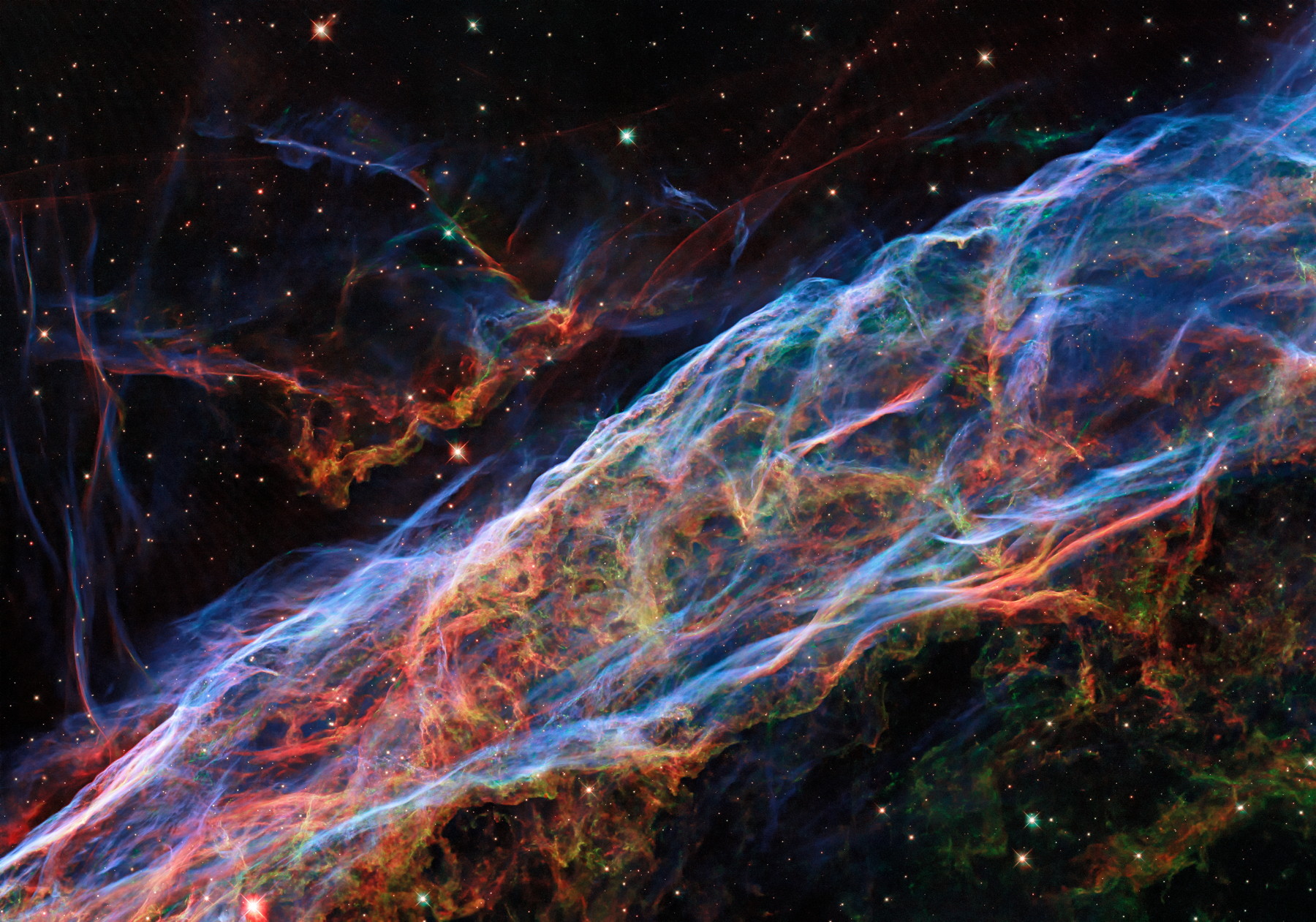
The image of a cosmic web or weave (Figure 2), like a cotton ball pulled apart, is also a cosmological trope.10 What is the shape of the universe anyway? In Bataille’s claim that it is formless and ‘resembles nothing’, I see a playful reworking of popular texts on cosmology such as Arthur Eddington’s, whom Bataille cites elsewhere. In The Nature of the Physical World (1928), Eddington warns against any dogmatic assertions about the universe’s shape beyond the general notion of its being without boundary, and in The Expanding Universe (1932), as though echoing Bataille’s entry, he quips that, for all we know, ‘the universe may be pear-shaped or sausage-shaped’, since the observable Beginning of page[p. 64] horizon is but ‘a small fraction of the whole extent of space’.11 No matter how far into its depths we penetrate, the modern universe refuses to take on form, while producing so many forms of which each one, however lowly or abject, equally refracts the (absent) whole.
One can also discern here, half-concealed under the form of the abject, an allusion to William Blake’s formula: ‘To see a world in a grain of sand | And a heaven in a wild flower’.12 Bataille translated Blake’s poetry, and it is hardly a coincidence that The Little One invokes the wildflower as an incantation of heavenly chance, beneath what a later poem calls ‘the spider-webbed sky’:
Taken to its limit within Bataille’s ‘base materialism’, Blake’s cross-scalar Romantic vision implies seeing heaven not only in a wildflower, but in spit, vomit, and snot. In ‘Formless’, Bataille advances informe as an operation that knocks all high, sublime forms down, off their pedestal: it is ‘not just an adjective […] but a term that serves to déclasser’ (i, p. 217), suggesting both declassification or dis-ordering and denigration (including the social class-related sense of déclassé).
Similarly, in the scene of death staged by the above poem, abject physiology becomes a medium of cosmic declassification: a reduction of the sky, the cosmic web, to the dying speaker’s snot coming out violently (‘vomited’) in filaments or strings, possibly blood-threaded. Formally and symbolically, the poem enacts a voiding. The compressed lines and harsh, unstable enjambments characteristic of Bataille’s poetry — as though evoking at once a body losing control and a fall or tumble down the scala naturae to the level of base matter, and ultimately into the void — string together a series of operations of expelling, thinning, evaporating, vanishing. The abundance of nasal and liquid consonants makes the writing itself feel runny, leaky.13 By the final lines, we face a terminal lack. Words run out, and with that the speaker vanishes, as though into the stanza gaps like the dying gasps coinciding materially with the death-figure of writing. It is an almost grammatical enactment of dying, as absence consumes language and, finally, the self.
The line ‘et les lis’ marks the poem’s moment of high lyricism, pointing to white lilies’ association with solemn funerary rites as well as purity and resurrection (the line comes after ‘je suis mort’, as if attempting to ascend). Yet resurrection is foreclosed as the poem converts purity into a chemical process (‘evaporate distilled water’), suggesting a clinical setting and a finality of death. ‘Distilled water’ makes purity sound emptied of contents, soulless, formless, declassifying its transcendent associations. Placed in distilled water, the funerary lilies turn even this (still tangible, substantial) purity into vapour, becoming further a figure of voiding.Beginning of page[p. 66]
In Bataille’s writing, sublime imagery, such as the star or the flower, is always ambiguous. The star, for instance our sun, is a dual image of life and death: it may be life-giving, but it is also blinding, scorching, annihilating; it shines in the cosmic desert and might, in the end, make a desert of the Earth itself. Bataille emphasizes the solar origin of life, which feeds on energy from the sun. At the same time, to quote from his poetry collection The Archangelic (1944), ‘The sun is nothing but death’ (iii, p. 81).14 The flower in its ‘flight of angelic and lyrical purity’, as Bataille dissects it in his essay ‘The Language of Flowers’ (1929), is a symbol of love, beauty, and striving towards the sun (is not the corolla itself like a star?). Yet ‘after a very short period of brilliance [éclat] the marvellous corolla rots indecently in the sun’ — and, in another instance of informe as operation, Bataille retraces the figure of the flower’s collapse, the bankruptcy (faillite) of transcendence, of ascent. Flowers ‘die ridiculously on stems that seemed to carry them to the clouds’, and what we take to be ‘the most ideal is rapidly reduced to a wisp of aerial manure’, exposing again the frailty of form (i, p. 176).15
Looking back at the line from The Little One — ‘chance animates the smallest parts of the universe: the scintillation of the stars is its power, a wildflower its incantation’ — we glimpse in it, likewise, a ‘death drama endlessly played out between earth and sky’ (i, p. 176). Even before The Little One’s next line invokes the loss of life, this line already carries a whiff of death (as though unsettling the verb ‘animates’). As the Earth accumulates dead beings, so writing accumulates dead signs, and the dead, the ancestors, the lost, at once animate the living and weigh on the fingers struggling to weave them into a cosmic web. The whole history of humanity, in its movements of ascent and fall, is a death drama that unfolds at the threshold between the Earth and solar wasteland, in the thin magnetic and atmospheric layer, this obstacle to solar wind and deadly high-energy radiation.Beginning of page[p. 67]
Threshold
When does chance become destiny? At what point does destiny turn into loss? A series of chance developments, reinforced in a violent feedback loop, can lock humanity itself onto a fatal trajectory, as we see with technological modernity and the climate crisis, whose accelerating, swirling movement leads to loss on a planetary scale. I write this out of my own, smaller-scale sense of loss: what feels like the loss of a country I considered my home, and of a possible future I had once imagined. It can be the loss of a loved one, too. The death of his lover, the writer Colette Peignot, known as Laure, in 1938 shatters Bataille, and his grief resonates across his texts. He imagines himself writing as one who is already dead, or who inhabits the liminal zone between life and death. A line from The Hatred of Poetry (1947), ‘I throw myself among the dead’ (je me jette chez les morts), implies a willed fall, even a suicidal plunge, by someone who is still alive, hurling himself across the threshold to the underworld.16 It also carries a hint of chance become destiny, evoking ‘les dés sont jetés’, the French rendering of alea iacta est, that classic expression of irreversibility and boundary crossing. The speaker now dwells in the house of the dead, chez les morts. In an unpublished 1940 note intended for Guilty (1944), a text in which death at the personal scale merges with the upscaling of loss during World War II, Laure’s death is explicitly figured as a threshold event for the writer: ‘I have just told the story of my life; death had taken the name laure’ (v, p. 530).
In the fragment from The Little One translated above, too, she (elle), as if through the very act of capitalization, transcends the reference to the feminine noun la chance and evokes, without naming her, a woman the writer mourns:
The warmth of life had left me, desire no longer had an object: my hostile fingers, aching, still wove the web of chance.
By giving to chance such a wretched anguish, I had the feeling I was supplying it with the missing thread.
Happy, I was being played, I was her thing [sa chose], she was the sun in the vast mist of my unhappiness. (iii, p. 69)Beginning of page[p. 68]
Here, sa chose can still refer to a plaything of chance, but the typographic eruption of elle — a scalar operation — points to a deeper layer of memory and grief, and to a more personal relation, resonating intertextually with the capitalization of laure in the 1940 note. The spectre of a dead woman, the longing of love, the scintillation of chance at the border of the beyond: one repeatedly finds this combination in Bataille’s poetry as well, where minor events such as a feeling of cold on one’s lips may appear as a phantom kiss, a material signal to be divined from across the threshold. ‘I find you in the star | I find you in death | you are the frost on my mouth’ (iii, p. 85).
The association between the sun or the star and loss points to a paradox at the heart of Bataille’s so-called general or solar economy. The sun, as he puts it, ‘gives without ever receiving’ (vii, p. 35), but even for the sun that means ultimate exhaustion and death.17 The solar figure of wealth, excess, and expenditure beyond gain (motifs typically associated with Bataille) is at the same time, inescapably, a figure of evanescence and loss. In this sense, too, ‘the sun is nothing but death’, and the lost lover merges with the lost sun. The task then becomes, for the living, to mediate this loss and all the layers of loss on which the edifice of humanity is erected. And if The Little One’s speaker compulsively keeps writing, if his fingers keep weaving the web of signs, it is because writing itself functions as a link to the dead, the lost: ‘I had lost her, but knowing the secrets of words I maintain the bond of writing between her and me’ (iii, p. 69). Writing threads together the realms of the living and the dead; as a calling to and binding of the dead, it possesses an incantatory, ritual character. Like a shaman or priest, the writer can perform the ritual by virtue of knowing ‘the secrets of words’. As such, writing appears as a technique of boundary crossing, of assembling the dead, of holding what has been lost within the circle of the present. Attuned to the beyond and divining its signs, the Bataillean writer reaches across the threshold to gather traces, spectral absences, and gaps and punctures left by loss, weaving them into figures and Beginning of page[p. 69] layers within the stubborn persistence of humanity under the life-giving and death-bearing sun. Writing gives form to loss, of an almost geological complexity, which serves as an obstacle to dissipation. This ritual brings no salvation or reconciliation; it serves only to access the void, the abyss, and to hold it close.
In The Little One, it is as though the loved one’s death, spun by the writer into his web, somehow completed the writing of chance, offering it ‘the missing thread’: as though, without the wound inflicted by loss, the summit of chance could not be glimpsed. ‘The peak [la pointe] of chance is veiled in the sadness of this book. It [elle] would be inaccessible without it’, goes the fragment’s last line (iii, p. 69), where elle likewise oscillates between the dead lover and the summit or tip (pointe) of chance.18 Only by writing this book, it seems, could Bataille himself attain a fleeting unity with Laure or with the void of chance that took her from him. In his other writings, too, the experience of death is presumed to open our narrow preoccupations onto the universe, onto the free play of the heavens, of cosmic chance. Hans Blumenberg has argued that, in the modern age, infinite cosmic contingency or chance becomes a figure of omnipotence, ‘reoccupying’ the position of divine omnipotence.19 The ascent to a summit as a path to the divine is, moreover, a mystical motif.20 The pointe of chance, as the peak one scales and the tip of a needle by which one is punctured, creates an aperture through which one can leap into the divine play of the skies.Beginning of page[p. 70]
Summit
meditation ii
I find a glowworm between two graves.
I place it, in the night, in my hand.
The glowworm looks at me from there, penetrates me to the point of shame.
And we lose ourselves, both of us, in its glow: we merge, both of us, with the light.
The marvelling glowworm laughs at me and at the dead, and I marvel likewise, laughing at being divined by the glowworm and by the dead.
On the margins of his corpus, in an unpublished diary entry written one year after Laure’s death, in 1939, one finds an account of Bataille’s own mystical experience of mountain ascent, undertaken together with Laure in 1937. Untitled in French, and known in English as ‘The Ascent of Mount Etna’, the text begins with the crossing of a threshold into what appears to be the realm of the dead: ‘I went yesterday to visit Laure’s grave, and as soon as I had stepped out of my door the night was so black that I wondered whether it would even be possible for me to find my way…’. Laure was buried in a cemetery on a hill. As the writer climbs up the hill and becomes increasingly lost, the moment of disorientation prompts a kind of negative conversion experience, when he is ‘overturned’ (bouleversé) by the memory of his and Laure’s ascent of Etna (v, p. 499).22
In Bataille’s account, the climb up the hill and the scaling of the volcano blend into one mystical scene. The blending takes place even at the level of language: Bataille first uses la côte to refer to the hill slope but then switches to la pente, the same word he uses for the slope of Etna. For someone so associated with disorder, Bataille strikes me as an almost structuralist writer, using carefully constructed binaries and parallelisms to pointed effect, in this case to unground linear narrative, and to merge the two episodes outside chronological time. His description Beginning of page[p. 71] of approaching the volcano, too, recalls crossing the liminal zone to the realm of death: ‘we entered an infernal region’, ‘dread and desolate’, as though beyond the Earth’s habitable environment. ‘We were, in a sense, thrown out of orbit [exorbités]’ (v, p. 500).
The ‘immense, bottomless’ crater, opening onto the underworld, corresponds structurally to the grave, which acquires a strange abyssal dimension: in the cemetery, ‘Laure’s grave […] formed, I do not know why, the only area [étendue] that was absolutely black’. The word étendue suggests a quality of extension or expansion, as if stretching towards the same darkness as death and the geocosmic abyss. Yet while the grave is dark, the crater glows with lava, exposing something of the planet’s fiery interior and revealing the cosmic duality of darkness and stellar fire: Bataille speaks of ‘the moment of rending when we are bent over the gaping wound, the fissure in the star [astre] whose air we were breathing’ (v, p. 500). Multiple cross-scalar operations are at play here, including what one may call scalar dilation and scalar puncturing. In the former, the stretch of the grave extends towards the cosmic outside, and volcanic fire connects to the glow of the Earth turned stellar and to the glow of all stars; in the latter, a wound or crack becomes a minor aperture through which the solidity of a body is fatally broken and the abyss seeps in.
By the end of the text, the wound inflicted by death breaks into an ecstatic meditation where the image of Laure as ‘my destiny advancing in darkness beside me’ becomes a figure both of chance (‘an ardent and uncertain destiny’) and of love as ‘burn[ing] down the prison walls that enclose each person’. Love, like death, connects one to the universe, yet unlike death, it is a solar communication that ‘blazes from being to being through the night’ (v, p. 501). What remains of this blaze when it burns towards death, and the lost loved one, again, merges with the lost sun?
There is another, more minor solar figure that haunts the cemetery scene: the glowworm (ver luisant), a tiny being often associated with spirits or the souls of the dead. ‘Despite the extreme darkness,’ Bataille writes, ‘I caught sight of two glowworms’ (v, p. 500), as though glimpsing himself and Laure in spirit form. Under conditions of loss, at the threshold of death, a faint glow (lueur) is perhaps what persists Beginning of page[p. 72] as a kind of light-fragment, or what remains of solar figuration.23 I am fascinated by the symmetry between this vision and the one from ‘Meditation II’ quoted above. Here, it is two glowworms and one grave; there, two graves (I am tempted to read them as those of Laure and of Bataille as one who had died with her) and one glowworm, a glimmer of the marvellous to which the writer abandons himself. In Inner Experience, transforming conventional practices of meditation, Bataille speaks of ‘a point’ with which one can unite and within which one can become abyssally lost (v, p. 141).24 A point can be, as in ‘Ascent’, a ‘breach through which two beings recognize one another’ (v, p. 500), divining and penetrating one another in love or in laughter. The beetle’s luminous dot is likewise such a point, ‘the point of shame’ from ‘Meditation II’, one with the ‘unbearable shame’ Bataille feels at Laure’s grave (v, p. 500), the anguish one must traverse to reach the summit. ‘One who loves beyond the grave’, Bataille writes, ‘has the right to release love within himself from its human limits’ (v, p. 501). Freed from merely human form and given over to the free play of chance, love’s glimmer may appear in various solar figures: a volcano, a star, or a glowworm.
Part 2. Planetary Writing
Surfacing and circling
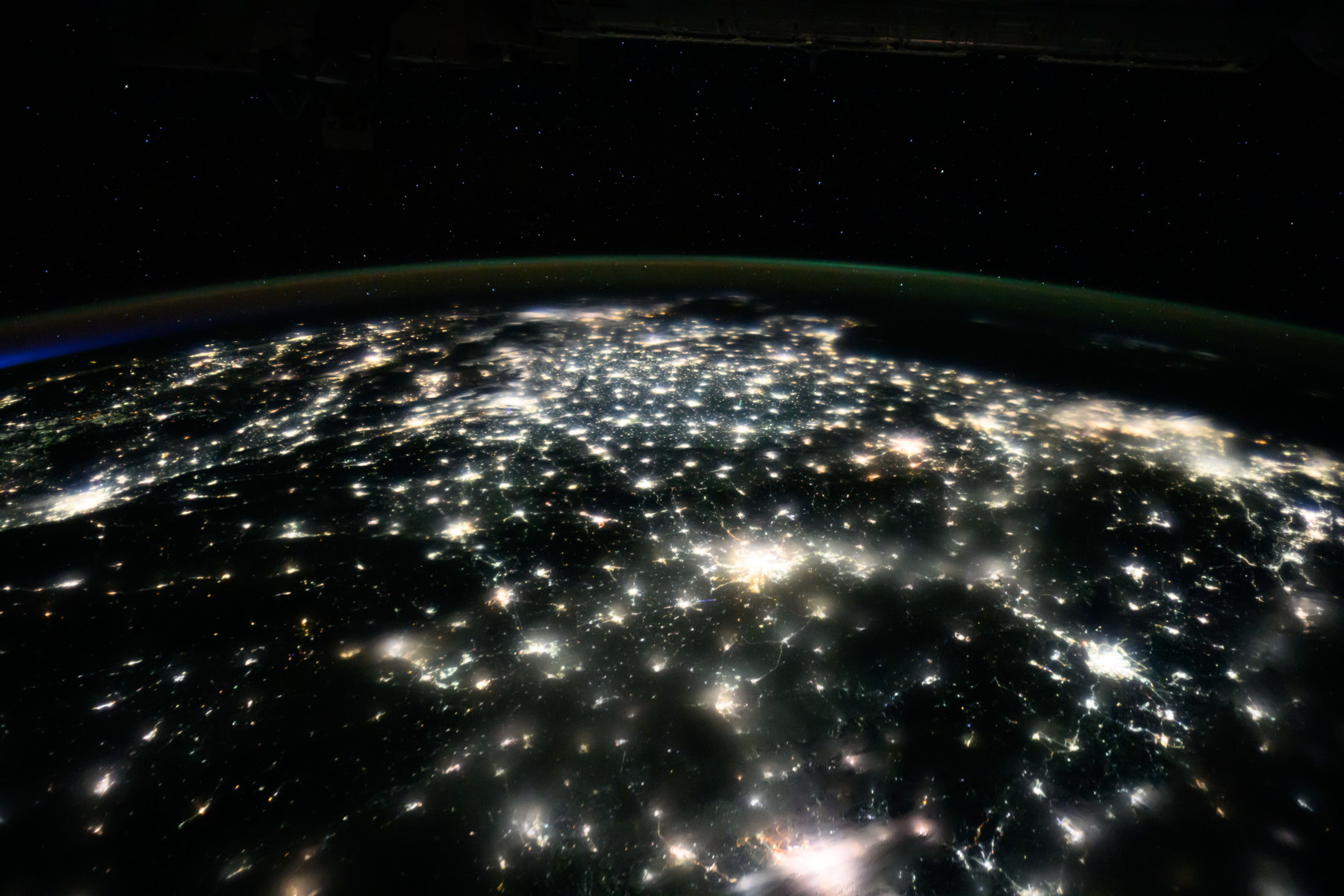
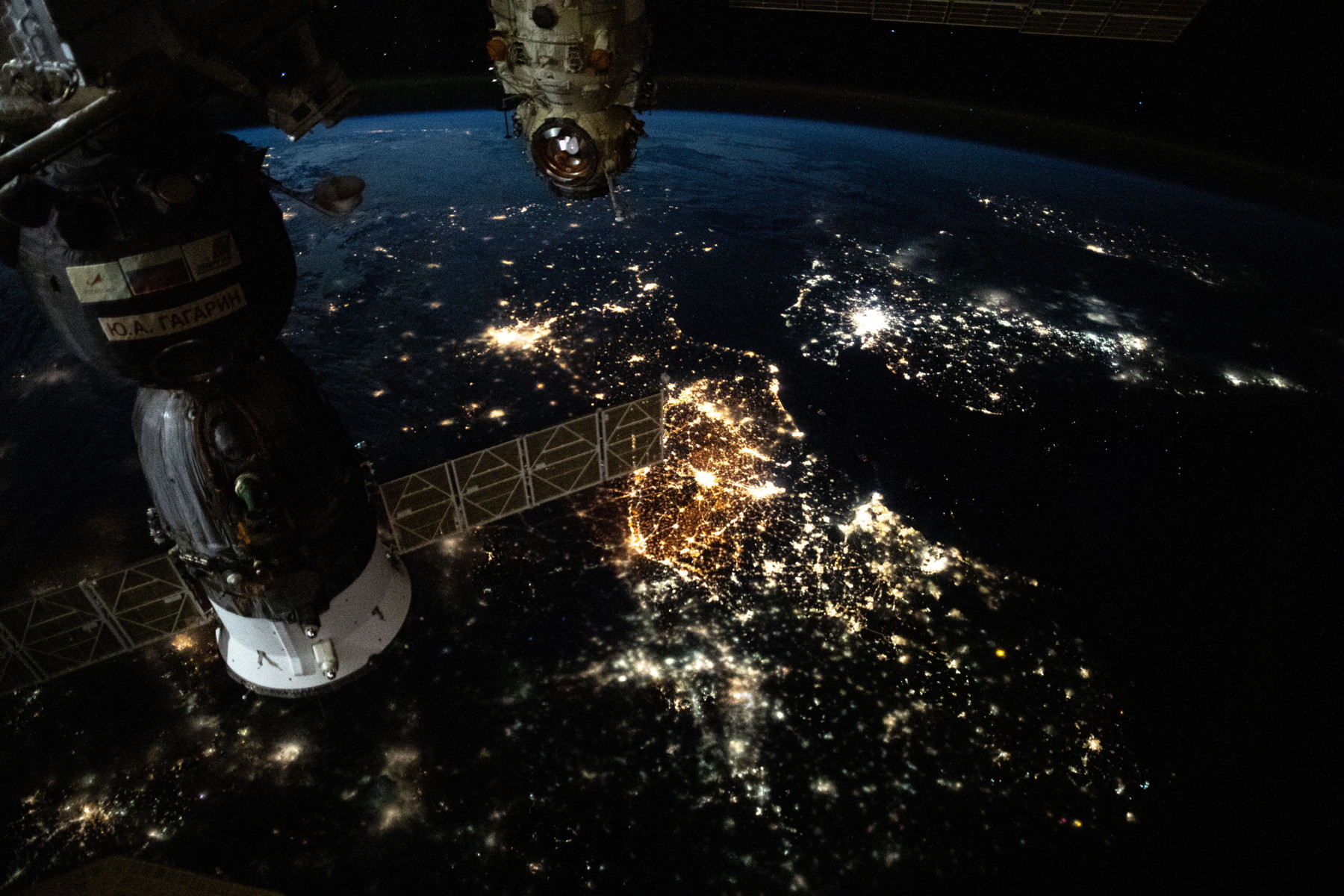
The play of solar figuration crosses forms and scales, tracing light-figures that blaze and glimmer through the night. This play precedes and exceeds the human, and is not beholden to it. The human is, rather, itself one of its forms. With and beyond Bataille, I want to think of ‘humanity’ as a cosmic movement, and of modern technological humanity in its surfacing and circling around the globe as a type of figuration,Beginning of page[p. 73] both brilliant and violent. One need only look at the Earth from above: at the swarm of satellites circling it; at the immense network of sensors, cables, data centres, power grids, railways, agricultural field patterns, cities, and numerous other technological signs and copulae that mediate and remediate the surface of the planet, its oceans, and its orbit. Paul Virilio speaks of digital, tele- and electro-technologies as technologies of indirect light, rivalling and substituting for the light of the sun;25 and, as seen in images of Earth at night taken from orbit (Figures 3 and 4), many of these signs glow in the dark, making visible human Beginning of page[p. 74] activity as a fire-being, a light-being. What is this system of planetary writing and planetary self-reflection that modern technological humanity erects at the threshold of outer space, signalling into the cosmic wasteland?
To shift the frame slightly, I should clarify that, when I say ‘modern humanity’, I have in mind what Sylvia Wynter calls ‘Man’: the paradigmatic technological subject that imposes its own model of being human on the entire globe. Elsewhere, I have written about the edifice of modernity as that of human upscaling, and about the modern concept of ‘humanity’ as assembled, at once materially and conceptually,Beginning of page[p. 75] in Man’s colonial movement.26 When Bataille, in his Eurocentrism, speaks of ‘humanity’ as a cosmic movement, I assume him to be referring to the process of Man’s upscaling. Despite his criticism of modernity and his turn to non-modern examples, he remains dismissive of those forms of being human that his schema leaves below and behind the rising spiral of history.27 Bataille is enthralled by this spiral — and I am fascinated by it, too, even as I try to resist its dazzling attraction. Suspending my own inclination to critique, I want to dwell here with the ambivalence of modernity’s ascending trajectory, and to think with Bataille about the moments of brilliance and miracle, of eruption and divination, inherent in this trajectory itself. Man’s very striving to scale the skies is eruptive, and in the signs that modern humanity obsessively inscribes into the planetary surface, through layer upon layer of the technological stack, one can see glyphs and signals to be divined, either by humanity itself or by imagined extraterrestrial others. The orbital image, too, is a medium of geo-bibliomancy, of reading for terrestrial flashes and signs.
In its iterative movement, technological humanity circumnavigates the globe and scales up to the skies, as if to represent to itself its own figure, to become conscious of its own surfacing — or as if to take some distance from itself, the distance necessary for self-reflection, and to view itself from above, from the skies, through the eyes of ancestors, aliens, gods, angels, or satellites. Pierre Teilhard de Chardin, a twentieth-century mystic of technology, writes that, if hypothetical Martians were to scan our planet for its ‘sidereal radiations’, that is, the play of energy exuded by its surface, they would note ‘not the blue of the seas or the green of the forests, but the phosphorescence of thought’. They would divine from the Earth’s technosignatures that a still-infirm planetary light-consciousness is being born in ‘this immense and growing edifice of matter and ideas’.28 For Bataille, too,Beginning of page[p. 76] the movement of life across the globe, feeding on solar energy, is a ‘movement of light’; humanity seeks to appropriate this movement while in fact being its ‘most intense form’ (vii, pp. 31, 41). He also regards planetary-scale technology, this ‘immense industrial network’, as ‘express[ing] a circuit of cosmic energy’ that modern humanity, vainly, strives to ‘regulate’ (vii, p. 33).29
Unlike some of his contemporaries, Bataille does not seem to react to the launch of Sputnik in 1957,30 and he tends to lament the loss of solar glory and brilliance in the modern age, identifying modernity predominantly with greed, individualism, and instrumental rationality. I believe one can, however, reflect or meditate on the lights of the Earth from space as traces of the marvellous, of solar figuration, within technological modernity itself, which cannot be fully understood in instrumental terms. As in Bataille’s ‘Meditation II’, does not the planet itself appear in these images like an artificial glowworm at whose brilliance one can marvel, as though an infirm sun were trying to be born from it? What can ultimately be more useless, more wasteful, more futile than this technological ascent towards the sun, through which humanity may burn itself out, sacrificing the planet’s habitability?
On a cosmic scale, this artificial brilliance, too, becomes a tiny luminous dot, growing pale and vanishing. Yet one can become ecstatically united with this light-point and its promise: to illuminate the Earth, to make a star out of it. This promise is bound up with that of a new golden age of plenty and equality. One cannot subtract this equally mystical and political promise from technological modernity, and from what Wynter likewise calls, not without admiration, modernity’s ‘dazzling triumphs and achievements’ conjoined with its ‘negative underside’.31 The promise of universal light resounds not only in Vladimir Lenin’s emphasis on electrification as an integral part of communism or in Bataille’s own solar communist vision, but already Beginning of page[p. 77] in Percy Shelley’s Romantic image of a unity of science and poetry, which jointly allow emancipated humanity to transfigure the planetary surface, transcending the cosmic night through artificial light: ‘And Science, and her sister Poesy, | Shall clothe in light the fields and cities of the free!’32
This glowing utopia, too, is what modernity — the world of Man — signals into outer space, wanting to assert itself, to be seen, to become a point of light shining, like a star, in cosmic darkness. Wynter herself invokes the ‘revelatory’ technological view of the Earth from space, alluding to images such as ‘Earthrise’ and ‘Blue Marble’ as emblematic of the achievements of modernity. Looking at our planet from the extraterrestrial vantage, she may also be said to glimpse the phosphorescence of thought: the brilliant promise of universal emancipation opened by the modern world. Yet, from within her deep ambivalence towards the ‘Janus-faced’ character of modernity, Wynter perceives at the same time Man’s foreclosure of this promise; she sees modernity’s light become catastrophic and blinding.33 From the cosmic outside, the movement of Man appears at once as a glowing utopia and as a figure of unparalleled catastrophe: a sacrifice, a planetary voiding.
Sacrifice
Can the light of enlightenment and technological upscaling be disentangled from the fire and heat that scorch the planet? Modernity’s glow from orbit appears soft and fragile, its violence concealed. Yet even indirect or soft electric light, or the buzzing of electric cables below the registers of human perception, constitutes an ‘offering’ to Beginning of page[p. 78] what Bataille calls human-made ‘conflagrations befitting the solar origin of life’s movement’ (vii, p. 43).34 The same cross-scalar technical apparatus, the same cosmic circuit that makes possible the planetary self-reflection necessary for the human to grasp the planetary scale itself and to visualize the climate crisis, also accelerates the swirling movement of this crisis, scaling up death and environmental devastation. As Bataille notes, perhaps the destiny of humanity will have been simply to exhaust the energy of the planet, to burn itself out, as though sacrificing itself and vanishing just as it has grasped its own solar figure.35
The movement of planetary writing, from this perspective, serves both planetary self-reflection and the upscaling of the human as an obstacle to death. Surrounded by the abyss of death in a decentred universe, and exposed to the fiery depths of the planet, humanity mediates and remediates the globe, inscribing itself into the threshold between earth and sky as though to fortify itself, to assert itself against cosmic insignificance, to make its own light-figure more dazzling and lasting. Over and against the extraterrestrial void, the human persists as ‘a challenge to this void’, a rebellious obstacle to the power of dissipation (v, p. 86). At the same time, humanity rises upward ‘like a challenge to the Earth, to the mud that engenders [humans] and that they are happy to send back to nothingness’ — or, one might say, to sacrifice (v, p. 93).36
Nothingness above reaffirmed in the nothingness below: Man reduplicates the nothing at the planetary scale, seeking to mediate and fill the void that it itself reproduces. Is it any wonder that the figure of modern humanity is so eruptive and unstable, hurtling towards catastrophe? Planetary writing aims to stabilize the order of Man, weaving into its web the figures and layers of technological signs, not least as so many layers of loss — of ruins, ashes, death — on which this order is erected. Modernity is an age of an unprecedented proliferation of writing, now also in the form of large language models, this new Beginning of page[p. 79] technology of planetary inscription, remediating the archive of signs and enveloping the planet in yet another semiotic and material layer. Of the ‘prosthetic’ technologies at the origin of human upscaling, fire and writing are among the most basic; it is ironic that, as the epoch of planetary writing par excellence, modernity contributes so much to the proliferation of heat and fires worldwide. It thus leads to the destabilization of the very ground that technological mediation is intended to regulate.
The ground, meanwhile, glows under our feet. ‘Not a day passes’, writes Michel Leiris in his essay ‘Civilisation’ (1930), published in the journal Documents, edited by Bataille, that we do not see new fissures that ‘sunder the fragile skin of the earth’s circumference and momentarily bare the fire at its centre’.37 Some have argued that the story of humanity can be told as that of a fire-handling and fire-starting species whose activity amplifies planetary fires, and whose technology is itself volcanic in origin.38 ‘Our whole life, our very breathing,’ Leiris continues, ‘is in touch with lava flows, craters, geysers, and everything else to do with volcanoes, and, as a consequence, if we hold up to it a mirror […] it must be capable of tracing vigorous sulphur-coloured lines upon it.’39
Like all writing, planetary writing is haunted by its relation to the dead. It is a writing of ash and flames. Its edifice is built on the ashes of the dead and their unequally distributed, often unwilling sacrifice — and it is as though this violence came back to unground the spiral of progress, and modernity itself were starting to become hell, drawn into the fiery underworld unfit for habitation. Large language models, too, trained on dead signs and the voices of the dead, dwell at and reach across the threshold, scaling up the circulation of death. Human upscaling, the upscaling of writing, and the upscaling of the Beginning of page[p. 80] burden of death go hand in hand. In this drama played out between earth and sky, the entire Earth threatens to become a cemetery, a realm of the dead.40 This planetary sacrifice would also be a mode of scaling up to the cosmic void, of becoming one with the free play of chance. It is entirely possible that the human species might succeed in becoming spacefaring and multi-planetary; it is equally possible that it will simply end, and that nothing will remain of it except ashes, traces, and extinguished signs, to be divined by non-human others or scattered into space. Either way, in a universe without an absolute above or below, humanity’s ascent to the skies is indistinguishable from a fall into the geocosmic depths, as invoked in Bataille’s ‘The Practice of Joy before Death’ (1939): ‘I slowly lose myself in unintelligible and bottomless space. | I reach the depths of worlds. | I am devoured by death’ (i, p. 555).41
Much has been written about modernity’s supposed lack of connection to the cosmic. In Man’s stubborn self-assertion against the post-Copernican abyss, however, does not modernity’s accelerating swirling movement, contingent yet catastrophic, in which tourner (to turn) slips into tournoyer (to swirl, to whirl), begin to imitate the whirl of galaxies? In ‘Celestial Bodies’ (1938), citing Eddington, Bataille emphasizes that, although we fail to notice it in everyday life, cosmic rotation is an extremely fast, vertiginous movement that makes one dizzy if one tries to imagine it. Our galaxy is ‘thrown into space like a whirling explosion’ (i, p. 514).42 Cosmic figuration is a universal dance of death: ‘The Practice of Joy’ also invokes this ‘universe composed of innumerable turning stars […] whose very movement requires that I die’ (i, p. 557).43
In its upscaling of death, of loss, it is as if humanity were trying to become ecstatically one with this movement, with ‘the fête of suns Beginning of page[p. 81] and spirals’ (i, p. 520), as Bataille concludes in ‘Celestial Bodies’. ‘Humanity can regain, through loss, the free movement of the universe, it can dance and whirl with […] the great swarm of stars,’ he writes there, ‘but in the violent expenditure it thus makes of itself, it must glimpse that it breathes in the power of death’ (i, p. 520). Yet what does it mean to glimpse (apercevoir) this dance, to become aware of it? Is this to say that, through loss, modern humanity discerns the figure of its own ongoing sacrifice? Or is it — as Bataille seems to suggest in the first volume of The Accursed Share (1949) — a way to attain a higher consciousness of solar figuration, so as to avoid the catastrophe facing the planet?44 Is there any way in which all this loss will have been worth it? Or does the question already amount to an attempt to justify or redeem the violent movement of modernity? However one responds, in the meantime the modern world keeps swirling.
Precipice (Reflecting, obliquely)
Bataille’s ‘The Practice of Joy before Death’ is, among other things, an account of meditative practice. To meditate, the practitioner focuses on a point — ‘this point being both the life and the death of the loved one’ — imagined as the glowing ‘geometric locus of all existence’. The scalar collapse between point and totality induces vertigo in the practitioner, a fall through the point as an opening into the depths where ‘everything is profoundly cracked’ (i, pp. 555–56).45 In order to think with, but also to resist, this movement of voiding — this fall — I want to linger at the precipice, the brink of the abyss, and to tarry with the moment when one is gazing down, poised at the edge and almost slipping, yet maintaining a precarious balance. I want to suggest that this precipice can be imagined as a place for philosophical reflection to occupy: a place from which one registers and holds fleeting figures just long enough to reflect on them, to articulate them, before they vanish in the abyss.
While Bataille draws on mysticism, and while he composes poetry, he refuses the labels of mystic and poet. He does not, however, refuse Beginning of page[p. 82] the title of philosopher.46 This fact is significant, but here I can approach its significance only obliquely. We may recall how, in ‘Ascent’, Bataille and Laure — out of breath from the climb and ‘thrown out of orbit’ — experience a ‘moment of rending’ when gazing into Etna’s crater, ‘bent over [penchés sur] the gaping wound, the fissure in the star whose air we were breathing’ (v, p. 500). In this sentence, too, everything is cracked. The operations of wounding, rending, and fissuring cut open all the bodies across scales: the humans, the volcano, and the celestial body. The whole scene blazes; it communicates with the solar outside beyond the terrestrial orbit.
Yet the movement stops there. The sentence’s ending, invoking ‘the star whose air we were breathing’ or ‘where we were breathing’ (où nous respirions), grounds the scene, returns it to its terrestrial place (the ‘where’), bringing the stellar scale down to earth, into the protective layer of the atmosphere. This abrupt stopping at the summit, this return of breath at the brink of asphyxiation and bleeding out from the cuts, signals for Bataille the heights of eroticism. As he writes in Guilty, ‘eroticism is the brink of the abyss: I bend over [je me penche au-dessus] senseless horror’ (v, p. 355), the horror of the depths.47
In these scenes of leaning over the abyss, I discern, however, something more distant than the blaze of eroticism and geocosmic terror. I see here a faint glimmer of philosophical reflection, like the scintillation of a star, invoked indirectly through echoes in the language. In The Accursed Share, Bataille calls for a new consciousness of the planetary condition, an expanded reflection able to grasp the eruptive figure of humanity and to do justice to the explosive condition of the globe. He gestures towards a lucid consciousness of vertigo one must,Beginning of page[p. 83] impossibly, attain: humanity’s ‘vertiginous movement’, he writes, must ‘appear clearly in consciousness’ (vii, p. 47).48
The scenes on the precipice may point to this type of consciousness. In French, se pencher sur (to lean over or to bend over, but also to examine) has epistemic connotations. It is a figure of reflection: one bends one’s attention, one’s head and gaze, over something, taking it as the object of thought. Bataille’s se pencher au-dessus shifts this from a neutral ‘looking into’ to a vertiginous operation — and in On Nietzsche (1945) he likewise speaks of the viewpoint that opens in the moment of ‘leaning over [se pencher sur] the abyss’ or ‘the void’ (vi, pp. 45, 72), as if perched above the crater and glimpsing the instability and perishability at the heart of things.49 ‘Philosophy’, he writes elsewhere, ‘cannot escape the perspective of the instant when the ground slips away’ (xii, p. 519). Only from this position, as Guilty implies, can one call into question ‘everything possible’ (v, p. 355). The philosopher, then, should be capable of a kind of slanted double vision, keeping in view at once the world of possibility and the abyss that ungrounds it, so as to reflect on the figures and signals that cross between the two.
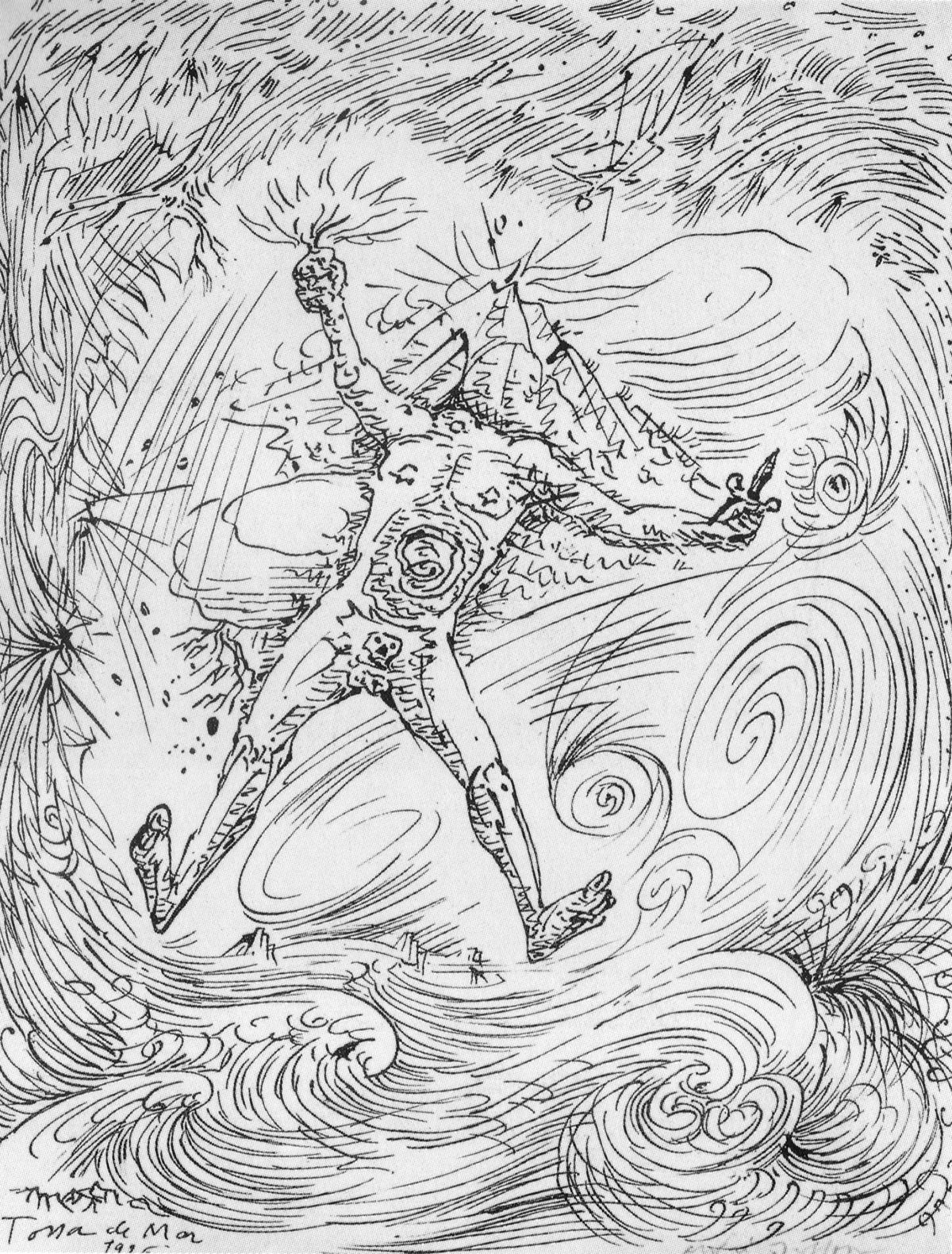
This vision of a philosopher suspended over the crater recalls for me another famous Bataillean image: André Masson’s Acéphale, which depicts a human figure without a head, holding a flaming heart in one hand and a sacrificial dagger in the other. Inspired by Leonardo da Vinci’s ‘Vitruvian Man’, that paradigmatic image of the human as cosmic measure, Acéphale served as the symbol of the secret society founded by Bataille. Masson drew multiple variations of this figure, one of which is reproduced in Figure 5; here, the figure is floating or falling into the abyss, surrounded by galactic swirls and oceanic waves, its head replaced by the volcano.
The volcano taking the place of the head may point to many Bataillean motifs, including eruptive passion that exceeds practical rationality. I wonder, though, whether one might also approach this as a philosophical figure. In this figure, an expanded volcanic reflection substitutes for the pragmatic bourgeois reason that shuns disorder and Beginning of page[p. 84] leaves the bounded subject intact. By contrast, the eruption in this drawing gestures to the volcano as the ‘proper’ site of philosophy, and as a vertiginous aperture through which the head is drawn into geocosmic instability. In his early Surrealist essay ‘The Pineal Eye’ (1930), Bataille even imagines a third concealed eye at the summit of the Beginning of page[p. 85] human head, which connects directly — eruptively, vertically — to the sun. It is perhaps this eye, overlooking the glowing abyss, that Bataille wants the philosopher to open.
My sense is that the philosopher need not, like Empedocles, jump into Etna’s crater. While the figure of the philosopher I pursue here is broadly Bataillean, I also want to position philosophy as a precarious obstacle to the ecstatic fall into the abyss Bataille often embraces. The peculiarity of philosophical writing is that it is reflective; it does not merge with the glow but maintains a gap, a distance from it. This glow can be that of a volcano, a star, or an exploding bomb (catastrophic technological light being very much on Bataille’s mind). But it can also be that of a luminous dot, a glowing beetle, the indirect light of electronic or satellite transmission, or the cold phantom glow of the lost loved one, the lost sun. Each of these may appear as a scintillation of cosmic chance.
Lingering at the threshold, at the precipice of the void, philosophical writing, too, is a writing of loss and recollection. If the philosopher gazes into the abyss, it is, Bataille writes in On Nietzsche, ‘to have knowledge of the nothingness’ — the void of chance — ‘that is revealed in pain’. He continues: ‘The most common operations of life require that we lean out over the abyss’ (vi, p. 158).50 We usually fail to notice the abyss that surrounds our everyday life. The philosopher’s double vision, however, functions as a sensor attuned to the abyss, discerning and reflecting on figures of voiding across scales, from daily goings-on to the circling of humanity around the globe.
In its double vision, philosophy in this sense must reflect on planetary writing as well, insofar as this writing mediates the gap between earth and sky. Without technological mediation, how could humanity’s movement appear clearly in consciousness? How else could philosophy become aware of this catastrophic movement, if not by reading cross-scalar processes, signs of instability, and atmospheric and seismic shifts? Philosophy needs to move not only across textual forms, but also across media, sensory registers, and geotechnologies of modelling, visualization, and formalization — across the whole apparatus of planetary self-reflection. So understood, philosophy cannot stand Beginning of page[p. 86] outside this apparatus. Philosophical reflection remains unstable and provisional, implicated in the very process it seeks to grasp, drawn into the planetary swirl even as it tries to resist its pull. In its own search for chance, philosophy needs to adopt at once a human and an extraterrestrial (Martian, post-Copernican) perspective: not in order to become a robotic posthuman intelligence coldly circling around the Earth, but to dwell within the interval, at the threshold of outer space, that humanity itself inhabits.
As Bataille writes in ‘The Pineal Eye’, the human is ‘polarized by the sky’ (ii, p. 26),51 and this tension is what defines the movement of humanity. In its double challenge to the Earth and to the cosmic void, the human strives, eruptively, to scale up to the sky, even as it always fails to ascend fully. The image of the pineal eye points to an ambivalence inherent in the human figure in Bataille. On the one hand, looking at itself rationally, in order to regulate its own circling and to fortify itself as an obstacle to death, the human sets up the borders that circumscribe for it the lawful circle of life — of laws and taboos — seeking to keep out, and hold at bay, the outside or ‘the sacred’.52 On the other, the human head, with the pineal eye, is an opening onto the solar essence that cannot be contained, and that irrupts through it. The human, as Bataille defines it, is a being of polarity, of the gap: a glowing fissure, a ‘negative’ wound in the body of nature. It figures a kind of cosmic addendum, and the main philosophical problem is ‘that of the human itself, insofar as it adds humanity to the universe’ (viii, p. 26).53 What the human adds is the gap, the interval, which does not exist in nature as such but marks nature’s distance from itself. On the scale of the universe, this gap is perhaps minuscule, contingent, a minor crack. Yet it is precisely this vanishing interval that philosophy inhabits in its double vision, making possible a meditation on loss, perishability, and the fleeting forms of humanity’s terrestrial and solar figuration. The human bends over the wound — over itself as wound — as over the crater, obliquely.Beginning of page[p. 87]
Communication
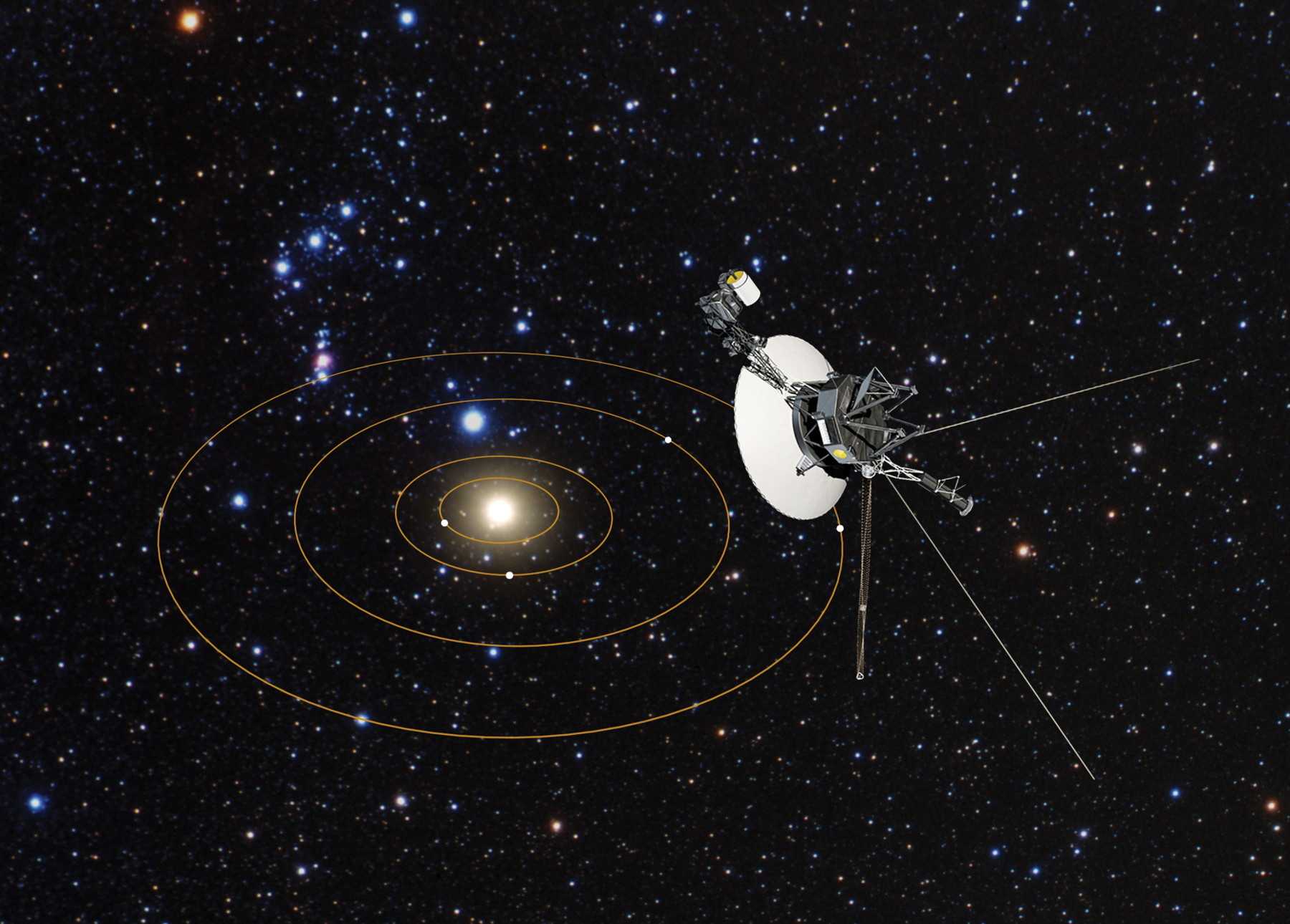
I want to meditate on an artificial beetle drifting in the beyond. In 2012, the space probe Voyager 1 (Figure 6), launched in 1977 and now the most distant human-made object in the cosmos, crossed into interstellar space. It continues to this day to collect data and to communicate with the Earth through the faint indirect light of radio signals. As I was writing this essay, I saw the news that Voyager 1 was running low on power, destined in the end to fade into silence, becoming a dead sign, a vanishing trace of humanity consumed by the cosmic expanse.Beginning of page[p. 88]
Not unlike the orbital lights of the Earth at night, or the messages humans have sent outward in the hope of reaching extraterrestrial intelligence, Voyager 1 shows that modernity — the world of Man — wants above all to communicate, to announce itself, to be seen. The modern age figures itself as a solar epoch, an age of light (and Bataille himself is, in this regard, very much a modernist). In its self-assertion, Man does not want to hide in the dark cosmic forest or conceal the signs and technosignatures of its own presence. Hence Voyager 1 does not merely explore the interstellar medium, reading the beyond for measurements and signals. Launched by NASA within the horizon of Cold War and imperial cosmic ambition, it is also an artificial angel, a messenger, carrying the so-called Golden Record: a partial archive of the history and knowledge of the world of Man. Through this archive, moreover, Man wants itself and the Earth to be heard: the record contains greetings, music, and sounds of our planet, including laughter, birdsong, and thunder.
Meditating on this strange beetle on a cosmic scale makes me think of Bataille’s concept of communication. He often connects communication to the blaze of love, the contagion of laughter, or the explosive solar community of festival or revolution. In Inner Experience, however, he also develops the concept in a direction that gestures, I would suggest, towards communication with the extraterrestrial beyond, or communication as a vanishing, runaway cosmic trajectory. In some passages, he reads the subject-object relation — when the subject reflects on an object — through what can be understood, somewhat anachronistically, as a proto-information theory: the subject sends a signal or request to the object, and the object sends back its response.
Let us call the subject ‘A’ and the object ‘B’. Bataille’s model of finite communication can be presented as ‘A=B’, where the linkage or copula marks the signal passing both ways. But what happens, he asks, when the object becomes the unknown and unknowable X, the immense cosmic abyss itself? ‘Above all’, he writes,
no more object. […] There is no longer subject=object, but a ‘gapping breach’ between one and the other and, in the breach, subject and object are dissolved, there is a passage, communication, but not from one to the other: one and the other have Beginning of page[p. 89] lost their distinct existence. […] In the same way, no response remains possible (v, p. 74).54
Here, the signal from the subject — from Man — becomes a signal without response, a message into the void, the empty inhuman sky.55 Instead of binding object to subject, the copula enacts a voiding that unbinds. Communication remains a passage without destination, a breach of the terrestrial threshold in which the very structure of exchange dissolves.
This move ungrounds both the standard model of communication and the figure of ‘cosmic man’. Through technology, humanity attempts — in Bataille’s description of communication — to ‘be accumulated and charged like a storm, inscribing its point of night into the luminous order of things’ (v, p. 443).56 Space probes such as Voyager 1 are prostheses and light-extensions of the human, sent into the extraterrestrial expanse to measure and mediate it, and to carry the signs of Man beyond the Earth’s orbit. In this, they recall the traditional conception of the human as a middle being or cosmic mediator, neither animal nor god, moving between earth and sky. But how is one to mediate the measureless universe? The task that the world of Man still strives to uphold, in its attempt to know all and become all, is constitutively impossible. Upscaling itself to the universe, modernity only increases the burden on the Earth, until the planet cries out.
Bataille’s late essay ‘The Encumbered Planet’ (1958) opens, strikingly, with this cry: ‘From the planet burdened with death and wealth, a cry pierces the clouds. Wealth and death enclose. No one hears this cry of wretched expectation’ (xii, p. 475). Is this the cry that an extraterrestrial intelligence might in truth hear in the Golden Record, if it were to decipher its contents and origin? For Bataille, this cry can itself Beginning of page[p. 90] be ecstatic.57 I hear it, at the same time, as melancholic. It is hard for me to imagine how cosmic communication or, for that matter, cosmic philosophy, in their modern forms, could be free from melancholy. Bent over the planetary wound, the world of Man is burdened, perhaps despite itself, with a ‘melancholic obligation’: an obligation to an unknown, unknowable X, ultimately to the immeasurable universe itself, of which humanity is only a transient, chance configuration.58
Instead of a glorious solar blaze, a new golden age, I meditate on the melancholic obligation that space probes such as Voyager 1 carry into the beyond. I meditate on the pale glow of the moon, this other figure of uselessness, of ‘useless eternity’, and of gentle reflection, as it reflects the light of the sun.59 (I wonder: Why is there no lunar condition in Bataille?) I meditate, finally, on the miracle, the marvel, that is the stubborn persistence of the manifold forms of humanity in the face not only of the geocosmic abyss, but also the escalating wars and devastations of the present. Lately, I find myself thinking less about all-consuming solar fire and more about a kind of fugitive glimmering bliss; about love as what Bataille calls in ‘Ascent’ his ‘daily bread’ (v, p. 501); and about the necessity of finding cracks in this world and building shelters from the world within them, perhaps in the hope of surviving its violent enclosure. The infirm light that glows in these cracks is a type of solar figuration, too.
Notes
- L’économie à la mesure de l’univers is the title of Bataille’s 1946 working notes for The Accursed Share, in English in Georges Bataille, The Limit of the Useful, trans. by Cory Austin Knudson and Tomas Elliott (MIT Press, 2022). ↵
- Oxana Timofeeva, in her analysis of violence in Bataille, relatedly links ‘Bataille’s enterprise’ to ‘finding an inhuman element within the human, which will connect me to the serpent, to the volcano, or to the sun’. See Oxana Timofeeva, Solar Politics (Polity Press, 2022), p. 58. ↵
- Throughout this essay, I capitalize ‘Earth’ to distinguish the planet from ‘earth’ as ground, while leaving ‘sun’ and ‘moon’ uncapitalized so that they can remain at once astronomical and figural. ↵
- Unless otherwise indicated, all references are to Georges Bataille, Œuvres complètes, 12 vols (Gallimard, 1970–88), with volume followed by page number. Translations are mine, but references to the existing English translations for select quotations are provided in the notes. Here the reference is to Georges Bataille, Inner Experience, trans. by Stuart Kendall (State University of New York Press, 2014), p. 98. ↵
- Georges Bataille, ‘Un peu plus tard’, in Bataille, Le Petit, iii, pp. 33–69 (p. 69). For a different translation, see Georges Bataille, Louis XXX: The Little One and The Tomb of Louis XXX, trans. by Stuart Kendall (Equus Press, 2013), p. 47. ↵
- Bataille, Inner Experience, p. 163. ↵
- See Yve-Alain Bois and Rosalind E. Krauss, Formless: A User’s Guide (Zone Books, 1997); and Georges Didi-Huberman, La Ressemblance informe, 3rd edn (Éditions Macula, 2019). ↵
- Georges Bataille, Visions of Excess: Selected Writings, 1927–1939, ed. and trans. by Allan Stoekl (University of Minnesota Press, 1985), p. 31. ↵
- Bataille, Inner Experience, p. 129. ↵
- See, for example, Richard J. Bond and others, ‘How Filaments of Galaxies Are Woven into the Cosmic Web’, Nature, 380 (1996), pp. 603–06 <https://doi.org/10.1038/380603a0>. I take the cosmological image of a cotton ball from Lisa Messeri, Placing Outer Space: An Earthly Ethnography of Other Worlds (Duke University Press, 2016), p. 22. ↵
- Arthur Eddington, The Expanding Universe [1932] (University of Michigan Press, 1958), p. 34. On the influence on Bataille of the physics and cosmology of his time, see Lysa Hochroth, ‘The Scientific Imperative: Improductive Expenditure and Energeticism’, Configurations, 3.1 (1995), pp. 47–77 <https://doi.org/10.1353/con.1995.0001>; Gavin Parkinson, Surrealism, Art, and Modern Science: Relativity, Quantum Mechanics, Epistemology (Yale University Press, 2008), pp. 117–44; and Cédric Mong-Hy, Bataille cosmique. Georges Bataille: Du système de la nature à la nature de la culture (Nouvelles Éditions Lignes, 2012). ↵
- William Blake, ‘Auguries of Innocence’ (1803). On other Blakean motifs in Bataille, see Joseph Albernaz, Common Measures: Romanticism and the Groundlessness of Community (Stanford University Press, 2024), pp. 188–202. ↵
- Cf. another poem by Bataille, where the eyes and the language or tongue are running, flowing out: ‘j’éclate je hais le ciel | qui suis-je à cracher les nues | […] | mon cœur est de l’encre noire | […] | je pleure et ma langue coule’ (iii, pp. 87–88). ↵
- On the sun’s duality, see Bataille’s essay ‘Rotten Sun’ (1930), in Bataille, Visions of Excess, pp. 57–58. Cf. George Gamow, The Birth and Death of the Sun (Viking Press, 1940), on a future where solar radiation burns up the Earth’s surface, making life impossible. ↵
- Bataille, Visions of Excess, p. 12. ↵
- Georges Bataille, La Haine de la poésie (Les Éditions de minuit, 1947), p. 39. ↵
- Georges Bataille, The Accursed Share: An Essay on General Economy, trans. by Robert Hurley, 3 vols (Zone Books, 1988–92), i: Consumption (1988), p. 28. The sun’s death occurs on a radically different timescale compared to that of humanity’s existence. Still, if we shift our view to this cosmic scale, the sun itself appears as a figure of voiding, not just of endless excessive giving, as it often does in Bataille. I thank Marietta Kesting for her remarks about this scalar discrepancy. ↵
- Compare also the identification of ‘summit’ (sommet) and ‘tip of a needle’ (la pointe d’une aiguille) in Method of Meditation as the location of sovereignty understood not as power, but as slippage, laughter, and birdsong (‘the way a bird sings’) — and thus as oneness with cosmic chance as well (v, p. 222). Georges Bataille, Method of Meditation, trans. by Stuart Kendall, in Bataille, Inner Experience, p. 197. ↵
- See Hans Blumenberg, The Legitimacy of the Modern Age, trans. by Robert M. Wallace (MIT Press, 1983). ↵
- One may recall St John of the Cross’s Ascent to Mount Carmel, with its affirmation of the divine void at the mountain summit, or Petrarch’s conversion experience atop Mont Ventoux, where he reflects on God and his unfulfilled love for Laura. ↵
- Bataille, Method of Meditation, p. 176; italics in the original. French original in v, p. 200. ↵
- Georges Bataille, ‘The Ascent of Mount Aetna’, trans. by Annette Michelson, October, 36 (1986), pp. 103–05 <https://doi.org/10.2307/778557>. ↵
- I owe my interest in the figure of the glowworm to my conversations with Jasmine Pisapia, by whose work on fireflies and the glimmering thresholds between life and death and the visible and the invisible I am deeply influenced. See her essay in this volume and Jasmine Clotilde Pisapia, ‘Poisonous Images: Taranto’s Environmental Crisis between the Visible and the Invisible’, Cultural Anthropology, 41.2 (2026), pp. 247–74 <https://doi.org/10.14506/ca41.2.03>. ↵
- Bataille, Inner Experience, p. 122. On the subject in Inner Experience as at once positing and losing itself, see Jean-Louis Baudry, ‘Bataille et l’expérience intérieure’, Tel Quel, 55 (1973), pp. 63–76. ↵
- Paul Virilio, Polar Inertia, trans. by Patrick Camiller (Sage, 2000). ↵
- See Kirill Chepurin, ‘Cosmic Delegitimation: Toward a Political Theology of Scale’, in Political Theology Reimagined, ed. by Alex Dubilet and Vincent W. Lloyd (Duke University Press, 2025), pp. 173–89 <https://doi.org/10.1515/9781478061144-012>. ↵
- For a critique of Bataille’s own colonial assumptions, see Howard Caygill, ‘Bataille and the Neanderthal Extinction’, in Georges Bataille and Contemporary Thought, ed. by Will Stronge (Bloomsbury, 2017), pp. 239–63. I thank Nicolas Helm-Grovas for drawing my attention to this text. ↵
- Pierre Teilhard de Chardin, The Phenomenon of Man, trans. by Bernard Wall (Collins, 1959), p. 183. ↵
- Bataille, The Accursed Share, i, pp. 23, 26, 34. ↵
- These contemporaries include philosophers such as Günther Anders, Hannah Arendt, and Martin Heidegger. ↵
- Sylvia Wynter, ‘On How We Mistook the Map for the Territory, and Re-Imprisoned Ourselves in Our Unbearable Wrongness of Being, of Désêtre: Black Studies Toward the Human Project’, in Not Only the Master’s Tools: African-American Studies in Theory and Practice, ed. by Lewis R. Gordon and Jane Anna Gordon (Paradigm, 2006), pp. 107–69 (pp. 123, 132, 161). ↵
- Percy Bysshe Shelley, Laon and Cythna [1817], ed. by Anahid Nersessian (Broadview, 2016), p. 134 (Canto v, lines 536–37). ↵
- On the ‘Janus-faced’ entanglement within modernity of the ‘dazzling series of cognitively emancipatory achievements’ — including the ‘revelatory, extraterrestrial perspectival view of our planet Earth’ — with Man’s racial-colonial negation of co-humanity and foreclosure of ecumenically human emancipation, see Sylvia Wynter, ‘The Ceremony Found: Towards the Autopoetic Turn/Overturn, its Autonomy of Human Agency and Extraterritoriality of (Self-)Cognition’, in Black Knowledges/Black Struggles: Essays in Critical Epistemology, ed. by Jason R. Ambrose and Sabine Broeck (Liverpool University Press, 2015), pp. 184–252 (p. 188). ↵
- Bataille, The Accursed Share, i, p. 37. ↵
- See, for example, vii, pp. 509–10; The Limit of the Useful, pp. 321–22: Humanity’s ‘sole aim has been using up the terrestrial globe. […] [Humanity’s movement] derives profits from a planet being exhausted; nevertheless, it is grand and glorious’. ↵
- Bataille, Inner Experience, pp. 75, 81. ↵
- Michel Leiris, ‘Civilisation’, in Encyclopædia Acephalica, ed. by Alastair Brotchie, trans. by Iain White and others (Atlas Press, 1995), pp. 93–96 (p. 93). ↵
- See the writings of Nigel Clark, in particular Nigel Clark, ‘PyroGaia: Planetary Fire as Force and Signification’, Ctrl-Z: New Media Philosophy, 7 (2017) <https://www.ctrl-z.net.au/articles/issue-7/clark-pyrogaia/> [accessed 28 May 2026]; and Nigel Clark, Alexandra Gormally, and Hugh Tuffen, ‘Speculative Volcanology: Time, Becoming, and Violence in Encounters with Magma’, Environmental Humanities, 10.1 (2018), pp. 273–94 <https://doi.org/10.1215/22011919-4385571>. ↵
- Leiris, ‘Civilisation’, p. 93. ↵
- On the ashes of the dead as an ethical problem, the Earth as cemetery, and modernity as hell, see Kirill Chepurin and Alex Dubilet, ‘Out of the Cemetery of the Earth, a Resurrective Commons: Nikolai Fedorov’s Common Task against the Biopolitics of Modernity’, CR: The New Centennial Review, 23.2 (2023), pp. 259–93 <https://doi.org/10.14321/crnewcentrevi.23.2.0259>. ↵
- Bataille, Visions of Excess, p. 237. ↵
- Georges Bataille, ‘Celestial Bodies’, trans. by Annette Michelson, October, 36 (1986), pp. 75–78 <https://doi.org/10.2307/778552>. ↵
- Bataille, Visions of Excess, p. 239. ↵
- See vii, p. 47; Bataille, The Accursed Share, i, p. 41. ↵
- Bataille, Visions of Excess, pp. 237–38. ↵
- See Bataille’s lecture where he compares himself to Sartre (ix, pp. 325–30), in English in Georges Bataille, The Cradle of Humanity: Prehistoric Art and Culture, trans. by Michelle Kendall and Stuart Kendall (Zone Books, 2005), pp. 47–55. Importantly, there is no rigid dichotomy for Bataille between philosophy and mysticism. For accounts of Bataille and mysticism, see in particular Amy Hollywood, Sensible Ecstasy: Mysticism, Sexual Difference, and the Demands of History (University of Chicago Press, 2002), pp. 60–119; and Alex Dubilet, The Self-Emptying Subject: Kenosis and Immanence, Medieval to Modern (Fordham University Press, 2018), pp. 146–72. ↵
- Georges Bataille, Guilty [1944], trans. by Stuart Kendall (State University of New York Press, 2011), p. 97. ↵
- Bataille, The Accursed Share, i, p. 40. ↵
- Georges Bataille, On Nietzsche, trans. by Stuart Kendall (State University of New York Press, 2015), pp. 34–35, 65. ↵
- Bataille, On Nietzsche, p. 140. ↵
- Bataille, Visions of Excess, p. 83. ↵
- See in particular volume ii of The Accursed Share, which theorizes these borders in dialogue with the anthropological theories of Émile Durkheim, Marcel Mauss, and Claude Lévi-Strauss. ↵
- Bataille, The Accursed Share, ii and iii (1992), p. 31. ↵
- Bataille, Inner Experience, p. 64. ↵
- Bataille’s vision of the universe as an empty sky devoid of response seems aligned with Eddington’s remark that, even if there is extraterrestrial intelligence, it is rare (with only ‘a few rival earths dotted here and there about the universe’). These other earths may, moreover, be ‘places where conscious life has already vanished or is yet to come’. All this makes communication with hypothetical extraterrestrials improbable. See Arthur Eddington, The Nature of the Physical World (Macmillan, 1928), p. 178. ↵
- Bataille, Inner Experience, p. 235. ↵
- I am also thinking of a line from Guilty: ‘THE OBJECT OF ECSTASY IS THE ABSENCE OF A RESPONSE FROM THE OUTSIDE’ (v, p. 320; Bataille, Guilty, p. 69; capitals in the original). Such is, perhaps, the ecstasy of a humanity conscious of being alone in the universe, or unlikely to reach other intelligent beings even if they exist: a specifically modern type of cosmic ecstasy. ↵
- I adapt the phrase ‘melancholic obligation’ from Elizabeth Povinelli, Geontologies: A Requiem to Late Liberalism (Duke University Press, 2016), p. 110. ↵
- On the moon’s ‘useless eternity’, see the beautiful cosmic tale in François Hemsterhuis’s Alexis, or on the Golden Age (1781), in François Hemsterhuis, Dialogues, 1778–1787, ed. and trans. by Jacob van Sluis and Daniel Whistler (Edinburgh University Press, 2022), p. 137. See also Kirill Chepurin, ‘Theodicy across Scales: Hemsterhuis’s Alexis and the Dawn of Romantic Cosmism’, Symphilosophie: International Journal of Philosophical Romanticism, 4 (2022), pp. 263–93. ↵
Bibliography
- , Common Measures: Romanticism and the Groundlessness of Community (Stanford University Press, 2024) <https://doi.org/10.1515/9781503639737>
- , The Accursed Share: An Essay on General Economy, trans. by Robert Hurley, 3 vols (Zone Books, 1988–92)
- Bataille, Georges‘The Ascent of Mount Aetna’, trans. by Annette Michelson, October, 36 (1986), pp. 103–05 <https://doi.org/10.2307/778557>
- Bataille, Georges‘Celestial Bodies’, trans. by Annette Michelson, October, 36 (1986), pp. 75–78 <https://doi.org/10.2307/778552>
- Bataille, GeorgesThe Cradle of Humanity: Prehistoric Art and Culture, trans. by Michelle Kendall and Stuart Kendall (Zone Books, 2005)
- Bataille, GeorgesGuilty [1944], trans. by Stuart Kendall (State University of New York Press, 2011)
- Bataille, GeorgesLa Haine de la poésie (Les Éditions de minuit, 1947)
- Bataille, GeorgesInner Experience, trans. by Stuart Kendall (State University of New York Press, 2014)
- Bataille, GeorgesThe Limit of the Useful, trans. by Cory Austin Knudson and Tomas Elliott (MIT Press, 2022) <https://doi.org/10.7551/mitpress/13669.001.0001>
- Bataille, GeorgesLouis XXX: The Little One and The Tomb of Louis XXX, trans. by Stuart Kendall (Equus Press, 2013)
- Bataille, GeorgesŒuvres complètes, 12 vols (Gallimard, 1970–88)
- Bataille, GeorgesVisions of Excess: Selected Writings, 1927–1939, ed. and trans. by Allan Stoekl (University of Minnesota Press, 1985)
- , ‘Bataille et l’expérience intérieure’, Tel Quel, 55 (1973), pp. 63–76
- , The Legitimacy of the Modern Age, trans. by Robert M. Wallace (The MIT Press, 1983)
- , , Formless: A User’s Guide (Zone Books, 1997)
- , , ‘How Filaments of Galaxies Are Woven into the Cosmic Web’, Nature, 380 (1996), pp. 603–06 <https://doi.org/10.1038/380603a0>
- , ‘Bataille and the Neanderthal Extinction’, in Georges Bataille and Contemporary Thought, ed. by Will Stronge (Bloomsbury, 2017), pp. 239–63 <https://doi.org/10.5040/9781474268721.ch-011>
- , ‘Cosmic Delegitimation: Toward a Political Theology of Scale’, in Political Theology Reimagined, ed. by Alex Dubilet and Vincent W. Lloyd (Duke University Press, 2025), pp. 173–89 <https://doi.org/10.1515/9781478061144-012>
- Chepurin, Kirill‘Theodicy across Scales: Hemsterhuis’s Alexis and the Dawn of Romantic Cosmism’, Symphilosophie: International Journal of Philosophical Romanticism, 4 (2022), pp. 263–93
- , , ‘Out of the Cemetery of the Earth, a Resurrective Commons: Nikolai Fedorov’s Common Task against the Biopolitics of Modernity’, CR: The New Centennial Review, 23.2 (2023), pp. 259–93 <https://doi.org/10.14321/crnewcentrevi.23.2.0259>
- , ‘PyroGaia: Planetary Fire as Force and Signification’, Ctrl-Z: New Media Philosophy, 7 (2017) <https://www.ctrl-z.net.au/articles/issue-7/clark-pyrogaia/> [accessed 28 May 2026]
- , , , ‘Speculative Volcanology: Time, Becoming, and Violence in Encounters with Magma’, Environmental Humanities, 10.1 (2018), pp. 273–94 <https://doi.org/10.1215/22011919-4385571>
- , La Ressemblance informe, 3rd edn (Éditions Macula, 2019)
- , The Self-Emptying Subject: Kenosis and Immanence, Medieval to Modern (Fordham University Press, 2018) <https://doi.org/10.5422/fordham/9780823279463.001.0001>
- , The Expanding Universe [1932] (The University of Michigan Press, 1958)
- Eddington, ArthurThe Nature of the Physical World (Macmillan, 1928)
- , The Birth and Death of the Sun (Viking Press, 1940)
- , Dialogues, 1778–1787, ed. and trans. by Jacob van Sluis and Daniel Whistler (Edinburgh University Press, 2022)
- , ‘The Scientific Imperative: Improductive Expenditure and Energeticism’, Configurations, 3.1 (1995), pp. 47–77 <https://doi.org/10.1353/con.1995.0001>
- , Sensible Ecstasy: Mysticism, Sexual Difference, and the Demands of History (University of Chicago Press, 2002) <https://doi.org/10.7208/chicago/9780226349466.001.0001>
- , ‘Civilisation’, in Encyclopædia Acephalica, ed. by Alastair Brotchie, trans. by Iain White and others (Atlas Press, 1995), pp. 93–96
- , Placing Outer Space: An Earthly Ethnography of Other Worlds (Duke University Press, 2016) <https://doi.org/10.1215/9780822373919>
- , Bataille cosmique. Georges Bataille: Du système de la nature à la nature de la culture (Nouvelles Éditions Lignes, 2012)
- , Surrealism, Art, and Modern Science: Relativity, Quantum Mechanics, Epistemology (Yale University Press, 2008)
- , ‘Poisonous Images: Taranto’s Environmental Crisis between the Visible and the Invisible’, Cultural Anthropology, 41.2 (2026), pp. 247–74 <https://doi.org/10.14506/ca41.2.03>
- , Geontologies: A Requiem to Late Liberalism (Duke University Press, 2016) <https://doi.org/10.1215/9780822373810>
- , Laon and Cythna [1817], ed. by Anahid Nersessian (Broadview, 2016)
- , The Phenomenon of Man, trans. by Bernard Wall (Collins, 1959)
- , Solar Politics (Polity Press, 2022)
- , ‘The Ceremony Found: Towards the Autopoetic Turn/Overturn, its Autonomy of Human Agency and Extraterritoriality of (Self‑)Cognition’, in Black Knowledges/Black Struggles: Essays in Critical Epistemology, ed. by Jason R. Ambrose and Sabine Broeck (Liverpool University Press, 2015), pp. 184–252 <https://doi.org/10.5949/liverpool/9781781381724.003.0008>
- Wynter, Sylvia‘On How We Mistook the Map for the Territory, and Re-Imprisoned Ourselves in Our Unbearable Wrongness of Being, of Désêtre: Black Studies Toward the Human Project’, in Not Only the Master’s Tools: African-American Studies in Theory and Practice, ed. by Lewis R. Gordon and Jane Anna Gordon (Paradigm, 2006), pp. 107–69 <https://doi.org/10.1002/9780470996645.ch9>
© by the author(s)
Except for images or otherwise noted, this publication is licensed under a Creative Commons Attribution-ShareAlike 4.0 International License.© 2026 ICI Berlin Press