
Editorial Writings from a Scalar PerspectiveReduction and Expansion as Publishing ProceduresVerónica Stedile Luna
Abstract
Can a series of small-scale artistic publishing projects provide insight into the conditions of contemporary large-scale publishing? Building on this question, this essay analyses a series of recent Latin American artistic publishing projects that develop scalar operations of expansion and reduction in relation both to the book as a material format and to writing itself. Through procedures involving enlargement and miniaturization, excess and scarcity, the works produced by Oficina Perambulante and DocumentA/Escénicas, as well as the publication work Líneas Móviles, can be understood as active responses to contemporary conditions of overproduction and destruction in the publishing industry.
Keywords: expansion; reduction; procedures; format; writing; artistic publishing projects
Three Publishing Scenes
Experimenting with writing through editing entails processes of expansion and reduction across formats, materials, texts, and images.
2016
Printed on a single A4 sheet, folded eight times and bound with cardboard collected from the street, brief and little-known texts by authors such as Judith Butler, Ursula K. Le Guin, María Martoccia, John Berger, Samuel Beckett, Giorgio Agamben, and Alfonsina Storni, among many others, began to appear in the small-scale format of ten by seven centimetres. In this cardboard-bound configuration, these texts became books (Figure 1).
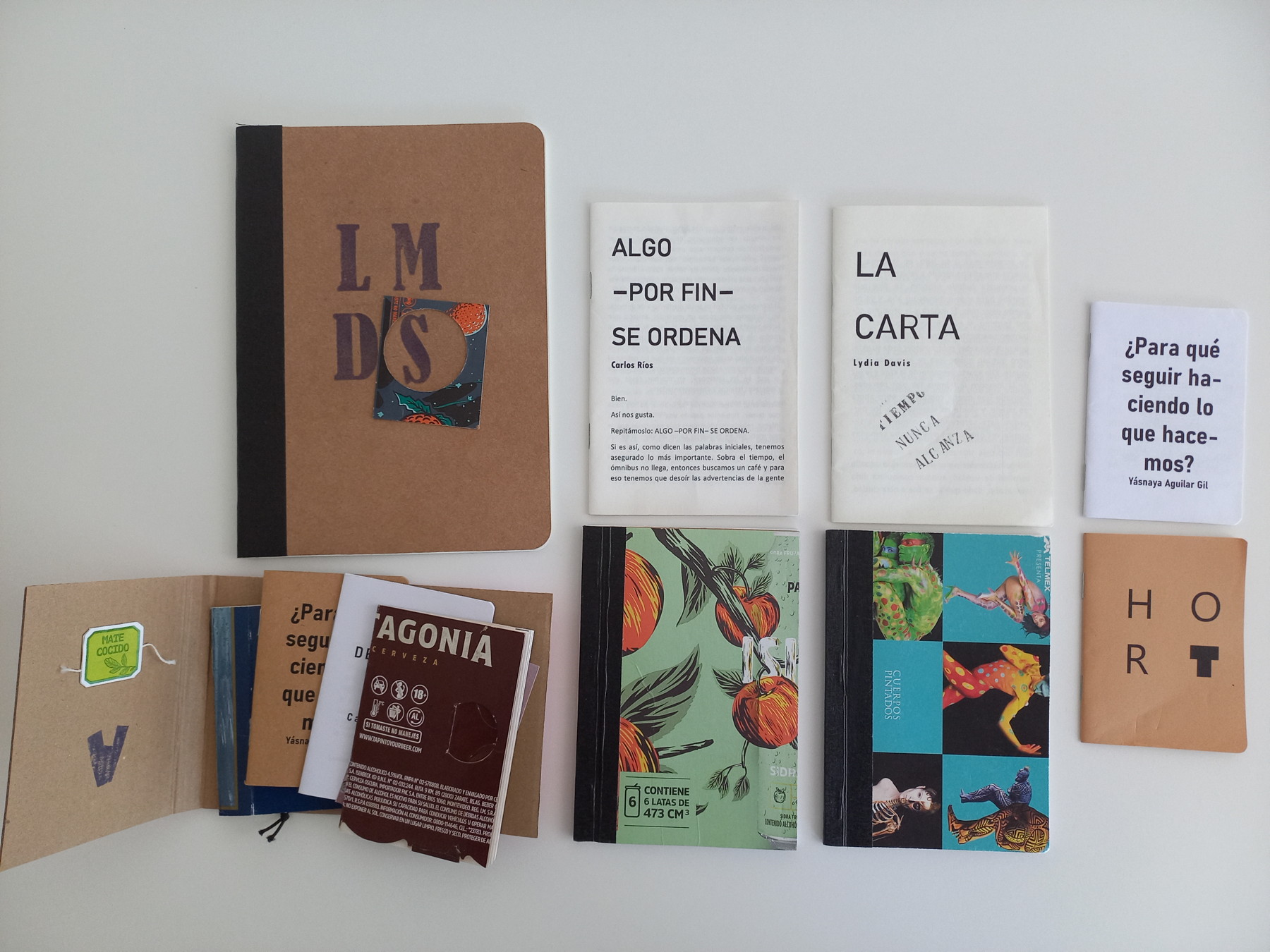
The publishing design protocol that shapes their visual identity is deliberately indeterminate: there is no logo, no consistent typography, and neither the title nor the author’s name appears on the cover. What we see instead is a fragment of recycled cardboard. Only upon opening Beginning of page[p. 454] the book does its condition as a publication become legible, revealing its belonging to the publishing project ‘Oficina Perambulante’. The name animates these objects: without a spine, they seem destined to circulate — too light to remain fixed — moving between towns in the province of Buenos Aires, always near other books yet never settling on a shelf. Beginning of page[p. 455]
They are destined to perambulate — the term evokes walking without a fixed destination, without a revealed purpose, and, in a certain sense, becoming lost in the very act of moving. The first published title is Poéticas, by Carlos Ríos, writer and publisher of the project. This is not Ríos’s first engagement with publishing: by 2016, he had already released more than ten titles across Argentina, France, Spain, Brazil, Chile, Uruguay, and Mexico, in more conventional book formats.1
Since then, Ríos has redefined the formats of Oficina Perambulante publications on multiple occasions. One element, however, has remained consistent since 2016: the use of cardboard as a graphic and linguistic semiotic device. It functions not merely as support or cover but enters the book as visual rhetoric in transformation. When scanned or photocopied, it becomes a template for the blank page, or a raw material for new compositions that replicate its texture and aesthetic in another medium.
As of 2026, Oficina Perambulante has published more than five hundred titles, including books by Ríos himself as well as by well-known authors and emerging and first-time writers, alongside non-authorial and pseudonymous texts, rewritings, and assembled works.
2019
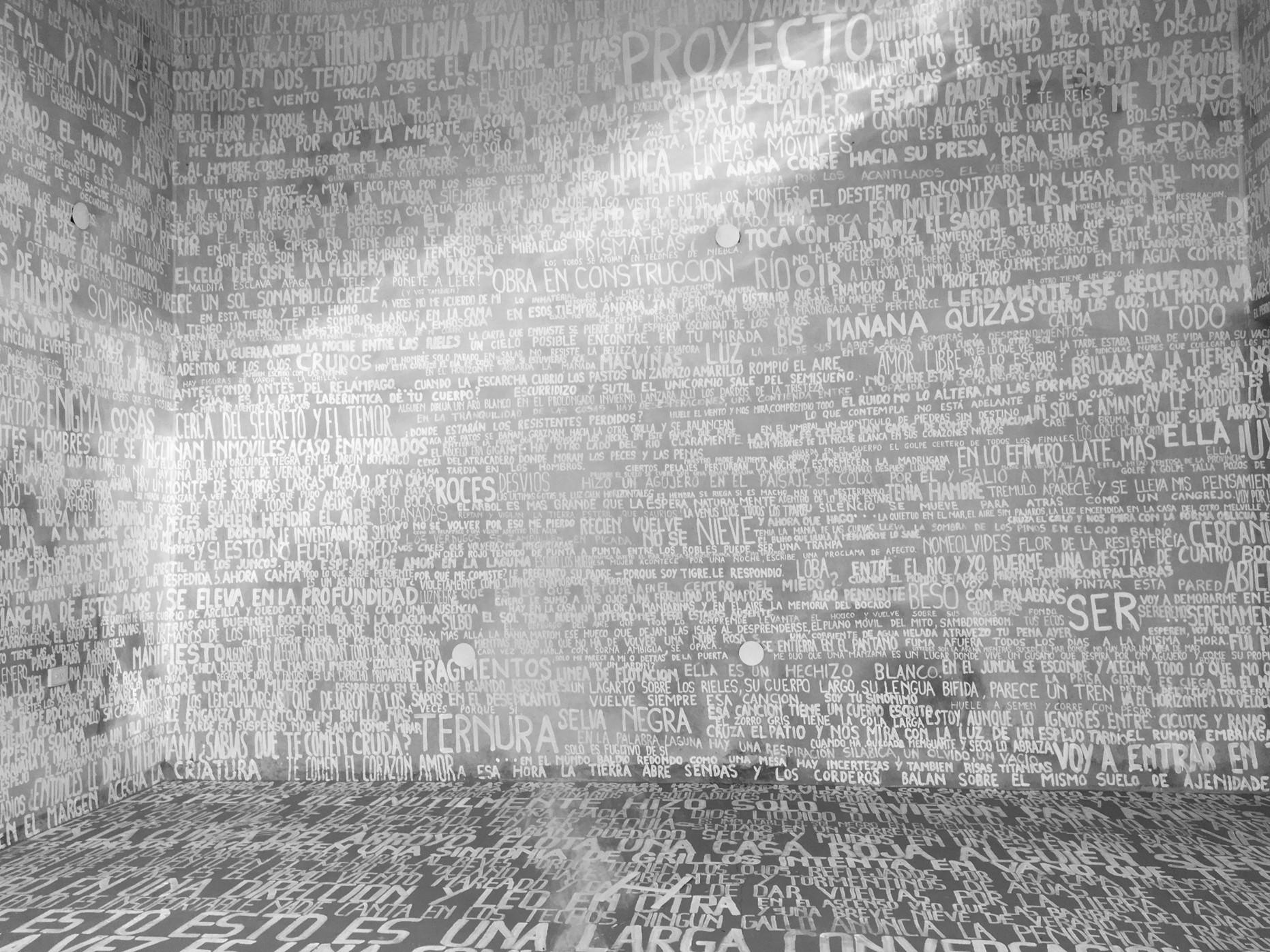
In a space measuring five by six metres and six metres in height, with unpainted grey cement walls, the Argentine artist, poet, and publisher Andrea Iriart writes, with a brush and white latex, one line per day: one line per day distributed across the walls in a clockwise direction; one line per day drawn from old notebooks where texts and poems are kept, only to be torn apart and recomposed as lines; one line per day that interrupts the previous notebook-writing in order to compose — over the years this work has been unfolding — new poems that overlay and mutate through their encounter with subsequent lines; one line per day oriented towards a limit-condition of writing: achieving an unbroken white through letters; one line per day in which writing ascends and meaning disperses at the edges of the letters, as Iriart balances painting Beginning of page[p. 456] while climbing a ladder: ‘I look at my hands as I write on a large scale, and at times I see them as independent of me, as if each word detached itself from the body and set out on a journey of its own,’ Iriart writes.2
The studio space is located in the Altos de San Lorenzo neighbourhood of La Plata. The work, titled Líneas Móviles (Figure 2), is Beginning of page[p. 457] conceived as a form of publication, as a reflection on publishing procedures, and as an inquiry into the time of writing and the time of publishing. Each week, the space opens to visitors, activating instances of reading as well as reading performances, dance, and light installations. Iriart also works at other sites, extending the same procedure onto different walls.
A book with the same title, Líneas Móviles, published in 2024 by Bruma Editorial, is neither a collection of the notebooks nor a facsimile of the walls, but an essay about the place of the body in the writing process, offering glimpses of a work that is still ongoing.
2023
A group of people gather around a table to overprint the pages of hundreds of books laid out before them with A5-sized stamps (Figure 3). Through an open call, members of the public were invited to send books that had been printed and distributed but never read: surplus copies abandoned in boxes or warehouses, awaiting entry into the reading circuit or else destined for destruction. Engraved on the stamp is a matrix composed of pages from the booklet La Biblioteca Negra. La edición como práctica forense (The Black Library: Editing as Forensic Practice), written by Gabriela Halac and published in the ‘Laboratorio’ series of her press, Ediciones DocumentA/Escénicas.
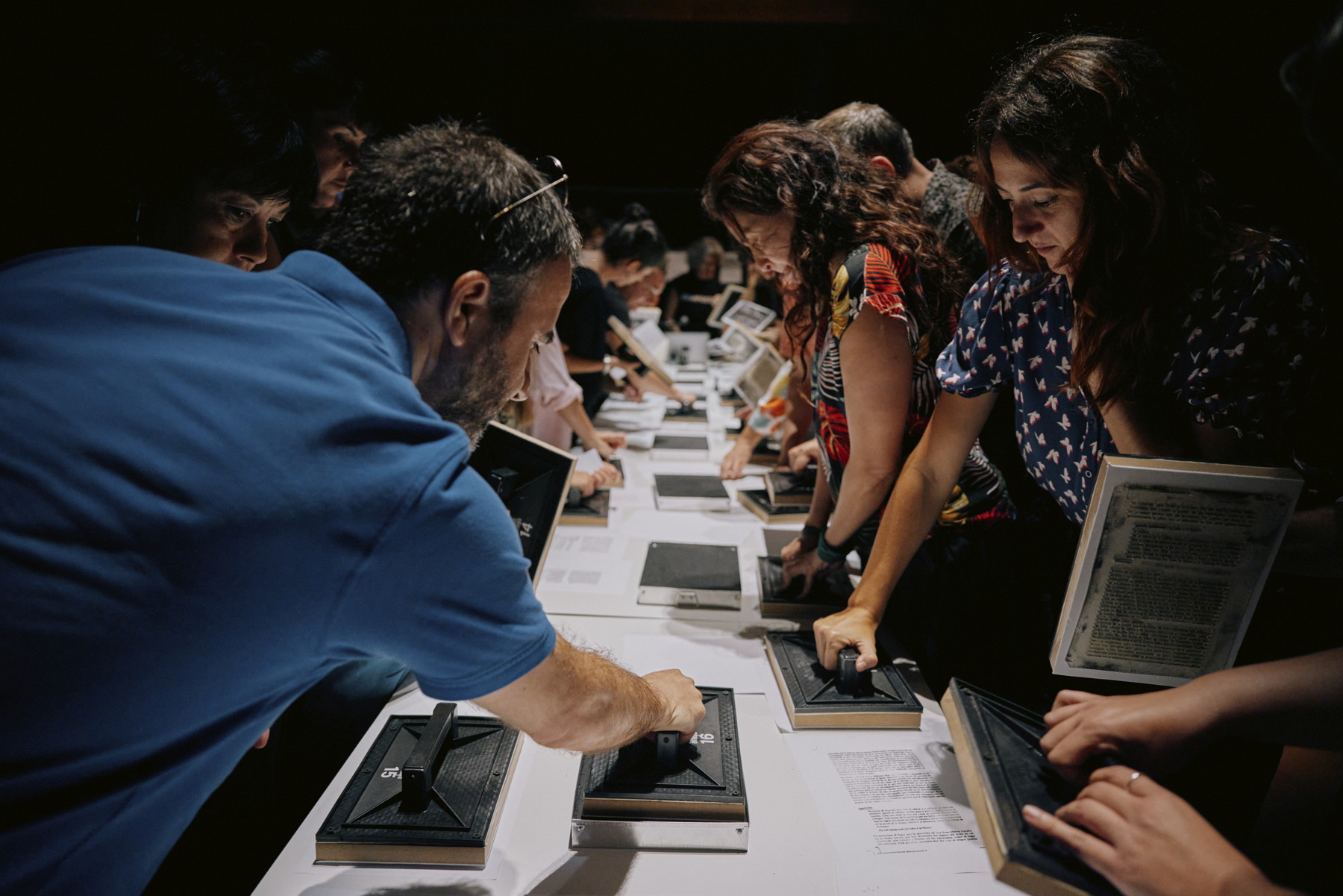
In this essay, the author reflects on the condition of the contemporary publishing industry by attending to the role of matter and bodies in the production of books. In contrast to the connotations of the ‘blank page’ — ‘a territory historically conquered by a white writer with guarantees of power and recognition’3 — the ‘black pages’ of this edition, conceived as a palimpsest, allude to concealed and denied existences, bearing the marks of time, inequality, and precarious conditions of production. Beginning of page[p. 458]
Books overprinted with stamps of La Biblioteca Negra undergo a shift in legibility: from writing destined for disposal to illegible writing, or to writing that becomes legible only through the superimposition of another mark, ink, or textual layer.
This performative editorial intervention took place across various institutions in Spain and Mexico between 2022 and 2025 and was coordinated by Gabriela Halac and Lluc Mayol.4 The stamped books Beginning of page[p. 459] contributed to the formation of a Black Library that seeks to infiltrate and disrupt cataloguing systems.
The differences between these three scenes are striking, as they highlight distinct aspects of the notion of ‘publication’. The small format and use of recycled cardboard contrast with the enlarged and expanded writing on the wall. The nature of the texts printed on the collected cardboard — public and anonymous — seems almost at odds with the authorial effect produced by Andrea Iriart’s writing. At the same time, although the performativity of the book as an actant bearing traces of its conditions and materials of production is evident both in La Biblioteca Negra and in Oficina Perambulante’s use of cardboard, the gestures surrounding the notion of legibility foreground different concerns.
Despite this diversity, the three cases are characterized by two shared features also present in other contemporary publishing projects from Latin America:5 first, a notion of writing shaped by publishing procedures, which can be described as ‘editorial writing’; and second, an interplay between writing and editing based on operations of scalar expansion and reduction.
Within this outline, ‘scale’ implies at least three approaches: first, scale as a property of the book itself, attending to processes of mutation in measures, quantitative differences, and material divisions that affect the meaning of what a book is,6 and the relation between writing and its conditions of legibility; second, scale as a mode of observation, in which changes in the resolution at which objects are observed not only transform the objects themselves but also produce meaningful Beginning of page[p. 460] disjunctions;7 and third, scale as a dimension of production and excess, related to modes of production, visual excess, and loss of meaning, following Peter Szendy’s notion of ‘general iconomy’,8 which extends Georges Bataille’s concept of ‘general economy’.9
This disjunction becomes visible when considering the relation between mass-scale publishing production and commercial writing printed on packaging. Within the logic of large-scale production, this writing may appear continuous with the regime of mass reproduction; however, once these cardboard packages are cut and reused as covers for books by Oficina Perambulante, the same commercial writing is not only reduced or miniaturized but also singularized, now bound to a specific literary-artistic text.
Further disjunctions in terms of resolution and meaning can be observed in Líneas Móviles, between publishing and meaning at the level of the text and at the level of the letter; and in the performances of La Biblioteca Negra, between what remains unread — an excess destined for disposal within the publishing process, where its connection to the conditions and materials of production is erased — and that which becomes illegible in a situated, contingent gesture.
From these three approaches to scale, we may observe how operations of expansion and reduction connect alterations in the nature of the book and of writing with ways of reading the conditions of publishing. Within this interaction, their status as editorial writing emerges — that is, as publishing objects that engage the conditions in which they circulate through their formal and material procedures. Beginning of page[p. 461]
Editorial Writings: Expansion and Reduction after Print Capitalism
The term ‘editorial writing’ operates on two convergent levels: on the one hand, it refers to the relation between writing and book formats; on the other, it addresses how formats, materialities, and procedures mobilized in editorial writing articulate a response to specific conditions of publishing production.
From the standpoint of the book, editorial writing designates a mode of writing shaped by the conditions of its publication, as well as publications in which writing and publishing are inextricably linked. Format, design, binding procedures, chosen materials, and printing methods are not external to the text but inseparable from experimentation with writing itself. In this sense, writing and publishing are not merely connected, but coextensive and meta-reflective.
In Líneas Móviles, for example, experimenting with writing involves moving between the notebook, the wall, and the book as three spaces of inscription. These spaces do not simply function as supports; rather, they actively shape what writing can become through the very procedure of producing a published text. Similarly, when Oficina Perambulante determines that a book is whatever fits on an A4 sheet, it intervenes not only in the notion of the book but also establishes constraints on writing itself. This coextensiveness further affects the semantic relationships that emerge within Oficina Perambulante, particularly between the commercial discourse of packaging — which replaces the editorial paratext of the cover — and the unexpected meanings generated through the interplay between its linguistic-graphic rhetoric and the published text.
Within this perspective, editorial writing invites a reconsideration of the inversion proposed by Roger Chartier in his well-known chiasmus, ‘the hand of the author and the spirit of the printer’.10 While Chartier interprets writing in terms of its artisanal dimension and printing in terms of thought, editorial writing extends this reflection to the broader field of publishing. From this standpoint, the book appears Beginning of page[p. 462] both as an object circulating across different markets and as a device capable of interpreting its own conditions of production.
Chartier’s formulation also allows us to identify significant precedents, over the past three centuries, in which writing processes are inseparable from editorial and publishing procedures. From Laurence Sterne’s Tristram Shandy (1759) to Stéphane Mallarmé’s conception of the page as an ocean through which words must navigate (Un coup de dés jamais n’abolira le hasard, 1897), and to Jack Kerouac’s continuous scroll of On the Road (1957), literary history reveals what Polish historian and literary scholar Katarzyna Bazarnik has highlighted as ‘liberature’:11 an approach that foregrounds the intersections between art, book design, transcription processes, and text as constitutive elements of meaning. What distinguishes these examples from editorial writing, however, is the latter’s underlying engagement with the publishing ecosystem, rather than with the book as an isolated object.
In this sense, editorial writing entails a double shift. First, it transforms the notion of writing itself: a poetics of writing can no longer be confined to ‘style’ as an attribute of the author’s relation to language, but must also encompass what has been described as the ‘rhetoric of print’.12 Second, it situates this redefinition within a publishing discourse structured by two complementary modalities. On the one hand, the mutual implication of writing and editing shifts the focus away from authorial poetics towards the effects produced by artistic publishing projects as they situate themselves within series, networks, and broader discursive formations. On the other hand, editorial writing refers to publications in which the relation between writing and editing becomes an indirect, meta-reflexive means of rendering visible the Beginning of page[p. 463] publishing market, its regimes of production, circulation, consumption, and their inequalities.
‘Indirect’, in Roland Barthes’s sense of the term, describes the way in which art and literature can dramatize or perform — instead of thematize — some subtle or non-explicit aspects that can be reshaped from artistic procedures. In his view, literature transforms what science understands as knowledge into a dramatic discourse rather than an epistemological one. The indirect thus becomes the mode through which art ‘bridges the gap’ between science, which is ‘unrefined’, and life, which is ‘subtle’.13
From this perspective, Oficina Perambulante, Líneas Móviles, and La Biblioteca Negra may be understood as editorial practices whose procedures of expansion and reduction — across formats, writing styles, and materials — respond to conditions that exceed the individual publication. To understand what these practices intervene in, it is necessary to shift from the scale of individual projects to that of the publishing industry itself. More specifically, they respond to the enduring effects of what Benedict Anderson characterizes as ‘print capitalism’, understood as a process of linguistic standardization and capital accumulation.
In Imagined Communities, Anderson argues that the expansion of print after Gutenberg fostered both the commodification of ideas and the standardization of written language.14 Although he situates this process within the emergence of the nation-state, his account also provides a broader way of understanding how publishing has historically linked linguistic forms to economic organization.
Today, these dynamics operate under different conditions. Rather than national publishing systems, large-scale publishing is increasingly organized through transnational multimedia conglomerates. As José Luis de Diego has shown, a series of acquisitions between 1997 and Beginning of page[p. 464] 2012 culminated in the merger of Penguin and Random House under the Bertelsmann umbrella, consolidating an unprecedented concentration of publishing capital.15
One of the main consequences of this process has been the rapid standardization of publications and a growing tendency towards formal and editorial uniformity, whereby many works have come to be conceived according to criteria shaped by business logic and the demands of short-term profit.
The projects introduced in the three initial scenes emerged in Argentina, where the consequences of publishing concentration intersected, at the beginning of the twenty-first century, with the country’s broader economic, political, and social trajectories, culminating in the crisis of 2001.16 Extremely high levels of poverty, widespread job insecurity, and the instability of democratic institutions gave rise to a state of revolt and permanent assembly that also affected the ways in which books were produced. In this context, the constraints imposed by large publishing houses — concentrated in the hands of a small number of managers and governed by high-yield business models — converged with a social environment demanding a transformation of existing modes of production. As a result, alternative ways of conceiving the book began to emerge.17
Against this backdrop, the phenomenon of so-called ‘independent publishers’ emerged in Argentina after 2001. These initiatives were characterized by small-scale structures, close editor–author–reader relations, alternative modes of circulation, low-investment models, and unconventional aesthetic and political orientations.18Beginning of page[p. 465]
Over time, this phenomenon proved highly effective in reshaping the sector: what was considered small, marginal, and alternative around 2004–05 has since consolidated into a professionalized field. Today, a significant part of this sector accounts for a substantial share of bookshop sales, plays an active role in the international market for rights acquisition and exchange, and increasingly participates in decision-making processes within the publishing industry.
For example, the first Feria de Editores (Publishers’ Fair) was held at a community radio station in 2012, with around thirty publishers taking part. Today, that same fair has become the second most important in the region, bringing together over four hundred publishers from Argentina and Latin America, while also hosting a fellowship programme and professional conferences. This development points to a dynamism that continually reconfigures the relationships between centre and periphery, as well as between small- and medium-scale operations. As Annette Gilbert has noted in relation to art publications — often characterized as ‘small ventures’ — ‘there is no one mainstream’, and ‘one cannot speak of the small press as the alternative’.19
As an offshoot of the phenomenon that began in 2001, the past decade has witnessed the emergence of another publishing formation, encompassing what I refer to here as ‘editorial writings’. These projects have evolved in non-homogeneous and non-linear ways as part of this expanding scene, yet they cannot be fully defined by the logic of professionalization — or, at the very least, they maintain a critical relationship with that process of professionalization — nor are they fully defined by the concerns that shaped the early years of the twenty-first Beginning of page[p. 466] century. Rather, these artistic publishing practices — emerging alongside a sector that has developed a high degree of self-awareness over the past twenty-five years — derive their specificity from a relative condition of non-assimilation, which enables a meta-reflective engagement with the field itself.
The performance La Biblioteca Negra, specifically, engages with one of the consequences that has intensified within the highly concentrated landscape of industrial publishing: a dynamic of overproduction and destruction of books.20 An excess of books — books produced but not read, books that, within short purchase cycles, become waste, unstorable matter — is part of the system of print capitalism. While this is a particularly pronounced phenomenon in large-scale production, the inquiry into resources, materiality, and what it means for writing to be disposable concerns us — as a latent backdrop — in every publishing practice.
Viewed from this perspective, the processes of expansion and reduction that characterize these practices do not simply produce diversity in opposition to the standardization associated with large-scale publishing. Instead, they demonstrate that scale is never neutral in relation to writing. Within this outline, the interplay between expansion and reduction challenges narratives of linear growth and professionalization, foregrounding instead a constitutive disjunction: scalar alterations transform the object precisely by modifying the procedures through which it is produced.
‘Scalar alterations’, here, implies the above-mentioned two approaches to understanding how notions of the book and of writing are shaped by shifts in scale. The first considers the dynamic of the publishing market and the interplay between production models; the second scalar layer draws on ‘quantitative difference’ and measurement around a publishing work (whether it be a book as an object or a performance that embodies a publishing issue). According to Rachel Wells, what can be measured and the elements considered in processes Beginning of page[p. 467] of measuring consistently produce relations of lack or surplus with respect to meaning.21 This suggests that the composition of meaning is always, to some degree, dislocated from any stable anchoring point.
The way in which these literary and artistic publications intervene critically in the fields of conglomerated publishing and independent publishing, and in the dynamics of overproduction and destruction, should not be understood as thematic or topic-based, but rather as an indirect, formal mode of intervention. The objective is not to present new ideas about the book market at the present moment, but to consider how some apparently tiny, small, alternative, and non-market-based experimental publications can be understood as artistic responses to the ethical dimensions of materiality and bodily engagement in the experience of reading, and to a broader question concerning that market, namely: What does the manufactured life of books mean in the current publishing era?
Expansion and Reduction: (De)materialization a Century after ‘The Future of the Book’
In ‘The Future of the Book’, an essay-manifesto published by the German journal Gutenberg-Jahrbuch in 1927, the Soviet artist El Lissitzky outlined a political history of technical innovations in the fields of art and print, focusing on the excess of matter and on processes of what he called ‘dematerialization’. Like an arrow shot towards the future, his questions now fall upon one of the most sensitive and obscure aspects of large-scale publishing production: the dynamics of overproduction and destruction of books.
While Lissitzky was advancing a cultural thesis for the form of the book — according to which ‘alteration in the structure and mood of language implies a change in the usual appearance of the book’22 — he sought to articulate this with systems of reproduction. According to Lissitzky, ‘The idea moving the masses today is called materialism, but dematerialization is the characteristic of the epoch.’23 The example Beginning of page[p. 468] he gives is eloquent: ‘correspondence grows, so the number of letters, the quantity of writing paper, the mass of material consumed expand, until relieved by the telephone. Again, the network and material of supply grow until they are relieved by the radio.’ He concludes: ‘Matter diminishes, we dematerialize, sluggish masses of matter are replaced by liberated energy.’
Lissitzky’s thesis addressed the following question about the future of books: Where should innovations in printing be heading if we remain within the realm of the tangible and the manufactured? He described collotype as a form of dematerialization, for the way it uses photosensitive paper and photographic negatives to print text and images simultaneously. This, together with the development of the facsimile-electrotype, paved the way for photomontage. However, the latter innovation had different implications for American and Russian posters at the level of meaning. American posters, designed for rapid viewing from a passing motor car, were driven by a ‘new, optimistic mentality that laid stress on immediate events and the fleeting moment’.24 During the Revolutionary period, Russian designers and printers, by contrast, ‘ripped up the traditional book into single pages, magnified these a hundred times, printed them in colour and stuck them up as posters in the streets […] to be read and to enlighten from a short distance’.25
There are two aspects worth highlighting in Lissitzky’s political history of printing. The first concerns the interaction between procedures of printing and reproduction and the meanings that, within a political history, become a field of dispute — for example, in transformations of the space-time of reading, ranging from ‘rapid perception’ to ‘enlightenment from a short distance’.26 The other concerns the way in which, whenever there is a dynamic of an abundance of matter and a release of energy in the field of reproduction, we are confronted with a problem of scale in terms of disjunction and discontinuity,27 which in turn implies a transformation in the definition of objects. What we Beginning of page[p. 469] call ‘printed matter’, and its possible meanings, depends on the scale of matter and reproduction that shapes the object itself through the procedures it enables. ‘Matter that increases’ and ‘energy that is released’ are not external factors of the ‘appearance of the book’, to recall Lissitzky’s terms, but rather an inherent dynamic, intertwined with something as sensitive as the structure of language and the meanings implied in books as makers of culture.
Expansion and Reduction #1: La Biblioteca Negra and Excess in General Economy
In the future that Lissitzky envisioned for the book — as a process of dematerialization in its forms of reproducibility, and as variations in format that would capture changes in language — he also viewed technological advances as temptations towards innovation understood as replacement. Yet he did not anticipate another form of catastrophic literalness implicit in his own diagnosis: by remaining within the field of books as manufactured objects, the growing accumulation of matter — and its eventual diminishment — leads us to one of the most controversial and capitalistic practices in publishing: the management and disposal of excess.
Major publishing houses calibrate their print runs according to the shelf space they intend to command in bookstores. As such, the production pulse is set not by the audience but by square footage: a tactical play for market dominance, not only seeking to be seen, but also ensuring that others will not be.28 These books often remain unread, and are eventually discarded and pulped.29Beginning of page[p. 470]
In Book Waste Book, Terry McKenzie writes: ‘You would faint away in horror if you understood how the bookselling/publishing industry functions.’30 He refers to dumpsters containing books ‘that no one would ever buy’ as a problem related to space: ‘there is not enough room in the world to archive the sheer cubic tonnage that exists.’31 We face, then, two interconnected paradoxes. The first concerns space: the space occupied in bookshops becomes, later, a lack of space in storage. At the same time, this attempt to gain visibility through overprinting leads to another dimension of the same practice, revealing a second paradox in terms of costs. The individual cost of books decreases with larger print runs, and this is one of the reasons for increasing print runs — even when the primary intention is not to occupy space — yet the costs of circulation and stock storage rise accordingly.
What is clear is that the simultaneous overproduction and destruction of surplus books highlight an encompassing paradox between excess and biblioclasm: as book production grows, the same scale of production generates surpluses destined for destruction. The excess of books is not merely a consequence of this system, but rather a structural condition that organizes the inherent dynamics of the publishing market.
‘Destruction’ in the publishing industry and ‘dematerialization’ in the sense El Lissitzky used the term to describe processes of reproduction are, of course, not synonymous. Nonetheless, both engage with abundance and share a similar methodological perspective, revealing the extent to which upscaling and destruction are interdependent (increasing numbers of products and shorter cycles; increasing matter and released energy). This dynamic can be examined through Georges Bataille’s hypothesis on the functioning of general and restricted economies, which becomes helpful for grasping how editorial writings whose procedures focus on expansion and reduction, as experimental gestures in publishing, displace and transform this problem. They move from a surplus framed within a restricted economy towards an indirect response informed by a general economy, using scale as a metaphor to ironize fixed meanings and logics in the publishing world. Beginning of page[p. 471]
From a Bataillean perspective, expenditure is not an effect, but rather a cause; there is always a destruction of ‘the excess energy that cannot be used’, since starting from ‘the radiation of the sun’, this initial expenditure of energy dispenses wealth ‘without any return’.32
‘General economy’ considers ‘nonproductive expenditures’,33 that is, matter and energy not reduced to the sense of utility, production, or reproduction.34 What Bataille calls ‘excess’ is not a matter of profit (which, in his terms, belongs to ‘the ends’), nor is it simply waste as an effect of ‘man’s activity’. Rather, ‘excess’ also names what exceeds the order of meaning itself. It points towards that which escapes definition, classification, and conceptualization. In this sense, general economy is inseparable from a ‘loss of meaning’,35 reminding us that beyond the ‘frock-coat’36 with which philosophical conceptualization seeks to clothe the world, there lies an excess that cannot be fully conceptualized, which Bataille calls ‘heterogeneous’. That said, excess entails a broader notion of energy: for Bataille, energy also encompasses language and meaning.
By contrast, ‘restricted economy’ refers to a ‘homogeneous realm’ that recognizes only what can be counted, measured, and rendered legible — what belongs to a productive result, production, or reproduction. General economy, however, is not a concept, nor a ‘place’ outside of restricted economy. Rather, it is a way of reading what restricted economy necessarily excludes: the excess that emerges within Beginning of page[p. 472] the dynamics of production and destruction, and that exceeds their immediately recognizable meaning.
Extending a Bataillean reading of excess to the economy of images, Peter Szendy analyses William Hogarth’s engraving The Battle of the Pictures and emphasizes that ‘expenditure’ — the consumption of wealth as a primary object of general economy — has nothing to do with the surplus produced within the restricted economy of capitalism.37 For Szendy, the engraving stages an iconomy (economy of images) from two entangled perspectives: on the one hand, the regulated circulation of images within a market; on the other, the uncontrolled proliferation of images that exceeds any system of valuation and containment.38 These are images that cannot be regulated or reintroduced into a chain of value. This tension between regulation and excess allows us to reconsider the limits of the image market and what escapes its logic.
The two perspectives that Szendy reads as restricted and general economy in Hogarth’s engraving can be reconsidered within the framework of the scales of printing, destruction, and interpretation in publishing procedures. The overproduction and mass destruction of books have a purpose: the reabsorption of that excess within the logic of production and the economy of the book (reduction of costs, profit in terms of visibility, and so on). In turn, publishing projects that experiment with editorial writings introduce a dislocation in the meaning and purpose of excess, resulting in other forms of multiplication of writing, destined to be lost in a different way — an ‘infinite multiplication’ of images of writing that can be thought in relation to a general economy, alongside other images and their meanings. The use of cardboard and inexpensive, easily reproducible literary forms in Oficina Perambulante, the way in which La Biblioteca Negra affirms the negation of readable conditions in discarded books, and the infinite possibilities of combination and recombination of writing in Líneas Móviles — these three initial scenes enact this displacement. Beginning of page[p. 473]
There is another point that intersects Bataille’s reflections on abundance with the current destruction in the publishing world. For Bataille, even when human activity is directed towards the exploitation of resources and productive ends, an irreducible element of futility remains — an expenditure of energy without return — which follows its own laws and dynamics. The problem, Bataille insists, is how unacquainted humanity remains with the force of this ‘movement’.39 Human action, however, must reckon with both terms: with productive ends and the useless and infinite fulfilment of the universe. Conversely, the attempt to transform every excess into something profitable —into a new end, a new meaning, the success of production — leads to what Bataille describes as the catastrophic reversal of our works. 40
These concerns of excess and catastrophe are in play in the performance La Biblioteca Negra (2022–25). The exercise of ‘blackening’ surplus publications (a procedure Gabriela Halac names nigromantia) consists in entirely erasing the legibility of these discarded books. The books were previously destined for destruction, not due to coercion or censorship, but as part of a publishing plan. There is no compensation here, but rather the articulation of a gesture that affirms what the publishing industry denies. Yet that very gesture of affirmation alters the relation to the meaning of the legible and enacts a relation to the loss of meaning by foregrounding the excess of those writings destined for loss.
These new black books are infiltrating public and private libraries. In this way, La Biblioteca Negra reacts to Lissitzky’s earlier vision of the future by focusing on another form of material excess. Detached from the logic of what ‘yields profit’, these doubly useless books (discarded by the publishing system and covered with ink) are able to reveal the marks of that very logic.41Beginning of page[p. 474]
Rather than affirming a blank page gradually filled with writing, blackening redirects attention from the written page to the material conditions of book production, making apparent what Halac suggests is one of the least visible practices through which appropriation and precarization take shape: the so-called ‘printing ships’ — vessels operating in international waters, where books are produced at half the cost, yet where almost nothing is known about the labour conditions under which they are made.
There are no photographs of these printing ships, although publishers and workers have testified that such services have been offered during parties held at international book fairs. As with the overproduction of books intended simply to occupy shelf space — being ‘present not only to be seen but also to prevent others from having the same opportunity’ — their invisibility is not accidental. Concealing the relations of production is part of the very logic that sustains them.42
Blackening therefore points simultaneously to the surplus book and to its material background: the modes of production, forms of labour, and economies of extraction that remain largely invisible in the finished object. As Halac remarks, ‘The question we often fail to ask ourselves is: where does [book matter] come from?’43 The ‘future of books’, she insists, depends on an ‘ethics of matter’, understood as the network of relations between energy, material resources, and modes of production: ‘It is therefore urgent to talk about books as entities that, in their creation and assemblage, deploy energies that affect and transform the world, involving politics, ethics and aesthetics.’44Beginning of page[p. 475]
Expansion and Reduction #2: Small Inscriptional Surfaces / Infinite Writing in Oficina Perambulante
The use of cardboard to produce affordable books in the Oficina Perambulante project is often seen as a response to sustainability challenges in publishing. While this perspective is not inaccurate, it is worth clarifying the nature of this response. The use of cardboard is not merely a substitute for industrial or handcrafted covers; rather, it constitutes a visual and semiotic rhetoric that makes possible material experimentation, thereby opening a space to interrogate the economics of writing and the circulation of meaning.
‘We might envisage cardboard books as the flip side of the publishing industry: its rough draft, its imperfect copy, a phenomenon of distortion,’ writes Carlos Ríos in the essay Ecosistema del libro cartonero,45 which has been published several times across various small-scale projects and translations.46 This statement highlights one of the aspects on account of which I am basing my characterization of these artistic publishing projects as an offshoot of a broader phenomenon: the opposition is not between industrial and artisanal cardboard, but rather a way of exploring reverse sides and folds, and a mode of interpreting the system within which they circulate. Thus, the use of cardboard does not simply propose an alternative mode of production; it provides another way of reading the publishing system.
In a sense, Ríos’s description of the cartonero book as a draft of the industrial publishing system implies a relation of inclusivity between the two: an inclusivity marked by overlaps, zones of opacity, and forms of negation that the finished book suppresses by concealing the traces of its conditions of production and circulation. This duplicitous and distorted condition places these writings in a supplementary relation to industrial publishing, as an unpredictable surplus that circulates within the book market.
Emerging from this backdrop of surpluses — referring both to discarded material and to supplementary meanings — processes of Beginning of page[p. 476] expansion and reduction articulate different scales from which the Oficina Perambulante intervenes in the publishing landscape. Firstly, a disjunction occurs at the level of meaning when elements of the mass production of consumer goods are introduced into small-format books. On the one hand, this dislocates the idea of the book as an object that conveys knowledge as the ‘author’s spirit’: ‘[cardboards] add a graphic memory not only of the industrial products they transported but also preserve design marks, a series of printing codes that produce unexpected meanings on the surfaces of the books.’47 On the other hand, it renders each book unique: ‘the same title, once intervened upon, can never be an identical book.’48 The overabundance of printed material — as waste from consumption — combined with the scale of the small format produces, as a collision between different scales, a disarticulation between the unique and the mass-produced: each book, unique, forms part of a continuum between editorial discourse and the discourse of commercial packaging.
Secondly, we need to reconsider the relationship between the abundance of printed material and the reduction in the size of books. This involves authors whose writings are cut back or selected to fit formats that can be published on A4 sheets, bound using recycled packaging, and produced either as A7 sewn booklets or as loose-leaf publications. Drawing on Ulises Carrión’s idea of ‘new writing’ — according to which the new writers make books rather than write texts49 — Carlos Ríos applies this to the problem of excess and waste, proposing, in response, the shrinkage of text to allow for minimal paper use.50Beginning of page[p. 477]
Ulises Carrión’s idea has been further developed at the intersection of publishing and artistic practice, where the ‘production-then-reproduction’ formula — based on a strict division between the author’s creation of the text and the publisher’s subsequent production of the book — has been reconfigured as a model of ‘reproduction as production’.51 From this perspective, writing is no longer understood as a privileged process, but as one moment within the broader publishing procedure, in which ‘reproduction’ becomes part of the conscious process of artistic creation.52 Oficina Perambulante foregrounds the availability of reproduction resources, directing attention to the conditions through which a book is reproduced and, in turn, produced.
The use of cardboard also provides an opportunity to reflect on the scarcity of materials and the restricted access to traditional publishing supplies such as paper. This jarring relation between overabundance and scarcity, between the mass-produced and the unique, becomes particularly evident in one of Oficina Perambulante’s publications, titled Notes of a Former Novelist, in which the writing takes the form of a short story that reflects on its own material conditions.
This book also serves in part as an ars poetica of the publishing house, staging a tension between what it narrates and the material on which it is read. Its protagonist seems to be writing from Lissitzky’s future: ‘Why write a novel? There are no bookshops left in the country. Books are published to be destroyed.’53 There is no paper, and there Beginning of page[p. 478] is no time; what remains are definitions of novels, among them the definition of a ‘novel produced by AI through ChatGPT’.54
Despite this vision, the former novelist continues to write, but she re-scales both writing and the material of paper:
Below is written, as an example, a novel like those she wrote far away and some time ago. For reasons of space (and lack of paper, moreover), said novel is transcribed at a reduced scale. A final observation: where it says ‘little mice’ one could write ‘courtiers’, ‘academics’, or ‘the exploited’. Where it says ‘the dying woman’ one could write ‘star’, ‘constitutionalist’, or simply ‘novel’. There is licence to substitute, out of necessity or democratic whim, whatever.55
In this context, the constraints of space and time challenge the stability of meaning. Writing embodies the performative act as a paradox: it does not merely thematize limitation but enacts it — acting out the lack of paper, the restriction itself; yet, in doing so, it simultaneously multiplies that limitation and generates a potentially infinite writing. Is the novel written or transcribed? Summarized or expanded? Here, reduction becomes coextensive with the ways in which language proliferates through unceasing substitutions: where it says ‘little mice’, one may write ‘courtiers’, ‘academics’, or ‘the exploited’.
As the paper shrinks, what appears to be reduced is the level of the syntagm and the progression of the novel; yet, in fact, substitution becomes infinite, now detached from its material medium of inscription. The question arises: Which paper is lacking? Does it refer to the ex-novelist’s notes, or to the very text we are reading? The text recounts that novel, but at the same time, it also writes it.
The book thus becomes a performance of the relationship between matter and dematerialization, surplus and destruction. There is a dematerialization, in the sense in which Lucy Lippard rereads Lissitzky from within ‘conceptual art’, where to dematerialize means that ‘material form [becomes] secondary, lightweight, ephemeral, cheap, Beginning of page[p. 479] unpretentious’.56 Writing becomes ephemeral, interchangeable, produced upon a condition of scarcity and reduction that we can experience in our hands.
Nevertheless, just as dematerializing — releasing energy, as Lissitzky proposed — means bringing into the book all those graphic memories already circulating in the world, treating material as something lighter and more ephemeral, it also entails an encounter with a certain general economy of images, insofar as this likewise activates a relation to excess, to images that appear infinite and inexhaustible. All that graphic memory contained in printed and discarded materials, and which forms part of an ‘expenditure regulated’ by the market (a restricted economy), shifts towards a sense of general economy, where writing and image are destined to be lost in another way, in an infinite multiplication that cannot be regulated because it is oriented towards misencounter.
Lack (the scarcity of paper) produces excess (self-generative writing), which defines a particular relation to loss: the loss of meaning and of the possibility of reabsorbing excess into a new logic of production. Against the excess of production that drives matter towards its disposal, Oficina Perambulante does not oppose the unique and singular book, but rather, at a certain point, the unarchivable book within that infinite multiplication of reproduced images — the book that can affirm this excess condition of production by placing it in relation to its own object: writing. A writing also destined to be lost. Paradoxically, once again, as Ríos states, ‘This condition of mutability largely determines its potential influence within the future of the publishing ecosystem.’57
Expansion and Reduction #3: Líneas Móviles: Spatio-temporal Scales of Writing
‘In the minuscule existence of a letter lies vertigo,’ we read on the cover of the printed book Líneas Móviles.58 This inscription presents us with two paradoxes. The first arises from the cover where this sentence Beginning of page[p. 480] is written, the cover of the printed book Líneas Móviles, which was published in 2024, five years after the beginning of the project, with the clear decision to render neither the texts from the notebooks nor an updated state of the walls in published form. The book explores fragments of this white writing on grey walls, and fragments of the body writing this writing; it explores traces of different materials employed around this painted writing. The cover is part of these fragments, but to read about that minuscule existence we must unfold this cover, which takes the form of a life-size poster. There is also another layer of the paradox of measure: How does ‘vertigo’ — an amplified feeling — lie in the smallest unit of the discrete system of our alphabet, which is by definition unmeaningful and only a sign?
‘The work is about the world and the form of publishing,’ says Andrea Iriart, speaking about the body in writing.59 Líneas Móviles also deals with accounts and possible measures of publication — measures that revisit some of the obsessions of publishing in terms of scale: temporality and space as material procedures meaningfully involved as much in the process as in the outcome of publication.
As mentioned in the opening scene, Líneas Móviles works with alterations in the scale of the writing-object. One line per day is written on a wall, breaking the linearity of a text in notebooks while expanding the scale of letters and opening multiple possible readings. That said, scalar alterations should be considered in numerous directions, since they are not only a matter of the ‘scaling of objects’ as ‘an operation performed externally onto objects’, nor exclusively of changes in levels of observation, according to the different approaches to the notion of scale proposed by Joshua DiCaglio.60 Rather, these alterations also result from fragmentations that call into question the progressive correspondence between letter, phrase, text, book, and what we understand as levels of legibility. If we must describe the resolution at which we consider the spatial and temporal dimensions of writing, we need to assess which quantitative differences are involved in what is measurable as a division. Beginning of page[p. 481]
To clarify these shifts, it is possible to deploy a series of editorial statements implicit in Líneas Móviles that engage the spatio-temporal scales of writing and blank space within an economy of writing.
Statement 1: To publish is to alter the time between the writing procedure and the editorial result. We usually speak of procedures — writing and editing — but we almost always encounter the book as their outcome. What if the published book were the procedure itself? Líneas Móviles reverses the long period of private writing that is revealed to the reader’s eyes all at once in the printed book, placing public graphic inscription on the side of continuous, meticulous writing. It is neither a matter of turning these notebook texts into a book, nor of publishing a book with images of the walls, but of producing new fragments of the procedure.
Statement 2: Publishing alters the proportions between units and fragments. Iriart begins with her handwritten notebooks: a mass of writing in block letters, letters the size of a table — like everyone else’s. That magma of writing is reduced, in a single day, to the size of a line: the minimum unit. Yet the painting on the wall turns that grammatical reduction into an expansion of the signifier: the letter becomes five, six, seven, eleven times larger on the wall, and, depending on its height, becomes vertiginous. From the notebook to the wall is not a path that moves from the small to the enlarged; it is a volumetric process of transformation between the extensive and the minimal, between the tiny and the gigantic, between the minimal signifying unit and the open ambiguity of meaning.
In Variations on Writing, Barthes ventures that Western writing is marked by economic calculation.61 In manuscripts, handwritten letters and punctuation marks implied differences in payment, according to the time that the task of writing demanded of copyists. Cursive writing, for example, is more economical than printing because it involves lifting the pen from the surface fewer times; a full stop requires more time than a comma, and so on. Following Barthes, the title of a book on the economics of publishing in the West could have been What a Comma Costs. In the East, on the other hand, writing has been linked to drawing: the gesture of the artist and that of the writer are one and Beginning of page[p. 482] the same. The opposition is certainly somewhat clumsy and lacking in subtlety, but it introduces a way to think of inscriptional, economic, and publishing practices as differences in scales of temporality and space.
The work Líneas Móviles draws on this history while at the same time Iriart ties it to modern writing: emptiness, whiteness, volumes, narrative devices, the readymade. Taking writing as drawing and painting, Iriart makes her own white cube — a contemporary art fetish if ever there was one — driven by a gesture of reversal, inversion, and concavity, arguing that something like a white/blank page does not exist. Neither Kazimir Malevich’s white square on a white ground nor Tony Smith’s black cube, but a large cube-cave-book written from the inside in order to reach the white. In publishing, the blank is an asset (space) and a material that sustains the page. This power was part of the illusion of invisible design, like the crystal goblet imagined by Beatrice Warde: the best design is the one you do not see; the best page is the one that makes us forget that it informs rather than merely supports.62 White space is also the territory of the margin, which regulates the outskirts of the text — its progressions and jumps. But in Líneas Móviles this relationship is reversed: white space does not exist; it is the fiction of a letter.
White space as a desire reveals how the measurement of limits between the letter as a minimal unit, the sentence, the text, and the book is always entangled with a fiction of emptiness and fulfilled meaning — what Wells describes as a ‘superimposed division’ that presupposes an ideal uniformity representing a ‘whole’.63
Conclusions
If scale doesn’t presuppose objects but rather describes the resolution at which one observes the world, then the projects discussed here mobilize effects, materials, and practices associated with large-scale publishing and reintroduce them within smaller-scale operations as critical and ironic metaphors. Beginning of page[p. 483]
Given the catastrophic form that the dynamic between materiality and dematerialization has assumed since El Lissitzky put his question on the table, these editorial writings suggest that the future of the book lies in producing meaning through the disjunction of scales that such dynamics tend to naturalize. That is: not in achieving a synthesis, but in enacting this tension within the materiality of language itself — foregrounding a material dimension that both presupposes dematerialization as catastrophe and rearticulates it as form.
In Oficina Perambulante, this scalar perspective operates at the level of format, size, and measure, while also engaging the conditions of production. It interrogates the rhetorical dimension — visual and grammatical — of commercial printed matter, and its relation to abundance and excess, in contrast to what is structurally lacking in the publishing field: paper. In Líneas Móviles, scale emerges through temporality and spatiality: the time of writing and publishing, and the shifting space between notebook and wall, displacing the temporal experience of publication. La Biblioteca Negra, in turn, emphasizes scale through the intertwined dynamics of overproduction and destruction, exploring how writing can be reconfigured through the large-scale accumulation of discarded publishing matter, and how this reshapes the conditions of legibility.
These responses, discernible only through the indirect and meta-reflective intervention enacted by procedures of expansion, make legible certain meanings produced by contemporary models of publishing — meanings that these same models, in the very act of their production, tend to obscure or erase under the guise of productivity. Thus, it is perhaps only by attending to the gaps, discontinuities, and shifts in meaning between small-scale projects and the dynamics of large-scale publishing that interpretation can emerge, offering an encounter with the loss of meaning that a constrained economy cannot register.
Notes
- His novels Manigua and Cuaderno de Pripyat were published by Entropía Editorial during the flourishing of alternative publishing in Argentina between 2009 and 2012. ↵
- Andrea Iriart, Líneas Móviles (Bruma Editorial, 2024), p. 16. In the original: ‘Miro mis manos mientras escribo a gran escala y por momentos las veo independientes de mí, como si en cada palabra se desprendieran del cuerpo.’ ↵
- This quotation is from Gabriela Halac, Instrucciones para ennegrecer un libro (UNAM and Museo Universitario del Chopo, 2025), p. 13. However, a similar idea had already been outlined in her previous publication: Gabriela Halac, Páginas en negro. La edición como práctica forense (Ediciones de Laboratorio Documenta Escénicas, 2022), p. 10, with notes by Patricio Villarreal. ↵
- The project was launched in 2022 and has so far been implemented at various institutions: La Mutant: Espacio de Artes Vivas (Valencia); the Institute Valencià d’Art Modern (IVAM); the Library of the Faculty of Fine Arts, Complutense University of Madrid; La Caldera (Barcelona); Salamanca Public Library ‘Casa de las Conchas’; and Espai Nyamnyam (Mières, Girona). ↵
- It is important to note that the two features common to these scenes are not confined to them; rather, they unfold within the framework of broader artistic publishing projects and may be extended to others with similar characteristics — for example, Reunión, Industria Mínima, Esto es un Libro, Barba de Abejas, Tercera Persona, and N Direcciones. ↵
- A special relation between scale and meaning is articulated in Rachel Wells, Scale in Contemporary Sculpture: Enlargement, Miniaturisation and the Life-Size (Ashgate, 2013). Wells highlights that the experience of scaled objects exceeds the body’s experience, revealing ‘a memory standing outside the self and thus presenting both a surplus and lack of significance’. That said, the ‘experience of the object […] is saturated with meanings that will never be fully revealed to us’ (Susan Stewart, quoted in ibid., p. 16). ↵
- Joshua DiCaglio, Scale Theory: A Nondisciplinary Inquiry (University of Minnesota Press, 2021) defines scale as ‘a systematic accounting for significant shifts in a measured range of observation’, shifts that produce a ‘change in resolution’ (p. 51) — that is, a transformation in what becomes visible and what remains invisible through alterations of scale. As he further notes in ‘Scale Tricks and God Tricks, or The Power of Scale in Powers of Ten’, Configurations, 28.4 (2020), pp. 459–90 <https://doi.org/10.1353/con.2020.0021>, ‘This idea of resolution implies a significant element of scale: if shifts in scale produce a change in resolution, then there is a real disjuncture between scales, because changing scales changes what is able to be seen within an observation’ (p. 466). ↵
- Peter Szendy, For an Ecology of Images, trans. by Marco Roth (Verso, 2025). ↵
- See Georges Bataille, The Accursed Share: An Essay on General Economy, trans. by Robert Hurley, 3 vols (Zone Books, 1988–92), i: Consumption (1988). ↵
- See Roger Chartier, The Author’s Hand and the Printer’s Mind: Transformations of the Written Word in Early Modern Europe (Polity Press, 2014). ↵
- The Polish artist Zenon Fajfer and the literary scholar Katarzyna Bazarnik have coined the neologism ‘liberature’ to describe ‘literature in the form of a book’. This shifts the emphasis from the letter (lat. litera) to the book (lat. liber): ‘the material book, which can be of any shape and structure, ceases to be a neutral container for a text, but becomes an integral component of the literary work’ (Katarzyna Bazarnik, ‘Time for Liberature’, in Zenon Fajfer, Liberature or Total Literature: Collected Essays 1999–2009 (Halart, 2010), pp. 7–8). ↵
- See Michael Cahn, Der Druck des Wissens. Geschichte und Medium der wissenschaftlichen Publikation (Reichert, 1991), p. 52; and Magnus Wieland, ‘Sculpture Lecture: Reading Un coup de dés’, in Thirteen Years: The Materialization of Ideas from 2002 to 2015, ed. by Michalis Pichler, Annette Gilbert, and Clemens Krümmel (Spector Books, 2015), pp. 26–35. ↵
- Roland Barthes, ‘Lecture in Inauguration of the Chair of Literary Semiology, Collège de France, January 7, 1977’, trans. by Richard Howard, October, 8 (1979), pp. 3–16 <https://doi.org/10.2307/778222>. This understanding is complemented by T. S. Eliot’s formulation of the ‘objective correlative’, in which artistic experience likewise operates indirectly through a set of objects, a situation, a chain of events which shall be the formula of a particular emotion. ↵
- Benedict Anderson, Imagined Communities: Reflections on the Origin and Spread of Nationalism (Verso, 1991), p. 22. ↵
- José Luis de Diego, La otra cara de Jano. Una mirada crítica sobre el libro y la edición (Ampersand, 2015). De Diego’s analysis focuses on the Spanish publishing market; however, the mechanisms he identifies apply beyond national boundaries. ↵
- The Argentinian crisis of 2001 was also one of the peaks in publishing concentration in Argentina, marked by a series of sales and takeovers of small and medium-sized publishing houses by large conglomerates. ↵
- The convergence of these phenomena is examined in José Luis de Diego, Editores y políticas editoriales en Argentina (1880–2010) (Fondo de Cultura Económica, 2014); Daniela Szpilbarg, Cartografía de la edición mundializada. Modos de hacer y pensar el libro en el siglo XXI (Tren en Movimiento, 2019); and Iñaki Vázquez Álvarez, ‘La concentración editorial: una aproximación conceptual al fenómeno’, Trama & Texturas, 28 (2015), pp. 43–53. ↵
- See Ezequiel Saferstein and Daniela Szpilbarg, ‘El espacio editorial “independiente”: heterogeneidad, posicionamientos y debates: hacia una tipología de las editoriales en el período 1998–2010’, Primer coloquio Argentino de Estudios sobre el libro y la edición (31 October–2 November 2012, La Plata, Argentina) <http://www.memoria.fahce.unlp.edu.ar/trab_eventos/ev.1955/ev.1955.pdf> [accessed 11 July 2026]; Hernán López Winne and Víctor Malumian, Independientes, ¿de qué? Hablan los editores de América Latina (Fondo de Cultura Económica, 2016); and Magalí Rabasa, The Book in Movement: Autonomous Politics and the Lettered City Underground (University of Pittsburgh Press, 2019). ↵
- Annette Gilbert, ‘Publishing as Artistic Practice’, in Publishing as Artistic Practice, ed. by Annette Gilbert (Sternberg Press, 2016), pp. 6–39 (p. 16). She adds that ‘the field of publishing fragments into many diverse models and categories of publishing that operate on entirely divergent premises, business models, and forms of organization, as one can see in the differences between trade and academic publishing as well as the POD industry’ (ibid.). ↵
- See Kathleen Fitzpatrick, Planned Obsolescence: Publishing, Technology, and the Future of the Academy (New York University Press, 2011); Halac, Páginas en negro; Andrew Laties, Rebel Bookseller: How to Improvise Your Own Indie Store and Beat Back the Chains (Vox Pop, 2005); and Temporary Services, Book Waste Book (Half Letter Press, 2022). ↵
- See Wells, Scale in Contemporary Sculpture, p. 16. ↵
- El Lissitzky, ‘The Future of the Book’, in Publishing Manifestos: An International Anthology from Artists and Writers, ed. by Michalis Pichler (MIT Press and Miss Read, 2019), pp. 24–27. ↵
- Ibid., p. 25. ↵
- Ibid. ↵
- Ibid., p. 26. ↵
- Ibid. ↵
- DiCaglio refers to problems of ‘resolution’ as involving jumps and discontinuities, citing Timothy Clark, who argues that these ‘concepts of scale are not a smooth zooming in and out but involve jumps and discontinuities’ (DiCaglio, Scale Theory, p. 70). ↵
- Halac, Páginas en Negro, p. 6. ↵
- Two key questions that structure the publishing world are: How many copies of a new title should be printed to enter the market, and, subsequently, how many copies are sold? This focus leaves room for two other pressing questions: How many books are collected, how and why, and how many are destroyed? An estimated thirty to forty per cent of books are returned by bookstores annually. Between sixty-five and ninety-five per cent of returned books are pulped — destroyed by publishers. Information on this subject is deliberately scarce or unclear; details are provided by Laties in Rebel Bookseller; by Halac, based on her interviews with publishers and authors, in Páginas en Negro; and by Temporary Services in Book Waste Book. ↵
- Terry McKenzie, in Temporary Services, Book Waste Book, p. 30. ↵
- Ibid. ↵
- Bataille, The Accursed Share, i, pp. 20, 28. ↵
- Ibid., p. 12. ↵
- Ibid., pp. 19–22. ↵
- The expression ‘loss of meaning’ derives from Derrida’s discussion of Bataille’s notions of ‘general economy’ and ‘sovereignty’. In the chapter ‘Knowledge of Sovereignty’, Bataille presents general economy as the science of relating the object of thought to sovereign moments, which implies that general economy envisages the meaning of these objects in relation to each other and finally in relation to the unknown. Derrida further elaborates this relation as ‘the absolute loss of their meaning’, as the ‘nonmeaning which is beyond absolute meaning’ and as ‘expenditure without reserve’. See Jacques Derrida, ‘From Restricted to General Economy: A Hegelianism without Reserve’, in Derrida, Writing and Difference [1967], trans. by Alan Bass (Routledge Classics, 2001), pp. 317–50 (p. 339); and Bataille, ‘Knowledge of Sovereignty’, in The Accursed Share, iii: Sovereignty (1992), pp. 197–211. ↵
- Georges Bataille, ‘Formless’, in Bataille and others, Encyclopædia Acephalica, ed. by Robert Lebel and Isabelle Waldberg, trans. by Iain White and others (Atlas Press, 1995), pp. 51–52 (p. 52). ↵
- Szendy, For an Ecology of Images, pp. 45–51. ↵
- At the top left of the stairs, we see ‘the miniaturized figure of an auctioneer, so designated by his emblem, the hammer’. Except for this person, there are no buyers, no viewers; ‘there’s no one apart from the paintings themselves, bumping, tearing, and scrapping with each other in a kind of aerial arena’ (ibid., p. 44). ↵
- Bataille, The Accursed Share, i, p. 21. ↵
- ‘[i]f these two terms [ends and the movement that surpasses them] are to be reconciled we must cease to ignore one of them; otherwise, our works quickly turn to catastrophe’ (Ibid., p. 29). ↵
- Halac affirms that ‘black pages’ are a realm of apparitions and discoveries, of densities and existences denied and concealed beneath the surface. And if we are able to engage with this black condition, a situated awareness emerges of the books that bridge their present condition with their past existences. These black pages evoke those unnameable presences, the ‘literary blacks’ of which Vivian Abenshushan speaks in Permanente obra negra. The black pages disfigure their writing as a result of the exchange that has irreversibly affected the material, and give way to the abandonment of the Platonic abstraction of a text that constantly seeks to transcend a possible body. See Halac, La edición como práctica forense, p. 19. ↵
- Ibid., p. 7. ↵
- Halac, Instrucciones para ennegrecer un libro, p. 16. ↵
- Ibid., p. 17. ↵
- Carlos Ríos, Ecosistema del libro cartonero (Olga Cartonera, 2022), p. 7. ↵
- Olga Cartonera (Chile, 2022); La liebre dorada (Rennes/La Plata, 2022); Tóxicx (Chaco, 2023); Barba de Abejas (2025); Ediciones de la Provincia de Buenos Aires (2020). ↵
- Ríos, Ecosistema del libro cartonero, p. 8. ↵
- Ibid. ↵
- Ulises Carrión, ‘The New Art of Making Books’, Kontexts, 6–7 (1975), later included in Carrión, Second Thoughts (Void Distributors, 1980), p. 8. ↵
- Some of the books are compositions — sometimes in prose, sometimes in verse — based on extensive texts or interviews. One sign of this procedure is visible in the visual relationship between author and title, where the former seems subsumed by the latter. See, for example, Scaloni. Kilómetro Cero, in which Oficina Perambulante composes poems from statements made by the Argentine football team manager that became particularly famous following the 2022 World Cup; Sandro en persona, a new prose work composed from excerpts of a long television interview from 1984; Bad Bunny. No quiero empezar un disco con una canción triste; and La aventura salvaje de componer canciones (a couple of excerpts selected and translated from Faith, Hope and Carnage, 2022), where the name ‘Nick Cave’ simultaneously forms both image and title. Similar operations are carried out with authors as diverse as H. P. Lovecraft, Ursula K. Le Guin, Ailton Krenak, and Judith Butler. ↵
- Following Nick Thurston, Annette Gilbert explains that, within the model ‘production-then-reproduction’, the text production phase has ‘positive connotations arising from the emphasis on the originality of the author’, while the phase of ‘manufacturing and publishing books is viewed as a purely mechanical reproduction of a given text’. By contrast, the formula ‘reproduction-as-production’ increases the value of reproduction ‘as a creative act’ equal to writing, so that it loses its secondary character. This would in turn mean ‘that authors implicate the processes of reproduction in the conscious processes of artistic production’ (Gilbert, ‘Publishing as Artistic Practice’, p. 20). ↵
- Ibid., p. 20. ↵
- Carlos Ríos, Apuntes para una exnovelista (Oficina Perambulante, 2022), p. 2; translation by Nicolas Helm-Grovas. In the original: ‘¿Para qué escribir una novela? Tiene la certeza de que nadie va a comprarla, ni pedirla prestada a sus conocidos o reservarla en la biblioteca popular más próxima. En el país ya no existen librerías. Los libros se publican para ser destruidos. Sin embargo, la pregunta funciona de algún modo como un agente estabilizador que le permite, noche tras noche, avanzar en la escritura de tres a cinco páginas.’ ↵
- Ibid., p. 2. ↵
- Ibid., p. 12. ↵
- Lucy R. Lippard, ‘Escape Attempts’, in Six Years: The Dematerialization of the Art Object from 1966 to 1972, ed. by Lucy R. Lippard (University of California Press, 1997), pp. vii–xxii (p. vii). ↵
- Carlos Ríos, Ecosistema del libro cartonero, p. 12 ↵
- Andrea Iriart, Líneas Móviles. ↵
- Ibid., p. 11. ↵
- DiCaglio, ‘Scale Tricks and God Tricks’, p. 466. ↵
- Roland Barthes, Le Plaisir du texte [1973] (Seuil, 2000). ↵
- See Amaranth Borsuk, The Book (MIT Press, 2018). ↵
- Wells, Scale in Contemporary Sculpture, pp. 5–6. ↵
Bibliography
- , Imagined Communities: Reflections on the Origin and Spread of Nationalism (Verso, 1991)
- , ‘Lecture in Inauguration of the Chair of Literary Semiology, Collège de France, January 7, 1977’, trans. by Richard Howard, October, 8 (1979), pp. 3–16 <https://doi.org/10.2307/778222>
- Barthes, RolandLe Plaisir du texte [1973] (Seuil, 2000)
- , The Accursed Share: An Essay on General Economy, trans. by Robert Hurley, 3 vols (Zone Books, 1988–92)
- Bataille, Georges‘Formless’, in Georges Bataille and others, Encyclopædia Acephalica, ed. by Robert Lebel and Isabelle Waldberg, trans. by Iain White and others (Atlas Press, 1995), pp. 51–52
- , ‘Time for Liberature’, in Zenon Fajfer, Liberature or Total Literature: Collected Essays 1999–2009 (Halart, 2010), pp. 7–8
- , Der Druck des Wissens. Geschichte und Medium der wissenschaftlichen Publikation (Reichert, 1991)
- , Second Thoughts (Void Distributors, 1980)
- , The Author’s Hand and the Printer’s Mind: Transformations of the Written Word in Early Modern Europe (Polity Press, 2014)
- , Editores y políticas editoriales en Argentina (1880-2010) (Fondo de Cultura Económica, 2014)
- de Diego, José LuisLa otra cara de Jano. Una mirada crítica sobre el libro y la edición (Ampersand, 2015)
- , ‘From Restricted to General Economy: A Hegelianism without Reserve’, in Derrida, Writing and Difference [1967] , trans. by Alan Bass (Routledge Classics, 2001), pp. 317–50
- , Scale Theory: A Nondisciplinary Inquiry (University of Minnesota Press, 2021) <https://doi.org/10.5749/j.ctv22fqc19>
- DiCaglio, Joshua‘Scale Tricks and God Tricks, or The Power of Scale in Powers of Ten’, Configurations, 28.4 (2020), pp. 459–90 <https://doi.org/10.1353/con.2020.0021>
- , Planned Obsolescence: Publishing, Technology, and the Future of the Academy (New York University Press, 2011) <https://doi.org/10.18574/nyu/9780814728963.001.0001>
- Gilbert, Annette, ed., Publishing as Artistic Practice (Sternberg Press, 2016)
- , Instrucciones para ennegrecer un libro (UNAM and Museo Universitario del Chopo, 2025)
- Halac, GabrielaPáginas en negro. La edición como práctica forense (Ediciones de Laboratorio Documenta Escénicas, 2022) <https://doi.org/10.18272/posts.v8i8.2706>
- , Líneas Móviles (Bruma Editorial, 2024)
- , Rebel Bookseller: How to Improvise Your Own Indie Store and Beat Back the Chains (Vox Pop, 2005)
- , ‘Escape Attempts’, in Six Years: The Dematerialization of the Art Object from 1966 to 1972, ed. by Lucy R. Lippard (University of California Press, 1997), pp. vii–xxii
- , ‘The Future of the Book’, in Publishing Manifestos: An International Anthology from Artists and Writers, ed. by Michalis Pichler (MIT Press and Miss Read, 2019), pp. 24–27
- , , Independientes, ¿de qué? Hablan los editores de América Latina (Fondo de Cultura Económica, 2016)
- , The Book in Movement: Autonomous Politics and the Lettered City Underground (University of Pittsburgh Press, 2019) <https://doi.org/10.2307/j.ctvgs09wc>
- , Apuntes para una exnovelista (Oficina Perambulante, 2022)
- Ríos, CarlosEcosistema del libro cartonero (Olga Cartonera, 2022)
- , , ‘El espacio editorial “independiente”: heterogeneidad, posicionamientos y debates: hacia una tipología de las editoriales en el período 1998–2010’, Primer coloquio Argentino de Estudios sobre el libro y la edición (31 October–2 November 2012, La Plata, Argentina) <http://www.memoria.fahce.unlp.edu.ar/trab_eventos/ev.1955/ev.1955.pdf> [accessed 11 July 2026]
- Schraenen, Guy, ed., Ulises Carrión: We Have Won! Haven’t We? (Museum Fodor, 1992)
- , For an Ecology of Images, trans. by Marco Roth (Verso, 2025)
- , Cartografía de la edición mundializada. Modos de hacer y pensar el libro en el siglo XXI (Tren en Movimiento, 2019)
- , Book Waste Book (Half Letter Press, 2022)
- , ‘La concentración editorial: una aproximación conceptual al fenómeno’, Trama & Texturas, 28 (2015), pp. 43–53
- , Scale in Contemporary Sculpture: Enlargement, Miniaturisation and the Life-Size (Ashgate, 2013)
- , ‘Sculpture Lecture: Reading Un coup de dés’, in Thirteen Years: The Materialization of Ideas from 2002 to 2015, ed. by Michalis Pichler, Annette Gilbert, and Clemens Krümmel (Spector Books, 2015), pp. 26–35
© by the author(s)
Except for images or otherwise noted, this publication is licensed under a Creative Commons Attribution-ShareAlike 4.0 International License.© 2026 ICI Berlin Press