
Scale and World-OrdersAn Effort at Diplomacy between Prometheans and GaiansJosé Antonio Magalhães
Abstract
This essay distinguishes and mediates between two contemporary cosmopolitical tendencies (at once theoretical, political, and aesthetic) figured as conceptual characters with contrasting approaches to scale: Promethean engineers, who make and apply models, and Gaian bricoleurs, who give and follow examples. These are prima facie associated respectively with large scales/upscaling and small scales/nonscalability. Through their interface, scalarity is neither universalized nor rejected, but circumscribed to contingent world-orders.
Keywords: cosmopolitics; political ecology; nonscalability; accelerationism; neorationalism; Viveiros de Castro, Eduardo; Latour, Bruno
Introduction
In recent years, I have frequently found myself inhabiting, intellectually as well as politically, a tense middle ground between two tendencies in thought and practice that, despite their proximity with regard to some of their presuppositions and goals, seem to radically diverge in many ways. In this essay, I will seek to compare but also mediate between these two tendencies, with a special focus on their respective ways of worldmaking and, more specifically, their approaches to the question of scale.1 Both have multiple names, which overlap and differ to Beginning of page[p. 346] varying degrees in their reference and implications. The first group are called ‘moderns’, ‘humans’, ‘inhumans’, ‘accelerationists’, ‘neorationalists’, ‘Prometheans’, or ‘engineers’. The second go by such names as the ‘earthbound’, ‘Terrans’, ‘animists’, ‘decelerationists’, ‘perspectivists’, ‘Gaians’, or ‘bricoleurs’. These tendencies differ not only in their conceptual commitments, but also in their practical dependencies and ways of inhabiting the world. Each is associated not only with different thinkers and academic movements, but also with different political collectives, state and non-state actors, technical and ecological networks, and so on.
Such complex intellectual traditions and lived realities will be reduced, in this essay, to the conceptual characters of Promethean engineers and Gaian bricoleurs, which I will associate, drawing from Claude Lévi-Strauss and Eduardo Viveiros de Castro, with two modes of worldmaking: engineers work with models, while bricoleurs deal in examples.2 This reductive operation is employed not only to avoid unduly attributing positions to an indeterminate variety of thinkers and actors, but also because the problem at hand occupies a midway position between abstraction and concreteness in which conceptual characters — neither pure philosophical concepts, nor concrete political agents — seem especially adequate as thinking devices. In that sense, my methodological wager is to create a feedback loop between form and content in which the essay itself performs the mediation between abstract models and concrete examples that it thematizes. Beginning of page[p. 347]
Prima facie, Prometheans may be defined as those who rely on the society/nature distinction as an epistemic and practical framework. Through it, Prometheans know nature as a causally determinate system and manipulate it technically in order to achieve normative goals. In that sense, they rehabilitate Enlightenment ideals of reason and progress, affirming the potential of technological developments such as artificial intelligence, planetary governance, and geoengineering, as well as the importance of institutional imagination and large-scale intervention. Gaians, in turn, seek to distance themselves from the modern distinction between society and nature, instead weaving their worlds through ecological networks of reciprocal entanglement and dependence that cut across human and non-human world-orders. While both tendencies may be understood as inheriting from the speculative turn,3 and, therefore, as distancing themselves from the postmodern deconstruction of Western thought, they do so in diametrically opposed ways: Prometheans do so by rehabilitating Enlightenment ideals, while Gaians look outside of modernity — and even humanity — for examples of other ways of thinking and living together, focusing on non-modern metaphysics and more-than-human ecologies.4
The differentiation of conceptual characters (Prometheans/Gaians) and worldmaking techniques (models/examples) is not operated here for merely classificatory purposes. The goal, rather, is to investigate the possibility of mediating the intellectual and cosmopolitical conflict between the two sides, presenting them not as strictly opposed monads, but as tendencies within a spectrum that may be combined in different compositions. This diplomatic work of mediation is proposed as a consequence of the diagnosis that both tendencies not only offer positive contributions and convincing Beginning of page[p. 348] critiques of one another, but that, through those contributions and critiques, each tendency seems indeed to compensate for the other’s shortcomings. Furthermore, it responds to pressing contemporary conundrums, such as the tension between, on the one hand, the affirmation of the philosophico-political dignity of non-modern worldviews, and, on the other, the apparent importance of scientific models and technological transitions in the navigation of our catastrophic times.5 This is, therefore, not simply a contribution to an intellectual debate, but also to an ongoing process of multilateral geopolitical negotiations and wars between heterogeneous parties. It operates on what I consider to be the fundamental axiom of political ecology: that there is no point in searching for a single, general answer to the question ‘What is to be done?’, not because all doings are indifferent, but for a more nuanced and double reason. First, because all answers to this question can only be given from a situated perspective. Second, because a desirable world-order will never be one in which everybody is doing the same thing, but rather an ecology of practices in which the doings of different agents afford and compensate for each other.6
As a final introductory note, I would like to highlight that the conception of scale that I adopt in this chapter is what, in our discussions at the ICI Berlin, I have been humorously calling a ‘fundamentalism’ about the concept of scale. In contrast to much contemporary scale critique,7 which claims that scales are fluid, indeterminate, and so on, I claim there is no sense in speaking of scales unless a bidirectional line can be drawn in which each scale can be unambiguously determined as being above or below, larger or smaller than every other scale. With this Beginning of page[p. 349] I am not here taking a substantive (Promethean) position about the question of scales (that will be the subject of the chapter as a whole), but only establishing a definition of scale to be used throughout. I adopt this definition not to defend or reject scale, but to clarify what it is that Prometheans mobilize, that Gaians criticize, and so on. As will become clear throughout the piece, I do agree with scale critics that scales are contingent and context-dependent, and must be constructed. Yet, insofar as scales are called ‘scales’ in any meaningful sense, I maintain that they must conform to the requirements of linear nesting and sequentiality.
The Most Important Division
In 2013, Nick Srnicek and Alex Williams published a ‘Manifesto for an Accelerationist Politics’, arguing that the political left should abandon its suspicion of large-scale, long-term strategies and instead engage with rational abstraction, advanced technology, institutional innovation, and economic calculation. The manifesto responds to a conjuncture marked by multiple ‘coming apocalypses’, the ‘most significant’ of which is identified as the ‘breakdown of the planetary climatic system’,8 as well as to the condition of ‘capitalist realism’ diagnosed by Mark Fisher,9 and, crucially, to what the authors perceive as the dominance within contemporary left politics of what they term ‘folk politics’. This latter tendency is described as a ‘variant of neo-primitivist localism’, committed to the ‘flimsy and ephemeral “authenticity” of communal immediacy’.10 Against this background, Srnicek and Williams formulate the following division:
We believe the most important division in today’s Left is between those that hold to a folk politics of localism, direct action, and relentless horizontalism, and those that outline what must become called an accelerationist politics at ease with a modernity of abstraction, complexity, globality, and technology. The Beginning of page[p. 350] former remains content with establishing small and temporary spaces of non-capitalist social relations, eschewing the real problems entailed in facing foes which are intrinsically non-local, abstract, and rooted deep in our everyday infrastructure. The failure of such politics has been built-in from the very beginning. By contrast, an accelerationist politics seeks to preserve the gains of late capitalism while going further than its value system, governance structures, and mass pathologies will allow.11
In The Ends of the World, Déborah Danowski and Eduardo Viveiros de Castro cite the above passage. They agree with its diagnosis — ‘that is indeed the most important fracture in the “left” today’12 — but they position themselves on the opposite side of that divide. For them, it is not ‘folk politics’ that remains trapped in nostalgia but rather accelerationism itself:
It seems to us that it is precisely this ‘accelerationist politics’, explicitly inspired by the Eurocentric eschatology of Progress, that is nostalgic of a rationalist, imperialist, triumphalist past […], and [that] the persistence of its faith in the liberating virtues of automation and technical progress is only possible on the condition of a glaring blind spot bang in the middle of its futurological vision: the intrusion of Gaia, no less.13
What emerges from this reversal is a reciprocally recognized antagonism between two cosmopolitical orientations, each of which initially appears to correspond to a characteristic scale of action: small-scale localism on the one hand, large-scale globality on the other. Yet Danowski and Viveiros de Castro reframe this opposition. Rather than treating accelerationism and ‘folk politics’ as competing tendencies within a single political orientation (hence their scare quotes around ‘left’), they speak — drawing on Bruno Latour’s Facing Gaia lectures (also from 2013) — of a war between humans and Terrans, understood not merely as political positions but as different peoples, if not different Beginning of page[p. 351] species or assemblages of species.14 In their usage, humans are ‘the Moderns who believe it will be possible to go on living in the unified, indifferent Nature of the Holocene’.15 More expansively, they describe humans as
that race — originally North-Western, but increasingly less European and more Chinese, Indian, Brazilian — which twice denied the Earth: first by defining itself as technologically exempt from nature’s trials, then by defining itself as the only civilization to have escaped the closed (but dangerous and unpredictable) world of archaic animisms, the only one that opened itself up to the infinite (but saturated with imperturbable necessity) universe of inanimate matter.16
Such ‘humans’ may be equated with what Bruno Latour calls the ‘moderns’, or with what Philippe Descola calls ‘naturalists’. The moderns, for Latour, are the inhabitants of a world structured on the basis of the separation and connection between, on the one hand, human society as the plane of normativity and freedom (as produced by juridico-political institutions such as parliaments and courts), and, on the other, non-human nature as the domain of causality and determinacy (as produced by scientific institutions such as laboratories).17 Within Descola’s quadripartite typology of ontologies, naturalism names the cosmology in which interiority (or culture) is plural and discontinuous while physicality (or nature) is continuous and unified: a multiplicity of cultures unfolds against the background of a single, universal nature.18Beginning of page[p. 352]
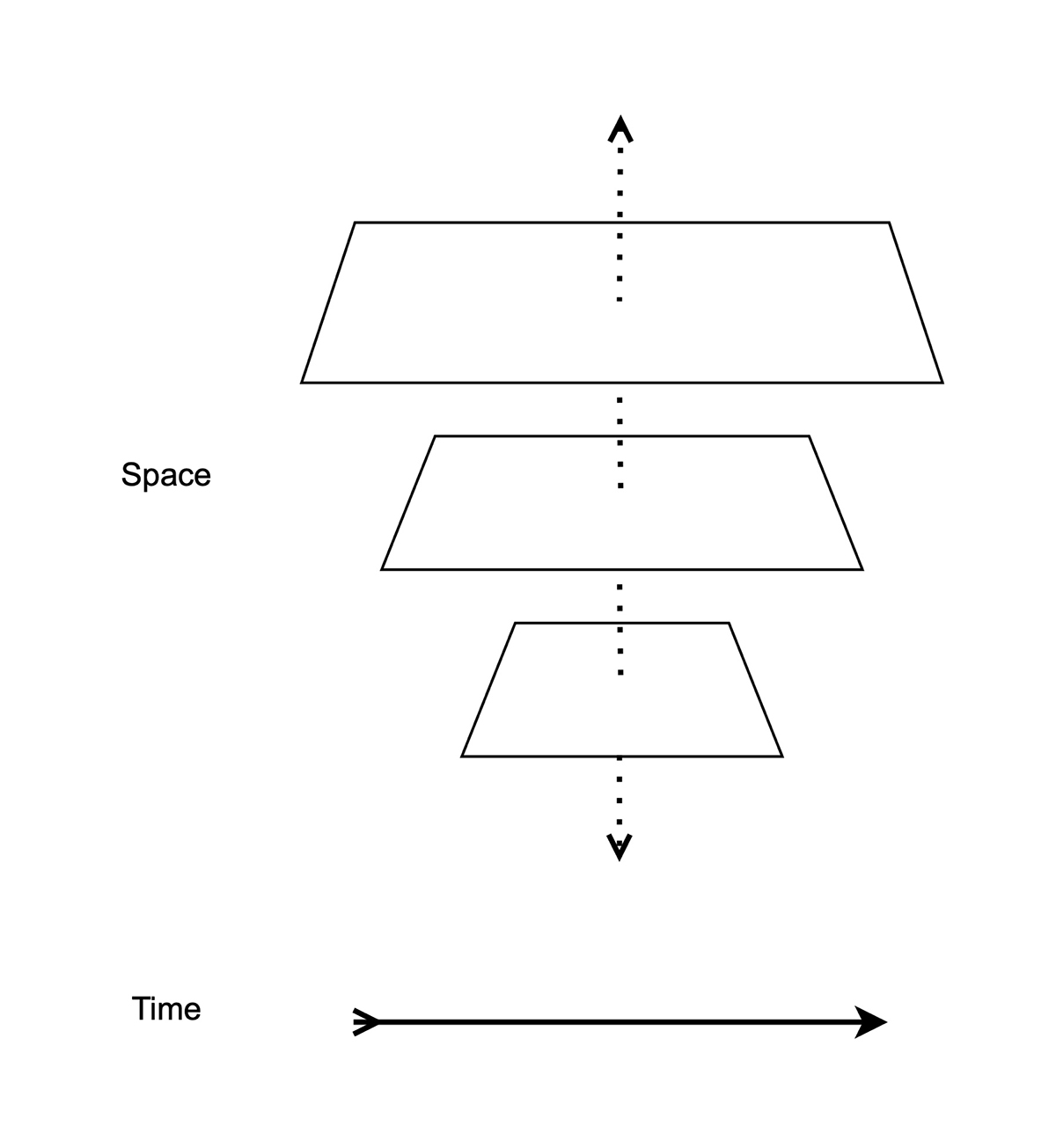
The world of humans, in the Gaian rendering,19 is thus defined by the spatiality of the globe (against the background of the universe) and the temporality of progress. The globe is a single, finite, mathematically defined object that can be known as such through science, and whose surface can therefore be neatly partitioned among different cultures, societies, or peoples. This globe exists within a universe that is itself assumed — on epistemic grounds — to be knowable as a coherent whole. The form of this potential knowledge is that of a vertically oriented scale-nesting in which the relative magnitudes and positions of all entities are in principle determinable from a unified perspective, as exemplified by the short film Powers of Ten.20 The time of humans is linear, progressive historical time, defined by the accumulation of knowledge of nature, the expansion of technical power, and the increase in freedom that is expected to follow from these (although not necessarily moral progress). Its central temporal figure is the future, understood as a projection from the present grounded on the predictability and controllability of nature, as well as on the expectation of the historical realization of freely posited human ends. Time scales, accordingly, are themselves nested and ultimately resolvable: as time is conceived as homogeneous and linear, every duration must be either longer or shorter than any other. For these reasons, Latour, Danowski, and Viveiros de Castro associate humans with the Holocene, an epoch in which the expectation of being able to predict and control nature remained tenable.21
Terrans — whom Latour admits he might have called ‘Gaian’, if the term was not, in his unexplained words, ‘too weird’22 — by contrast live in the time of the Anthropocene, or the time of catastrophes, and for that reason do not inhabit nature but rather the non-totalizable, deeply political network of diplomatic relations and reciprocal Beginning of page[p. 353] dependencies that Latour and Isabelle Stengers call ‘Gaia’.23 In this sense, Terrans tend to fall, in Descola’s scheme, within the quadrant of animism, later developed by Viveiros de Castro into the more tenable version he calls ‘perspectivism’.24 Diametrically opposed to naturalism, animism or perspectivism holds that culture or society is a single, Beginning of page[p. 354] continuous plane, while natures are discontinuous and multiple. For animists, non-humans such as jaguars are people from their own perspective; what differentiates them from humans — such that jaguars and humans do not see one another as people — is that they inhabit different natural worlds. The differences to be negotiated, therefore, do not concern culture but nature, and they are not resolved by appeal to science, but in political (juridical, diplomatic, military) terms. Terrans tend towards animism or perspectivism regardless of whether they are Indigenous or not, human or not, and so on; what matters is that they deal with the problem of composing worlds in juridico-political rather than technoscientific terms. The paradigmatic Terran, in this sense, is the shaman who, in perspectivist metaphysics, is not necessarily a member of the human species, since, on the one hand, shamans tend to be understood as species-ambiguous, and, on the other, non-human peoples are held to have their own shamans.25
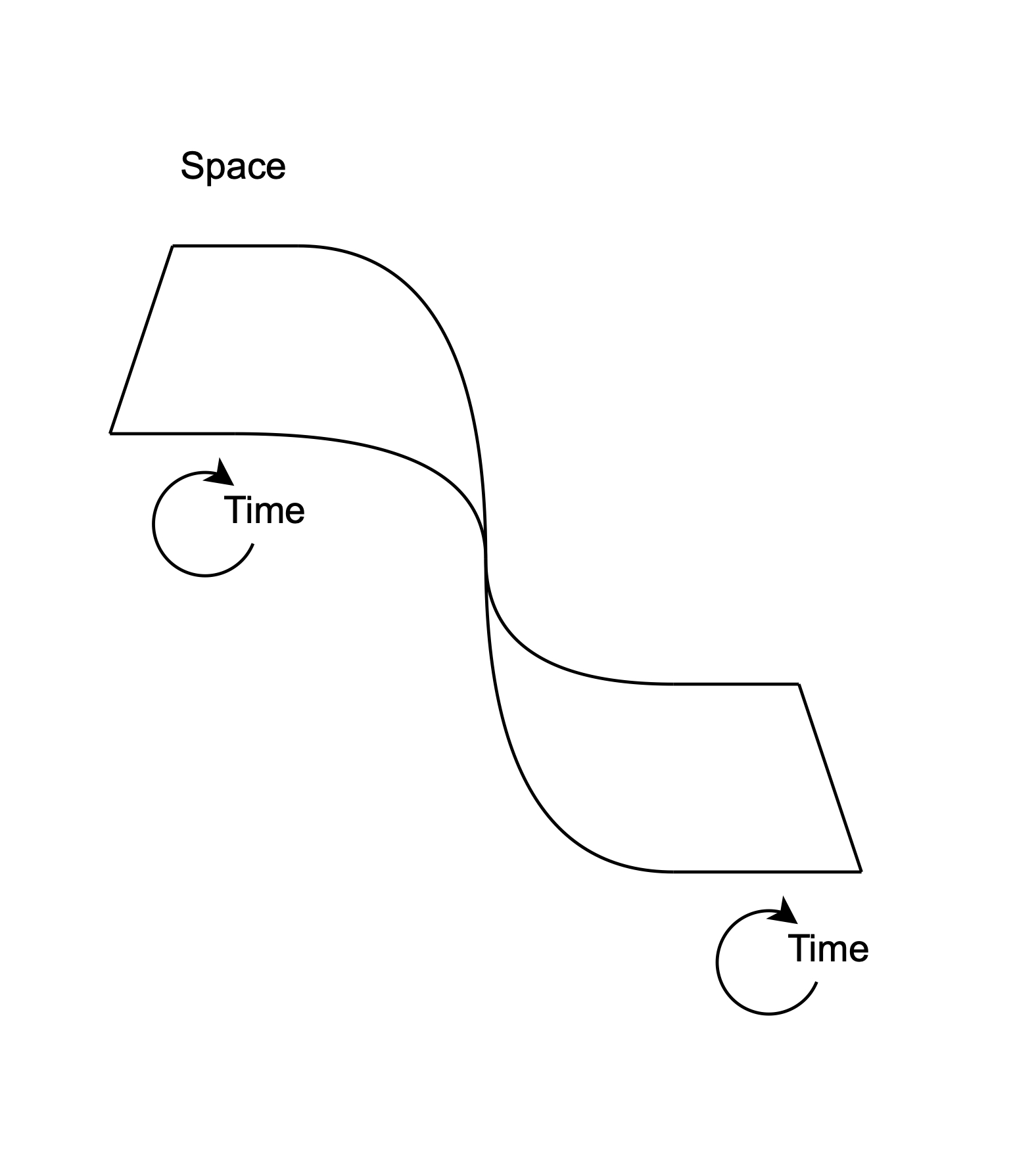
Terrans, or Gaians, therefore, do not have a common world in the strict sense that humans, by definition, do. Rather, they inhabit multiple worlds. Their spatial figure is not the globe or universe, but a multiversal spatiality (speaking of ‘the multiverse’ would seem contradictory), whose borders and transitions are continuously renegotiated in juridico-political terms. Consequently, they assume no scale-nested universe: when two different natural worlds are at play, there is no determinate spatial orientation that includes both, and therefore no determinate scalar relation — no vertical line across which each object must be bigger or smaller, above or below every other object. Gaian temporality, in turn, corresponds to mythical time, understood as involving the present and the past, but not the future. The past is not positioned linearly behind the present; it is rather an absolute past that, precisely because it lies outside linear history, can be reactivated at any moment through the appropriate procedures.26 In that sense, although Gaian peoples engage with extensive spatio-temporal figures within their respective worlds, their more fundamental spatio-temporality is intensive. From a Gaian perspective, time is no more scale-oriented than space. Indeed, at the intensive level of multiversal cosmopolitics, in which the Beginning of page[p. 355] limits and crossings between different worlds are negotiated, the very distinction between space and time may seem to break down.
An interesting, although not surprising, aspect of the mutually recognized rivalry between Prometheans and Gaians is that both sides, while offering a highly contemporary and richly detailed picture of themselves, fail to grant their adversaries the same luxury. Accelerationists update modernity for the posthuman era of advanced technology and climate catastrophe, giving it a shiny cyborg glaze, yet still depict ‘folk politics’ under an antiquated, all-too-human light. Gaian thinkers such as Latour, Danowski, and Viveiros de Castro offer a more Beginning of page[p. 356] compelling account of themselves, but their version of the humans/moderns, outlined above, is itself too naive and humanist to do justice to their Promethean adversaries, especially if we consider the elaborations of more philosophical Prometheans like Ray Brassier or Reza Negarestani. To produce a fair, balanced, and — most importantly — maximally useful diagram of the differences and potential interfaces between these two collectives, I seek to adopt here the strongest picture I can construct of each side. For that reason, I speak primarily of Gaians versus Prometheans, alluding to Brassier’s defense of Prometheanism, and, rather than opposing Terrans to humans (the standard, naive position described a few paragraphs above), I prefer to speak of ‘inhumans’ in Negarestani’s sense.27
In ‘The Labor of the Inhuman’, Negarestani advances a conception of the human not as a substance or essence, but as a self-reforming network of norm-bound practices and commitments. Because of its purely functional character, this system would be virtually capable of transmigrating onto material infrastructures entirely different from those that currently implement it, including Homo sapiens.28 Furthermore, inhumans in Negarestani’s sense, like Brassierian Prometheans, do not simply assume the human/nature or norm/fact distinction as a metaphysical given, but instead thematize its artificial production and implementation as a practice that creates and maintains its own conditions of possibility. Recognizing, as all true moderns do, that the norm/nature distinction must be explicable in fully naturalized terms, they nonetheless maintain that normativity is capable of grounding a plane in which the distinction between causes and reasons is practically operative.29
Gaians might still argue that the Promethean attitude, by reproducing the society/nature bifurcation, will necessarily perpetuate the same kind of environmental destruction that modernity has wrought Beginning of page[p. 357] thus far. Prometheans, however, may retort that the real culprit for such destruction was not naturalism or reason, but capitalism, and that the former are a necessary part of any viable solution to the problem. For them, accurately mapping the causes of climate change and efficaciously intervening to mitigate (if not reverse) it, are necessary components of any effective response to the Anthropocene. To mediate this confrontation, the next section will explore in greater detail the ways of making and unmaking worlds that characterize each of the two collectives.
Models and Examples
In ‘On Models and Examples: Engineers and Bricoleurs in the Anthropocene’, Viveiros de Castro draws on two conceptual characters from the introduction to Lévi-Strauss’s Wild Thought — engineers and bricoleurs, which fairly obviously map onto the division between Prometheans and Gaians — to discuss what he calls two contrasting ‘forms of world-making’ and ‘ways to confront the Anthropocene’.30 This treatment is especially useful because Viveiros de Castro introduces a further pair of concepts corresponding specifically to how each of our conceptual characters approaches worldmaking: Promethean engineers participate in the making and unmaking of worlds by designing and applying models; perspectivist bricoleurs do so by giving and following examples.
The general import of the distinction consists in the difference between a mode of creativity that relies on already available heterogeneous materials (like the encyclopedic knowledge stored in the myth-maker’s culture and language) not originally designed with the bricoleur’s contingent project in view, and one that starts with a project, devises a conceptual blueprint, and orders cut-to-measure equipment and elaborate specific materials to accomplish the engineer’s project. In short, the bricoleur is inspired by former examples of the kind of work she or he is engaged in; the engineer follows a model of his/her own design.31 Beginning of page[p. 358]
Lévi-Strauss associates bricolage, which for him is a form of scientific knowledge (the ‘science of the concrete’ that names the first chapter of Wild Thought), with mythical thought. Elements involved in bricolage, whether material or intellectual, are gathered on the assumption that they might ‘come in handy’, which is to say, that one or another of their multiple potentials might ‘click’, as it were, with those of other assembled elements, actualizing a possibility that was not prefigured by the bricoleur in the form of a plan.32 In this sense, the material and spiritual multiplicities that come together in bricolage do not do so as passive instruments in the service of a unified agency, but rather as agents or actants themselves.33 For Lévi-Strauss, ‘elements of mythical reflection always lie midway between percepts and concepts’,34 meaning that they occupy an intermediary level between perceptual concreteness and intellectual abstraction. Percepts such as animals, tools, natural phenomena, and kinship roles are accumulated in mythical imagination and subsequently deployed in order to enact conceptual structures. For example, ‘raw’ and ‘cooked’ are perceptible states of food, but are then mobilized in mythical narrative as operators of the more abstract, structuring concepts of nature/culture, which in turn are never formulated in purely conceptual form (as they are in anthropology or philosophy).35 In this way, Lévi-Strauss avoids either treating Indigenous bricoleurs as purely affective, non-intellectual beings, or ascribing to them the same kind of abstract conceptual thought of modern Western engineers.
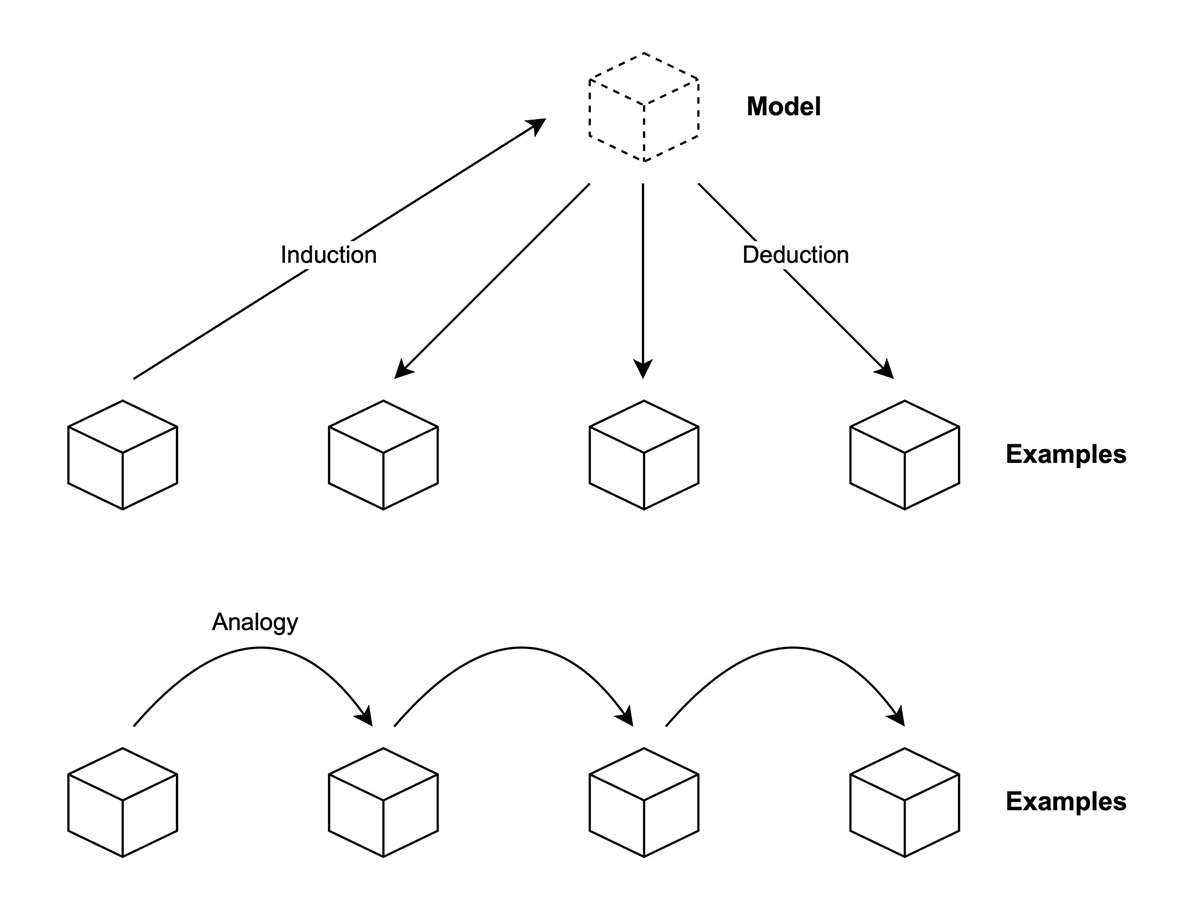
Viveiros de Castro introduces the ‘model versus example’ distinction as correlating to the engineer’s and the bricoleur’s respective modes of worldmaking. While engineers operate by abstracting models from past experience and then applying them to new experience (whether to interpret or manipulate it), bricoleurs approach Beginning of page[p. 359] experience itself as a multitude of examples of practical possibilities that may be differentially repeated and assembled in new configurations.36
Examples […] are ideas (techniques, institutions, etc.) that work as enticements to do something ‘differently alike’ the inspiring example, which is itself always a version or transformation of yet another example, just as myths are but versions of one another with no original model or template. Examples are borrowed horizontally — they diffuse — while models are imposed vertically — they emanate. Models give orders and enforce order; examples give cues, inspiring inventions and subversions. The model of the model is Being, while the example lies within the remit of Doing. If the first is congenitally idealist and rationalist, the second is pragmatist and empiricist.37
I propose to read this conceptual pair alongside Giorgio Agamben’s discussion, in his book on method, of the logic of paradigms — ‘paradigm’ being synonymous with ‘example’. On that basis, we may say that model-makers move from the particular to the general (or from percepts to concepts) through induction, and from the general to the particular through deduction, while example-mongers move from the singular to the singular through analogy (being thus able to operatively connect assemblages of percepts without abstracting pure concepts from them). Agamben argues that when, in Thomas Kuhn’s terms, revolutionary science results in a paradigm shift, the new scientific paradigm does not neatly fit within the previously existing general concept of science, but rather constitutes an example of what else science might be — one that can be reproduced by subsequent scientists until a new form of normal science is established. Similarly, for Agamben, when Michel Foucault defines disciplinary power through an analysis of Bentham’s panopticon, and then proceeds to indicate schools, barracks, factories, hospitals, and so on as variants of the prison, he is not so much creating a general category that applies to all of these power architectures, but rather is analogically interpreting them through the paradigm of the panopticon.38Beginning of page[p. 360]
The very method of ontological-turn anthropology, or comparative metaphysics, of which Viveiros de Castro is one of the main proponents, is directly connected to the rejection of the making and applying of models in favour of a paradigmatic, example-mongering logic in which anthropological concepts cannot be placed at a separate level from the ‘native’ concepts they grapple with. In that sense, ‘the shift to ontology was […] in essence an attempt to force the prior backdrop of comparison back into the space of the comparable’:39
Several generations of anthropologists assumed that they could account for the indifference of certain indigenous peoples to some basic modern ontological distinctions — those between nature and culture, thing and person, and humans and animals — without questioning the validity of using those very Beginning of page[p. 361] categories to make the explanation. When anthropologists instead accepted that these partitions form merely one means of distributing beings among others — when they began trying to do justice to those other ways of making worlds — they exited the reassuring framework of scientific inquiry for the unstable terrain of ontological comparison.40
Scaling and Nonscalability
Negarestani’s essay ‘Where is the Concept?’ provides a Promethean approach to the relationship between the local and the global, and therefore to the problems of scale and scaling:
The transition from the local to the global requires something more than the juxtaposition or addition of local contexts. It requires a form of interknitting multiplication between localities that while it acknowledges their particular specifications (parameters and orientations), takes localities beyond their immediate and restricted ambits. It is in this sense that the passage from the local to the global is not simply a form of transit through which the local element preserves its constancy. It is instead a mode of production of new orientations, structures, dimensions and new intuitions of locality and globality. In this respect, universality becomes the operation of productive locality which is globally oriented.41
By making scalar transition something that cannot be taken for granted, but that demands the work of ‘interknitting’, Negarestani seeks to avoid both ‘a universalism in which a pre-established and given idea of universality is imposed as the term of unification’ and a ‘localism that insists on analysing the problems at the level of the local without any recourse to non-local possibilities’.42 Universality is not presupposed, but rather laboriously constructed from a situated standpoint. Of course, the universal is, on an a priori and theoretical level, a pure logical structure — a model, or the condition for turning an example into a model — but that structure is without any efficacy until it is mobilized, from a concrete standpoint, as a device through which to Beginning of page[p. 362] navigate the space between conception and implementation. From a perspective busy with producing scalar nesting, the nesting itself is not given, and spatial relationships are still messy. It is only in retrospect that the relationship appears as one between the local and the global, and therefore as scalar. In his later theorization of artificial intelligence, Negarestani argues that, by constructing a model of itself as universal, inhuman intelligence can map out its present conditions of implementation, so that it can then intervene upon those conditions in order to change them, and is thus able to propel itself beyond its local contingencies.43
Thus, through model-making, Promethean engineers are able not only to construct scale-nested world-maps, establishing the rules of transition from one scale to another, but also to use those maps to effectively travel across scales.44 By determining and intervening upon the conditions of implementation of a certain form of organization at a lower scale, Prometheans can scale up their own projects, which, as we have seen, is an essential part of their strategy of large-scale transformation. By contrast, example-mongering Gaians do not picture the world as a scale-nested totality, and, by composing worlds through the mutual giving and following of examples, avoid creating conditions in which vertical scale-relations come into play.45 In that sense, we find not only the association of Prometheans and Gaians with large and small scales, respectively, but also a more complex contrast: epistemic scales versus their absence, as well as practices of upscaling versus nonscalability.
The reader less familiar with the authors I am defining as Gaian might ask, ‘But isn’t Gaia a large-scale figure?’ The answer is yes and no. Yes, in the sense that, indeed, Gaian bricolage does not remain restricted to small scales, but rather traverses virtually every scale of what Prometheans would call the ‘globe’ or the ‘planet’. Still, more Beginning of page[p. 363] fundamentally, Gaia is not a scalar figure. As Latour puts it, it is true that ‘the most common definition of the Gaia theory is that Gaia acts as a single, unique coordinating agent’. Latour asks, rhetorically, ‘Is there then a superior order in addition to living organisms?’, and his negative answer is precisely what puts Gaia on the side of bricolage, not engineering: ‘as soon as you imagine parts that “fulfill a function” within a whole, you are inevitably bound to imagine, also, an engineer who proceeds to make them work together.’46 Indeed, it is precisely because the scale of Gaia is the largest scale possible (in the ‘sublunary’ plane that primarily concerns Latour) that the figure of the organism is inadequate: ‘the metaphor of the organism […] is meaningless on this scale, unless we imagine a General Engineer […] capable of giving each of these actors agency for the greatest good of all.’47 For Latour,
The inside and outside of all borders are subverted […] not because there is some global plan that orders the concatenation of agents, but because the interaction between a neighbor who is actively manipulating his neighbors and all the others who are manipulating the first one defines what could be called waves of action, which respect no borders and, even more importantly, never respect any fixed scale.48
Latour emphasizes that Lovelock, in his theory of Gaia, ultimately abandons the ideas of parts and wholes. Lovelock and Margulis, according to Latour, ‘were trying to get along entirely without the notion of levels layered on top of one another’.49 Latour notes that this implies nothing less than the abandonment of the modern idea of nature: ‘“Nature”, in the classical conception, had levels, strata; it was possible to pass from one to another according to a continuous well-ordered process of “zooming”. Gaia subverts the levels.’50 Since both the attitude in regard to scale and the attachment to the modern concept of Beginning of page[p. 364] nature are defining factors in the disagreement between our cosmopolitical factions, Latour declares that ‘those who claim to be ordering neatly the various dimensions of the Earth don’t deserve to be called Earthbound’.51
In her article ‘On Nonscalability’, Anna Lowenhaupt Tsing makes one of the most direct cases, from the Gaian side, against scalability, which she defines as ‘the ability to expand — and expand, and expand — without rethinking basic elements’.52 Situating its cosmopolitical paradigm in the plantations of colonial South America, Tsing associates scalability with most of what is wrong with modernity, from slavery, through capitalism, to environmental collapse. Scalable plantations are contrasted to nonscalable mushrooms, which themselves offer the paradigm of alternative ways of existing among the ruins of modernity.53 Perhaps wary of the real possibility that her ‘nonscalability theory’ might seem Manichean, Tsing makes sure to caveat that ‘nonscalability is by no means better than scalability just by being nonscalable’. ‘Scalability’, she notes, is simply ‘a distinctive design feature’, and ‘nonscalability refers to everything that is without that feature, whether good or bad’.54 While it is unclear how such declarations chime with the rest of Tsing’s argument, I would still like to take them seriously, since the avoidance of a strict opposition between Promethean scaling and Gaian nonscalability seems to be the most promising reading of her text — at least for the purposes of the present argument. After all, despite the superficially apparent Manichaeism of her discourse, there are crucial details in the text that allow for the kind of more nuanced reading that I am seeking to construct.
Tsing often seems to oscillate between two claims that are both individually excessive and reciprocally contradictory. On the one hand, she often implies that scalability is inherently impossible and an illusion (because assemblages are always too complex and messy to meet Beginning of page[p. 365] its idealized strictures). On the other, she suggests that it is the source of the greatest evils of the modern world. I believe it is possible, however, to remedy these problems by unpacking the implications of how, in Tsing’s own terms, scalability is ‘a triumph in precision design’. For a project to be made scalable, she notes, its elements have ‘to be stabilized so that the expansion [adds] more elements without changing the program’. Since scalability ‘is not an ordinary feature of nature’, producing it ‘takes a lot of work’.55 In other words, precisely because reality is always too messy to neatly fit into abstract models, stabilizing it enough for the model to maintain a sufficient degree of efficacy requires constant labour — this is what Latour called the ‘labour of purification’.56 This version of nonscalability theory recognizes that if scaling means — as per Tsing’s definition — ‘to change the scale without changing the framework of knowledge or action’,57 then it is indeed impossible. A project that works across scales requires the labour of mapping and stabilizing the conditions of transference across the relevant scales. At the same time, it becomes clear that imperfect scaling is practically possible, precisely insofar as the necessary organized effort is put not only into making the right model, but also into operationalizing the conditions for its trans-scalar application. In this way, a position becomes available that avoids both claiming that scalability is a mere error or illusion — which, if true, would imply that moderns would have never been able to pull the Earth into climate disaster — as well as demonizing it as an all-powerful, unnatural force. This reading is coherent with Tsing’s claims that ‘nonscalability theory allows scales to arise from the relationships that inform particular projects, scenes, or events’, or, in other words, that it ‘shows us scalability in action’.58 Nonscalability cannot work as a theory according to which scalability does not exist, or is inherently bad. It must rather hold, on the one hand, that nonscalability is the background condition (no scalability is simply given), and, on the other, that scalability must be scrupulously constructed and maintained in practice if it is to have any purchase in the making of worlds. Beginning of page[p. 366]
The Bricolage–Engineering Spectrum
Although Viveiros de Castro is both a proponent of the cosmopolitical potential of perspectivist bricolage and very critical of Prometheans’ engineering attitude and technological fixes, he too seeks to avoid a Manichean position. ‘Let us not simplify the contrast, much less vilify the “engineer”,’ he writes. Indeed, for him the distinction itself ‘cannot but be relative, lying along a continuum rather than being a strict dichotomy’.59 After all,
The only engineer in a pure, absolute sense would be God, in whom concept-model and material implementation coincide immediately; human engineers must make do with ideas and materials at hand and therefore are bricoleurs, particularly when they leave the world (the worldview) of models and try to make things work in the phenomenal world. Reciprocally, every grassroots bricoleur calculates, anticipates results, and modifies the state of the world according to a certain intention, that is, a model; she or he is, after all, a ‘scientist of the concrete’.60
This points to the possibility of understanding engineering and bricolage not as discrete opposites, but as tendencies in the realm of practice that may be navigated and combined in various ways. Indeed, I would argue that to take this distinction for granted as a hard one would be to adopt an engineer’s conceptual attitude, while the bricoleur alternative lies precisely in understanding the strict dichotomy as a surface effect of a more complex, differential spectrum of practices. Still, Viveiros de Castro maintains his condemnation of a certain type of Promethean engineering by mobilizing a Geertzian distinction between ‘model of’ (descriptive) and ‘model for’ (normative).61 ‘In its normative sense,’ he writes, ‘a model is above all a political instrument, involving an asymmetric power relation which maximizes the distance between the modelling authority and the subjects (human and nonhuman peoples, landscapes, the atmosphere) that are to be modelled.’62 He later adds: Beginning of page[p. 367]
Models are, by definition, simplifications of reality, but they can be used to understand it (models as heuristics) or be imposed upon it (models as norms) in order to browbeat reality, so to speak, into obeying them. In this latter sense they have always lain behind (or above) the Modernist project to flatten the many worlds of Gaian beings into a single global nomos.63
Here I diverge with Viveiros de Castro in that I doubt that this distinction is the most useful for solving the cosmopolitical conundrums of the engineer-bricoleur interface. Admitting heuristic scientific models — limited abstractions from empirical data that can be reformed and updated in the light of further experience — is a relevant concession. However, it seems to me that discarding all normative modelling (under the guise of the unilateral postulation of an abstract ideal and subsequent imposition of that ideal on reality) relies both on an inferior rendering of Promethean engineering (we want to confront the best possible versions of each approach), and on a separation between description and normativity that would seem out of place in a Gaian argument. Although, in the Sellarsian framework adopted by thinkers such as Brassier and Negarestani, normativity is differentiated from causality, it does not maintain a unilateral, top-down relation with empirical reality. Quite the contrary: the emphasis is on the contingency and constant re-evaluation of normative commitments.64 Furthermore, after Wittgenstein as well as with Latour, it seems to me difficult to separate purely cognitive practices from normativity, since the former are themselves afforded by normative frameworks (notably the ‘game of giving and asking for reasons’) or by nature-culture (and therefore factuality-normativity) ‘hybrids’.65 In that sense, I would like to avoid discarding all models ‘for’ as inherently complicit with climate catastrophe. After all, even if a monoculture — or mononature — of modern naturalism at a global scale has most likely been destructive to the biosphere in the period of its hegemony following the Industrial Beginning of page[p. 368] Revolution, I would not want to neglect the possibility that the participation of such cosmology in a more diverse ecology of practices could still be not only sustainable, but even beneficial.
It is not entirely clear to me what Viveiros de Castro’s position is about this. What I am interested in is countering a particular interpretation of his text by emphasizing another side of its argument: that models and examples can be understood as opposing vectors within a continuous spectrum, such that neither figure of practice is entirely alien to the other, but each may be seen as a variant or transformation of its counterpart. In other words, I suggest that, through the right procedures, an example may be turned into a model and vice versa. What we still need, however, is an articulate conception of how models and examples can be thought in such a way. In order to achieve that, my strategy will be to introduce a notion that is usually associated with radical bricolage, but to interpret it with an emphasis on its often-disregarded engineering potentials. That is the elusive gesture of thought that appears in Gilles Deleuze and Félix Guattari’s work,66 individually as well as collaboratively, under names as varied as ‘diagram’, ‘abstract machine’, ‘rhizome’, and ‘nomos’.
Deleuze takes the notion of the diagram, among other sources, from the same Foucauldian discussion of the panopticon that, as mentioned above, is also a privileged example of the paradigm for Agamben.67 Foucault uses the word in the following passage:
The Panopticon should not be understood as a dream building: it is the diagram of a mechanism of power reduced to its ideal form; its functioning, abstracted from any obstacle, resistance or friction, may very well be represented as a purely architectural and optical system: it is in fact a figure of political technology that can and must be detached from any specific use.68
Agamben argues that the Foucauldian paradigm is ‘not only an exemplar or model, which imposes the constitution of a normal science, Beginning of page[p. 369] but also and above all an exemplum which allows one to gather the statements and the discursive practices within a new intelligible ensemble and a new problematic context’.69 By referring to ‘normal science’, Agamben is here referring to how, in Kuhn, the concept of paradigm also holds ‘two different senses’, one in which it designates ‘the ensemble of technics, models and values to which the members of a community more or less consciously adhere’, and one in which it indicates ‘a single element of that ensemble […] that, functioning as a common example, substitutes itself to the explicit rules that allow us to define a certain tradition of research’. Thus, we see that a paradigm/diagram like that of the panopticon is neither purely a model nor simply an example, but rather that it can drift along a model-example axis according to different contexts and procedures.
For Deleuze (and Guattari), the diagram is a complex of force-relations that inhabit a middle ground between the absence of form and form as such; they are quasi-formal force relations that precede (logically rather than historically) the emergence of determinate forms and, for that reason, help explain them. ‘The diagram’, Jakub Zdebik writes, ‘allows a glimpse of the state that comes before the formation of an object, and of what goes into its formation.’70 This gesture of thought is at the centre of the Deleuzian project of an inverted Platonism, in which ideal structures hold no explanatory power, but are rather that which must be explained. If there is such a thing as a difference between normative models and the factual nature to which they apply, those are no grounds for a final explanation of reality, but rather the product of a geologically deep history that demands genealogy — a ‘geology of morals’, in Deleuze and Guattari’s expression.71
That the diagram, in that sense, would seem like a bricoleur’s concept, closer to example-mongering than model-making, does not mean that it is entirely alien to the model. Indeed, although Deleuze and Guattari write that ‘there is no abstract machine, or machines, in the sense of a Platonic Idea, transcendent, universal, eternal’, they proceed Beginning of page[p. 370] to add that ‘what we have said does not preclude the possibility of “the” abstract machine serving as a transcendent model, under very particular conditions’.72 In his critical reading of A Thousand Plateaus, Brassier emphasizes this often-neglected opening to the possibility of engineering:
Tensors perform a diagrammatic function: they are the operators of torsion through which deformalization composes intensities, sign-particles and flows on the plane of consistency. Diagrammatic composition is the identification of these points of torsion. But this composition requires concrete rules: ‘There are rules, rules of plan(n)ing, of diagramming […]. The abstract machine is not random; the continuities, emissions and combinations, and conjunctions do not occur in just any fashion.’ Thus it is the rules of planification (‘planing’) that ensure consistency, not decoding, deterritorialization or destratification as such.73
In that sense, Brassier claims that ‘diagramming is akin to engineering: it is a cognitive operation carried out with a view to effectuating certain practical imperatives under specific material constraints’.74 Equating the Deleuzian diagram with a finalized model is, in my view, directly at odds with Deleuze and Guattari’s insistence on the non-teleological character of diagrammatic functions. Nevertheless, Brassier is right that under the ‘very particular conditions’ that the two authors themselves acknowledge, diagrams can and do operate as models. Indeed, a naturalized approach to model-making (one that does not rely either on Platonism or theology) cannot but arrive at the conclusion that all models are but sufficiently stabilized diagrams — schemas of practice that, by mapping and controlling their own conditions of implementation, are able to abstract themselves from their local origin and scale, in the sense of becoming reproducible with a sufficient (although imperfect) degree of success. Perhaps for that reason, a moderate Promethean thinker like Patricia Reed often uses both terms without Beginning of page[p. 371] creating a strong contrast between them, even while maintaining an emphasis on organization, future-oriented planning, and interventive efficacy.75
Based on the above, we may say that, to the extent that ‘we have never been modern’, there have also never been, at the ontological level, any models, but only diagrams or examples. Still, the epistemic idea of models, made efficacious by collectives acting as though models really existed, is sufficient to provide these fictional entities with a degree of efficacy. We may have never been modern, and yet it seems undeniable that modernity has transformed reality. That is a sense in which Prometheans and Gaians turn out not to be in direct contradiction, either in the domain of theory or in that of practice. While Gaians focus on metaphysics, claiming that exemplary singularities/multiplicities are more fundamental than either normative or descriptive models, Prometheans tend to avoid any metaphysical claims, focusing instead on the epistemic and pragmatic domains in which models indeed hold operational priority.
Concluding Remarks
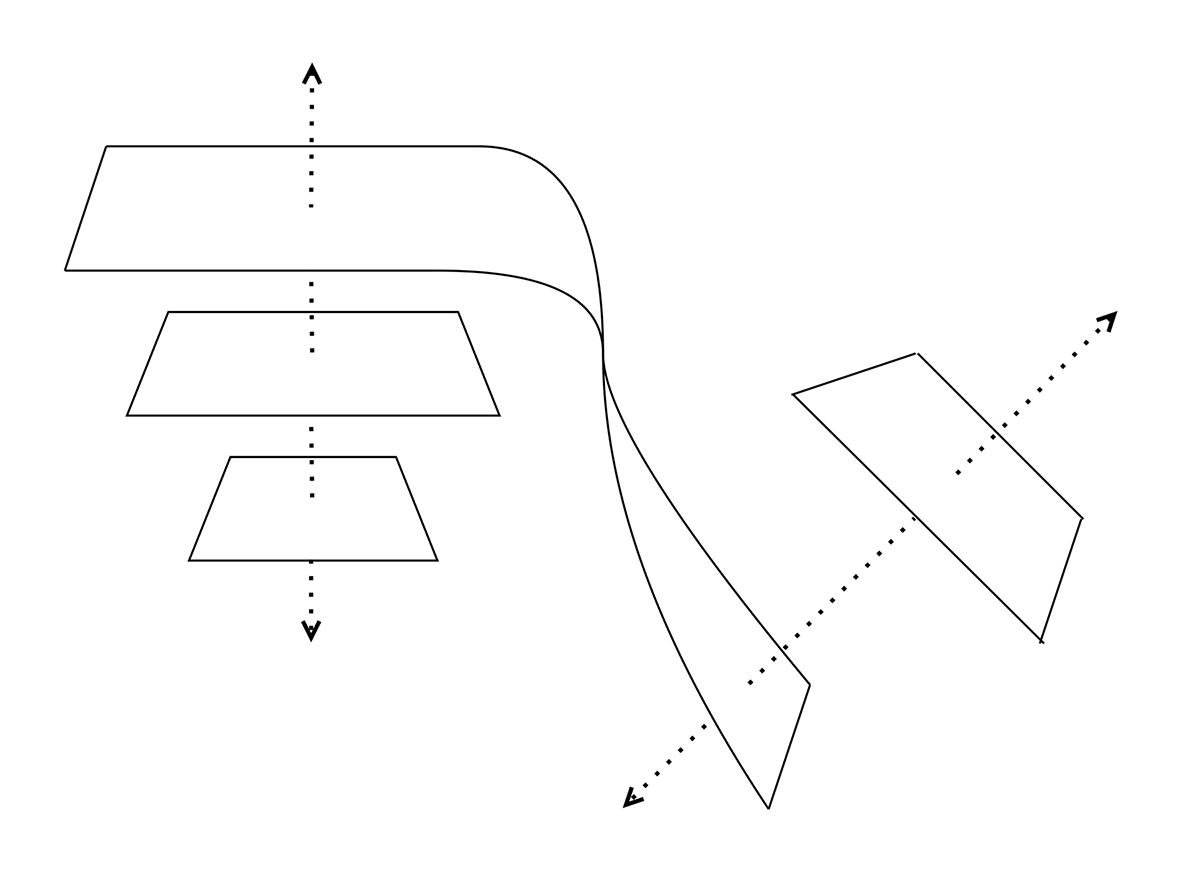
Let us conclude by schematizing the consequences of the distinction and interfacing of Promethean engineers and Gaian bricoleurs in the sections above. In the terms of our discussion, scales (a scalar view of the world) and scaling (practical trans-scalar navigation) are the products of practices of worldmaking that rely on models, associated with a naturalist cosmology. Outside of the worlds constructed through those particular practices, the notion of scale, in a strict definition, loses applicability. That, however, does not mean that the notion of scale is false, nor ethico-politically condemnable. It only means that, in order to be rigorously and ethically manipulated, it must be carefully circumscribed to its own conditions of applicability, while the Beginning of page[p. 372] worldmaking projects to which it is, in each concrete case, associated should be interrogated in terms of their sustainability and compatibility with surrounding world-orders.
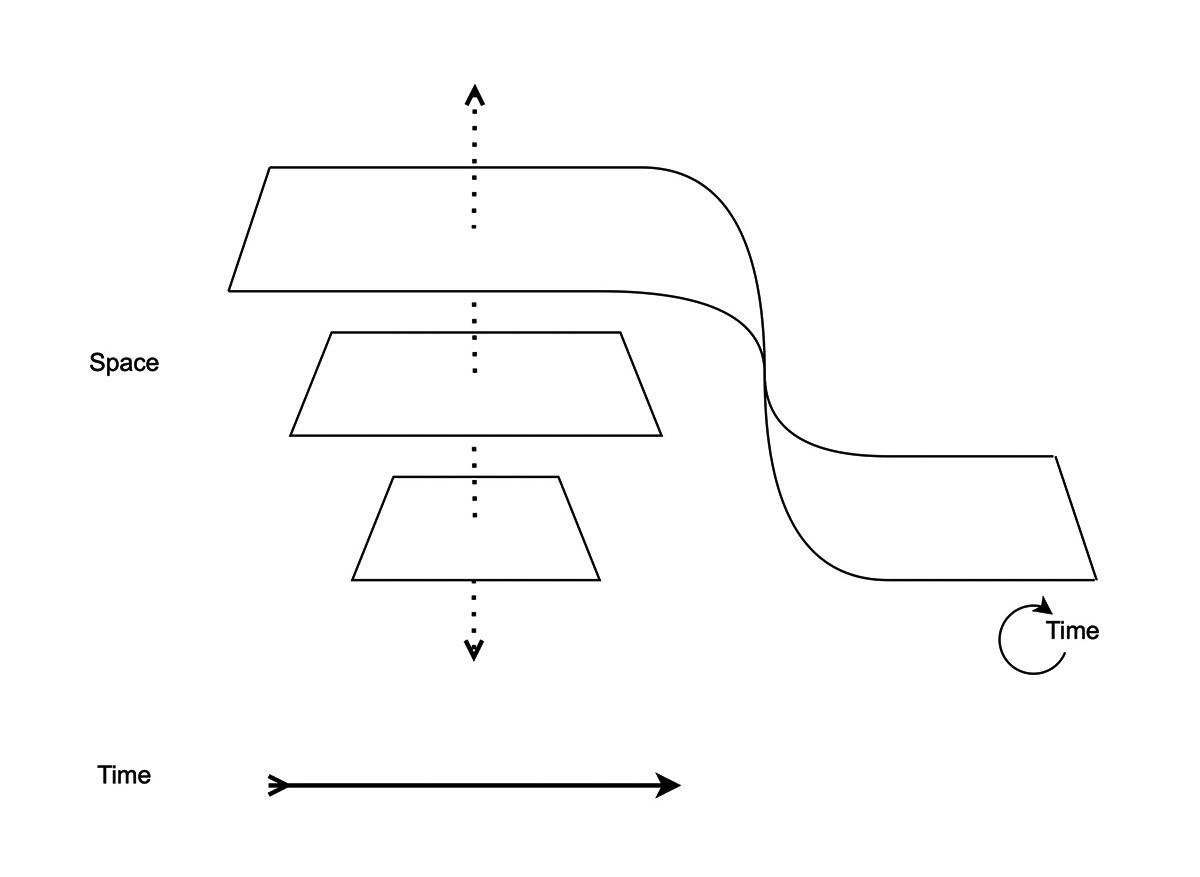
Prometheans and Gaians alike will agree that there is no metaphysically given scale-ordered reality. On this metaphysical plane, Gaians deal with world-differences in cosmopolitical terms, without assuming any kind of spatio-temporal ordering that is a priori trans-worldly. They do not, however, preclude spatio-temporal scale-orders being established internally to any given world — indeed this may constitute the very essence of any natural world as such (we should not forget that animists are not purely animistic — that they do mobilize a modicum of naturalist practices immanently to the world they inhabit). If, however, spatial and temporal orders allowing for scale-nesting become applicable across worlds, that already means that we are no longer dealing with separate worlds, but rather with an encompassing world that has been unified.
In this sense, dealing with the geopolitics of scale through the conceptual characters of Prometheans and Gaians allows us to coherently Beginning of page[p. 373] adopt a critique of scalar worldviews and scaling practices without discarding the explanatory power and practical utility of the concept of scale. Rather than disavowed, scale is simply provincialized — not in the sense of being defined as a strictly European cultural practice, but of being circumscribed to world-orders in which scalar orientations are actively constructed as such. This should allow the concept of scale to remain handy in dealing with the scientific and political problems that our age of catastrophes implies, without sustaining the unexamined ideological character associated with its colonial and extractive versions.
Notes
- This effort stems, to a great measure, from a Brazilian and Latin American context of intellectual and political debate where the division in question is central. See especially Hilan Bensusan, ‘Geist and Ge-Stell: Beyond the Cyber-Nihilist Convergence of Intelligence’, Cosmos and History: The Journal of Natural and Social Philosophy, 16.2 (2020), pp. 94–117 <https://cosmosandhistory.org/index.php/journal/article/view/878> [accessed 15 July 2026]; and Hilan Bensusan, ‘Cosmopolitical Parties in the Post-human Age’, &&&, 16 November 2020 <https://tripleampersand.org/cosmopolitical-parties-post-human-age/> [accessed 15 July 2026]. For a Promethean response to Bensusan, see J.-P. Caron, ‘Place and Scale’, Cosmos and History: The Journal of Natural and Social Philosophy, 17.2 (2021), pp. 162–84 <https://cosmosandhistory.org/index.php/journal/article/view/991> [accessed 15 July 2026]. See also Moysés Pinto Neto, Política Especulativa: Ensaio sobre as imagens de futuro em disputa no século XXI (Cultura e Barbárie, 2025). A similar effort of mediation, albeit focused on human politics, is developed in Rodrigo Nunes, Neither Vertical nor Horizontal: A Theory of Political Organisation (Verso, 2021). ↵
- The notion of conceptual characters is developed in Gilles Deleuze and Félix Guattari, Qu’est-ce que la philosophie? [1991] (Les Éditions de minuit, 2005), as part of an effort to avoid a concept of the concept as pure intellectual abstraction and generalization. I default to ‘Prometheans’ and ‘Gaians’, rather than other names, because their common reference to Greek deities keeps things clear and symmetrical. These names are, however, not perfect. On the one hand, they carry a mythical bias that, as will be seen, would seem to express more of a bricoleur perspective (although Prometheans often self-identify as such). On the other, the figure of Gaia carries some unfortunate resonances, namely its apparent unity, as well as its Greekness, which would seem too linked to a ‘Western tradition’ for the decolonial standpoint of bricoleurs. In any case, as none of the available denominations seems perfect, the obviously mythical/theatrical register of Prometheus versus Gaia seems most adequate. For a recent use of this framing, see Harrison Fluss and Landon Frim, Prometheus and Gaia: Technology, Ecology and Anti-Humanism (Anthem Press, 2022), although in my opinion the authors render both conceptual characters in inferior versions. ↵
- See The Speculative Turn: Continental Materialism and Realism, ed. by Levi R. Bryant, Nick Srnicek, and Graham Harman (re.press, 2011). ↵
- Beyond what I will be able to directly address in this short chapter, key Promethean references include Laboria Cuboniks, The Xenofeminist Manifesto: A Politics for Alienation (Verso, 2018); Helen Hester, Xenofeminism (Polity Press, 2018); and Benjamin Bratton, The Stack: On Software and Sovereignty (MIT Press, 2015). Key Gaian references include Davi Kopenawa and Bruce Albert, A queda do céu: Palavras de um xamã yanomami (Companhia das Letras, 2015); Donna J. Haraway, Staying with the Trouble: Making Kin in the Chthulucene (Duke University Press, 2016); and Marisol de la Cadena, Earth Beings: Ecologies of Practice across Andean Worlds (Duke University Press, 2015). ↵
- See Alyne Costa, ‘Da verdade inconveniente à suficiente: cosmopolíticas do Antropoceno’, Cognitio-Estudos: revista eletrônica de filosofia, 18.1 (2021), pp. 37–49 <https://doi.org/10.23925/1809-8428.2021v18i1p37-49>. ↵
- Isabelle Stengers, ‘Introductory Notes on an Ecology of Practices’, CSR, 11.1 (2013), pp. 183–96 <https://doi.org/10.5130/csr.v11i1.3459>. ↵
- See Sallie A. Marston, John Paul Jones III, and Keith Woodward, ‘Human Geography without Scale’, Transactions of the Institute of British Geographers, 30.4 (2005), pp. 416–32 (p. 416) <https://doi.org/10.1111/j.1475-5661.2005.00180.x>. The authors provide an overview of the debate in human geography that fluidifies the concepts of scale. Curiously, the authors themselves, even as they set out to ‘critique the dominant — hierarchical — conception of scale’, end up adopting precisely that conception, albeit in order to argue for entirely doing away with the concept of scale. ↵
- Alex Williams and Nick Srnicek, ‘#Accelerate: Manifesto for an Accelerationist Politics’, in Accelerate: The Accelerationist Reader, ed. by Robin Mackay and Armen Avanessian (Urbanomic, 2014), pp. 347–62 (p. 349). ↵
- Mark Fisher, Capitalist Realism: Is There No Alternative? (Zero Books, 2009). ↵
- Williams and Srnicek, ‘#Accelerate: Manifesto for an Accelerationist Politics’, p. 351. ↵
- Ibid., 354. ↵
- Déborah Danowski and Eduardo Viveiros de Castro, The Ends of the World, trans. by Rodrigo Guimarães Nunes (Polity Press, 2017), p. 114. ↵
- Ibid. The expression ‘intrusion of Gaia’ is a reference to Isabelle Stengers, Au temps des catastrophes: Résister à la barbarie qui vient (Découverte, 2009). ↵
- See Bruno Latour, Facing Gaia: Eight Lectures on the New Climatic Regime, trans. by Catherine Porter (Polity Press, 2017). The book consists of updated versions of Latour’s Gifford Lectures, ‘Facing Gaia: A New Enquiry into Natural Religion’, given at the University of Edinburgh in 2013. Latour speaks of humans versus Earthlings. In French, he calls the latter Terriens, which is rendered by Danowski and Viveiros de Castro as Terranos and translated into English as ‘Terrans’ by Rodrigo Nunes; see Danowski and Viveiros de Castro, The Ends of the World. Haraway also speaks of humans and Terrans in Staying with the Trouble. ↵
- Danowski and Viveiros de Castro, The Ends of the World, p. 91. ↵
- Ibid., 93. ↵
- Bruno Latour, We Have Never Been Modern, trans. by Catherine Porter (Harvard University Press, 1993). ↵
- Philippe Descola, Par-delà nature et culture (Gallimard, 2005). ↵
- This framing of naive humanism should not be conflated with the stronger version of Prometheanism that will be further presented below as inhumanism. ↵
- Powers of Ten, dir. by Charles and Ray Eames (USA, 1977) <https://www.eamesoffice.com/the-work/powers-of-ten/> [accessed 8 September 2026]. ↵
- Latour, Facing Gaia; Danowski and Viveiros de Castro, The Ends of the World. Gaians tend to affirm the transition from the Holocene to the Anthropocene, although that notion is disputed. The International Union of Geological Sciences (IUGS) officially rejected the Anthropocene as an epoch-level boundary in 2024. ↵
- Latour, Facing Gaia, p. 248. ↵
- Stengers, Au temps des catastrophes. ↵
- See Descola, Par-delà nature et culture; and Eduardo Viveiros de Castro, Cannibal Metaphysics: For a Post-Structural Anthropology, ed. and trans. by Peter Skafish (University of Minnesota Press, 2014). It could be argued that the other two quadrants, totemism and analogism, would also compose the Terran side, since they too are not moderns. Animists, however, seem to fit more obviously as paradigmatic Terrans. ↵
- Viveiros de Castro, Cannibal Metaphysics. ↵
- Danowski and Viveiros de Castro, The Ends of the World. ↵
- See Ray Brassier, ‘Prometheanism and its Critics’, in Accelerate, ed. by Mackay and Avanessian, pp. 467–88; and Reza Negarestani, ‘The Labor of the Inhuman’, in Accelerate, ed. by Mackay and Avanessian, pp. 425–66. ↵
- Negarestani, ‘The Labor of the Inhuman’. ↵
- Ray Brassier, ‘Unfree Improvisation/Compulsive Freedom’, 2013 <http://www.mattin.org/essays/unfree_improvisation-compulsive_freedom.html> [accessed 30 July 2022]. ↵
- Eduardo Viveiros de Castro, ‘On Models and Examples: Engineers and Bricoleurs in the Anthropocene’, Current Anthropology, 60.S20 (2019), pp. S296–S308 (S299) <https://doi.org/10.1086/702787>. ↵
- Ibid., p. S300. ↵
- Claude Lévi-Strauss, Wild Thought: A New Translation of ‘La Pensée sauvage’, trans. by Jeffrey Mehlman and John Leavitt (University of Chicago Press, 2021). ↵
- Bruno Latour, Reassembling the Social: An Introduction to Actor-Network-Theory (Oxford University Press, 2005) <https://doi.org/10.1093/oso/9780199256044.001.0001>. ↵
- Lévi-Strauss, Wild Thought, p. 21. ↵
- Claude Lévi-Strauss, Le Cru et le Cuit (Plon, 1964). ↵
- Viveiros de Castro, ‘On Models and Examples’. ↵
- Ibid., p. S301. ↵
- See Giorgio Agamben, Signatura rerum: Sul metodo (Bollati Boringhieri, 2008); and Michel Foucault, Surveiller et punir: Naissance de la prison (Gallimard, 1975). Agamben engages with Thomas S. Kuhn, The Structure of Scientific Revolutions [1962], 2nd edn (University of Chicago Press, 1970). ↵
- Pierre Charbonnier, Gildas Salmon, and Peter Skafish, ‘Introduction’, in Comparative Metaphysics: Ontology after Anthropology, ed. by Pierre Charbonnier, Gildas Salmon, and Peter Skafish (Rowman & Littlefield, 2017), pp. 1–24 (p. 4). ↵
- Ibid., p. 1. ↵
- Reza Negarestani, ‘Where Is the Concept? Localization, Ramification, Navigation’, in When Site Lost the Plot, ed. by Robin Mackay (Urbanomic, 2015), pp. 225–51 (p. 227). ↵
- Ibid. ↵
- See Reza Negarestani, Intelligence and Spirit (Urbanomic, 2018). ↵
- This does not imply that Gaians cannot travel far and wide, only that they do not do it through scale-nesting techniques. Polynesian navigation might provide a good example of how great distances can be traversed while using fully nonscalar maps. ↵
- We might read Clastres’s ‘societies against the state’ as preempting the emergence of vertical scales in politics and cosmology. See Pierre Clastres, La Société contre l’État (Les Éditions de minuit, 1974). ↵
- Latour, Facing Gaia, p. 94. See also Bruno Latour, ‘Why Gaia Is Not a God of Totality’, Theory, Culture & Society, 34.2–3 (2017), pp. 1–21 <https://doi.org/10.1177/0263276416652700>. ↵
- Latour, Facing Gaia, p. 95. ↵
- Ibid., p. 101. ↵
- Ibid., p. 105. ↵
- Ibid., p. 106. It is clear that the ‘classical conception’ that Latour refers to here is not ‘Classic’ in the sense of ancient, but rather the modern one. See Latour, We Have Never Been Modern. ↵
- Latour, Facing Gaia, p. 223. ↵
- Anna Lowenhaupt Tsing, ‘On Nonscalability: The Living World Is Not Amenable to Precision-Nested Scales’, Common Knowledge, 18.3 (2012), pp. 505–24 (p. 505) <https://doi.org/10.1215/0961754X-1630424>. Similar arguments are made in Chapter 3 of Anna Lowenhaupt Tsing, The Mushroom at the End of the World: On the Possibility of Life in Capitalist Ruins (Princeton University Press, 2015). ↵
- Tsing, ‘On Nonscalability’. ↵
- Ibid., p. 509. ↵
- Ibid., p. 507. ↵
- Latour, We Have Never Been Modern. ↵
- Tsing, ‘On Nonscalability’, p. 507. ↵
- Ibid., p. 509. ↵
- Viveiros de Castro, ‘On Models and Examples’, p. S300. ↵
- Ibid. ↵
- Ibid. See also Clifford Geertz, The Interpretation of Cultures: Selected Essays (Basic Books, 1973). ↵
- Viveiros de Castro, ‘On Models and Examples’, p. S300. ↵
- Ibid. ↵
- Wilfrid Sellars, In the Space of Reasons: Selected Essays of Wilfrid Sellars, ed. by Kevin Scharp and Robert B. Brandom (Harvard University Press, 2007). See, for example, Negarestani, ‘The Labor of the Inhuman’. ↵
- See Ludwig Wittgenstein, Philosophical Investigations [1953], rev. 4th edn, ed. by P. M. S. Hacker and Joachim Schulte, trans. by G. E. M. Anscombe, P. M. S. Hacker, and Joachim Schulte (Wiley-Blackwell, 2009); Latour, We Have Never Been Modern. ↵
- ‘Gesture of thought’ may not be the most adequate expression, but I would not dare to say ‘concept’, since the authors seem to be aiming precisely at something pre-conceptual or non-conceptual. ↵
- Gilles Deleuze, Foucault [1986] (Les Éditions de minuit, 2013). ↵
- Foucault, Surveiller et punir, p. 207; my translation. ↵
- Agamben, Signatura rerum, p. 20. ↵
- Jakub Zdebik, Deleuze and the Diagram: Aesthetic Threads in Visual Organization (Continuum, 2012), p. 2. ↵
- See Gilles Deleuze and Félix Guattari, Mille plateaux. Capitalisme et schizophrénie II (Les Éditions de minuit, 1980). ↵
- Ibid., p. 639. ↵
- Ray Brassier, ‘Concrete Rules and Abstract Machines: Form and Function in A Thousand Plateaus’, in ‘A Thousand Plateaus’ and Philosophy, ed. by Henry Sommers-Hall, Jeffrey A. Bell, and James Williams (Edinburgh University Press, 2018), pp. 260–79 (p. 267). ↵
- Ibid., p. 270. ↵
- See, for example, Patricia Reed, ‘Orientation in a Big World: On the Necessity of Horizonless Perspectives’, e-flux, 101 (2019) <https://www.e-flux.com/journal/101/273343/orientation-in-a-big-world-on-the-necessity-of-horizonless-perspectives> [accessed 26 June 2026]; and Patricia Reed, ‘The End of a World and its Pedagogies’, Making and Breaking, 2 (2021), pp. 1–6 <https://makingandbreaking.org/article/the-end-of-a-world-and-its-pedagogies/> [accessed 26 June 2026]. The ‘moderate Promethean’ characterization is mine, not Reed’s. ↵
Bibliography
- , Signatura rerum: Sul metodo (Bollati Boringhieri, 2008)
- , ‘Cosmopolitical Parties in the Post-human Age’, &&&, 16 November 2020 <https://tripleampersand.org/cosmopolitical-parties-post-human-age/> [accessed 15 July 2026]
- Bensusan, Hilan‘Geist and Ge-Stell: Beyond the Cyber-Nihilist Convergence of Intelligence’, Cosmos and History: The Journal of Natural and Social Philosophy, 16.2 (2020), pp. 94–117 <https://cosmosandhistory.org/index.php/journal/article/view/878> [accessed 15 July 2026]
- , ‘Concrete Rules and Abstract Machines: Form and Function in A Thousand Plateaus’, in ‘A Thousand Plateaus’ and Philosophy, ed. by Henry Sommers-Hall, Jeffrey A. Bell, and James Williams (Edinburgh University Press, 2018), pp. 260–79 <https://doi.org/10.1515/9780748697274-017>
- Brassier, Ray‘Prometheanism and its Critics’, in Accelerate: The Accelerationist Reader, ed. by Robin Mackay and Armen Avanessian (Urbanomic, 2014), pp. 467–88
- Brassier, Ray‘Unfree Improvisation/Compulsive Freedom’, 2013 <http://www.mattin.org/essays/unfree_improvisation-compulsive_freedom.html> [accessed 30 July 2022]
- , The Stack: On Software and Sovereignty (MIT Press, 2015) <https://doi.org/10.7551/mitpress/9780262029575.001.0001>
- Bryant, Levi R., Nick Srnicek, and Graham Harman, eds, The Speculative Turn: Continental Materialism and Realism (re.press, 2011)
- , ‘Place and Scale’, Cosmos and History: The Journal of Natural and Social Philosophy, 17.2 (2021), pp. 162–84 <https://cosmosandhistory.org/index.php/journal/article/view/991> [accessed 15 July 2026]
- Charbonnier, Pierre, Gildas Salmon, and Peter Skafish, eds, Comparative Metaphysics: Ontology after Anthropology (Rowman & Littlefield, 2017) <https://doi.org/10.5040/9798881812645>
- , La Société contre l’État (Les Éditions de minuit, 1974)
- , ‘Da verdade inconveniente à suficiente: cosmopolíticas do Antropoceno’, Cognitio-Estudos: revista eletrônica de filosofia, 18.1 (2021), pp. 37–49 <https://doi.org/10.23925/1809-8428.2021v18i1p37-49>
- , and , The Ends of the World, trans. by Rodrigo Guimarães Nunes (Polity Press, 2017)
- , Earth Beings: Ecologies of Practice across Andean Worlds (Duke University Press, 2015) <https://doi.org/10.1515/9781478093626>
- , Foucault [1986] (Les Éditions de minuit, 2013)
- , and , Mille plateaux. Capitalisme et schizophrénie (Les Éditions de minuit, 1980)
- Deleuze, GillesFélix GuattariQu’est-ce que la philosophie? [1991] (Les Éditions de minuit, 2005)
- , Par-delà nature et culture (Gallimard, 2005)
- , Capitalist Realism: Is There No Alternative? (Zero Books, 2009)
- , , Prometheus and Gaia: Technology, Ecology and Anti-Humanism (Anthem Press, 2022) <https://doi.org/10.2307/j.ctv270kvbf>
- , Surveiller et punir: Naissance de la prison (Gallimard, 1975)
- , The Interpretation of Cultures: Selected Essays (Basic Books, 1973)
- , Staying with the Trouble: Making Kin in the Chthulucene (Duke University Press, 2016) <https://doi.org/10.1215/9780822373780>
- , Xenofeminism (Polity Press, 2018)
- , , A queda do céu: Palavras de um xamã yanomami (Companhia das Letras, 2015)
- , The Structure of Scientific Revolutions [1962], 2nd edn (University of Chicago Press, 1970)
- , The Xenofeminist Manifesto: A Politics for Alienation (Verso, 2018)
- , Facing Gaia: Eight Lectures on the New Climatic Regime, trans. by Catherine Porter (Polity Press, 2017)
- Latour, BrunoReassembling the Social: An Introduction to Actor-Network-Theory (Oxford University Press, 2005) <https://doi.org/10.1093/oso/9780199256044.001.0001>
- Latour, BrunoWe Have Never Been Modern, trans. by Catherine Porter (Harvard University Press, 1993)
- Latour, Bruno‘Why Gaia Is Not a God of Totality’, Theory, Culture & Society, 34.2–3 (2017), pp. 1–21 <https://doi.org/10.1177/0263276416652700>
- , Le Cru et le Cuit (Plon, 1964)
- Lévi-Strauss, ClaudeWild Thought: A New Translation of ‘La Pensée sauvage’, trans. by Jeffrey Mehlman and John Leavitt (University of Chicago Press, 2021) <https://doi.org/10.7208/chicago/9780226413112.001.0001>
- , , , ‘Human Geography without Scale’, Transactions of the Institute of British Geographers, 30.4 (2005), pp. 416–32 <https://doi.org/10.1111/j.1475-5661.2005.00180.x>
- , Intelligence and Spirit (Urbanomic, 2018)
- Negarestani, Reza‘The Labor of the Inhuman’, in Alex Williams and Nick Srnicek, ‘#Accelerate: Manifesto for an Accelerationist Politics’, in Accelerate: The Accelerationist Reader, ed. by Robin Mackay and Armen Avanessian (Urbanomic, 2014), pp. 425–66
- Negarestani, Reza‘Where Is the Concept? Localization, Ramification, Navigation’, in When Site Lost the Plot, ed. by Robin Mackay (Urbanomic, 2015), pp. 225–51
- , Neither Vertical nor Horizontal: A Theory of Political Organization (Verso, 2021)
- , Política Especulativa: Ensaio sobre as imagens de futuro em disputa no século XXI (Cultura e Barbárie, 2025)
- Powers of Ten, dir. by Charles and Ray Eames (USA, 1977) <https://www.eamesoffice.com/the-work/powers-of-ten/> [accessed 8 September 2026]
- , ‘The End of a World and its Pedagogies’, Making and Breaking, 2 (2021) <https://makingandbreaking.org/article/the-end-of-a-world-and-its-pedagogies/> [accessed 26 June 2026]
- Reed, Patricia‘Orientation in a Big World: On the Necessity of Horizonless Perspectives’, e-flux, 101 (2019) <https://www.e-flux.com/journal/101/273343/orientation-in-a-big-world-on-the-necessity-of-horizonless-perspectives> [accessed 26 June 2026]
- , In the Space of Reasons: Selected Essays of Wilfrid Sellars, ed. by Kevin Scharp and Robert B. Brandom (Harvard University Press, 2007)
- , Au temps des catastrophes: Résister à la barbarie qui vient (Découverte, 2009)
- Stengers, Isabelle‘Introductory Notes on an Ecology of Practices’, CSR, 11.1 (2013), pp. 183–96 <https://doi.org/10.5130/csr.v11i1.3459>
- , The Mushroom at the End of the World: On the Possibility of Life in Capitalist Ruins (Princeton University Press, 2015) <https://doi.org/10.1515/9781400873548>
- Tsing, Anna Lowenhaupt‘On Nonscalability: The Living World Is Not Amenable to Precision-Nested Scales’, Common Knowledge, 18.3 (2012), pp. 505–24 <https://doi.org/10.1215/0961754X-1630424>
- , Cannibal Metaphysics: For a Post-Structural Anthropology, ed. and trans. by Peter Skafish (University of Minnesota Press, 2014)
- Viveiros de Castro, Eduardo‘On Models and Examples: Engineers and Bricoleurs in the Anthropocene’, Current Anthropology, 60.S20 (2019), pp. S296–S308 (S299) <https://doi.org/10.1086/702787>
- , , ‘#Accelerate: Manifesto for an Accelerationist Politics’, in Accelerate: The Accelerationist Reader, ed. by Robin Mackay and Armen Avanessian (Urbanomic, 2014), pp. 347–62
- , Philosophical Investigations [1953], rev. 4th edn, ed. by P. M. S. Hacker and Joachim Schulte, trans. by G. E. M. Anscombe, P. M. S. Hacker, and Joachim Schulte (Wiley-Blackwell, 2009)
- , Deleuze and the Diagram: Aesthetic Threads in Visual Organization (Continuum, 2012) <https://doi.org/10.5040/9781350251809>
© by the author(s)
Except for images or otherwise noted, this publication is licensed under a Creative Commons Attribution-ShareAlike 4.0 International License.© 2026 ICI Berlin Press