
Dust, Death, and the Body of the EarthNotes on the Scales of Ecological Disaster*Jasmine Clotilde Pisapia
Abstract
This essay follows dust across scales of ecological disaster: from particulate matter to volcanic magnitude, and from toxic accumulation to catastrophic rupture. Drawing on long-term anthropological fieldwork in southern Italy’s toxic and volcanic worlds, it moves between satellite views, images of scientific prediction, and Georges Bataille’s writings on dust and the subterranean abyss. Dust emerges as a medium between life and death, visibility and invisibility, the infinitesimal and the cosmic.
Keywords: dust; environmental crisis; toxicity; timescales; anthropology; volcano; death
* These preliminary reflections are part of a broader ongoing project on the timescales of ecological disaster. A few paragraphs draw on a published piece: Jasmine Clotilde Pisapia, ‘Poisonous Images: Taranto’s Environmental Crisis between the Visible and the Invisible’, Cultural Anthropology, 41.2 (2026), pp. 247–74 <https://doi.org/10.14506/ca41.2.03>. For their valuable comments on this specific piece, I thank Marietta Kesting, Christoph F. E. Holzhey, and Kirill Chepurin. I also wish to thank others who have engaged with parts or versions of this essay: Rosalind Morris, Lisa Stevenson, Valentina Bonifacio, Ulrich van Loyen, Jean-Ernest Joos, Filippo Bosco, Hélène Quiniou. This essay was developed during my fellowship at the ICI Berlin Institute for Cultural Inquiry. There, I extend my deepest gratitude to Nicolas Helm-Grovas, Verónica Stedile Luna, Angelica Stathopoulos, Tobi Haslett, Franco Costantini, Yuri Di Liberto, Magdalena Krysztoforska, Cat Dawson, Federica Di Blasio, José Antonio Magalhães, Claudia Peppel, and Manuele Gragnolati.
The last night in our beds, you will remember
our dreams: warm mouths swollen with sleep,
soft eyes closed, trapped somewhere else.
What follows is a set of notes that dwell, like dust, in the gaps between image and text — what anthropologist and filmmaker Trinh T. Minh-ha has called the ‘interval’.1 They move across scales — spatially, from Beginning of page[p. 406] infinitesimal particulate matter to volcanic magnitude, and temporally, from the slow accumulation of toxic exposure to the sudden force of catastrophe. Dust here is both the materialization of an event and the residual trace of crisis.2 While it settles gradually, almost imperceptibly, it also marks moments of rupture. Both slow processes and catastrophic events produce dust, and it is through this particulate matter that their apparent opposition begins to blur. To begin from dust, then, is to ask how different scales of disaster come to oscillate and coexist in times of environmental crisis.
These reflections emerged during a period of intense collective thinking in Berlin around questions of scale. Drawing on a constellation of texts, images, and encounters, this chapter explores the scalar relations between ecological disaster and the everyday, the presumed temporal disjuncture between slow violence and catastrophic events, and the paradoxes at the heart of two perspectives often taken for granted across disciplines, including anthropology: ‘situatedness’ and ‘the everyday’.3 This text gathers fragments and scenes from my fieldwork as an anthropologist in zones of environmental instability, alongside archival sources and the writings and artworks of others. This meandering juxtaposition follows the trajectories of dust itself: particulate, dispersed, and somewhat formless — what Georges Bataille called l’informe,4 that which refuses stable shape even as it takes on the contours of the surfaces it settles upon. Beginning of page[p. 407]
These notes also proceed as a kind of woolgathering — what Lisa Stevenson describes, drawing on Margaret Atwood’s image of the ‘slut’s wool’, as a way of writing that proceeds through aimless wandering and the gleaning of dust balls which have sedimented along the way.5 They follow what returns and persists, where dust carries traces of death across scales, from the infinitesimal to the cosmic — something that flickers at the threshold between life and death as much as between the visible and the invisible.
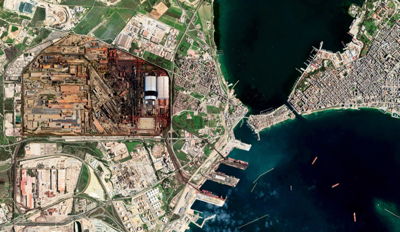
My point of departure is situated in place — visible here through a disembodied image taken from above by a satellite: Taranto, a city in southern Italy, known for being one of the most polluted in Europe Beginning of page[p. 408] due to the presence there of the continent’s largest and most hazardous steel factory (Figure 1). The factory can be seen on the left, its area (almost three times larger than the city itself) rendered in a saturated palette of oxidized reds and rust browns. As an anthropologist who lived in Taranto for roughly three years, I have often found this machinic view from above to be a helpful reminder of the factory’s overwhelming scale, of its sheer physical presence, which, in everyday life, slipped out of view — momentarily stepping back through something like the scalar operation famously staged in the film Powers of Ten.6 The satellite image risks reproducing the disembodied distance that feminist critiques of the ‘god trick’ have taught us to distrust.7 Yet it also performs a necessary scalar operation. It makes visible a magnitude that exceeds lived perception, while requiring, as Lisa Messeri’s work on planetary place-making suggests, a return from abstract scale to situated experience.8
I lived for several years in Taranto, which meant entering the scale and rhythm of everyday life, where my own body was directly involved. Although I did not frame it this way at the time, I was grappling with the challenge of connecting seemingly incommensurable scales: establishing a relation between the slow unfolding of an imperceptible disaster and everyday embodied experience. Minute details — from overheard stories to the uncannily sweet, chemical taste in my mouth — became objects of suspicious scrutiny. Were these small-scale manifestations, like symptoms, of the larger crisis unfolding? These paradoxical scales of experience involving the presence of infinitesimal poisons day to day, gesture towards what Max Liboiron has described as ‘scalar mismatches’.9
In spaces of environmental uncertainty, where material harms are known to cause premature deaths and illness, yet etiological connections remain difficult to prove, everyday life fluctuates between the Beginning of page[p. 409] denial of toxic threats and the tacit knowledge that they determine individual trajectories and the fabric of an entire social world. This radical uncertainty is condensed in a frequent expression in town: ‘In Taranto, we all have deaths in the family’ (A Taranto, abbiamo tutti i morti in famiglia). Of course, everyone has deaths in the family; but here, the saying signalled an entanglement of death with the everyday (alongside, of course, the recognition that most families are tied to the factory across generations). What was at stake, then, was not only the negotiation of spatial scale — the relation between one’s singular embodied trajectory and global industrial processes — but also a confrontation with another kind of temporality. During the fieldwork I conducted when living in Taranto from 2017 to 2020, stories of illness and death circulated constantly: a neighbour who lost her dog to cancer and asked to see its lung scans; a young man recounting the deaths of both his parents; a woman on the bus showing me a photograph of a child who had died in hospital. Over time, I came to understand this intense storytelling as a kind of collective intuition — people looking for signs, providing interpretations, working things out through experimental forms of knowledge and assessment.
Long-term fieldwork opens a window onto the everyday, allowing for a situated kind of knowledge, as Donna Haraway would have it. My own body became enmeshed over time: a listening body, porous to the affects and stories of others, as much as to the poisons they inherit. At the same time, ethnography of toxicity calls for another scale. The view from above, despite its disembodied distance, remains necessary to grasp the magnitude of industrial processes that exceed lived perception. What is at stake, then, is not only the negotiation of spatial scale, but also a movement between forms of situatedness and what Joshua DiCaglio has called a ‘situated dislocation’: a transcendence outside the logic of the god trick. This is a scale that meets the realm of the dead, of dreams, and of spectral presences that are, in some profound ways, nowhere and everywhere at the same time.
This raises a broader question that runs throughout these notes: How might one sustain a relation to scales that exceed lived perception without abandoning the situated experience of the body? For DiCaglio, ‘Scale demands that already within your everyday experiences are other scales of being. Looking at this hand, you are already seeing cells, Beginning of page[p. 410] atoms, ecological relations, bits of stardust.’10 And yet, if stardust gestures towards a cosmic scale embedded within the everyday, in Taranto this scale returns in a far more immediate, earthly form. Dust particles made of iron residues and heavy metals (lead, cadmium, arsenic) accumulate. They cling, are breathed in, tasted in one’s mouth.11 It is at the threshold between the planetary and the particulate that my attention turns to a series of images taken inside the city’s cemetery — so close to the factory that their edges touch. On the right, immediately adjacent to the factory’s darkest rust-red structures, a tightly packed grid of pale, stone-coloured rectangles marks the graveyard. Upon closer inspection, one can see it set within a patch of green.
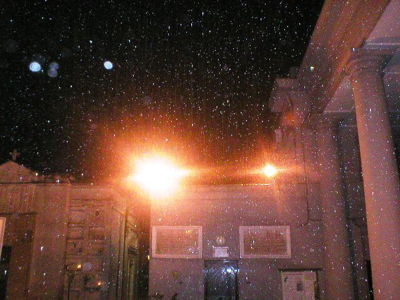
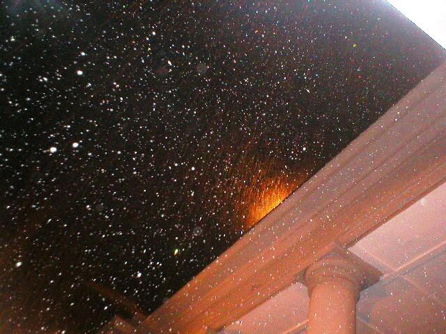
These photographs were taken by custodians on guard duty at night in the cemetery of Taranto (Figures 2–5).12 Rumour had it that Beginning of page[p. 411] some of the workers were falling asleep during nightshifts. To ensure they were awake, the office managers had them take pictures every two hours from different locations inside the cemetery. A date and time signature marks each digital file, proving that the custodians were not being paid to sleep. Thousands of images like these were systematically archived over a period of roughly four years.13 They are gritty, often out of focus. Light flares and architectural fragments appear in the frames, at times exiting their contours or receding into the darkness of night. The shots enact an auto-surveillance, where those surveilled do not themselves appear in the frame. What does appear through the camera’s flash is the glitter of dust.14 This dust is transported by the wind, over the cemetery walls, from a massive factory located a few metres away.
In Taranto’s social imaginary, toxicity has the consistency of pervasive dust. To distinguish it from regular domestic dust, it is called minerale (mineral’ in the Tarantino dialect), an ambiguous expression evoking both nourishment and poison. White tombs are coloured with the muted pink hue of the volatile iron ores imported from Brazilian mines — containing lead, cadmium, and arsenic. The ores are stocked in expansive, open-air ‘mineral parks’, where they await the wind that will carry them inside the graveyard. Dust enters your mouth, your eyes. If you caress a tomb, it stains the palm of your hand. Depending on time, oxidation, and the surface it lands on, ore dust can shift colour from grey-black to orange, ochre, burnt sienna, or brownish red. Beginning of page[p. 412]
Dust does not only settle on surfaces, but also circulates through speech, images, jokes, and forms of social exclusion. In 2017, a video shot in Taranto went viral on YouTube.15 Filmed in the Tamburi neighbourhood, it featured an interview with a woman named Annapia, who was asked to comment on windy days and their effect on residents. To describe the avalanche of toxic dust — minerale — that fell over people’s houses, she resorted to a forceful interjection in the Tarantino dialect: ‘quanda mineral’!’ (so much dust!). The video circulated widely, often as a joke, among Taranto residents and those living abroad who recognized that familiar speech. Her accent, her gestures, the simplicity of her outcry elicited laughter and mockery. Two years later, in 2019, Annapia was reported dead of cancer at the age of fifty-three — a piece of news that went largely unnoticed in comparison to the earlier circulation of her image.16
This was not the first time I had seen videos produced by Taranto residents that approached the environmental catastrophe through humour, irony, or self-ridicule. And yet this one struck me as a different form of derision, one marked by gendered and classed violence — the violence that likewise underlies the unequal distribution of toxicity. What was being mocked was not only the content of her speech, but her way of speaking, her gestures, her being marked as coming from one of the most marginal areas of the city (and, further, she was marginalized within her own neighbourhood for having a mental illness). The discomfort eliciting laughter also had to do with this material substance — dust — being a strangely familiar thing. Minerale, uttered in dialect, is both incredibly intimate and external: this is the same dust one can find extracted in the Brazilian mines of Minas Gerais. Zooming out from the infinitesimal iron ore and its utterance in a hyperlocal dialect to global extractive chains allows us to sense the scalar overlap between what Liboiron distinguishes as harm — namely the measurable effects of pollution as a process on the ground — and violence — the structural Beginning of page[p. 413] conditions of exploitation and colonial histories that make that process possible.17
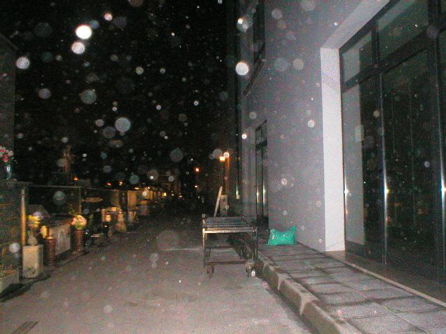
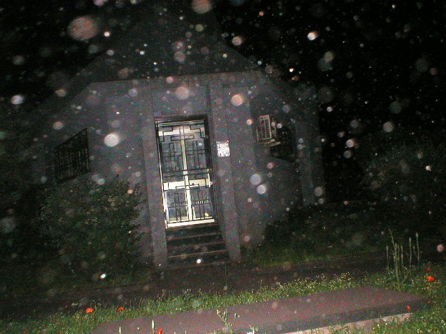
But let us stay with those cemetery images, with the situated surfaces where global extractive chains settle as intermittently visible dust. Initially, the images were meant to serve as proof of the night watchman’s ‘being there’, of his open eyes. Every two hours of that night, the guardian of the city of the dead was alive and awake, hard at work and not asleep. It was only later, during ‘Ambiente svenduto’ (Environment Sold Off), the decade-long criminal trial brought against former owners and executives of the steel factory for environmental disaster and widespread toxic contamination, that these photographs came to be seen as potential proof. Yet prosecutors deemed them unfit for the trial, too elusive and unreliable to serve as forensic evidence. After a decade of legal struggle, the trial itself has now been dissolved, this time because the prosecutors themselves were deemed unfit. In September 2024, the verdict was overturned on appeal. The reasoning is significant: the judges, being Taranto citizens, were deemed subject to toxic exposure, which made them potential victims of pollution and thus Beginning of page[p. 414] unable to judge the situation objectively. The verdict was overturned on appeal in September 2024, and the proceedings were transferred to Potenza for retrial, making it harder for Taranto residents to participate and testify.
In the transcriptions of the trial, now themselves gathering dust, we find a paediatric doctor recalling seeing and touching dust on children’s feet, between their toes, in the folds behind their ears. We find gravediggers struggling to describe in words the unnameable experience their labour entails: ‘I noticed that when I was shovelling the earth one day, the ground would shine from the inside’, one man said when interrogated. ‘It was strange. The dust has the consistency of flour. If you touch it, it rises. All it takes is a gust of wind; it accumulates on the surrounding cypresses. You find yourself chewing on it. On windy days, you feel it in your eyes, in your mouth.’18 Echoing this gravedigger’s words, the cemetery photographs belatedly reveal inscriptions of poison. They are — along with the dust itself — ‘material witnesses’ of an elusive environmental harm, even if the trial deemed them too unreliable for forensic evidence.19 The issue was not only one of visibility, but of temporality: these photographs seemed to arrive either Beginning of page[p. 415] too early or too late, caught in what Peter Szendy might understand as their heterochronic condition.20
As we scrolled through the full collection of thousands of dust images one afternoon in the cemetery office, the cemetery employees continued to ponder on their signification: Was the factory tormenting the dead, manifesting in the form of dust? Was dust their signal for a general awakening? ‘They poisoned this entire city slowly, they said, while we were asleep.’ On those nightshifts, taking photographs was meant literally to prohibit sleep — to hold the body within a forced register of wakefulness, suspending the rhythms through which the everyday ordinarily unfolds, as Marietta Kesting makes clear in her own piece in this volume.21 This in itself might have constituted what Maurice Blanchot sees, in The Writing of the Disaster, as one of the multiple facets of disaster: ‘sleepless night — such is the disaster: the night lacking darkness but brightened by no light.’22
If the injunction to remain awake marks these nocturnal images of dust, Georges Bataille’s brief dictionary entry ‘Dust’ (Poussière) offers a counterpoint.23 In this entry, he notes that ‘the storytellers have not realised that the Sleeping Beauty would have awoken covered in a thick layer of dust’, as ‘dismal sheets of dust constantly invade earthly habitations’ and nourish ‘phantoms, spectres’ (Figure 6).24 Teresa Stoppani, in her reading of Bataille, posits dust as the formless — l’informe — that does not possess its own form, and instead takes on that of the surfaces it coats, even as it alters them: a ‘performative process of form-making’.25 In her reading, dust reveals an ‘architecture Beginning of page[p. 416] of becoming’ that challenges its norms and economies of order, even while liveliness itself is suspended or at a standstill.
In Taranto, dust indeed blurs the boundaries traditionally enacted by the cemetery, which, as Michel Foucault writes in his short text on heterotopias, were meant to separate the living from the stuff of death — human corpses having long been considered in themselves a source of toxic contamination to be kept at bay.26 In one striking photograph from the cemetery by Taranto artist Isabella Mongelli, the body of Christ itself appears covered in toxic residue, as environmental contamination settles directly onto a representation of suffering and death (Figure 7). In the toxic city, dust infiltrates the graveyard’s porous borders, as well as the physical boundaries of its labourers. The many cemetery workers I met there insisted on their corporeal enmeshment with this dusty environment. ‘I am like a living dead’, one grave caretaker once told me. ‘I hear they are planning a decontamination here, but what exactly will they decontaminate? Will they have to decontaminate my body as well?’
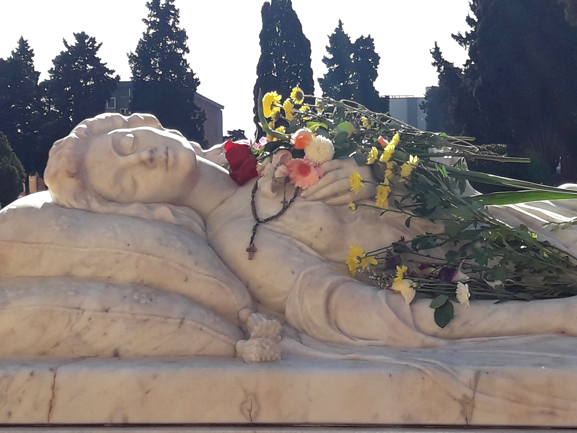
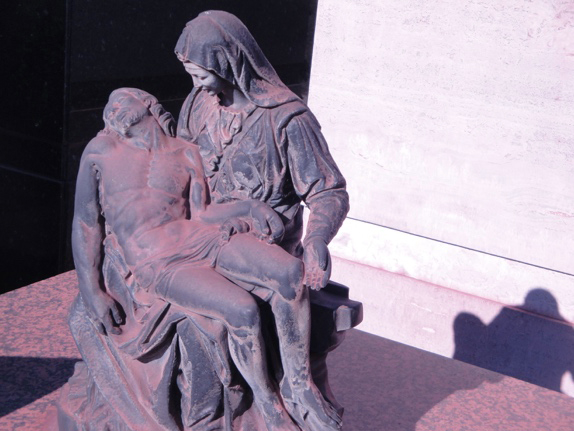
If the image of being poisoned while asleep was a metaphor summoned by Taranto cemetery employees, then ‘to be asleep’ meant that something was happening out of consciousness, a state implied by a change in scale, not only materially but temporally, into the everyday (or the everynight) where nothing happens, where events themselves disappear. The night photographs taken day by day mark the continuity of an unspectacular accumulation of dust.27 Here a strange redoubling takes place: the slowness of toxicity begins to share qualities with the Beginning of page[p. 417] very temporality of the everyday itself. Yet what might it mean to consider the everyday of toxic materialities (such as dust) as a timescale through which to think planetary environmental disasters?
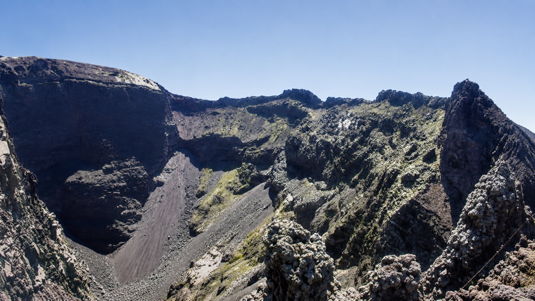
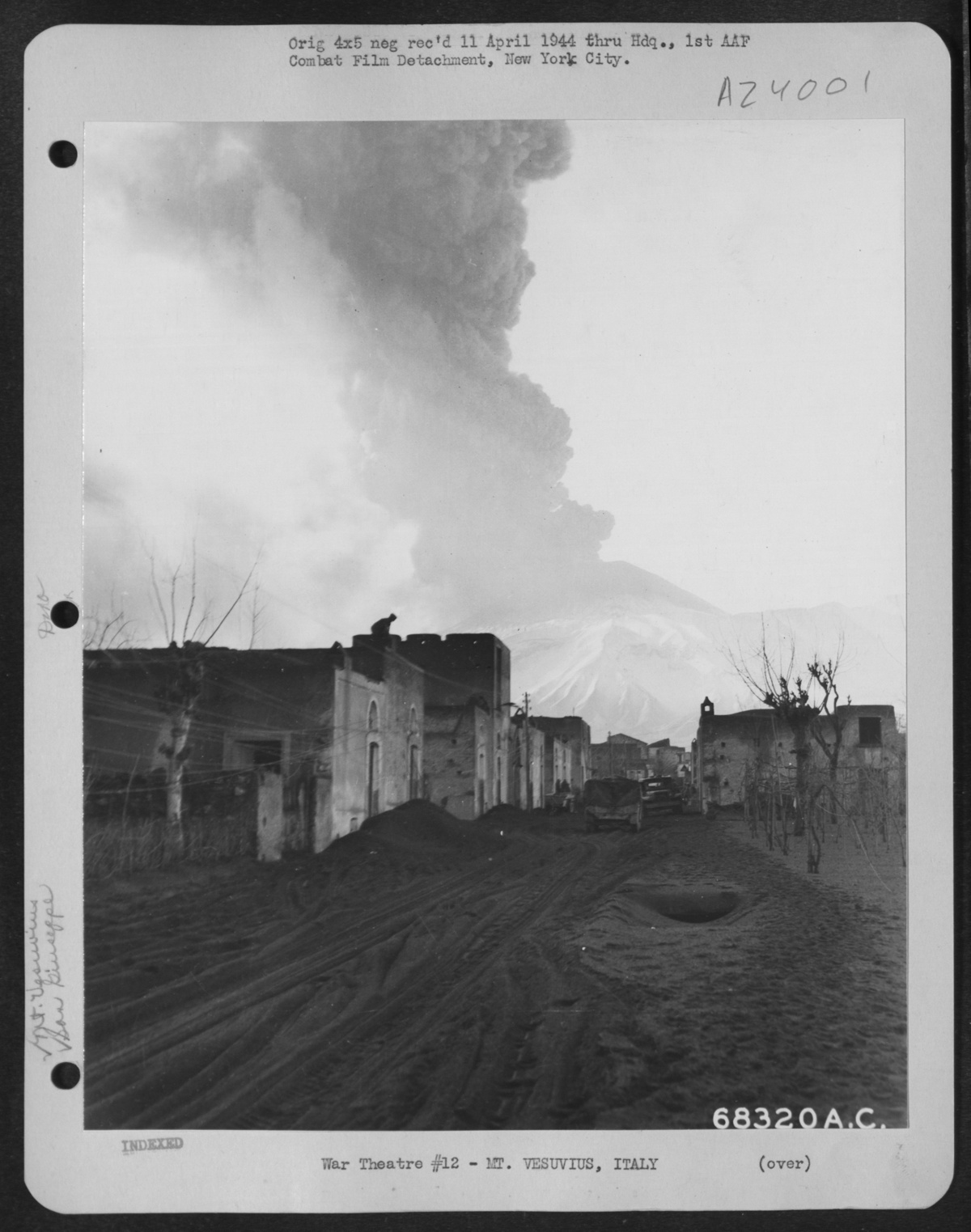
If the cemetery photographs bring us into the timescale of slow toxic accumulation, volcanic environments ask us to remain with particulate matter while shifting towards another scalar threshold, where dust and ash are not only linked to day-to-day exposure, but also to the sudden, eventful temporality of eruption. Of late, I have begun ethnographic research in the so-called Land of Fires — an area near Naples known today for an environmental disaster of a completely different nature,28 where such contradictory timescales — different Beginning of page[p. 418] temporal densities, rhythms, velocities — materially overlap. Here, layers of toxic waste have been buried on the slopes of a dormant volcano. I took this photograph (Figure 8) at the monitoring centre of the Vesuvius Observatory. It is an image of the livestream, one of the many techniques used to monitor its activity from day to day. Although it is ‘asleep’, as many residents of the area say, the volcano undergoes its own micro-variations. The vulcanologist and director of the observatory pointed out things I could not perceive in this image, such as tiny fumaroles — small volcanic holes from which hot gases and vapours issue in little puffs — indicating seismic swarms: minuscule, persistent tremors that occur beneath the ground over days or months, a continuous movement that takes place at a small scale, yet that could provide oracular warning signs of a large-scale eruption to come. The observatory Beginning of page[p. 419] cameras capture this uncanny sleep of the volcano: an interval, a gap — the non-eventfulness of anticipation, seismic latency, and surface tension. This dormancy is punctuated by histories of eruption: the most recent occurred in March 1944, during the Second World War, as captured in a photograph by American soldiers (Figure 9).
In his study of dust, Joseph Amato notes that ‘volcanoes shower the earth with fine particles of dust’.29 One can also think of Pompeii, where volcanic ash left cast traces of physical bodies.30 By contrast, the cemetery of Taranto has given rise to an ongoing struggle for vision, and for the identification and inscription of traces — where what emerges, even in writing and second-hand testimonies, is a form of intimate material intrusion, such as in the observations of doctors in Taranto, who describe dust on children’s bodies in similarly minute and invasive ways. Temporality, here, is stretched: we are in the space of slow catastrophe unfolding, in the folds behind one’s ears, in the micro-events of everyday life, in the realm of the infinitesimal and of ethnography — in other words, of dust.
Let us circle back to cemetery nights, via Georges Bataille and his short text entitled ‘The Ascent of Mount Etna’. If dust has appeared throughout this essay as a medium through which disparate scales come into relation, the volcano is, for Bataille, a fundamental image: one where the scale of the human body meets the body of the world. Across his writings, volcanoes repeatedly appear at moments when the intimate, geological, and cosmic are brought into relation. In ‘The Solar Anus’, he famously writes that ‘the terrestrial globe is covered with volcanoes, which serve as its anus’. In ‘The Ascent of Mount Etna’, originally a diary entry, this encounter takes place at the threshold between grave and crater, death and cosmos. On 15 September 1939 Beginning of page[p. 421] — two weeks after the beginning of World War II, and less than a year after the death of his lover Colette Peignot, otherwise known as Laure — Bataille recounts exiting his home in the night on a journey to reach her grave.
Yet as he makes his way towards the region of death in the darkness of the night, walking along the uphill slope towards the cemetery of Fourqueux, he is suddenly disoriented, interrupted, taken by a forceful vision: that of the terror he felt when ascending Mount Etna with Laure, only a year prior — a vision in which death is not encountered at a distance, but as an intimate force that binds body and environment into disorienting relation. ‘There was that shattering moment’, he writes, ‘when we leaned over the gaping wound, the crack in that star on which we drew breath.’31
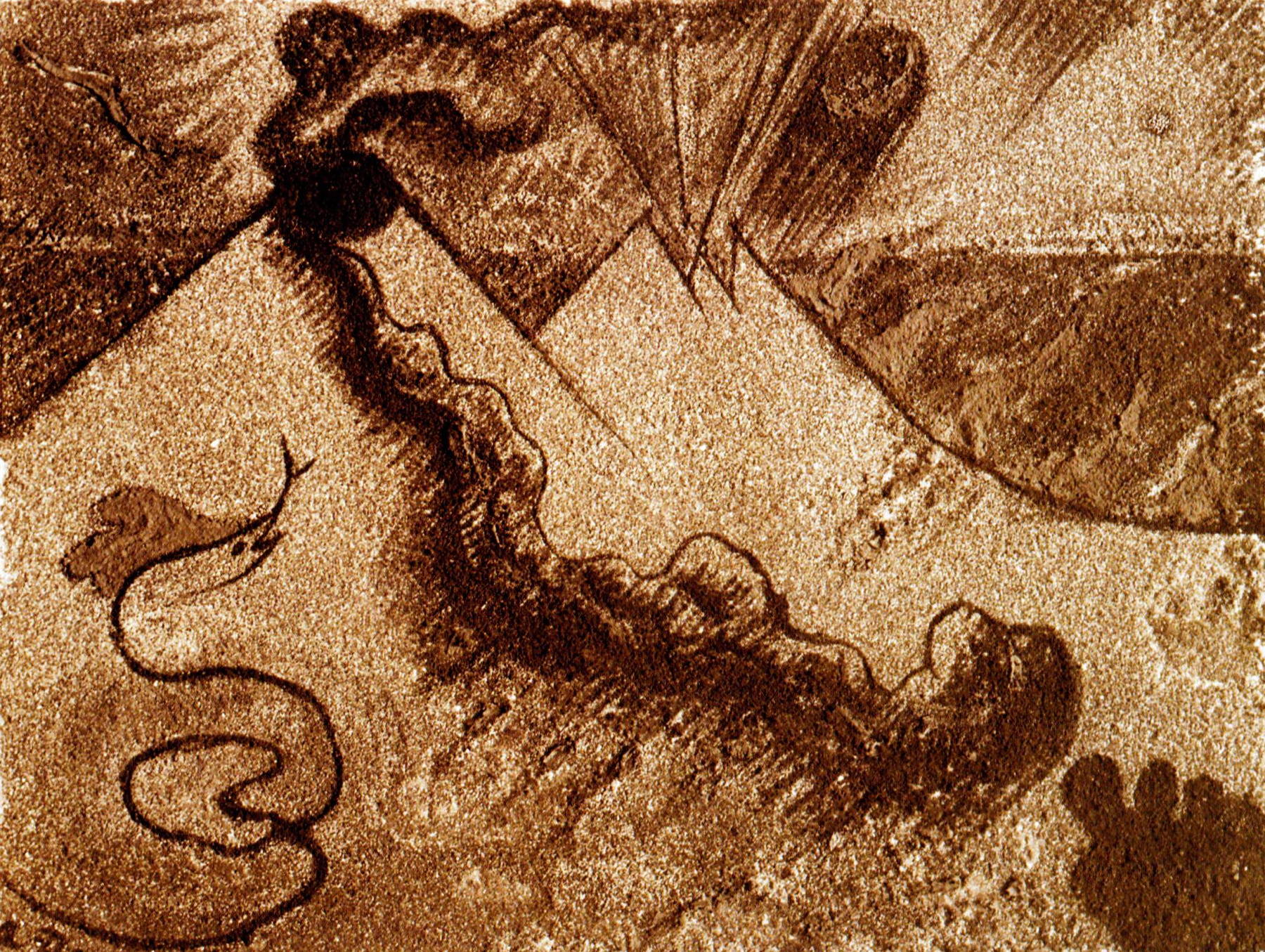
Laure later described their volcanic excursion, this shattering and anguishing moment, to their friend, the Surrealist painter André Masson, who translated her account into a small painting made of oil and dusty sand. This painting, likely the one reproduced in Figure 10, hung in Bataille’s room, over the bed where Laure died.32 My own attention is drawn to a detail in its lower right corner: a foot that protrudes from the image, reminiscent of Bataille’s obsession with the big toes photographed up close by Jacques-André Boiffard for the journal Documents.33 The upright toes in the painting almost touch, ever so lightly, the undulating flow of dark lava descending on the slopes. What interests me in Masson’s painting is the peculiar scalar operation it performs. It is impossible to fully discern, in the painting, the representation of an actual foot from that of a footprint — that mark which, as Radhika Subramaniam suggests, has long served to bind human, planetary, and cosmic scales. From the tracks preserved in volcanic ash at Laetoli, to boot prints on the moon, and the diffuse measure of carbon footprints, the footprint oscillates between a fleeting sign of passage and a measure Beginning of page[p. 422] of planetary burden.34 Masson’s image suspends the scalar relation between a human step and volcanic ground, rendering the toes and the flow of lava at the same size, as if body and earth (as in the anus and the crater) occupied a single plane of measure. Beginning of page[p. 423]
Such a scalar collapse — which often translates, in Bataille’s writing more generally, into an oscillating movement between ascent and descent — appears at the very moment of his encounter with Laure’s grave, when he is irresistibly drawn to Mount Etna, whose image interrupts and diverts his walk towards the cemetery. In this nocturnal passage between grave and crater, the volcano appears here as a threshold figure mediating between the lovers and death. Interrupting Bataille’s walk towards the cemetery, it opens a passage beyond the everyday, which he repeatedly describes as an enclosure within human particularity. Loving beyond the grave, he writes, frees one from the ‘vulgarity of daily relation’,35 and from a condition of estrangement that separates the human from the universe. Such moments are threshold experiences in which the human is violently exposed to scales that exceed it, suspending the ordinary coordinates of existence.36 How, then, can the human reconnect to scales from which the everyday estranges it? It is precisely this estrangement, and the everyday forms through which it is sustained, that becomes the object of reflection in the ‘incomplete’ chapter of his book Guilty (first published in French in 1944).
Here, a riveting mise en scène, not to say mise en abyme of scales takes place when a tiny ladybird falls on his philosophy papers, crawling its way onto big Hegelian concepts, ‘from allgemeiner Geist to sinnliches Bewusstsein (Einzelheit)’, all the way to the ‘column marked Leben’.37 This small creature, which causes in the philosopher a feeling of deep humiliation, is the opening of a text that will reflect on the everyday as something that locks humans in their particularity — in other words, in a state of absolute estrangement from the universe. Ordinary things — such as objects, meals, newspapers — leave us, he writes, ignorant of all else. ‘What connects existence to all else (tout le reste) is death; looking at death, you stop belonging to your room, Beginning of page[p. 424] to family and friend — you’re part of heaven’s free play.’38 Death, for Bataille, is what interrupts the enclosure of particularity, connecting the everyday to cosmic scales. To look at death is to enter a kind of cosmic exposure, ‘heaven’s free play’ (les jeux du ciel).
But what happens when death is not an interruption of the everyday, but is already woven into it? What happens in a place like Taranto, where death is not held at a distance but lived as an intimate, corporeal presence in the everyday? Recall the common expression recorded during my fieldwork: ‘A Taranto, abbiamo tutti I morti in famiglia.’39 Perhaps the daily accumulation of toxic dust — captured in photographs where it settles in zebra-like streaks, a flickering of death within the living — opens a pathway towards what Bataille called le reste, understood both as the totality of the universe and as residual matter, lo scarto. Dust, as particulate matter, might seem to confirm a logic of division into corpuscles, a fragmentation that severs connection to the cosmos. And yet dust, DiCaglio reminds us, recalls stardust.
If toxicity is the physical and spectral presence of death blurring the boundaries of the cemetery itself, these particles subvert all division and become a medium of relation across scales. In this sense, death operates as a passage — from the particular to the universal — so that what appears as minute and dispersed matter becomes the very site of a renewed, excessive relation to the cosmos. This resonates with what Michael Taussig calls the ‘mastery of non-mastery’: in conditions of ecological breakdown, the granular details of toxicity intensify a mimetic entanglement with planetary processes, a kind of ‘dark re-enchantment’ in which the body, no longer a bounded corpuscle, dissolves into and with the world.40
In ‘The Ascent of Mount Etna’, the vision of the crater, of an opening of the earth, certainly triggers anguish, but for Bataille, it is also a necessity, the source of subterranean glory. Perhaps it is this ability to swiftly shift between scales — as he ecstatically encounters death in a more-than-human, volcanic vision — that protects him from the risk of Beginning of page[p. 426] madness. It is striking that, in the final moments of the text, two fireflies appear in the darkness of the cemetery. Barely perceptible, flickering at the threshold of vision, they emerge just before the encounter with Laure’s grave as a zone of absolute darkness. These minute points of light do not illuminate so much as interrupt the surrounding obscurity, marking a fragile persistence of the visible. Neither aligned with the overwhelming scale of the volcanic nor with the enclosed particularity of the everyday, the fireflies occupy an intermediate register, barely perceptible, yet capable of sustaining a relation across scales. If they seem to belong to the logic of corpuscles, of division into ever smaller units, they in fact do something else — they flicker between scales; they hold open a tenuous passage.
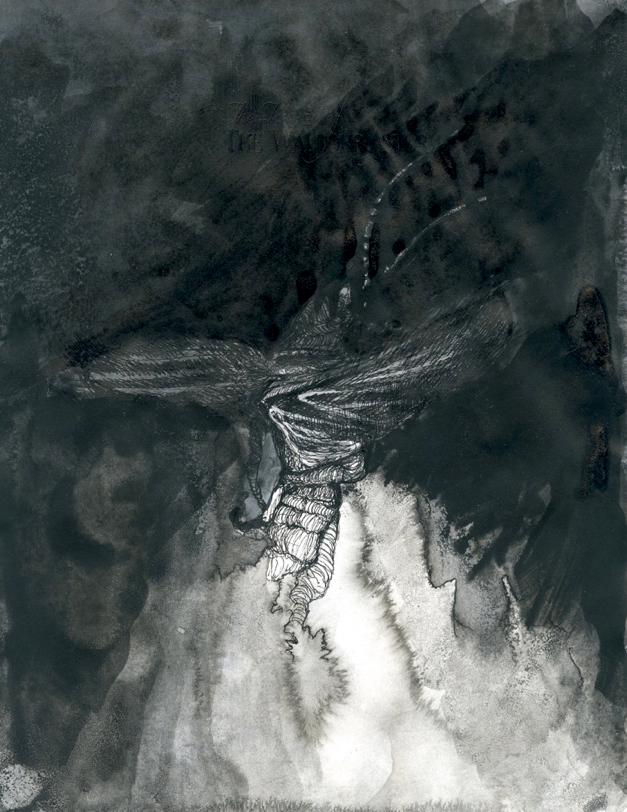
In this sense, they prefigure what Pier Paolo Pasolini would later evoke, in the mid-1970s, as the disappearance of fireflies under conditions of environmental pollution — an allegory for cultural loss that also referred to the material effects of industrial toxicity on environments (Figure 11). Their faint glow, here, reads as an uncanny anticipation, or even a poetic resurrection, of those vanishing lights: fragile signals resisting, at the threshold of perception. As I have argued elsewhere, following Vinciane Despret, such flickering forms are not simply visual phenomena but modes of relation, attuned to what remains uncertain, ungraspable, or not yet legible as evidence.41 Bataille’s fireflies do enact a passage across scales, between the infinitesimal and the cosmic. They hold together heterogeneous temporalities, from the slow violence of toxic exposure to the belated recognition of its effects. They flicker, not only in space but in time, between latency and apparition, as they keep open the possibility of relation at the very limits of visibility and life.
What my work seeks to follow are these flickering thresholds — where dust and death open unstable passages between scales, binding the most minute traces to the vastness of the cosmos, the situated experience of bodily processes in the everyday to the broader planetary and cosmic crises we endure today, yet struggle to grasp. It asks what it Beginning of page[p. 427] means to inhabit the condition that the southern Italian anthropologist Ernesto de Martino termed spaesamento: not simply disorientation, but, as he explores in his reflections on apocalypse, a crisis of presence in which the coordinates of existence begin to dissolve, and which demands a rewriting of the body’s relation to the world. To dwell within this condition means to remain with its instability, where an often-incommensurable relation between scales must be continually reconstituted at the threshold where it risks coming undone.42
Notes
- These preliminary reflections are part of a broader ongoing project on the timescales of ecological disaster. A few paragraphs draw on a published piece: Jasmine Clotilde Pisapia, ‘Poisonous Images: Taranto’s Environmental Crisis between the Visible and the Invisible’, Cultural Anthropology, 41.2 (2026), pp. 247–74 <https://doi.org/10.14506/ca41.2.03>. For their valuable comments on this specific piece, I thank Marietta Kesting, Christoph F. E. Holzhey, and Kirill Chepurin. I also wish to thank others who have engaged with parts or versions of this essay: Rosalind Morris, Lisa Stevenson, Valentina Bonifacio, Ulrich van Loyen, Jean-Ernest Joos, Filippo Bosco, Hélène Quiniou. This essay was developed during my fellowship at the ICI Berlin Institute for Cultural Inquiry. There, I extend my deepest gratitude to Nicolas Helm-Grovas, Verónica Stedile Luna, Angelica Stathopoulos, Tobi Haslett, Franco Costantini, Yuri Di Liberto, Magdalena Krysztoforska, Cat Dawson, Federica Di Blasio, José Antonio Magalhães, Claudia Peppel, and Manuele Gragnolati. ↵
- Trinh T. Minh-ha, Cinema Interval (Routledge, 1999). Film theorist Nicolas Helm-Grovas has kindly lent me this book, letting it rest on the shelf of my office for a few months. I thank him for many conversations around the images of disaster, and in particular films featuring volcanoes shown in our co-curated programme ‘The Screening Room’. ↵
- This point resonates with the seminal work of Carolyn Steedman, for whom dust is the material remainder through which history persists. See Carolyn Steedman, Dust: The Archive and Cultural History (Rutgers University Press, 2001). ↵
- This gesture is by no means exhaustive or conclusive, nor does it traverse the full range of what anthropology has already so generatively done on the topic of scale. For key interventions, see E. Summerson Carr and Michael Lempert, eds, Scale: Discourse and Dimensions of Social Life (University of California Press, 2016); Michael Lempert, From Small Talk to Microaggression: A History of Scale (University of Chicago Press, 2024); Anna Lowenhaupt Tsing, Friction: An Ethnography of Global Connection (Princeton University Press, 2005); and Anna Lowenhaupt Tsing, ‘On Nonscalability: The Living World Is Not Amenable to Precision-Nested Scales’, Common Knowledge, 18.3 (2012), pp. 505–24 <https://doi.org/10.1215/0961754X-1630424>; as well as Lisa Messeri, Placing Outer Space: An Earthly Ethnography of Other Worlds (Duke University Press, 2016). ↵
- Georges Bataille, ‘Formless’, in Bataille and others, Encyclopædia Acephalica, ed. by Robert Lebel and Isabelle Waldberg, trans. by Iain White and others (Atlas Press, 1995), pp. 51–52. ↵
- Lisa Stevenson, in Rima Praspaliauskiene, ‘Interview with Lisa Stevenson’, Write What You Like, Substack, 18 February 2026 <https://open.substack.com/pub/writewhatyoulike/p/interview-with-lisa-stevenson> [accessed 9 July 2026]. ↵
- Powers of Ten, dir. by Charles and Ray Eames (USA, 1977) <https://www.eamesoffice.com/the-work/powers-of-ten/> [accessed 8 September 2026]. ↵
- Donna J. Haraway, ‘Situated Knowledges: The Science Question in Feminism and the Privilege of Partial Perspective’, Feminist Studies, 14.3 (1988), pp. 575–99. ↵
- See Messeri, Placing Outer Space. ↵
- Max Liboiron and Josh Lepawsky, ‘The Scales of Waste: A Theory of Relationality’, in Liboiron and Lepawsky, Discard Studies: Wasting, Systems, and Power (MIT Press, 2022), pp. 35–60 <https://doi.org/10.7551/mitpress/12442.001.0001>. ↵
- Joshua DiCaglio, Scale Theory: A Nondisciplinary Inquiry (University of Minnesota Press, 2021), p. 5. ↵
- For an insightful political anthropology of dust as a scalar and relational medium between air, bodies, and environmental governance, see Jerry C. Zee, Continent in Dust: Experiments in a Chinese Weather System (University of California Press, 2022). ↵
- These photographs were presented in ‘The Everyday in Dramatic Closeness’, a group exhibition at the ICI Berlin Institute for Cultural Inquiry, Berlin (December 2025–January 2026), co-curated by Filippo Bosco, Christoph Breuer, Louisa Elderton, Claudia Peppel, Jasmine Pisapia, Anna R. Winder Salling, Silke Schwarz, and Verónica Stedile Luna. ↵
- We must think about this accumulation of images (akin to surveillance cameras) and the repetitive gesture of taking photographs in terms of the more general upscaling of the production of images in the contemporary everyday. See Jussi Parikka and Tomáš Dvořák, ‘Introduction: On the Scale, Quantity and Measure of Images’, in Photography Off the Scale: Technologies and Theories of the Mass Image, ed. by Tomáš Dvořák and Jussi Parikka (Edinburgh University Press, 2021), pp. 1–20. Regarding the massification of images and their temporal compression, the authors discuss Erik Kessels’s installation 24 Hrs in Photos, which materializes the overwhelming accumulation of images produced within a single day. ↵
- On the ambivalent aesthetics of seemingly harmless or playful materials such as glitter (often associated with childhood, femininity, or queer celebration, yet composed of persistent microplastics), see Nicole Seymour, Bad Environmentalism: Irony and Irreverence in the Ecological Age (University of Minnesota Press, 2018); Heather Davis, Plastic Matter (Duke University Press, 2022) <https://doi.org/10.1215/9781478022374>; and Mel Y. Chen, Animacies: Biopolitics, Racial Mattering, and Queer Affect (Duke University Press, 2012) <https://doi.org/10.1215/9780822395447>. ↵
- ‘Taranto, mineral, quanda mineral’, YouTube, 10 November 2017 <https://www.youtube.com/watch?v=s703tEh3PyE> [accessed 12 June 2026]. ↵
- ‘Addio ad Annapia, la sua denuncia “Quanda Mineral” era diventata virale sul web’, Rai News Puglia, 22 March 2019 <https://www.rainews.it/tgr/puglia/video/2019/03/pug-morte-annapia-video-quanda-mineral-ilva-taranto-manifestazione-roma-no-tap-514ee24e-a5e2-4b8a-a57f-6435e4c95d3b.html> [accessed 12 June 2026]. ↵
- See, in particular, Max Liboiron, ‘Scale, Harm, Violence, Land’, in Liboiron, Pollution Is Colonialism (Duke University Press, 2021), pp. 61–92 <https://doi.org/10.1215/9781478021445>. ↵
- ‘3e Dossier Processo Ilva: Parlano I lavoratori Ilva e cimitero, gli abitanti dei Tamburi, parti civili’ to the ‘Ambiente svenduto’ trial, made on 8–9 January 2019, by Slai Cobas. ↵
- Susan Schuppli, Material Witness: Media, Forensics, Evidence (MIT Press, 2020) <https://doi.org/10.7551/mitpress/9953.001.0001>. Recent work has explored the material presence and aesthetic-political form of toxic dust. See Rosario Talevi, Toxic Dust: A Field Guide to Ostrava’s Altered Landscapes (Plato, 2025). In addition, see Rebecca Comay, ‘When the Dust Settles’, and Natascha Sadr Haghighian, ‘Composed of Many’, video-recorded papers delivered at the conference ‘Minima Formalia: Minor Details and Empty Gestures’, ICI Berlin Institute for Cultural Inquiry, 20 May 2026, organized by Nicolas Helm-Grovas, Jasmine Pisapia, Angelica Stathopoulos, and Verónica Stedile Luna, <https://doi.org/10.25620/e260520_12> and <https://doi.org/10.25620/e260520_11>, respectively. Both presentations foregrounded dust in relation to the unfolding destruction and pulverization of Gaza. Although I cannot develop this analysis in the present context, I would like to invoke here Palestinian artist Raeda Saadeh’s video performance Vacuum (2007), in which Saadeh is shown vacuuming the barren hills of Palestine, displacing the domestic labour traditionally associated with women onto a landscape marked by dispossession. In this astonishing work made twenty years ago, dust is at once an environmental phenomenon, the haunting residue of violence, and the object of endless reproductive labour. José Segebre has written beautifully on waiting in Saadeh’s work Penelope (2012), where the artist is seen knitting while sitting over a pile of rubble. ↵
- Peter Szendy develops the notion of a heterochrony of images within a broader discussion of scale and of a general ‘iconomy’, in Peter Szendy, For an Ecology of Images, trans. by Marco Roth (Verso, 2025). ↵
- In her essay for this volume, on ‘Scaling Sleep’, Marietta Kesting approaches sleep as a scalar phenomenon, moving between the microphysiology of the body and planetary temporalities. She foregrounds sleep as a site of suspended time, non-eventfulness, and the disruption of everyday rhythms — an insight that resonates with the enforced wakefulness and temporal dislocation at stake in these nocturnal photographs. ↵
- Maurice Blanchot, The Writing of the Disaster, trans. by Ann Smock (University of Nebraska Press, 1995), p. 2. ↵
- Many thanks to literary scholar Verónica Stedile Luna for drawing my attention to this reference early on. ↵
- Georges Bataille, ‘Dust’, in Bataille and others, Encyclopædia Acephalica, pp. 42–43. ↵
- Teresa Stoppani, ‘Dust Revolutions: Dust, Informe, Architecture (Notes for a Reading of Dust in Bataille)’, The Journal of Architecture, 12.4 (2007), pp. 437–47 <https://doi.org/10.1080/13602360701614714>. I thank Angelica Stathopoulos for kindly introducing me to this body of work. See also Teresa Stoppani, ‘Venetian Dusts’, Log, 17 (2009), pp. 109–18; and, for an analysis of the gendered dimensions of dust, Teresa Stoppani, ‘Dusty Stories of Woman: Notes for a Re-definition of Dust’, in The Issues: Contemporary Culture and Aesthetics, ed. by Sue Golding (Nerve, 2005), pp. 125–32. ↵
- Michel Foucault, ‘Of Other Spaces’, trans. by Jay Miskowiec, Diacritics, 16.1 (1986), pp. 22–27. ↵
- This is, of course, a timescale — or temporality — that aligns with what Rob Nixon has called ‘slow violence’: forms of environmental harm that are gradual, dispersed, and therefore often imperceptible, in contrast to spectacular, immediately visible events such as oil spills or explosions. Nixon’s central concern is how such attritional processes (because they lack visibility) pose significant challenges for representation and political mobilization. I draw on this important work to complicate the apparent opposition between slow violence and the event. See Rob Nixon, Slow Violence and the Environmentalism of the Poor (Harvard University Press, 2011). ↵
- The Terra dei Fuochi (Land of Fires) designates a contaminated area near Naples and around Mount Vesuvius marked by the illegal dumping and burning of toxic waste, with significant environmental and health consequences. See Gabriella Corona, ‘La “Terra dei fuochi”: ambiente, storia e percezione sociale’, in Storia e ambiente: città, risorse e territori dell’Italia contemporanea, ed. by Gabriella Corona and Simone Neri Serneri (Carocci, 2010), pp. 195–217; Marco Armiero, Wasteocene: Stories from the Global Dump (Cambridge University Press, 2021); and Ilenia Iengo, ‘Endometriosis and Environmental Violence: An Embodied, Situated Ecopolitics from the Land of Fires in Campania, Italy’, Environmental Humanities, 14.2 (2022), pp. 341–60 <https://doi.org/10.1215/22011919-9712412>. ↵
- Joseph A. Amato, Dust: A History of the Small and the Invisible (University of California Press, 2000), p. 5. ↵
- Walter Benjamin visualizes the details of this traumatic invasion by material forces in ways that insist on the penetration of dust into the most infinitesimal parts of the body: ‘Ash managed to insinuate itself into every wrinkle of clothing, every whorl of the ear, and everywhere between people’s fingers, hair, and lips.’ Walter Benjamin, ‘The Fall of Herculaneum and Pompeii’, in Benjamin, Radio Benjamin, ed. by Lecia Rosenthal, trans. by Jonathan Lutes (Verso, 2014), pp. 152–57 (p. 155). In his recent film on life on volcanic ground in and around Naples, Gianfranco Rosi also insists visually and metaphorically on the persistence of dust. See Sotto le nuvole (Below the Clouds), dir. by Gianfranco Rosi (Italy, 2025). ↵
- Georges Bataille, ‘The Ascent of Mount Aetna’, trans. by Annette Michelson, October, 36 (Spring 1986), pp. 103–05 (p. 103) <https://doi.org/10.2307/778557>. ↵
- I would like to thank art historian Filippo Bosco for identifying the painting as Masson’s Empédocle (1937) in the André Masson catalogue held at the Staatsbibliothek zu Berlin. ↵
- Georges Bataille, ‘The Big Toe’, in Bataille and others, Encyclopædia Acephalica, pp. 88–89. ↵
- See Radhika Subramaniam, ‘Footprint: An Itinerary’, Borderlands, 21.1 (2022), pp. 117–37; and Radhika Subramaniam, Footprint: Four Itineraries (np:, 2025). ↵
- Bataille, ‘The Ascent of Mount Aetna’, p. 104. ↵
- Kirill Chepurin also identifies such threshold moments in his own reading of Bataille for this volume. See Kirill Chepurin, ‘Solar Figuration: Thinking the Human at the Scale of the Universe with Georges Bataille’, in this volume, pp. 53–90. ↵
- Georges Bataille, Guilty [1944], trans. by Bruce Boone (The Lapis Press, 1988), p. 46. The translation of the German expressions is given in footnotes: ‘From universal mind to sensory consciousness (individuality)’ and ‘Life’. ↵
- Ibid. ↵
- See above, p. 409. ↵
- See Michael Taussig, Mastery of Non-Mastery in the Age of Meltdown (University of Chicago Press, 2020), where he evokes ‘my body, your body, and the body of the world’ as entangled in interscalar, mimetic relation. ↵
- Vinciane Despret, ‘Fireflies in Uncertain Times (With a Rhythmic Instinction to Be Able to Travel Beyond Existing Forces of Life)’, in Philippe Parreno, Fireflies (HENI, 2019), pp. 129–35. I also use ‘flickering’ as an anthropological method attentive to intermittence — to what appears and disappears across gaps and intervals. ↵
- Ernesto de Martino, The End of the World: Cultural Apocalypse and Transcendence, trans. by Dorothy Louise Zinn (University of Chicago Press, 2023). ↵
Bibliography
- ‘Addio ad Annapia, la sua denuncia “Quanda Mineral” era diventata virale sul web’, Rai News Puglia, 22 March 2019 <https://www.rainews.it/tgr/puglia/video/2019/03/pug-morte-annapia-video-quanda-mineral-ilva-taranto-manifestazione-roma-no-tap-514ee24e-a5e2-4b8a-a57f-6435e4c95d3b.html> [accessed 12 June 2026]
- , Dust: A History of the Small and the Invisible (University of California Press, 2000)
- , Wasteocene: Stories from the Global Dump (Cambridge University Press, 2021) <https://doi.org/10.1017/9781108920322>
- , ‘The Ascent of Mount Aetna’, trans. by Annette Michelson, October, 36 (1986), pp. 103–05 <https://doi.org/10.2307/778557>
- Bataille, GeorgesGuilty [1944], trans. by Bruce Boone (The Lapis Press, 1988)
- , , Encyclopædia Acephalica, ed. by Robert Lebel and Isabelle Waldberg, trans. by Iain White and others (Atlas Press, 1995)
- , ‘The Fall of Herculaneum and Pompeii’, in Walter Benjamin, Radio Benjamin, ed. by Lecia Rosenthal, trans. by Jonathan Lutes (Verso, 2014), pp. 152–57
- , The Writing of the Disaster, trans. by Ann Smock (University of Nebraska Press, 1995)
- Carr, E. Summerson, and Michael Lempert, eds, Scale: Discourse and Dimensions of Social Life (University of California Press, 2016)
- , Animacies: Biopolitics, Racial Mattering, and Queer Affect (Duke University Press, 2012) <https://doi.org/10.1215/9780822395447>
- , ‘Solar Figuration: Thinking the Human at the Scale of the Universe with Georges Bataille’, in Scale: New Critical Essays, ed. by Christoph F. E. Holzhey and Marietta Kesting, Cultural Inquiry, 40 (ICI Berlin Press, 2026), pp. 53–90 <https://doi.org/10.37050/ci-40_kc>
- , ‘When the Dust Settles’, paper delivered at the conference Minima Formalia: Minor Details and Empty Gestures, ICI Berlin Institute for Cultural Inquiry, 20 May 2026, video recording, mp4, 31:07 <https://doi.org/10.25620/e260520_12>
- , ‘La “Terra dei fuochi”: ambiente, storia e percezione sociale’, in Storia e ambiente: città, risorse e territori dell’Italia contemporanea, ed. by Gabriella Corona and Simone Neri Serneri (Carocci, 2010), pp. 195–217
- , The End of the World: Cultural Apocalypse and Transcendence, trans. by Dorothy Louise Zinn (University of Chicago Press, 2023) <https://doi.org/10.7208/chicago/9780226820569.001.0001>
- , ‘Fireflies in Uncertain Times (With a Rhythmic Instinction to Be Able to Travel Beyond Existing Forces of Life)’, in Philippe Parreno, Fireflies (HENI, 2019), pp. 129–35
- , Scale Theory: A Nondisciplinary Inquiry (University of Minnesota Press, 2021) <https://doi.org/10.5749/j.ctv22fqc19>
- , ‘Of Other Spaces’, trans. by Jay Miskowiec, Diacritics, 16.1 (1986), pp. 22–27 <https://doi.org/10.2307/464648>
- , ‘Composed of Many’, paper delivered at the conference Minima Formalia: Minor Details and Empty Gestures, ICI Berlin Institute for Cultural Inquiry, 20 May 2026, video recording, mp4, 25:52 <https://doi.org/10.25620/e260520_11>
- , ‘Situated Knowledges: The Science Question in Feminism and the Privilege of Partial Perspective’, Feminist Studies, 14.3 (1988), pp. 575–99 <https://doi.org/10.2307/3178066>
- , ‘Endometriosis and Environmental Violence: An Embodied, Situated Ecopolitics from the Land of Fires in Campania, Italy’, Environmental Humanities, 14.2 (2022), pp. 341–60 <https://doi.org/10.1215/22011919-9712412>
- , ‘Scaling Sleep: Modes of Suspension, Reduction, and Intensification’, in Scale: New Critical Essays, ed. by Christoph F. E. Holzhey and Marietta Kesting, Cultural Inquiry, 40 (Berlin: ICI Berlin Press, 2025), pp. ##–## <https://doi.org/10.37050/ci-40_mak>
- , From Small Talk to Microaggression: A History of Scale (University of Chicago Press, 2024)
- , ‘Scale, Harm, Violence, Land’, in Max Liboiron, Pollution Is Colonialism (Duke University Press, 2021), pp. 61–92 <https://doi.org/10.1215/9781478021445>
- , , ‘The Scales of Waste: A Theory of Relationality’, in Liboiron and Lepawsky, Discard Studies: Wasting, Systems, and Power (MIT Press, 2022), pp. 35–60 <https://doi.org/10.7551/mitpress/12442.001.0001>
- , Placing Outer Space: An Earthly Ethnography of Other Worlds (Duke University Press, 2016) <https://doi.org/10.1215/9780822373919>
- , Slow Violence and the Environmentalism of the Poor (Harvard University Press, 2011) <https://doi.org/10.4159/harvard.9780674061194>
- , , ‘Introduction: On the Scale, Quantity and Measure of Images’, in Photography Off the Scale: Technologies and Theories of the Mass Image, ed. by Tomáš Dvořák and Jussi Parikka (Edinburgh University Press, 2021), pp. 1–20 <https://doi.org/10.3366/edinburgh/9781474478816.003.0001>
- , ‘Poisonous Images: Taranto’s Environmental Crisis between the Visible and the Invisible’, Cultural Anthropology, 41.2 (2026), pp. 247–74 <https://doi.org/10.14506/ca41.2.03>
- Powers of Ten, dir. by Charles and Ray Eames (USA, 1977) <https://www.eamesoffice.com/the-work/powers-of-ten/> [accessed 8 September 2026]
- , ‘Interview with Lisa Stevenson’, Write What You Like, Substack, 18 February 2026 <https://open.substack.com/pub/writewhatyoulike/p/interview-with-lisa-stevenson> [accessed 9 July 2026]
- , Material Witness: Media, Forensics, Evidence (MIT Press, 2020) <https://doi.org/10.7551/mitpress/9953.001.0001>
- , Bad Environmentalism: Irony and Irreverence in the Ecological Age (University of Minnesota Press, 2018) <https://doi.org/10.5749/j.ctv65sz3q>
- Sotto le nuvole (Below the Clouds), dir. by Gianfranco Rosi (Italy, 2025)
- , Dust: The Archive and Cultural History (Rutgers University Press, 2001)
- , ‘Dust Revolutions: Dust, Informe, Architecture (Notes for a Reading of Dust in Bataille)’, The Journal of Architecture, 12.4 (2007), pp. 437–47 <https://doi.org/10.1080/13602360701614714>
- Stoppani, Teresa‘Dusty Stories of Woman: Notes for a Re-definition of Dust’, in The Issues: Contemporary Culture and Aesthetics, ed. by Sue Golding (Nerve, 2005), pp. 125–32
- Stoppani, Teresa‘Venetian Dusts’, Log, 17 (2009), pp. 109–18
- , ‘Footprint: An Itinerary’, Borderlands, 21.1 (2022), pp. 117–37
- Subramaniam, RadhikaFootprint: Four Itineraries (np:, 2025)
- , For an Ecology of Images, trans. by Marco Roth (Verso, 2025)
- ‘Taranto, mineral, quanda mineral’, YouTube, 10 November 2017 <https://www.youtube.com/watch?v=s703tEh3PyE> [accessed 12 June 2026]
- , Mastery of Non-Mastery in the Age of Meltdown (University of Chicago Press, 2020) <https://doi.org/10.7208/chicago/9780226698700.001.0001>
- , Cinema Interval (Routledge, 1999)
- , Friction: An Ethnography of Global Connection (Princeton University Press, 2005) <https://doi.org/10.1515/9780691263526>
- Tsing, Anna Lowenhaupt‘On Nonscalability: The Living World Is Not Amenable to Precision-Nested Scales’, Common Knowledge, 18.3 (2012), pp. 505–24 <https://doi.org/10.1215/0961754X-1630424>
- , Continent in Dust: Experiments in a Chinese Weather System (University of California Press, 2022) <https://doi.org/10.1525/9780520384101>
© by the author(s)
Except for images or otherwise noted, this publication is licensed under a Creative Commons Attribution-ShareAlike 4.0 International License.© 2026 ICI Berlin Press