

‘A Subtle System of Feints’Gender, Medical Photography, and the Essential Void of Sex*Cat Dawson
Abstract
This essay studies a selection of regulatory projects related to sex and gender to describe the role that scale plays in categorizing and ordering bodies. It uses a series of medical photographs by the sexologist Magnus Hirschfeld as its historical point of departure to show that sex is the incoherent product of a series of effects constructed in aggregate from multiple scales. The essay concludes by exploring ways that strategies to curtail trans life and rights can be appropriated to not only redress transantagonisms but also to contribute to broader struggles for justice.
Keywords: scale; sports; medical photography; transgender; Las Meninas; Foucault, Michel; Hirschfeld, Magnus; sexology; sex; gender
* This article benefited greatly from conversations with and thoughtful feedback from colleagues involved in the ICI Berlin project ‘Scale’, in particular Filippo Bosco, Tobi Haslett, Nicolas Helm-Grovas, Christoph F. E. Holzhey, José Antonio Magalhães, Angelica Stathopoulos, and Verónica Stedile Luna. Special thanks to Colin Hoag and Beans Velocci for generous feedback on the draft as well.
One of the most oft-cited origins of both the trans rights movement and the field of trans studies is the Institute for Sexual Science (Institut für Sexualwissenschaft), founded by Magnus Hirschfeld in Berlin in 1919 to establish a scientific basis upon which to build a case for the social acceptance and civil rights of individuals who today fall under the initialism ‘LGBTQ’.1 Interwar Berlin was a particularly fitting city in which to open such a place; at the time, Berlin had both a law that prohibited cross-dressing and a licence one could apply for to be exempt from that law.2 This incongruity anticipated some of the problems that would arise from trying to sort bodies into binary sex and gender categories over the following century.3Beginning of page[p. 118]
Hirschfeld’s patients included subjects with intersex conditions, some of whom he took photos of that were subsequently included in the many books he published over the course of his career.4 One recurring trope in the photos that appear in Hirschfeld’s publications is a three- or four-photograph series of a single subject that is intended to describe the relationship between the subject’s genitals and their gender presentation. One example is Pseudohermaphroditismus masculinus bei überwiegend männlichem Habitus, which first appears in his 1905 book Geschlechtsübergänge. In the top left image, the patient seems to have a pronounced chest, suggesting the presence of breasts, and wears a skirt, cropped jacket, and veiled hat with a flower on it. In the top right image, the same subject appears to have a flat chest and is sporting trousers, a longer coat with collar and tie, and a bowler-style hat. In the bottom two images, the patient is nude, shown from the front on the left and the back on the right. Alone in three of the images, the patient is joined in the frontal nude photo by Hirschfeld, who stands perpendicular to the camera, his gaze directed at the patient’s genital area so as to direct the viewer’s gaze there as well.
In representing a single subject who can be read as either masculine or feminine, Pseudohermaphroditismus masculinus evidences the bleeding edge of sex research at the turn of the twentieth century, a moment in which biomedical science began studying variations in human sexuality with increasing attention and sophistication. The formal deployment of a two-by-two grid emphasizes the binary logic that structures the patient’s body across the series — masculine-presenting and feminine-presenting, clothed and nude, front and back. The series also evidences the emergence of a strain of practitioners who were enfolding an understanding of the ethical stakes of their work into their practice: Hirschfeld obscures his patient’s identity with a mask even in the image taken from behind, and, in the frame taken from the front, he uses his gaze, rather than a finger or a pointer, to direct the viewer’s gaze towards the area intended to be understood as the locus of the subject’s ability to present as either of two genders — and thus, by implication, their inability to normatively cohere to only one.Beginning of page[p. 119]
Pseudohermaphroditismus masculinus invites the viewer to infer that this patient’s ability to present convincingly as both male and female at the scale of the sartorial — which would have been understood as equivalent to the social — is implicitly indexed to genitals that, as the title of the series suggests, do not cohere to either of the two predominating sex categories. By using a set of binaries to structure this series, Hirschfeld suggests that the physiological expression of sexual characteristics — and, therefore, of sartorial expression and social roles — can, in most cases, be easily sorted into one of two sex categories, but that those expressions that cannot also pose no threat of disruption to the social order. One can also infer from the series that the patient’s ability to pass socially as both masculine and feminine is the result of the subject’s supposed intersex condition, a causality most directly suggested in the frame in which Hirschfeld joins his patient, a decision that draws the viewer in from the scale of the full-length body to that of the genitals.
But there is just one problem: the genitals themselves — the ostensible final term in this spectatorial chain — are entirely obscured by a dense profusion of pubic hair. Both the biomedical and spectatorial logic of the series turn on something that cannot be verified by the viewer, and that undermines the indexicality of gender to genitalia that the series was created to illustrate. Pseudohermaphroditismus masculinus introduces ambivalence into a biomedical attempt to sort bodies neatly into binary categories. This ambivalence is just one of many ways in which what Beans Velocci calls ‘the incoherence of sex — its multiple, coexisting, conflicting meanings’ shows up in twentieth and twenty-first century research and discourse about sex, gender, and the relationship between the two.5 As Velocci observes, that incoherence ‘was a feature, not a bug […] a means of ensuring near limitless claims to scientific innovation’ that turned on a ‘tacit agreement to not look too closely at the contradictions contained within’ biomedical science’s ‘struggle to make knowledge out of complex bodies’.6 This heady mix of binary rigidity and ‘built-in dexterity’ facilitated the development Beginning of page[p. 120] of a scientific explanation for pre-existing social categories. These worked in tandem with other efforts to sort bodies — especially race — to further solidify a range of hierarchies.7 Rather than supporting the argument it is intended to, Pseudohermaphroditismus masculinus exposes sex as a collection of effects that occur at multiple scales both within and on the body, produce sex in aggregate, and have a non-indexical relationship to gender.
This essay investigates the inheritance of the binary logic that Pseudohermaphroditismus masculinus was intended to support, beginning with one of its most consistently visible legacies: sex testing in sport. Sex testing initially gained authority in much the same way that the biomedical knowledge on which it relies did: by claiming to be able to see things at ever smaller scales. But eventually the search for a single and conclusive origin of sex hit a limit, producing the same asymptotic situation allegorized by Hirschfeld’s series, in which a single locus for sex seems to draw ever nearer, but is never quite reached. Because no test at any single scale could produce a satisfactorily binary result, sex testing regimes began shifting among scales in a non-linear fashion. This produced, by the middle of the twentieth century, a regulatory system in the world of sport that purports to draw on and contribute to the perpetuation of a coherent and binary system but is instead a subtle system of feints. In sport, the banner of fair play is waved to distract from a broader agenda of reinforcing specious assertions of the existence of fundamental sexual difference and other systems of knowledge subtended by the binary logic of sex. A close reading of this history reveals how sex and gender binaries are constructed in aggregate and across multiple scales that contain the same incoherence today that the scientists who developed these systems long ago also found.
In what follows, I study two instances beyond sport in which similar systems of feints have been leveraged to resolve certain questions about political economy raised by trans life and rights. Both are examples of a conservative political initiative deploying scalar logic to bring heightened scrutiny to a group of persons or set of issues in order to subtly but substantively erode progressive institutions, including Beginning of page[p. 121] but not limited to intersectional coalitions such as labour unions. I then explore how a similar but inverse strategy can be mobilized to redress the effects of such attacks and buttress against them in the future.
Scale has played a substantial role in producing and disrupting ideological projects related to sex. As biomedical understandings of sex took shape and were deployed to explain a range of systems beyond reproduction, it came to seem as though sex could be found at multiple scales, creating the illusion of a cohesive sex system despite the incoherence of its constituent parts. Scalar discourse persists in being used to transantagonistic ends today, the material fact of the unruliness of bodies obscured in the service of cultivating a belief that sex and gender are binary, deviations from them are a novelty, and dominant culture will falter if their conventions are transgressed.
Transness is observed at few if any of the scales at which binary sex is purportedly found. But it is nevertheless a central term in the discourse about sex at nearly every scale and is therefore a key tool for disrupting ordering systems that rely on a trans-scalar logic of sex. To bridge this gap, I deploy a trans analysis, decoupling understandings of the body from binary sex categories, and deracinating gender from sex, to expose instances in which the trans-scalar relationships that underwrite systems of sex and gender also scaffold efforts to curtail trans life and rights. Explicating the scalar logic of sex from the molecular to the juridical using a trans approach elucidates the degree to which binary sex and gender categories are not ontological fact, but rather expressions of regulatory systems developed to sustain existing architectures of power.8 This work also makes it possible to reframe vulnerabilities as sites from which to redress challenges to trans rights, and to demonstrate how questions about political economy raised by trans life and rights are urgently relevant to broader struggles for justice.
Sleights of Hand
Among its other definitions, scale is a way to measure and describe the relationship between related but distinct objects or concepts. Emanuele Lugli has demonstrated how the process of measurement has Beginning of page[p. 122] fundamentally shaped how subjects perceive the world around them, arguing for example that ‘the abstraction of bodies through measurement was the first step in accessing the ideal world of beauty’.9 But, Lugli continues, ‘the harmful social and psychological repercussions of this delusion continue to affect us to this day.’ Systems of measurement, in other words, may begin hyperlocally to serve a particular need, but they tend to foreclose on as many possibilities as they create. Measurement entails slicing between phenomena, which severs connections between related entities, and systems of measurement have regularly been exported from their origin and imposed elsewhere, resulting in their application to a greater heterogeneity of phenomena than those for which they were initially designed. An analytic developed at one scale superimposed onto other, even nearby scales orders subjects according to often ill-fitting logics, excluding or rendering invisible subjects or content that are present.
Scale routinely results in hierarchies that mirror and reinforce social norms derived from ideological projects.10 Phenomena at different scales are linked together, using the supposed presence and dependencies of a concept at multiple levels as evidentiary support for extant hierarchies, as in the example of biomedical scientists’ historical assertions that binary expressions of sex could be identified at the endocrinological, genetic, and gonadal levels. The further one moves away from the origins of a scale, the more abstract the system for which it was developed becomes, eventually expanding, like the concept of binary sex, to the point that it seems inescapable. When the origins of such a system are obscured enough, they can also come to be naturalized across scales, and put forth as systems of knowledge that promise objectivity. This strategy, which Donna J. Haraway calls the ‘god trick’,11 is a sleight of hand that answers to what Anna Lowenhaupt Tsing calls the ‘malevolent hegemony’ of ‘precision nesting’, in which an ordering Beginning of page[p. 123] logic’s claim to authority turns on the creation of an illusion of a smooth scroll across a range of scales.12 The canonical example of this is the 1977 film Powers of Ten, by Charles and Ray Eames, which begins with a tight shot on a white, heterosexual couple picnicking on a red and white checked blanket before zooming out from the couple to the cosmos, then back in to the scale of quarks, at increments of powers of ten metres.13
But scalar precision, nesting, and smooth scrolls are incompatible with the heterogeneity of the world. Presenting the scope of human knowledge as accessible via an infinite scroll across a set of neatly nested scales, Powers of Ten is an example of the conventional application of scale, demonstrating not only that knowledge can be disciplined to an ordering system, but also that a tight fit between that system and the knowledge it purports to order is contingent on exceptions to its own rules. As Zachary Horton observes, the smooth scroll in Powers of Ten is made possible by a series of ‘resolving cuts’ used as ‘explanatory […] representations’ that facilitate adherence to the powers-of-ten zoom conceit despite ontological barriers such as the surface of the skin.14 The ability to subsume resolving cuts into neat jumps that obscure ‘negotiations between ontological scalar difference and disciplinary resolution’,15 facilitated by the built-in dexterity of the form of film, echoes presumptions about race, class, and familial entailments implied by the couple with whom the film begins.
Similarly to the smooth scroll in Powers of Ten, sex is routinely presented as a binary native to each of a set of nested scales that are anchored within the body but applicable beyond it. To see the full range of ways in which the ordering systems of gender and sex co-create hierarchies requires a degree of permissiveness regarding the imperfect conjunction of the relevant scales — something that, as Powers of Ten demonstrates, is a foundational characteristic of scalar Beginning of page[p. 124] logics. Not only can binary sex not be found at every scale where its presence is asserted, but one of the ways of defining scale also holds that it be constrained by ‘a measured range of observation’ — something that cannot hold true under the asymptotic conditions that define the search for sex on the body, which I have provisionally explicated in Figure 1.16 Moreover, as feminist historians of science have documented extensively since the 1980s, sex research was often motivated by a desire for a scientific basis for existing social hierarchies that would reinforce both the social order and science’s claims to authority. These efforts routinely impacted ordering systems beyond those they sought to shore up, including anatomical drawings derived far more from social gender norms than from actual skeletons; the pathologization of homosexuals in the course of developing a scientific excuse for racism; and hierarchies in the plant and animal sciences that resulted from the superimposition of human sex and race categories.17 In each of these cases, the problem of abstraction is solved through the system’s inherent dexterity; in other words, the incoherence of the system of sex is precisely what makes it such a productive tool to shore up other ordering logics.
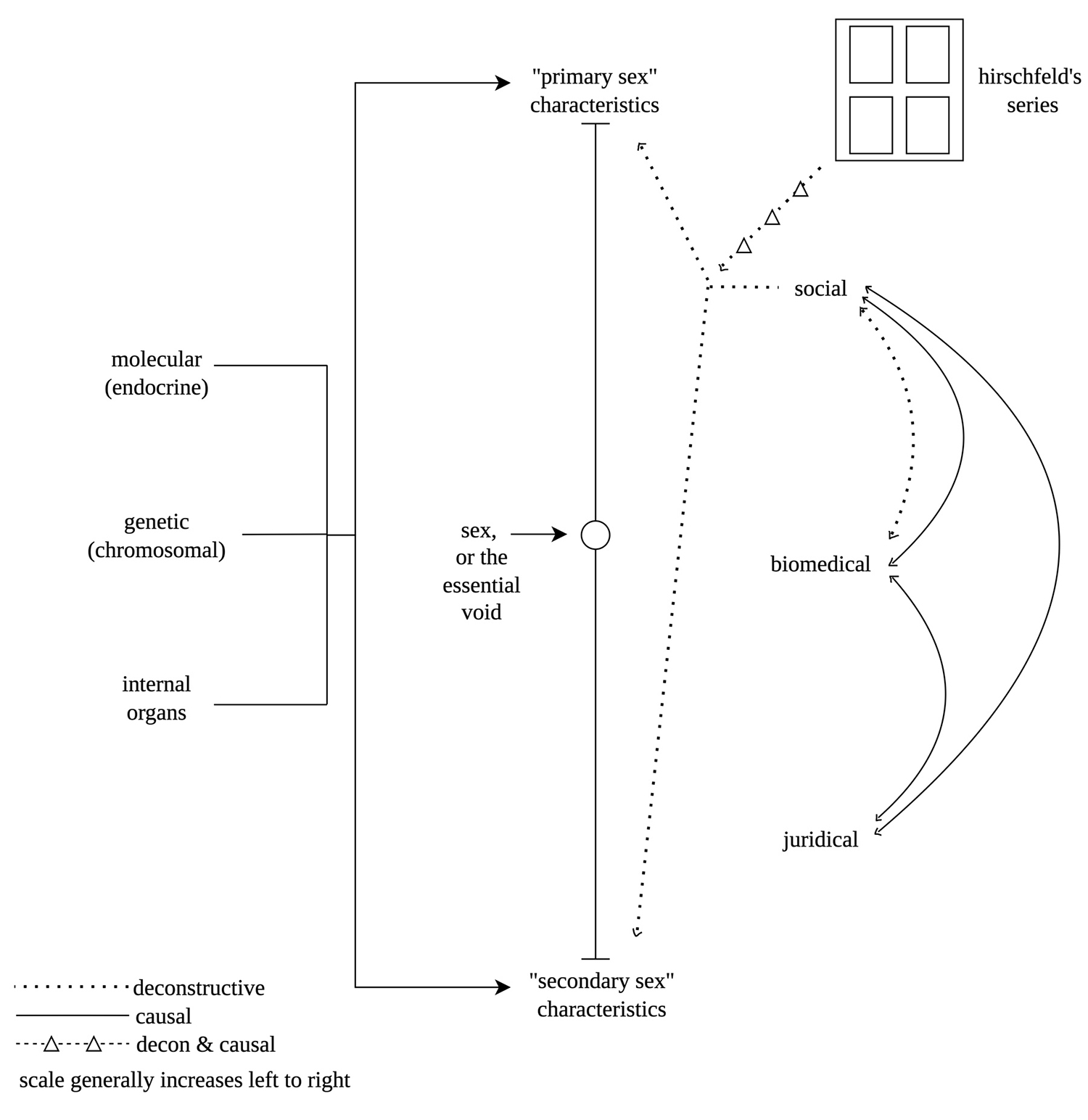
The problem of abstraction inherent in scalarity is compounded when distinct scales are conjoined across ontological divides. In discourse around sex and gender, the body risks becoming — indeed often becomes — abstracted to the point that the material subject is obscured to a monolithic straw man that Beans Velocci calls a ‘microcosm of patriarchal ideology and abstract scientific logics’.18 One example of this is observed by Katrina Karkazis and Rebecca M. Jordan-Young, who describe how perceptions that testosterone provides a decisive and unparallelled competitive edge persist in determining official narratives about testosterone both within and beyond the world of sport despite research that clearly evidences testosterone’s divergent and Beginning of page[p. 126] often diluted effects on performance, and comparably insufficient attention to the expansive network of entanglements of nature and culture that constitute competitive advantage.19
The trans-scalar effects of presenting sex as a binary that appears across a series of neatly nested scales are just some of the collateral damage caused by the subtle system of feints that continue to shore up sex and gender binaries. As Marquis Bey observes, ‘classificatory systems demand that we remain within them, that we remain on this side of classification, […] that we remain cis, the transing of which requires reprimand.’20 Trouble also arises when scalar orthodoxy either precludes us from seeing, or provides a permission structure to not see, how power operates across otherwise disparate scales. Orthodoxies that insist on the clean separation of scales blinker us to the ways that power operates across otherwise incompatible scales. For example, because the scale of processes within the human body is framed as distinct from the scale of the jurisprudential, scalar convention may suggest they are unable to be studied together. But court decisions impact, regulate, and constrain the subject, while challenges to trans rights have consistently sought to control what happens within bodies. By the same token, narratives that stage systems like sex as linear and trans-scalar, despite little evidence that they are either of these, mimic and perpetuate the operations of power by constantly redirecting focus to different places where sex might be found, and leave little time to interrogate the motivations either for that constant movement or for finding a single locus in the first place.
The problems with leveraging scalar logics to underwrite arguments that sex is binary and can be found at multiple scales come into sharp relief when confronted with trans life. At the scales at which sex is regulated, transness is not actually visible. It is not possible to test for transness at the endocrinological or genetic levels, only to mark out deviation from the binary logic superimposed onto hormone levels or genetic markers in the form of implications about sex and the expectations about gender from which those expectations overwhelmingly Beginning of page[p. 127] derive. For example, the regulation of clothing to sex assigned at birth has long been a vector of social control in the form of anti-cross-dressing laws, cases brought against subjects for violating them, and, as in the example of Berlin’s regulations, the existence of public policies that created exceptions to them. But rebellion against those regulations has also been a crucial site of resistance to it.
Pseudohermaphroditismus masculinus demonstrates this ambivalence with precision by illustrating the presumed relationship between the sartorial and the genital while simultaneously undermining it. The series delineates the presumption that a larger-scale concept — the clothing a subject wears — is the product of a process that occurs at a smaller scale. What is suggested to be the patient’s intersex condition is staged as the locus of their inability to conform sartorially, and thus by implication socially, to only one of two binary genders. At the same time, this series can be read as a deracination of the indexicality of genitalia from sartorial expectation: because the viewer is presented with images of the patient in attire that convincingly answers to two distinctly gendered sartorial expectations but only verbal information about the patient’s genitalia, genitalia is implied to have little or nothing to do with the sartorial or social in this series or the theories it underwrites.
As a photograph of a scalar chain of causality that turns on something that is present only by inference, Pseudohermaphroditismus masculinus is an illustration of what Michel Foucault calls the ‘essential void’ at the core of any project of representation.21 Foucault develops this theory of the ‘necessary disappearance of that which is [representation’s] foundation’ in a close reading of Diego Velázquez’s Las Meninas, in which he argues that representation and perception are co-created and thus irreducible to a single origin.22 This impasse is allegorized by Velázquez, who places a mirror at the centre of the painting, which, in reflecting only the king and queen where the viewer and the painter should also be, exposes what Foucault calls a ‘subtle system of feints’ that is present but elided in more conventional representational projects.23Beginning of page[p. 128] Pseudohermaphroditismus masculinus positions the locus of sex and gender as a site that, like Foucault’s mirror, ‘enables us to see what it is supposed to show’ — if not, perhaps, what Hirschfeld intended.24 The binary disposition of, and visual zoom within, the series reveal little other than their own systematization, illustrating most evidently the subtle system of feints on which sex, and thus gender, rest. Meanwhile, the obscured genitalia on which the logic built upon the series rests presents the scientific basis of sex as its own essential void that confounds representation: the obscured genitalia becomes the mirror at the back of the painting at which all lines of sight converge, but which does not reflect back what the viewer expects it to. This is the black hole that yawns wide at the core of any project that rests upon the binary logic of sex and gender: there is no true nature of sex, only a series of effects aggregated across a range of scales, and the ontological barriers between them, such as distinctions between humans and animals, can only be disciplined to a binary conceit as a function of the built-in dexterity of sex itself.
Taken in 1906, Pseudohermaphroditismus masculinus antedates biomedical innovations in gender-affirming surgery including vaginoplasties, interspecies gonadal transpositions, and exogenous and synthetic hormones. These became available in the 1930s and contributed to an understanding of transness that Talia Mae Bettcher calls the ‘wrong body model’, which would continue as the predominant understanding of transness until the 1990s.25 Around the same time, women began to compete in international sporting events, starting with track and field in 1928.26 The International Amateur Athletic Federation (or IAAF, now World Athletics) passed the first sex testing rule in 1936, inaugurating efforts to regulate women’s bodies in sport that Katrina Karkazis and Rebecca M. Jordan-Young call ‘a scientific fix to the perceived problem of some women outperforming their peers’.27 Such Beginning of page[p. 129] efforts also took place against the backdrop of changes in women’s social roles in interwar Europe, which spurred anxieties about women’s bodies.28
Sex testing in the world of women’s sport followed biomedical science’s progression to being able to ‘see’ at ever smaller scales before pivoting to a series of testing strategies that jumped around scales in a far from linear fashion: genital inspections of athletes under suspicion; asking athletes under suspicion to provide letters from a doctor affirming they have been ‘diagnosed’ as female; nude parades for all athletes; chromosomal testing (which is linked to, but not definitively determinative of, the development of reproductive cells) for all athletes;29 a reversion to suspicion-based (and vaguely defined) ‘health checks’; testing for the SRY gene (which is linked to, but not determinative of, testes development); extra tests for athletes under suspicion; hormone-level-based testing for all athletes (with no specified ceiling for testosterone); the removal of all International Olympic Committee (IOC) and IAAF testing regulations altogether; and, finally, the reinstitution of a complex regulatory frame that includes a new and universally lower testosterone ceiling.30 This brief history reveals a regulatory system cobbled together from different scales of arbitration that, like sex itself, are perhaps better defined by their shared degree of incoherence than they are by their binarism.
As with Foucault’s retracing of the infinitely refracting lines of sight that structure the pictorial space of Las Meninas, the rotation among scales at which sex is tested for in sport reveals the logic that undergirds that testing to be structured through a subtle system of feints that scaffold an essential void whose presence is enunciated by its very obfuscation. At the same time, the greater the distance between scales supposedly connected both by and to sex, the more visible the mismatch between such inquiries and the goals they are deployed to achieve. As a result, the logic that underwrites those relationships becomes abstracted, and other factors that contribute to competitive Beginning of page[p. 130] advantage — such as the convergence of the right strength training at the right age, the familial and socioeconomic support to focus wholly on sport, and various psychological resiliencies — further cloud the purportedly easy causality of sex.
Meanwhile, at each scale at which sex is supposedly found, we learn little about what constitutes a woman. Yet sex testing was never designed to confirm status as a woman, but rather to deny or disprove it. It is this fact, perhaps more than anything else, that draws sex testing most closely to Foucault’s analysis of Las Meninas: just as the painting is a representation of the process of representation, rather than of the royal family that is the ostensible subject of the painting, so too is sex testing about the process of sorting bodies to patriarchal ends, rather than the outcome of that sorting.
Scale against Transantagonism
The introduction and evolution of sex testing in sport stoked the flames of a pre-existing moral panic about gender equality that hindered progress towards that goal. Central to that effort was a scalar strategy in which phenomena at one set of scales — in this case, scientific discoveries within the body — were used to explain and perpetuate hierarchies at other scales — specifically that women are naturally weaker than men. But the long-standing fixation on establishing a definitive locus of sex has also repeatedly been a vector through which to secure a range of other hierarchies by way of their mobilization in the service of the construction of what Stuart Hall calls ‘an authoritarian consensus’ within dominant culture that is secured through the creation or exaggeration of a correlation between a category of minoritized persons and a new or particularly concentrated set of social phenomena.31 Those strategies also often have implications that exceed their target. Serena Bassi and Greta LaFleur observe that ‘ongoing litigation surrounding what constitutes legitimate womanhood […] has been conscripted into the service of forms of structural power that we would do well to work against — white supremacy, xenophobia and nativism, ableism and Beginning of page[p. 131] eugenics’.32 Rhetoric around protecting women — usually limited to cis-identifying women and girls — also overwhelmingly serves ideological projects whose most substantial contribution is the erosion of women’s rights. Paisley Currah shows how contemporary struggles over the definition of feminism — ongoing since the term’s very inception and perhaps most visible today in efforts to exclude trans women from that category — leverage rhetoric around protecting women that undermines the very rights that those who weaponize it against trans women seek to claim for themselves.33 This is just one example of how TERF discourse is uniquely seductive to a subset of people who are themselves disenfranchised by misogyny but see in such rhetoric the illusion of progress as a function of curtailing rights for someone else. TERF discourse is the Bataillean big toe, the purest form of hegemonic oppression, the mechanism through which one believes oneself to be propelling oneself forward but which in fact is just grinding one down further into the earth.34
Currah’s analysis of the misogynistic implications of TERF discourse shows how a contest over categories within a single scale can underwrite projects at another. Currah looks to Naomi Schoenbaum, who shows that, since the nineteenth century, ‘when the [Supreme] Court’s justices have struck down laws that discriminate on the basis of sex, with few exceptions they have […] relied on the social phenomenon of sex stereotyping’ — something Currah defines as gender — rather than a ‘biological’ definition of sex.35 This practice, Currah argues, ‘results in the very kind of sex stereotyping that this tradition of law has long opposed’,36 such that sex has come to mean something different jurisprudentially than it does scientifically, despite the fact Beginning of page[p. 132] that the former purports to be indexed to the latter. The near complete pivot in definition from the biological to the juridical when the latter is ostensibly indexed to the former is as clear a sign as any of the logical incoherence of this category at any scale.
Kay Gabriel describes a similar strategy in her close reading of efforts to radically curtail the ability of public-school teachers to discuss gender with students in an accurate and contemporary manner. Gabriel observes that ‘anti-trans panic […] inflames feelings of suspicion and protectiveness among people who actually have good reasons to feel powerless to change their conditions and gives them clear, though terribly wrong, targets for their fury and blame’.37 Suspicion of the fungibility or nonconformity of sex has long been a powerful tool for regulating subjects to binary gender norms and, by association, for the perpetuation of misogyny. But, Gabriel argues, the intended target of such attacks in the contemporary context is neither women nor trans people, but rather the ‘multiracial organizations of […] unionized educators’ that comprise a powerful bloc of the labour movement. This is, in Gabriel’s analysis, the opening salvo of a broader effort aimed at ‘destabilizing bulwarks of working-class power, obliterating free and universal public education, privatizing critical elements of social life, reinforcing racial segregation, and pulverizing institutions that can and often do produce oppositional political consciousness’ — a project, in other words, to secure an authoritarian consensus by realigning working-class voters with the right through a politics of fear and grievance.38
The analyses by Hall, Currah, and Gabriel, who study situations in which a particular population is zoomed in on and held up as exceptional for purposes that extend well beyond that group, exemplify one approach to explicating the malevolent application of scalar logic. Another is identified by Kadji Amin, who observes that work being done in queer studies on subjects such as homonationalism and pinkwashing ‘analytically shifts the scale of the political within which queerness operates, bringing the large-scale technologies of biopolitics,Beginning of page[p. 133] necropolitics, racialization, and global neoliberalism into focus for Queer Studies’ to demonstrate how queerness is coopted for ideologies that seem fundamentally out of step with queerness’s more radical promises.39
As readily as scalar vocabularies lend themselves to obscuring ways in which science is over-indexed to social convention, they also offer rhetorical positions from which to construct rejoinders to the detrimental effects thereof. At least two approaches taken by trans political projects have relied on scalar logic. The first is grounded in an assertion that trans people have always been here. Transhistorical in nature, these projects often call attention to pre-Columbian cultures — such as the Hijra in India, or the Joya in Spanish California — in which gender non-conforming subjects were held in esteem as part of mythology or spiritual practice before the arrival of European colonizers, who used the regulation of gender to binary norms as a tool for religious coercion and social control.40 They also or alternatively highlight evidence of subjects in the US and Europe dating back to the eighteenth century who lived in the gender opposite their sex assigned at birth and who are recorded primarily in juridical contexts in which they were discovered and penalized, sometimes under cross-dressing laws.41 Narrating history in this way provides trans subjects in the present with a sense of place not available in conventional histories, and proposes that attacks on trans life are nothing new because trans people are nothing new. This strategy is executed with incantatory frequency, as if mentioning the historical presence of trans people enough times will itself afford trans subjects the rights and privileges they are routinely denied.Beginning of page[p. 134]
Another scalar approach asserts that what is happening today is different, worse, or taking place on a larger scale than in the past. This line of argumentation usually characterizes the last decade or several decades as a period of progress, but also of backlash and increasing danger. Dominant culture has become more aware of trans people, gender dysphoria has to some degree been de-pathologized, the number of people identifying openly as trans or nonbinary has increased, and some of the barriers to entry for gender-affirming healthcare and legal services have been lowered, at least in some places. At the same time, there has been an uptick in regulatory efforts to write trans people out of professional life, and in policies that revoke privileges or seal off barriers to entry for identity documentation and gender-affirming medical care. These changes extend beyond the rollback of recently conferred protections to the abrogation of processes that had been in place for several decades, as in the example of gender markers on US passports, which individuals had been able to change since 1992, but as of 2025 cannot.
Both lines of argumentation make their meaning through scale. The first proposes the presence of a single all-encompassing scale to create the illusion of a continuous condition across epochs. The second uses changes in scale to distinguish between what is and what has been. The antinomies of temporal progression and transtemporal consistency, and the equivalent applicability of scale as a tool of both repression and resistance, echo tensions that structure contemporary discourse around transness from within trans and trans studies communities. These tensions — including those between the binary and nonbinary, and between the biomedical and non-biomedical — have given rise to distinct analytics that are, like the Supreme Court’s reliance on a social rather than scientific definition of sex, grounded in social perceptions of the presence of distinct material conditions of embodiment. These analytics contribute to the construction of discrete categories of transness that, as in the case of conventional binary sex categories, serve primarily to shore up binary hierarchical understandings of sex and gender.
Working anti-trans strategies in reverse is another scalar avenue to redressing some of the lines of attack on trans life and rights while nurturing and expanding progressive political solidarities. The strategies Beginning of page[p. 135] that Hall, Currah, and Gabriel identify are akin to what, in the security sciences, is called a ‘hybrid threat’. These usually manifest as an act of political violence that has a narrowly defined overt target, but also has a broader and more covert goal of spreading ‘uncertainty, fear, [and] distrust’ in the state or political apparatus — often in the service of the consolidation of an authoritarian consensus.42 Ideological projects that deploy anti-trans rhetoric to erode other coalitions constitute a hybrid threat, overtly targeting a minoritized group whose very existence presents a challenge to key ordering logics of the social fabric while covertly eroding sociopolitical architectures that encourage equity.
In his analysis of Powers of Ten, Horton asks how to ‘keep […] knowledge production supple enough for’ the task of describing the relationship between related concepts without shading over into a malevolent scalarity.43 Mobilizing the scalar logics of the hybrid threat in reverse is one way to redress both transantagonism and efforts to mobilize trans life and rights as a political wedge, while deflecting attention from terms and subjects that have become objects of particular fixation on the right. One example of this strategy in action is Bassi and LaFleur’s investigation of how to evolve the regulatory climate in sport: ‘moving away from the category girls and women — assumed, too often, to also mean cis’, in favour of, for example, ‘weight and height classes’, ‘would also benefit all who identify as girls and women, as well as participants of all other genders, too’.44
While such a strategy, following Horton’s caution, invites overcorrection to a situation in which trans subjects swing from being disenfranchised through hypervisibility to being disenfranchised through invisibility, it nevertheless creates space for a substantive paradigmatic shift in the application of categories. This strategy has already been tested, and to great effect: in a 2016 campaign to thwart state and local bills regulating bathroom use to sex assigned at birth in North Carolina, lawyers for the American Civil Liberties Union and Lambda Legal argued that the bill both constituted federal overreach into local issues Beginning of page[p. 136] and caused economic harm in so doing. This is an example of a reverse-engineered hybrid threat, where an overt attack on a narrowly tailored subset of the population is mobilized as a synecdoche for a broader but more subtle attack that implicitly curtails the rights of all constituents in a particular jurisdiction.
Yet another example of this approach is the analysis of the photo series with which this essay began. Hirschfeld was using medical photography — a genre most closely associated, then and now, with objectification — against its conventional deployment to argue for the acceptance of a particular category of subjects. In this essay, however, the series is revealed to channel the plasticity of sex itself to expose an ambivalence inherent in the overarching logics of binary sex and gender that challenges rather than subtends the rigid lines that have been drawn between or around those categories at so many scales. My close reading also models the deracination of physiological characteristics from social ‘stereotyping’ to intervene into projects that encourage a retrenchment to identitarian stances, as in the example of Gabriel’s account of the use of wedge issues to rupture solidarities or keep them from forming in the first place. To expand these discrete instances into a broader movement would require both non-juridical strategies to erode anti-trans sentiment, and a coordinated legal effort to refocus some energy away from the Supreme Court of the United States — which at present is fixated on a return to antiquated norms — and towards lower courts and local elections. Among other possible avenues, such a process would create space for a thorough examination of the uneven ways in which sex testing has been applied, and an honest look at the subjective nature and weaponization of the concept of fairness in sport.
This is not a call for the deflation of the relevance of trans politics or issues, or their subsumption into other movements or questions of political economy. Rather, it is an invitation to attend more closely, and in a manner that is networked — Tsing might call this ‘nonscalar’ — to the ways in which issues framed as pertinent to trans subjects are also a vector for right-wing attacks on civil liberties more broadly. Trans people are, after all, members of other constituencies as well; they are working-class people and unionized labour and members of countless other identitarian communities and cultural ecosystems that Beginning of page[p. 137] suffer from blows to intersectional solidarities and are buoyed by windfalls to them. An approach that repurposes strategies used against trans life to buttress its persistence can also be applied to grappling with the implications of the essential void of sex. To understand sex as a system build on a sleight of hand affords space for an understanding of sex whose built-in dexterity underwrites a more nuanced and critical approach to other categorical imperatives as well. This includes the myriad disparate and mutually exclusive ways that subjects stand under the sign ‘trans’ — a reality that, as of 2022, is reflected in the World Professional Association for Transgender Health (WPATH) Standards of Care, the global gold standard clinical guidelines for health professionals who serve trans and gender-diverse individuals. Expanding that approach beyond WPATH and the clinicians who form and follow its guidelines could create the conditions for resonances that weave biomedical, social, and juridical scales together in ways that, contrary to the present emphasis on defining and ill-defining categories, enable us to uncover the rich political potentialities of a trans-scalar approach to categories.
Notes
- This article benefited greatly from conversations with and thoughtful feedback from colleagues involved in the ICI Berlin project ‘Scale’, in particular Filippo Bosco, Tobi Haslett, Nicolas Helm-Grovas, Christoph F. E. Holzhey, José Antonio Magalhães, Angelica Stathopoulos, and Verónica Stedile Luna. Special thanks to Colin Hoag and Beans Velocci for generous feedback on the draft as well. ↵
- In this article, the term ‘trans’ is, to borrow from Marquis Bey, ‘articulable by, but not reducible to, transgender’. See Marquis Bey, ‘Trouble Genders: “LGBT” Collapse and Trans Fundamentality’, Hypatia, 36 (2021), pp. 191–206 (p. 194) <https://doi.org/10.1017/hyp.2020.52>. ↵
- Joanne Meyerowitz, How Sex Changed: A History of Transsexuality in the United States (Harvard University Press, 2004), p. 19. ↵
- For the purposes of this essay, while acknowledging these terms’ deep imbrication, I use the term ‘sex’ to refer to systems of classification at scales within the body, and ‘gender’ to refer to those same systems outside of the body. ↵
- Meyerowitz, How Sex Changed, p. 19. ↵
- Beans Velocci, Sex Isn’t Real: The Invention of an Incoherent Binary (Duke University Press, 2026), p. 2 <https://doi.org/10.1215/9781478061779>. ↵
- Ibid., pp. 3, 19. ↵
- Ibid., pp. 18, 19. ↵
- Ibid., p. 14. ↵
- Emanuele Lugli, Measuring in the Renaissance: An Introduction (Cambridge University Press, 2023), pp. 59–60. ↵
- Londa Schiebinger, ‘Skeletons in the Closet: The First Representations of the Female Skeleton in Eighteenth Century Anatomy’, Representations, 14 (1986), pp. 42–82 <https://doi.org/10.2307/2928435>. ↵
- Donna J. Haraway, ‘Situated Knowledges: The Science Question in Feminism and the Privilege of Partial Perspective’, Feminist Studies, 14.3 (1988), pp. 575–99 (p. 581). ↵
- Anna Lowenhaupt Tsing, ‘On Nonscalability: The Living World Is Not Amenable to Precision Nested-Scales’, Common Knowledge, 18.3 (2012), pp. 505–24 (pp. 505, 507). ↵
- Powers of Ten, dir. by Charles and Ray Eames (USA, 1977) <https://www.eamesoffice.com/the-work/powers-of-ten/> [accessed 8 September 2026]. ↵
- Zachary Horton, The Cosmic Zoom: Scale, Knowledge, and Mediation (University of Chicago Press, 2021), pp. 98, 135. ↵
- Ibid., p. 135. ↵
- Joshua DiCaglio, ‘Scale Tricks and God Tricks, or The Power of Scale in Powers of Ten’, Configurations, 28.4 (2020), pp. 459–90 (p. 461) <https://doi.org/10.1353/con.2020.0021>. ↵
- In addition to Schiebinger, see also Siobhan Somerville, ‘Scientific Racism and the Emergence of the Homosexual Body’, Journal of the History of Sexuality, 5.2 (1994), pp. 243–66; and Banu Subramaniam, Botany of Empire: Plant Worlds and the Scientific Legacies of Colonialism (University of Washington Press, 2024), p. 52. ↵
- Beans Velocci, in conversation with the author, April 2026. ↵
- Rebecca M. Jordan-Young and Katrina Karkazis, Testosterone: An Unauthorized Biography (Harvard University Press, 2019), p. 15. ↵
- Bey, ‘Trouble Genders’, p. 203. ↵
- Michel Foucault, The Order of Things: An Archaeology of the Human Sciences, trans. by Alan Sheridan (Random House, 1970), p. 18. ↵
- Ibid. ↵
- Ibid., pp. 3, 9. ↵
- Ibid., p. 7. ↵
- Talia Mae Bettcher, ‘Trapped in the Wrong Theory: Rethinking Trans Oppression and Resistance’, Signs: Journal of Women in Culture and Society, 39.2 (2014), pp. 383–406 (p. 383) <https://doi.org/10.1086/673088>. ↵
- Meyerowitz, How Sex Changed, pp. 19–21. ↵
- Jordan-Young and Karkazis, Testosterone, p. 19. ↵
- Meyerowitz, How Sex Changed, p. 21. ↵
- See Sarah S. Richardson, Sex Itself: The Search for Male and Female in the Human Genome (University of Chicago Press, 2013). ↵
- For a more thorough account of this history, see Lindsay Parks Pieper, Sex Testing: Gender Policing in Women’s Sports (University of Illinois Press, 2016). ↵
- Stuart Hall and others, Policing the Crisis: Mugging, the State, and Law and Order (MacMillan, 1978), pp. vii–viii. ↵
- Serena Bassi and Greta LaFleur, ‘TERFs, Gender-Critical Movements, and Postfascist Feminisms’, TSQ: Transgender Studies Quarterly, 9.2 (2022), pp. 311–33 (p. 327) <https://doi.org/10.1215/23289252-9836008>. ↵
- See Paisley Currah, ‘The Anti-Trans Playbook’, The New York Review, 18 December 2025, pp. 26–30 <https://www.nybooks.com/articles/2025/12/18/the-anti-trans-playbook-paisley-currah/> [accessed 8 July 2026]. ↵
- I am indebted to Tobi Haslett for this framing; see Georges Bataille and others, Encyclopædia Acephalica, ed. by Robert Lebel and Isabelle Waldberg, trans. by Iain White and others (Atlas Press, 1995), p. 87. ↵
- Currah, ‘The Anti-Trans Playbook’, p. 30. ↵
- Ibid. ↵
- Kay Gabriel, ‘Inventing the Crisis’, n+1, 47 (2024), pp. 37–48 (p. 43) <https://www.nplusonemag.com/issue-47/politics/inventing-the-crisis/> [accessed 8 July 2026]. ↵
- Ibid., pp. 40, 45. ↵
- Kadji Amin, Disturbing Attachments: Genet, Modern Pederasty, and Queer History (Duke University Press, 2017), p. 146 <https://doi.org/10.1215/9780822372592>. ↵
- Shashi Tharoor, Inglorious Empire: What the British Did to India (Hurst, 2017), p. 129; Deborah A. Miranda (Ohlone-Costanoan Esselen Nation, Chumash), ‘Extermination of the Joyas: Gendercide in Spanish California’, GLQ, 16.1 (2010), pp. 253–84 <https://doi.org/10.1215/10642684-2009-022>. ↵
- For an extensive citation of the scholarship on this subject, see Kate Redburn, ‘Before Equal Protection: The Fall of Cross-Dressing Laws and the Transgender Legal Movement’, Law & History Review, 40.4 (2022), pp. 679–723 (p. 680, n. 3) <https://doi.org/10.1017/S0738248022000384>. ↵
- Joshua Yaffa, ‘To Build a Fire’, The New Yorker, 2 February 2026 <https://www.newyorker.com/magazine/2026/02/09/to-build-a-fire> [accessed 19 June 2026]. ↵
- Horton, The Cosmic Zoom, p. 135. ↵
- Bassi and LaFleur, ‘TERFs, Gender-Critical Movements, and Postfascist Feminisms’, p. 325. ↵
Bibliography
- , Disturbing Attachments: Genet, Modern Pederasty, and Queer History (Duke University Press, 2017) <https://doi.org/10.1215/9780822372592>
- , , ‘TERFs, Gender-Critical Movements, and Postfascist Feminisms’, TSQ: Transgender Studies Quarterly, 9.2 (2022), pp. 311–33 <https://doi.org/10.1215/23289252-9836008>
- , , Encyclopædia Acephalica, ed. by Robert Lebel and Isabelle Waldberg, trans. by Iain White and others (Atlas Press, 1995)
- , ‘Trapped in the Wrong Theory: Rethinking Trans Oppression and Resistance’, Signs: Journal of Women in Culture and Society, 39.2 (2014), pp. 383–406 <https://doi.org/10.1086/673088>
- , ‘Trouble Genders: “LGBT” Collapse and Trans Fundamentality’, Hypatia, 36 (2021), pp. 191–206 <https://doi.org/10.1017/hyp.2020.52>
- , ‘The Anti-Trans Playbook’, The New York Review, 18 December 2025, pp. 26–30 <https://www.nybooks.com/articles/2025/12/18/the-anti-trans-playbook-paisley-currah/> [accessed 8 July 2026]
- , ‘Scale Tricks and God Tricks, or The Power of Scale in Powers of Ten’, Configurations, 28.4 (2020), pp. 459–90 <https://doi.org/10.1353/con.2020.0021>
- , The Order of Things: An Archaeology of the Human Sciences, trans. by Alan Sheridan (Random House, 1970)
- , ‘Inventing the Crisis’, n+1, 47 (2024), pp. 37–48 <https://www.nplusonemag.com/issue-47/politics/inventing-the-crisis/> [accessed 8 July 2026]
- , , Policing the Crisis: Mugging, the State, and Law and Order (MacMillan, 1978)
- , ‘Situated Knowledges: The Science Question in Feminism and the Privilege of Partial Perspective’, Feminist Studies, 14.3 (1988), pp. 575–99 <https://doi.org/10.2307/3178066>
- , The Cosmic Zoom: Scale, Knowledge, and Mediation (University of Chicago Press, 2021) <https://doi.org/10.7208/chicago/9780226742588.001.0001>
- , , Testosterone: An Unauthorized Biography (Harvard University Press, 2019) <https://doi.org/10.4159/9780674242647>
- , Measuring in the Renaissance: An Introduction (Cambridge University Press, 2023) <https://doi.org/10.1017/9781009072830>
- , How Sex Changed: A History of Transsexuality in the United States (Harvard University Press, 2004) <https://doi.org/10.2307/j.ctv1c7zfrv>
- , , ‘Extermination of the Joyas: Gendercide in Spanish California’, GLQ, 16.1 (2010), pp. 253–84 <https://doi.org/10.1215/10642684-2009-022>
- , Sex Testing: Gender Policing in Women’s Sports (University of Illinois Press, 2016) <https://doi.org/10.5406/illinois/9780252040221.001.0001>
- Powers of Ten, dir. by Charles and Ray Eames (USA, 1977) <https://www.eamesoffice.com/the-work/powers-of-ten/> [accessed 8 September 2026]
- , ‘Before Equal Protection: The Fall of Cross-Dressing Laws and the Transgender Legal Movement’, Law & History Review, 40.4 (2022), pp. 679–723 <https://doi.org/10.1017/S0738248022000384>
- , Sex Itself: The Search for Male and Female in the Human Genome (University of Chicago Press, 2013) <https://doi.org/10.7208/chicago/9780226084718.001.0001>
- , ‘Skeletons in the Closet: The First Representations of the Female Skeleton in Eighteenth Century Anatomy’, Representations, 14 (1986), pp. 42–82 <https://doi.org/10.2307/2928435>
- , ‘Scientific Racism and the Emergence of the Homosexual Body’, Journal of the History of Sexuality, 5.2 (1994), pp. 243–66
- , Botany of Empire: Plant Worlds and the Scientific Legacies of Colonialism (University of Washington Press, 2024) <https://doi.org/10.1515/9780295752471>
- , Inglorious Empire: What the British Did to India (Hurst, 2017)
- , ‘On Nonscalability: The Living World Is Not Amenable to Precision-Nested Scales’, Common Knowledge, 18.3 (2012), pp. 505–24 <https://doi.org/10.1215/0961754X-1630424>
- , Sex Isn’t Real: The Invention of an Incoherent Binary (Duke University Press, 2026) <https://doi.org/10.1215/9781478061779>
- , ‘To Build a Fire’, The New Yorker, 2 February 2026 <https://www.newyorker.com/magazine/2026/02/09/to-build-a-fire> [accessed 19 June 2026]
© by the author(s)
Except for images or otherwise noted, this publication is licensed under a Creative Commons Attribution-ShareAlike 4.0 International License.© 2026 ICI Berlin Press