
sweet nothingsAngelica Stathopoulos
Abstract
This essay meditates on the relation between minoritarian beings and minor forms. By way of thematically engaging minor points — the i, the tittle, the dot, the period, the atom — it argues both that small things can unveil and deconstruct large structures, and that minoritarian beings hold a privileged relationship to minor forms. Queer, racialized, feminine, and other minoritarian beings often tend towards smaller cases rather than accept the premises of the capital ‘I’. Aligning form, content, and subject, the essay sketches a diminutive ethics modelled on diminutive life.
Keywords: the i; diminution; form; subjectivity; ethics; the point; no point
what is the point?
I [J/e] am physically incapable of writing ‘I’ [Je], I [J/e] have no desire to do so.
I demand i, not as the only art form, but as a special form.
What were two brown boys dancing in the forest of northern Alberta but glistening accidents, lowercase letters scribbled down for no one to see, that somehow, against all odds, came to life? What was I if not a disobedient blur?
Let us begin with the smallest point. ‘i’ is the smallest letter of the Latin alphabet, and its little dot, the tittle, the ˙, is the smallest diacritic mark. i might be the simplest letter, as Kurt Schwitters argued in his i-project, but it is also adorned, decorated. The tittle ornaments the i, endows it with makeup. Like ‘title’, the tittle signifies a label or mark placed over a letter or text. Originally it had a practical function and was used to distinguish the i from other vowels that looked similar at the hands of medieval scribes. But since texts are no longer products of the hand, the tittle doesn’t serve a practical point. The tittle is beside the point: extra. Quite like the feminine, known for being too much, or for wearing too much makeup, the tittle stands out in a system where everything has a discrete place, and a concrete function.4 But being beside the point, the tittle points out, is not to be pointless.
What a small point though, you might be thinking. Why should we even care one tittle about something so tiny? About the fate and status of the i and its dot? Because scrutinizing small parts can help us see, as well as deconstruct, large structures. This was Schwitters’s intention homing in on the i as both form, method, and subject. The Hanover-based artist was a poet, Surrealist, typographer, and graphic designer, best known for his collages labelled with the term Merz. Merz alludes to the German Commerz, to März, and to ausmerzen, which means to eradicate or eliminate.5 Schwitters’s Merz-pictures used everyday debris, litter, and garbage, which for the artist were as suited as conventional materials for composing the work of art.6 The i-drawings were also collages created using debris, but unlike the Merz-pictures, which were composed using a collection of found parts, the i-drawings resisted alteration; they ‘posit the found fragment itself as the whole’.7 In his ‘i manifesto’, Schwitters describes this difference in the following way: Beginning of page[p. 431]
Every child today knows what Merz is. But what is i? i is the middle vowel of the alphabet and a term for what happens when Merz intensely grasps artistic form. Merz makes use of large, existing complexes that can be treated as material to form a work of art in order to reduce the path from the intuition to the visualization of the artistic idea as much as possible, thereby avoiding loss of heat from friction. i sets this path to = zero. Idea, material, and artwork are identical. i grasps the art-work in nature. Here the act of artistic form-creation is the recognition of rhythm and expression in a part of nature. Hence, there is no loss of friction, i.e., there is no possible disruptive interference during creation.8
There is a simplicity to i that Schwitters wants to capture with his collages. In i, the artist reduces his own involvement by seizing upon an existing rhythm in the material. Even though he contests that the i of the i-project relates to the English first-person pronoun ‘I’ (‘it is not the “I”’),9 he simultaneously plays with this confluence by accentuating the i in ich with a bold typeface, or with his distinct i-logo, which appears for example in his first i-poem, and in the poem ‘/i/ am the artist of /i/’ (Figures 1 and 2).10
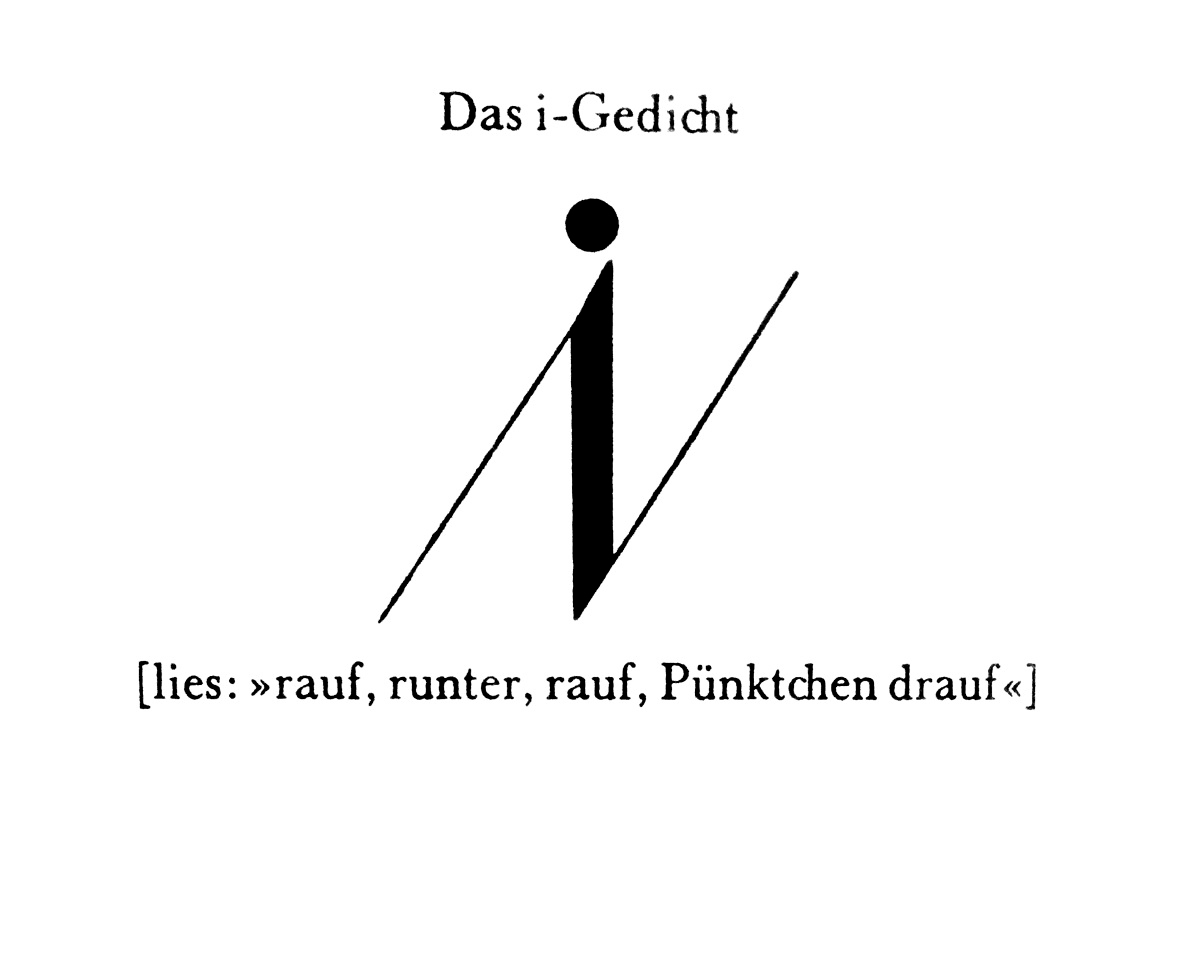
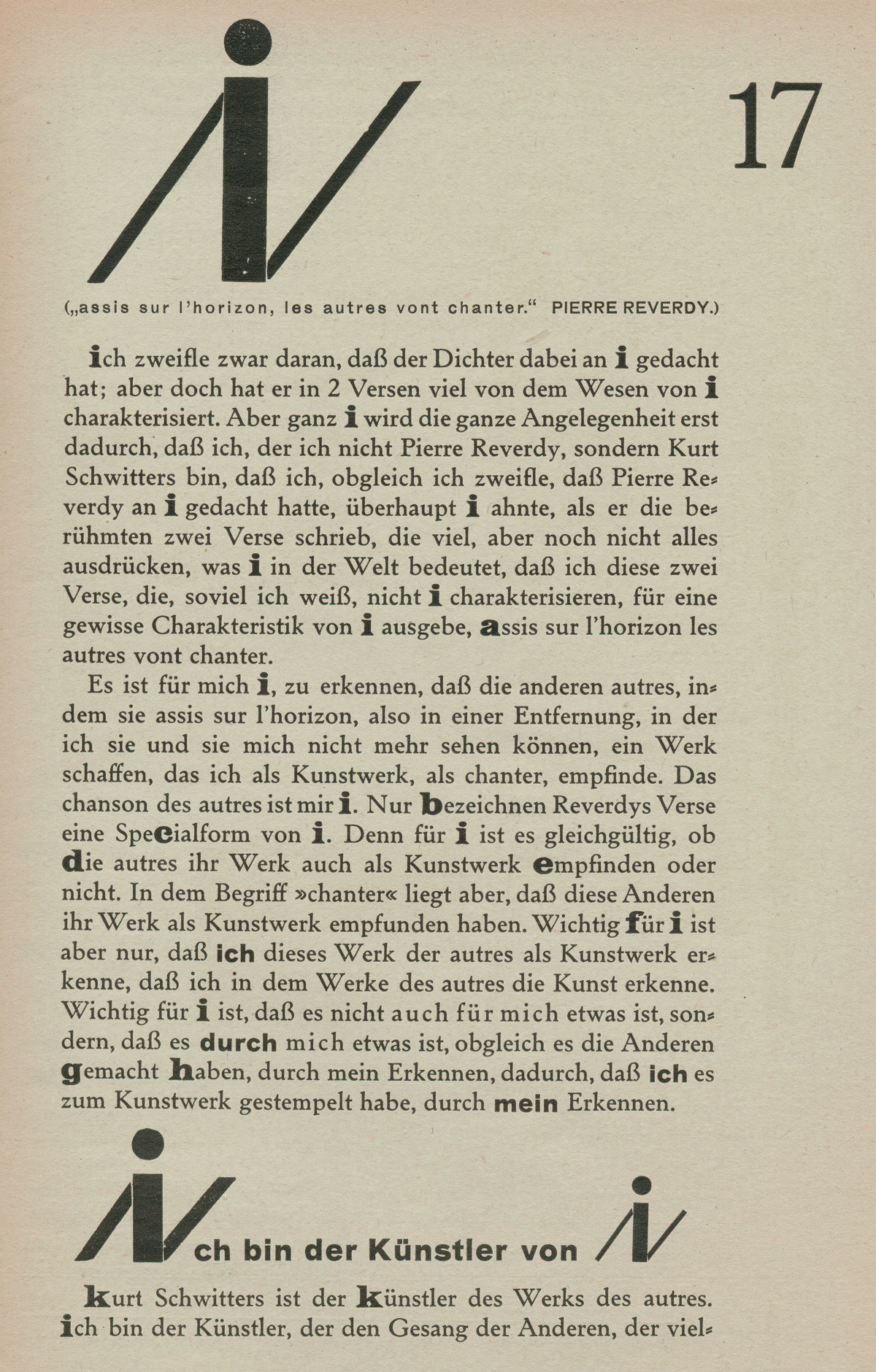
The i-project spans many years, and even though the drawings would be easy — and quick — to mass-produce, the production — as if echoing the form — remained small (very small compared to Merz).11 The artist played a reduced role in their formation, as a mere composer of what is already there, aiming, as Schwitters put it, to accentuate their intrinsic rhythm. Schwitters, Megan R. Luke writes, ‘does not wield sovereign control over his materials and is rather more a medium through which forces of difference […] may cohere into form’.12 He wanted to harmonize with the material — to allow for difference to proliferate within the work of art, yet in the end, Max Boersma argues, the artist asserts his dominance over the small found parts. Schwitters designates ‘creative activity solely to Beginning of page[p. 432] himself’.13 ‘In short,’ Boersma explains, ‘the concept of i — in its most developed articulation — manifested for Schwitters a model of artistic making premised exclusively on the visual authority of the artist and its metaphorical impress, realized directly through and upon others’ labor.’14 Despite the promise of the i-project to intimate idea, material, and artwork on the same lateral plane, the artist eventually assumed the augmented, frontal role of I.
Even though, or perhaps because Schwitters failed to remain at the level of the i, his project continues to be a source of inspiration for thinking about the relation between form, subjectivity, and ethics. What does the role of the interpreter look like when it doesn’t assert its dominance over the material? How is the subject to be responsibly Beginning of page[p. 434] with and in form? What is the relation between form and experience? Minoritarian beings, this essay attempts to show, possess a special relationship to minor forms — to what a majoritarian gaze might call insignificant details, futile gestures, or mere sweet nothings — one that tends to, adapts to, the lateral promise of the material. The lower-case i, for Billy-Ray Belcourt, becomes the aesthetic representation for a way of living beyond capital forms of selfhood, illustrating a queer, indigenous existence described as both a ‘glistening accident’ and a ‘disobedient blur’. The ‘I’ is for Belcourt a site of experimentation and contestation. ‘[W]hat remains queer about queerness’, he writes in A History of My Brief Body, ‘is that it entices us to gamble with the “I” in the name of love, sex, friendship, art, and so forth.’15 The minoritized subject doesn’t identify as an I, but places the I in brackets, in the oblique or diminutive case, or performs, as Monique Wittig in Le Corps lesbien, a cut, slashing the j/e down the middle, in order to experiment with its potential for being, seeing, and relating differently. J/e is a way of typographically expressing the lived reality of the lesbian I, who glances at the world sideways, who encounters the other obliquely, laterally, rather than head-on.16 The I or je only communicates the first-person reality of the neutral masculine subject, who by way of saying I appropriates all of language, everything.17 The political importance of language — of saying I — cannot for Wittig be overstated: ‘the personal and impersonal pronouns are the subject, the subject matter of all my books.’18 To play with the i is not to erase the subject position, but the picture that emerges when we home in on jots and tittles, as Gayatri Chakravorty Spivak cautions in her preface to Jacques Derrida’s Of Grammatology, is also a no-picture: something becomes nothing. Minor life balances at the edge of this nothing, as something that has come to life ‘against all odds’. Beginning of page[p. 435]
The Derridean school of deconstruction was known for its excessive attention to detail, elucidating how the role and function of one letter can change our understanding of a whole word/sentence/paragraph/text/institution/world. In a self-conscious reflection on the role of preface-writing, Spivak wonders about her own role prefacing Derrida’s book, and, in doing so, she elucidates the meaning of grammatology and its deconstructive heart:
Why must we worry over so simple a thing as preface-making? There is, of course, no real answer to questions of this sort. The most that can be said, and Derrida has reminded us to say it anew, is that a certain view of the world, of consciousness, and of language has been accepted as the correct one, and, if the minute particulars of that view are examined, a rather different picture (that is also a no-picture, as we shall see) emerges. That examination involves an enquiry into the ‘operation’ of our most familiar gestures.19
Zooming in on minute particulars, on sweet nothings, on ‘our most familiar gestures’, can have large-scale effects for how we understand our world and its language. That is why we care about the tittle and other inconsequential iotas. But to home in on the tittle, in Spivak’s Derridean language, is also to reckon with its escape. To name a topic, as Spivak says about setting out to write on De la grammatologie, is to determine a point of origin, but this origin story is never definitive; it is instead always inaccurate, even though it is necessary.20 Spivak calls this double-sidedness writing ‘under erasure’ (sous rature): ‘This is to write a word, cross it out, and then print both word and deletion.’21 A picture and a no-picture. In her work on what she names the ‘I?’, Sandra Stephens calls this escape a ‘magic remainder’, which alerts us to that which ‘we are never able to fully conceptualize’ about our being, about I. Stephens’s work on the decolonial, feminist ‘I?’ reminds us that to creatively and critically renegotiate the terms of the I is to grapple with the ‘you’. ‘[C]onceptualizing their multiple universal Is,’ Stephens says Beginning of page[p. 436] about her work on the ‘I?’ in relation to Frantz Fanon, Luce Irigaray, and Jean-Luc Nancy, ‘provides the space to put “you” on the plain of I’ and ‘to create a world of I and Is’, whereby she evokes the relationality, the ethics, of the Rastafarian phrase ‘I and I’.22 Zooming in on the i, I, or I?, then, is also to zoom out to the you. What this essay will call a ‘diminutive ethics’ begins by way of unpointing that which Western thought has nominated as the starting point for understanding: I.23
Gambling with the I is fun and games — love, sex, friendship, art — but it is never just about language (just as language is never just language). To challenge the I is to challenge the very structure of being, and to structure a new way of being together. These ontological and ethical aspects are felt in a major way in minor stories.
from an absolute to a vanishing point
But not every little thing is of speculative interest, and philosophers — in particular certain structuralists — are, according to Michel Pêcheux, prone to overinterpretation. Overinterpretation, Pêcheux writes in ‘Discourse: Structure or Event?’, ‘functions as a translating device, transposing “common empirical statements” into “conceptual structural statements”’.24 Suspicious of the I, of psychology and egoically focused models of knowing, structuralists, Pêcheux argues, have turned an ‘anti-narcissistic movement’ into ‘a new form of theoretical narcissism — a narcissism of structure’.25 This narcissism of structure is how Pêcheux identifies overinterpretation, which ‘applies the “theoretical” as a kind of metalanguage, organized as a network of paradigms’.26 These structuralists care about form in the wrong way, or — to echo Boersma’s critique of Schwitters — assert their dominance over the material. Pêcheux urges us to describe rather than interpret in Beginning of page[p. 437] order to get at the ordinary register of meaning. Description is not a phenomenological methodology, since phenomenology for Pêcheux always turns description into interpretation, but a way of tending to the real of langue. Langue is how he names the condition of existence of language:
I say langue, that is, neither language, speech, discourse, text, nor conversational interaction, but rather what has been posed by linguists as its condition of existence (in principle) in the form of the existence of the Symbolic as Jakobson and Lacan understood it.27
This understanding of langue is an attempt to acknowledge the equivocity of language and move away from a linguistic attachment to the either/or. Discourse is both structure and event. Language has a fluctuating or poetic side to it, which for Pêcheux has been fetishized in structuralism and rendered exceptional, when in fact it is ordinary, material, and real. One must begin not with ‘a series of points of definition’.28 Or, in other words, one does not get to the point by moving through definitions or theoretical concepts, but by stumbling upon what is ‘taking place before your very eyes like a film that cannot be rewound or edited’:29 common empeiria. Overinterpretation erases the event of langue, or buries it in metalanguage.
Pêcheux’s scale critique is not only epistemological, but ethical and political. Describing the intellectual milieu of twentieth-century Beginning of page[p. 438] France, he notes that as political structuralism fades out of fashion, space becomes liberated ‘to reckon with the below’.30 The below is the ordinary language of the masses and what he calls the ‘ordinary of meaning’. Reckoning with the below entails finding a way of combining ordinary language philosophy with structuralist forms of reading. Structuralism, by theorizing from above, failed at describing what Pêcheux calls the ‘equivocity of meaning’. Structuralists, he continues, not only place the unintelligible beyond the purview of the masses, but they also — in and by way of the very same gesture — fetishize the common as an extra-linguistic space: ‘Ultimately, the proletariat, the masses, the people, have such a vital need for logically stabilized universes that the play of the symbolic order does not concern them at all!’31 They have no unconscious, no poetry, no symbolic universe. This erasure is an effect of overinterpretation. Against overinterpretation, Pêcheux presents description as a way of interpreting responsibly. Freed from the superstructure of overinterpretation, perhaps every little thing — or, rather, whatever thing that takes ‘place before your eyes like a film’ — could be of interpretive interest. As far as points go, what matters is that the interpreter doesn’t act ‘as an absolute point, without any other or real’. This, Pêcheux says, ending his essay, is ‘a matter of ethics and politics: a question of responsibility’.32 It was this responsibility that Schwitters failed to undertake in his i-project when he, in the end, asserted his own interpretive role as resolutely as an absolute point.
Similarly to Pêcheux, Derrida also makes a point against what he calls ‘ultra-structuralism’, which he charges with a form of interpretive closure.33 When structure becomes the subject as opposed to a method, it takes on that hyperbolic form. But unlike Pêcheux, Derrida finds a way out of the dead end of ultra-structuralism through phenomenology. To recover the aliveness of langue and lived experience, Derrida turns to Edmund Husserl. In The Ethics of Deconstruction: Derrida and Levinas, Simon Critchley describes this as a strategy: ‘he Beginning of page[p. 439] employs the resources of phenomenology and puts on the mask of the phenomenologist in order to make a veiled attack on structuralism and the notion of finite totality which it presupposes. Phenomenology is the overcoming of structural closure.’34 Against structuralism and borrowing from phenomenology, deconstruction emerges as a practice of reading, of interpreting responsibly.
An absolute point is one that encapsulates everything, that makes no distinction between a picture and a no-picture, or, as Peter Szendy puts it, ‘between an I and non-I’.35 Unlike overinterpretation and ultra-structuralism, which solidify the role of the interpreter, what Szendy calls ‘overpunctuation’ diffuses it. Szendy’s prefix doesn’t mean ‘from above’ or ‘dead end’. ‘Over’ for Szendy points to something hyper; he describes how overpunctuation ‘by dint of detailed articulation, atomizes, pulverizes, and granularizes phrases and forms’.36 In other words, overpunctuation is a kind of formal hysteria that scrutinizes every little thing precisely to — as Pêcheux wanted — reckon with the below. The point, Szendy shows in Of Stigmatology: Punctuation as Experience, in fact always falls prey to overpunctuation, and yet never becomes a hard kernel. Punctuation, because of its relation to breath, to the body, and to the other in its promise to serve the reader, has a more direct relation to meaning than words. Punctuation incarnates the principle of description or deconstruction, namely to interpret responsibly, in order to serve the other. In this way, punctuation echoes what Pêcheux called langue, an aspect of language that is poetic, affective, and alive. ‘Any description’, Pêcheux writes, ‘is intrinsically exposed to the equivocity of langue: any utterance is intrinsically able to become other than itself, to split discursively from its meaning in order then to drift toward another.’37 If langue is a point, it is intrinsically split, or at drift — uncertain rather than definite.38Beginning of page[p. 440]
Szendy’s understanding of overpunctuation is explained by way of the point, which epitomizes all typographic marks, which is to say that all punctuation marks are forms of points. The point that punctuation is is one, but also both+and. The point, the atom, was in ancient Greek an indivisible or literally uncut unity (ἀ-τέμνω, a-témnō). But, as Rebecca Comay and Frank Ruda note in their meditation on the dash — which echoes Szendy’s conception of overpunctuation —
there is no atom without the void, no atom (and no void) that is not the result of a prior splitting. The atoms are already split when they co-emerge with the void as their flipside. The atom is itself the pulverization of every atomic unit.39
It is precisely the ‘divisibility of the point’ that Szendy names ‘overpunctuation’.40 Overpunctuation simultaneously performs excess and lack: it is everything, and nothing.
In contemporary Greek, άτομο (átomo) also just means ‘person’. When we read the person, the self, across ancient and modern Greek conceptions of the point, what emerges is both what Szendy calls ‘punctuation as experience’, as well as a different understanding of the subject that is internally fractured rather than hermetically sealed — a vanishing rather than absolute point.
which point?
To write is to research chance.
Chance animates the smallest parts of the universe: the scintillation of the stars is its power, a flower in the field its incantation.
What does the i look like? For Szendy, the i becomes an overpunctuated expression of a monarch that asserts its authority by dotting the Beginning of page[p. 441] i.42 But since the tittle is over the top, extra, it is also ‘prosthetic’.43 Applying the logic of overpunctuation to the i, it comes to represent not the absolute sovereign, but the decapitated ruler. The i looks like a head hovering above a small body, and the tittle, more a dead end than a crown. For Georges Bataille, the point with his Society for Cutting Off Heads was to wholly leave that top part behind. Rumour has it that all the members of the secret society Acéphale agreed to be sacrificial victims, but none agreed to be the executioner. On the diminutive side of life, less is done, fewer (things) are executed. Were Bataille a graphic designer like Schwitters, he would have left that part out, or simply let it fall to the side: ı.
What are the stories of ı? Which are the images that take place before its eyes like a film? What does the eye see from that point? From below, as gravity would have it, or from above, dissolved into the air as dust or drops? Bataille’s work de-situates and re-situates the gaze by way of scalar play. Enacting the convergence between form and experience, his writing takes the shape of philosophical treatises, aphoristic poetry, and erotic novels. Bataille is best known for his Story of the Eye, which was written under the pseudonym ‘Lord Auch’ and published in 1928.44 Histoire de l’oeil begins as a tale about the sexual endeavours of three teenagers during one summer in a French coastal city: Simone, Marcel, and an unnamed protagonist who looks back at their perverted adventures to tell their story. The tale proceeds by way of metaphors, which is why Roland Barthes calls it a constellation of images, or a poem. The eye holds a special place in Bataille’s iconography, alluding at once to his father’s blindness and to the ecstatic white eye, where the pupil or the whole eyeball is rolled back in experiences of pleasure or pain, as well as to a scene that Bataille witnessed during a bullfight in Spain, where the bullfighter Manuel Granero was killed, his right Beginning of page[p. 442] eye gored by the bull’s horn:45 ‘The “eye” in Story of the Eye is Granero’s eye’, Stuart Kendall affirms in his biography of Bataille. ‘But the event also informed his fascination with bulls and with their sacrificial slaughter, as in the Mithraic cult, and by extension his understanding of sacrifice and the sacred in general.’46 The sacred and the sacrificial, the high and the low, converge in Story of the Eye, which also culminates in a bullfight. In the novel, Bataille makes use of a decentralized textual geography that channels the local capacity for deliberation of each testicle, eye, or egg. These ovoid ‘subjects’, as Evi Roumani refers to Bataille’s images,47 are connected formally by way of their shape and colour, and experientially in Bataille’s life and work, notably in his story of the eye, Ei, or Eier.48
In the middle of Ei’s Story — its heart, core, yolk, or pupil — the reader is invited to witness Simone’s egg-play. Eggs are floating in the toilet, broken into the bidet, pissed on, and swallowed by various corporeal cracks. Ei’s Story is formless; it vacillates in meaning by way of its metaphoric and metonymic structure, where each ‘quality and action’ is exchanged for another — the sun is an eye is an egg is a testicle; or piss as rain as blood as vomit as milk as tears… The ‘transgression of values’, as Barthes writes, ‘corresponds to or even establishes a technical transgression of the forms of language’.49 By way of this new form, the erotic can be reimagined. This is not true of all erotica. Sade’s eroticism, Barthes exemplifies, ‘is encyclopedic’.50 ‘Bataille’s erotic language’, on the other hand, Barthes concludes, ‘is connoted by Georges Bataille’s very being, it is a style; between the Beginning of page[p. 443] two, something is born, something which transforms every experience into a warped language and which is literature.’51 Between the subject and the story, experience is turned into language, and language into experience. Bataille’s little book echoes and is echoed by small, warped experiences. An embodied linguistic manipulation that sees the interpretive i akin to Szendy’s logic of overpunctuation, and to Belcourt’s glistening accidents. Something at the verge of nothing.
How does Georges Bataille’s ‘very being’ hold up to this ephemeral style? ‘Bataille’s thought, his work, is inseparable from his life,’ Kendall writes, in stark agreement with Barthes.52 Bataille — the philosopher, the prolific writer, the avid client of the brothel as only a white, straight cis-man could be. Lord Auch, Pierre Angélique, Louis Trente, Dianus — pseudonymic personas, experimental erotica, posthumous publications… Bataille’s work mirrors the ways in which he was both a major and a minor figure, internally split like a Greek atom. Yet all his face(t)s, for Kendall, gleam with one and the same guiding principle: friendship. The principle of friendship can be seen as an ethical communion between form and subject, which Kendall exemplifies by turning to Bataille’s Guilty: ‘If I utter a word, I bring into play the thought of other people. This is a thought, it so happens, I’ve gleaned from the human substance surrounding me.’53 To write is to echo that human substance, by way of a form that devastates form. ‘He wrote to ruin words,’ Kendall explains in his discussion of Bataille’s style, ‘to reveal the ultimate impossibility of complete communication and to open a sphere wherein the impossible — the heterogeneous, the different, the sacred — could be communicated.’54 Bataille’s formless call for heterogeneity echoes Belcourt’s minor chorus. ‘How do you intend to write both an autobiography and a novel?’ one of the characters in A Minor Chorus asks the protagonist.55 ‘Well,’ he replies, ‘I believe every person is a repository of a community’s memories.’ By way of interviewing people from the small town in rural Alberta where he grew up, the protagonist explains that he seeks to ‘summon an honest Beginning of page[p. 444] emotional voice’.56 ‘[T]he autobiographical’, he meditates, ‘was rarely an individualistic mode; all of its wonder and devastation was social.’57 The i, being already fractured, already two, communicates the principle of friendship or community in both form and content.58
no point
… she wants nothing, truly she wants nothing.
‘Let’s start with these small points,’ Hélène Cixous suggests at the beginning of her essay ‘Castration or Decapitation?’. The points that she begins to explore relate to sexual difference and jouissance. The dominant masculine sexual economy, Cixous notes, is lived in relation Beginning of page[p. 445] to a permanent castration anxiety. With regard to feminine life, this logic is displaced and functions instead ‘as decapitation, execution’, ‘as loss of her head’.60 Language is the necessary starting point for Cixous, and reimagining its expression is the intuitive beginning for a theory of feminine existence. Signification, by way of determining, naming, always excludes one thing in favour of another. ‘What is it?’ is a masculine question. A question for ontology. Meaning. Law. I’s questions. What women are, and what they want, is the prevailing anxiety of psychoanalysis, unable to fathom what being is without being with the phallus. The prevailing anxiety for feminine beings is not to lose lack, but to express in the language of ontology that which remains elusive to its meaning. Her experience cannot be said in a masculine syntax. She cannot make sense, so she loses her head, and with it, the point. Being beside an already predetermined point is not possible within a masculine economy. There is no margin, which means that feminine life measured according to masculine parameters has no point. Nothing. Truly, nothing. For Cixous, the hysteric is the archetype for this acephalic creature. The hysteric is a decapitated woman, someone who has had her tongue as well as head cut off, and who can’t be heard by the symbolic order since she speaks through her body, which man never listens to, and writes with her body, texts that he never reads. It strikes us that with just one ‘l’, the cephalic and phallic logic at the heart of the masculine economy become one. ‘Cephallic’ would be another spelling for its name.
The point resurfaces in Cixous’s text under the guise of the period, which she uses to characterize both what feminine writing is, and what it isn’t. A picture and a no-picture. Periods punctuate some feminine lives, and for Cixous, the period that bleeds becomes a metaphor for the fluidity of feminine writing, where the text becomes a menstrual flow. Poetically renegotiating syntax. Meaning. Law. Feminine writing is written in red ink, using droplets of periodically disgorged blood and tissue, or, providing a more democratic and less cis-centric image, in green ink, collecting droplets of spewing vomit.61 What matters is the viscosity, borderlessness, flow, fluidity… ‘Let’s look not at syntax,’ Beginning of page[p. 446] Cixous urges, ‘but at fantasy, at the unconscious: all the feminine texts I’ve read are very close to the voice, very close to the flesh of language’; they are, she writes, ‘at the threshold of feeling’.62 Feminine texts break grammatical norms to privilege fantasy over syntax. Cixous’s feminine writing goes on and on. At a certain moment it stops, but it’s never a full stop; it lives on in the reader. Feminine texts, for Cixous, have an end that is a no-end, and they have a beginning, but they are not preoccupied with origins. ‘The quest for origins’, she writes, ‘doesn’t haunt a feminine unconscious.’
The problem of origins lies at the heart of Hortense Spillers’s essay ‘Mama’s Baby, Papa’s Maybe: An American Grammar Book’, which rewrites the role of personal pronouns like ‘I’, like ‘hers’, like ‘his’ from the perspective of the African American woman. ‘Though there is no absolute point of chronological initiation,’ Spillers notes, ‘we might repeat certain familiar impression points that lend shape to the business of dehumanized naming.’63 Such impression points constellate in the ‘initiative strikes which open the Atlantic Slave Trade in the fifteenth century of our Christ’.64 Spillers’s grammar shows that the metaphorically split subject of psychoanalysis has a real material referent in the subject ruptured, rendered no-subject by colonial violence. Her deconstructive writing unveils the solipsism and force of the nominative case. Everyone that is not the white European ego becomes, as she puts it, an ‘altered human factor’.65 When everything is about the I, all other stories are without I. For those whose stories are told as non-I, who hold the non-subject position in grammar and history, the split self of psychoanalysis seems both apolitical and ahistorical. To tell one’s story, for Spillers, is to gain nominative authority; it is to gain, as she says ‘the insurgent ground as female social subject’.66 One with the potential to name.
Expression and experience become intertwined phenomena the moment we recognize the power that stories have for making Beginning of page[p. 447] history. Spillers introduces the terms ‘flesh’ and ‘body’ to address the distinction between ‘captive and liberated subject-positions’.67 This distinction is what she calls the ‘zero degree of social conceptualization’,68 which underwrites our cultural script, or ‘cultural conspiracy’ — our discourse, language, grammar.69 Writing about the origin, to recall Spivak’s contention about writing under erasure, is necessary, even if it is also inaccurate. The Black woman, for Spillers, ‘stands in the flesh, both mother and mother-dispossessed’.70 She inhabits the both+and, which marks a difference with regard to the dominating story about the gender binary, conceptualized through a strict either/or. Spillers’s ‘female social subject’ is ‘insurgent’; she occupies the female subject position while at the same time deconstructing the coordinates that delimit it.
There is no absolute point of knowing; every starting point also evaporates, or, to echo Belcourt, becomes a social repository. ‘[T]he disregarded sometimes live the most remarkable lives, but there’s so much we have to unsee to see that in its entirety,’ Belcourt writes in A Minor Chorus.71 And earlier in the novel, he exemplifies the relation between experience and expression by way of punctuation: ‘Suppose a body were trapped between two parentheses, I thought, made out to be an aside, a distraction, a trace of another narrative possibility. Would you set it free, set it loose on the world?’72 The point is not for the marginalized subject to become centralized, to contribute to The Story. To release the body from being trapped in a parenthesis lodged somewhere at the middle of another’s story is to tell a different story. ‘[W]hat is it like in the interstitial spaces where you fall between everyone who has a name, a category, a sponsor, an agenda, spokespersons, people looking out for them — but you don’t have anybody?’ Spillers asks in an interview about ‘Mama’s Baby, Papa’s Maybe’, Beginning of page[p. 448] recorded twenty years after its publication (which is almost twenty years from today).73 What is it like in the parentheses? And how do we find ways of telling those stories? Spillers wrote her grammar in search of a vocabulary that could communicate the I of the Black woman. She describes this discourse as a way of being in battle, to ‘actually go to war with a whole repertoire of violent behavior that was always performed in a very genteel way’.74 The point, the atom, as we have been talking about it, is not split in the psychoanalytic sense, but fractured nonetheless in the Greek sense. Spillers’s American grammar comes through this wound, echoing Belcourt’s contention that ‘Desire, like writing, initiates a war waged against the “I”, its permanency regime’.75 To tell the stories of the disregarded is to write against the absolute point from within.
how is the point?
I am… something formless and dull, indeterminate and inconsistent.
When you think of me, picture a glistening wreck, something of a piece with the subliminal.
Sweet nothings are what we call those sayings, those words and expressions that are small and inconsequential, which the i utters to the other. What matters is not so much their what, but their how. Sweet nothings are diminutive declarations expressed in the form of the whisper, the other being so close as to feel every vibration of breath, intuit every Beginning of page[p. 449] murmur or hum. Sweet nothings only exist in the context of the other, the lover. Sweetness occupies the space between other and i; it points to a way of ‘being together’, as Anne Dufourmantelle writes in her book on douceur.78 Dufourmantelle turns to the etymology of douceur to recover meanings that have been lost. For the ancient Greeks, douceur served as a contrary or counterweight to hubris. But rather than a moral principle, sweetness for Dufourmantelle is an intervalic modality:
in a certain way gentleness belongs more to the gods than to humans. Although it is tangible just as much as it is intelligible, it comprises the good without being the good, the relationship without being a relationship, the spiritual without being a divine attribute, or matter in its pure receptivity.79
Sweetness, by way of balancing nothing and something, performs an ethics of overpunctuation. Like Dufourmantelle, Roland Barthes relates sweetness to the body, to tact, and he also emphasizes its ‘nonparadigmatizable’ quality. Sweetness seems to be that thing which evades dogma, which evades reducing things to preconceived notions: an un-stigmatizable point. Sweetness opens a space for reflection, and is thus for Barthes philosophically resident in scepticism. Sweetness is no-thing rather than one thing.
I would suggest calling the nonviolent refusal of reduction, the parrying of generality by inventive, unexpected, nonparadigmatizable behavior, the elegant and discreet flight in the face of dogmatism, in short, the principle of tact, I would call it, all being said: sweetness. Thus, as far as I am concerned, I do not find it the least surprising that one of the philosophical ‘orientations’ that presents the most affinity with the Neutral, to wit, Beginning of page[p. 450] Pyrrhonism, was at some point defined by gentleness: ‘Sweetness is the final word of Skepticism,’ and Diogenes Laertius: ‘According to some authorities the end proposed by the Sceptics is insensibility [apatheia]; according to others, gentleness [praotès].’80
To evacuate the decision, to withhold judgement, are characteristics of what Barthes calls ‘the Neutral’, which is a diminutive principle in its promise to reduce harmful activity. When less is done, fewer (things) are executed. As an un-stigmatizable or vanishing point — diffuse and blurry rather than absolute — sweetness embodies that principle which Barthes links to tact, and which is an ethics: an ethics that balances its something with nothing, that can never be formalized into a moral code, but that remains a living ethos, in relation to and for the other. The i is the starting point for this ethics, an i that affirms its diminution so that the other has more space to live, to laugh, to love.
Like sweetness, punctuation only exists in the context of the other, the reader. And like the point, sweetness is felt as a moment of nothingness that glimpses itself. This point does not coincide with the hard shell of the I that casts its shadow onto all the other letters of the page and all the other people in the room,81 but with a point that is a ruin more than a monument. ‘[T]he final full stop,’ as Szendy puts it, ‘the grandest of all the monuments, remains divisible, exposed to its overpunctuation to come, which it already contains and comprehends, which from the start already begins to (un)point it.’82 The subjectivity that is intimated by way of this point is extra-ordinary, over the top, being at the same time too much and too little. Evading the either/or, affirming the both+and, the fact that there is no something without nothing. Nothing, Comay and Ruda remind us, is but an amalgamation of not one thing, modelled on the Greek οὐδέν, a double negative. Only one thing cannot change the way we understand the world, but ‘something Beginning of page[p. 451] that is less than nothing can generate a world’.83 Οὐδέν: ‘Stripped of its substantifying prefix,’ Comay and Ruda continue, ‘the particle [δέν] points to what is neither one nor not one — something that is even less than nothing, “a decapitation of nothing”.’84 This acephalic gesture, this tiny detail, becomes the starting point for what, with Anne Carson, we could call a ‘bittersweet ethics’. Eros, like overpunctuation, splits the ά-τομο in two. Its divergent forces of pleasure and pain rupture the i. In her analysis of Sappho’s poem, where she heralds the sweetbitter — γλυκύπικρον — Carson notes: ‘“Sweetbitter eros” is what hits the raw film of the lover’s mind. Paradox is what takes shape on the sensitized plate of the poem, a negative image from which positive pictures can be created.’85 What takes place before the lover’s very eyes like a film is both a picture and a no-picture.
Similarly to Barthes, Carson also touches upon the connections between sweetness and nothingness, but in her vocabulary they are named ‘love’ and ‘hole’:
The experience of eros as lack alerts a person to the boundaries of himself, of other people, of things in general. It is the edge separating my tongue from the taste for which it longs that teaches me what edge is. Like Sappho’s addictive glykopikron, the moment of desire is one that defies proper edge, being a compound of opposites forced together at pressure. Pleasure and pain at once register upon the lover, inasmuch as the desirability of the love object derives, in part, from its lack. To whom is it lacking? To the lover. If we follow the trajectory of eros we consistently find it tracing out this same route: it moves out from the lover toward the beloved, then ricochets back to the lover himself and the hole in him, unnoticed before. Who is the real subject of most love poems? Not the beloved. It is that hole.86
Love burrs holes in the lover, eroding their sense of self, which renders the I more unstable, looking and feeling more like an i, a sweet nothing. Eros ‘robs the body of limbs, substance, integrity and leaves the lover, Beginning of page[p. 452] essentially, less’ — diminished.87 To be loved is to be made small. The lover adorns the beloved with diminutives, adding suffixes or prefixes according to their linguistic culture. To be small is to be loved. The bittersweet is a split point, it opens a parenthesis, a gap, a space for breathing:
At this point I invoke your help m/y incomparable Sappho, give m/e by thousands the fingers that allay the wounds, give m/e the lips the tongue the saliva which draw one into the slow sweet poisoned country from which one cannot return.88
Altering the status of the I by way of experimenting with its form — slashing it down the middle, literally calling it into question (?), placing it in an oblique or diminutive case — changes the relation to the other and the world. In a diminutive ethics, the i becomes an imprint for forces of difference, losing its edge so as to welcome the other and the sweet nothingness that may incur. In the ‘slow sweet poisoned country’ the i unpoints its self to serve the you, to let the other be
Notes
- Monique Wittig, ‘Author’s Note’, in The Lesbian Body, trans. by David Le Vay (Peter Owen, 1975), pp. 9–11 (p. 11). In this translation, j/e is rendered as ‘I’, and m/a as ‘m/y’, m/on as ‘m/y’, and so on. ↵
- Kurt Schwitters, Myself and My Aims: Writings on Art and Criticism, ed. by Megan R. Luke, trans. by Timothy Grundy (University of Chicago Press, 2021), p. 122. ↵
- Billy-Ray Belcourt, A Minor Chorus (W. W. Norton & Company, 2022), p. 46. ↵
- Some of these thoughts on the i are discussed in my essay ‘iota • kurum, küçülme, feminenlik ve diger ince noktalar’, translated to Turkish from English by Alâra Kuset, in Sanat Dünyamiz, 207 (2026), pp. 30–34. ↵
- Megan R. Luke, ‘An Introduction to Merz-Thought’, in Schwitters, Myself and My Aims, pp. xiii–xxvi (p. xv). ↵
- Ibid., p. xvi. ↵
- Schwitters, Myself and My Aims, p. 122. ↵
- Ibid., p. 122. ↵
- Ibid., p. 145. ↵
- Ibid., pp. 141–42. ↵
- The i-drawings are called i ‘to indicate the quickness of their production’, as Schwitters puts it. See Dorothea Dietrich, The Collages of Kurt Schwitters: Tradition and Innovation (Cambridge University Press, 1993), p. 219, note 9. ↵
- Luke, ‘An Introduction to Merz-Thought’, p. xviii. ↵
- Max Boersma, Technical Implications: The Making of Interwar Abstraction in Russia and Germany (University of Chicago Press, forthcoming), p. 217. ↵
- Ibid., p. 168. ↵
- Billy-Ray Belcourt, A History of My Brief Body (Two Dollar Radio, 2020), p. 101. ↵
- Cf. Monique Wittig, The Straight Mind and Other Essays (Beacon Press, 1992), p. 62: ‘All minority writers (who are conscious of being so) enter into literature obliquely, if I may say so.’ ↵
- Monique Wittig, Le chantier littéraire (Presses universitaires de Lyon, 2010), p. 138; Wittig, The Lesbian Body, p. 11. ↵
- Wittig, Le chantier littéraire, p. 141; my translation (‘les pronoms personnels et impersonnels sont le sujet, la matière de tous mes livres’). ↵
- Gayatri Chakravorty Spivak, ‘Translator’s Preface’, in Jacques Derrida, Of Grammatology [1967], trans. by Gayatri Chakravorty Spivak (John Hopkins University Press, 1997), pp. ix–ixxxvii (p. xiii). ↵
- Ibid., p. xiv. ↵
- Ibid. ↵
- Sandra Hope Stephens, ‘The I?: Decolonizing the I through Art and EmDisEmbodiment’ (unpublished doctoral dissertation, Institute for Doctoral Studies in the Visual Arts, 2021), p. 38. ↵
- The term ‘unpointing’ is borrowed from Peter Szendy, and i will return to it in the final part of this essay. ↵
- Michel Pêcheux, ‘Discourse: Structure or Event?’, trans. by Warren Montag, in Marxism and the Interpretation of Culture, ed. by Cary Nelson and Lawrence Grossberg (University of Illinois Press, 1988), pp. 77–97 (p. 90). ↵
- Ibid., p. 90. ↵
- Ibid. ↵
- He continues: ‘Certain recent tendencies in linguistics are rather encouraging from this point of view. Beyond Harrisian distributionalism and Chomskyan generativism, trends have emerged that call into question the primacy of the logical proposition as well as the limitations imposed on linguistic analysis as sentence analysis. Thus, linguistic research might begin to free itself from its obsession with ambiguity (meant as the logic of “either/or”) in order to grasp what is proper to langue through the role of equivocity, ellipsis, lack, and so on. This play of differences, alternations, and contradictions cannot be seen as the softening of a logical hard core: the equivocity, the “constitutive heterogeneity” (the expression is J. Authier’s) of langue corresponds to Milner’s “articles of faith”: “Nothing of poetry is foreign to langue”; and “No language can be completely understood without integrating the possibility of its poetry”’ (ibid., p. 91). ↵
- Ibid., p. 77. ↵
- Ibid., p. 78. ‘One says in French that someone does not need to beat around the bush when he is getting right to the point (n’y va pas par quatre chemins quand il se dirige droit sur l’essentiel). But in these circumstances, what would this wonderful way to the point be when the “affair” of which I speak is taking place before your very eyes like a film that cannot be rewound or edited?’ ↵
- Ibid., p. 91. ↵
- Ibid., p. 92. ↵
- Ibid., p. 94. ↵
- Jacques Derrida, L’écriture et la différence (Éditions du Sueil, 1967), p. 28. ↵
- Simon Critchley, The Ethics of Deconstruction: Derrida and Levinas (Edinburgh University Press, 2014), p. 68. ↵
- Peter Szendy, Of Stigmatology: Punctuation as Experience, trans. by Jan Plug (Fordham University Press, 2018), p. 95. ↵
- Ibid., p. 104. ↵
- Pêcheux, ‘Discourse: Structure or Event?’, pp. 92–93. ↵
- ‘Any utterance or sequence of utterances is thus linguistically describable as a series (lexico-syntactically determined) of the possible points of drift, leaving room for interpretation. It is in this space that discourse analysis claims to work’ (ibid., p. 93). ↵
- Rebecca Comay and Frank Ruda, The Dash — The Other Side of Absolute Knowing (MIT Press, 2018) <https://doi.org/10.7551/mitpress/10877.001.0001>, p. 61. ↵
- Szendy, Of Stigmatology, p. 94. ↵
- Georges Bataille, Louis XXX: The Little One and The Tomb of Louis XXX, trans. by Stuart Kendall (Equus Press, 2013), p. 47; see also Georges Bataille, Le Petit (Pauvert, 1985), p. 43: ‘Écrire est rechercher la chance. | La chance anime les plus petites parties de l’univers: le scintillement des étoiles est son pouvoir, une fleur des champs son incantation.’ ↵
- ‘[T]he stakes of the point and punctuation are also those of sovereignty and sovereign decisions’ (Szendy, Of Stigmatology, pp. 95–96). ↵
- Ibid. ↵
- ‘Lord Auch’, Bataille explains, is borrowed from an expression that his friend would use when going to the loo: aux chiottes! Thus: lord of the shithouse. ↵
- Bataille describes these scenes in the section entitled ‘Réminiscences’ at the end of Georges Bataille, Histoire de l’oeil (Gallimard, 2022), pp. 97–103. ↵
- Stuart Kendall, Georges Bataille (Reaktion, 2007), p. 33. ↵
- Evi Roumani, ‘The Devouring Eye’, Journal for Cultural Research, 29.1–2 (2025), pp. 161–73 (p. 163) <https://doi.org/10.1080/14797585.2024.2406397>. ↵
- In my talk ‘A Grammar of Diminution: (the I, the i, the eye, the Ei)’, i also address the confluence between self, egg, eye, and testicle in Bataille’s work. See Angelica Stathopoulos, ‘A Grammar of Diminution: (the I, the i, the eye, the Ei)’, talk presented at the panel ‘Form’ of the workshop Scale: A Fragmentary Atlas for the Humanities, ICI Berlin, 6–7 October 2025, video recording, mp4, 20:00 <https://doi.org/10.25620/e251006_6>. ↵
- Roland Barthes, ‘The Metaphor of the Eye’, in Barthes, Critical Essays, trans. by Richard Howard (Northwestern University Press, 1972), pp. 239–47 (p. 246). ↵
- Ibid., p. 246. ↵
- Ibid., p. 247. ↵
- Kendall, Georges Bataille, p. 10. ↵
- Georges Bataille, Guilty [1944], trans. by Bruce Boone (The Lapis Press, 1988), p. 108. ↵
- Kendall, Georges Bataille, p. 8. ↵
- Belcourt, A Minor Chorus, p. 53. ↵
- ‘This is what I know about where I come from: it’s a place where history begins and ends. Before it was part of Alberta, it was the District of Athabasca, and before that it didn’t have an English name. It’s the homeland of the Cree and Dene and Métis, and for centuries my ancestors lived in harmony with the land and water and forests and animals. At the close of one century and the start of another, those from whom I descend signed a treaty near the shores of the lake around which many reserves are now located, including my own. They signed in the spirit of communality and peace and in the name of future generations, though what followed was an era defined by a systematic assault on Indigenous livability: death schools, open-air prisons, child abductions. Many sick experiments were carried out by the federal government and its henchmen from which we’re still recovering; though recovery isn’t always an option. All the while people resisted, loudly and quietly, but always creatively. This was one way to tell a story about northern Alberta. There was another way, one that was embodied and consequential for the living, one that zoomed in on emotions and intimacy. It was this more corporeal mode of storytelling that enticed me’ (Belcourt, A Minor Chorus, p. 30). ↵
- Ibid., p. 53. ↵
- At this moment i would like to echo the community and friendship that brought this text to life, and express my big gratitude to my fellow fellows at the ICI Berlin — Filippo Bosco, Kirill Chepurin, Franco Costantini, Cat Dawson, Federica Di Blasio, Yuri Di Liberto, Tobi Haslett, Nicolas Helm-Grovas, Magdalena Krysztoforska, José Antonio Magalhães, Jasmine Pisapia, and Verónica Stedile Luna — for their invaluable feedback on different versions of this essay. I would in particular like to extend gratitude to Filippo Bosco for introducing me to Schwitters, to Yuri Di Liberto for talking to me about Pêcheux, to Verónica Stedile Luna and Nicolas Helm-Grovas for all our discussions about form, and to the Bataille Reading Group for teaching me about the formless. Thank you also to the editors Christoph Holzhey and Marietta Kesting for their careful comments on this text, and to Claudia Peppel and Manuele Gragnolati for their reflections and support. Grazie mille a tutti voi. ↵
- Hélène Cixous, ‘Castration or Decapitation?’, Signs, 7. 1 (1981), pp. 41–55 (p. 49). ↵
- Ibid., p. 43. ↵
- Ibid., p. 54. ↵
- Ibid. ↵
- Hortense J. Spillers, ‘Mama’s Baby, Papa’s Maybe: An American Grammar Book’, Diacritics, 17.2 (1987), pp. 64–81 (p. 69) <https://doi.org/10.2307/464747>. ↵
- Ibid., p. 68. ↵
- Ibid., p. 70. ↵
- Ibid., p. 80. ↵
- Ibid., p. 67. ↵
- Ibid. ↵
- Hortense J. Spillers, ‘“The Permanent Obliquity of an In(pha)llibly Straight”: In the Time of the Daughters and the Fathers’, in Spillers, Black, White, and in Color: Essays on American Literature and Culture (University of Chicago Press, 2003), pp. 230–50 (p. 230). ↵
- Spillers, ‘Mama’s Baby, Papa’s Maybe’, p. 80. ↵
- Belcourt, A Minor Chorus, p. 119. ↵
- Ibid., p. 64. ↵
- Hortense J. Spillers and others, ‘“Whatcha Gonna Do?”: Revisiting “Mama’s Baby, Papa’s Maybe: An American Grammar Book”: A Conversation with Hortense Spillers, Saidiya Hartman, Farah Jasmine Griffin, Shelly Eversley, and Jennifer L. Morgan’, Women’s Studies Quarterly, 35.1–2 (2007), pp. 299–309 (p. 308). ↵
- Ibid., p. 301. ↵
- Belcourt, A History of My Brief Body, p. 80. ↵
- In Georges Poulet, La pensée indeterminée 2: Du Romantisme au début du xx-ème siècle (Presses universitaires de France, 1987), p. 135; my translation (‘Je suis… une chose amorphe et atone, indeterminée et inconsistante’). ↵
- Belcourt, A Minor Chorus, p. 67. ↵
- See Anne Dufourmantelle, Power of Gentleness: Meditations on the Risk of Living, trans. by Katherine Payne and Vincent Sallé (Fordham University Press, 2018), p. 28: ‘From the outset, gentleness involves the question of “being together”, the close circle of politics and ethics. But praos also means gentleness, a more sensibility-laden term meaning good-natured that the Vulgate will translate into Latin as mites (in English, “meek” — “poor and gentle”).’ For the French original, see Anne Dufourmantelle, Puissance de la douceur (Éditions Payot et Rivages, 2013), p. 45. ↵
- Dufourmantelle, Power of Gentleness, p. 28. Cf. Dufourmantelle, Puissance de la douceur, p. 45: ‘la douceur appartient d’une certain manière aux dieux plus qu’aux hommes. Bien qu’elle soit tangible tout autant qu’intelligible, elle inclut le bien sans être le bien, la relation sans être une relation, le spirituel sans être un attribut divin et la matière dans sa pure réceptivité.’ ↵
- Roland Barthes, The Neutral: Lecture Course at the Collège de France (1977–1978), trans. by Rosalind E. Krauss and Denis Hollier (Columbia University Press, 2005), p. 36. ↵
- From Adriana Cavarero’s reading of Virginia Woolf in Adriana Cavarero, ‘Virginia Woolf and the Shadow of the “I”’, in Cavarero, Inclinations: A Critique of Rectitude, trans. by Amanda Minervini and Adam Sitze (Stanford University Press, 2016), pp. 35–44. ↵
- Szendy, Of Stigmatology, p. 29. ↵
- Comay and Ruda, The Dash, p. 61. ↵
- Ibid., p. 60. ↵
- Anne Carson, Eros, the Bittersweet (Dalkey Archive Press, 1998), p. 9. ↵
- Ibid., p. 30. ↵
- Ibid., p. 32. ↵
- Wittig, The Lesbian Body, p. 16. Cf. Monique Wittig, Le Corps lesbien (Les Éditions de Minuit, 2022), pp. 8–9: ‘À ce point là j/e t’appelle à m/on aide Sappho m/on incomparable, donne m/oi les doigts par milliers qui adoucissent les plaies, donne m/oi les lèvres la langue la salive qui attire dans le lent le doux l’empoisonné pays d’où l’on ne peut pas revenir.’ ↵
Bibliography
- , ‘The Metaphor of the Eye’, in Roland Barthes, Critical Essays, trans. by Richard Howard (Northwestern University Press, 1972), pp. 239–47
- Barthes, RolandThe Neutral: Lecture Course at the Collège de France (1977–1978), trans. by Rosalind E. Krauss and Denis Hollier (Columbia University Press, 2005)
- , Guilty [1944], trans. by Bruce Boone (The Lapis Press, 1988)
- Bataille, GeorgesHistoire de l’oeil (Gallimard, 2022)
- Bataille, GeorgesLouis XXX: The Little One and The Tomb of Louis XXX, trans. by Stuart Kendall (Equus Press, 2013)
- Bataille, GeorgesLe Petit (Pauvert, 1985)
- , A History of My Brief Body (Two Dollar Radio, 2020)
- Belcourt, Billy-RayA Minor Chorus (W. W. Norton & Company, 2022)
- , Technical Implications: The Making of Interwar Abstraction in Russia and Germany (University of Chicago Press, forthcoming)
- , Eros, the Bittersweet (Dalkey Archive Press, 1998)
- , ‘Virginia Woolf and the Shadow of the “I”’, in Andrea Cavarero, Inclinations: A Critique of Rectitude, trans. by Amanda Minervini and Adam Sitze (Stanford University Press, 2016), pp. 35–44
- , , The Dash — The Other Side of Absolute Knowing (MIT Press, 2018) <https://doi.org/10.7551/mitpress/10877.001.0001>
- , The Ethics of Deconstruction: Derrida and Levinas (Edinburgh University Press, 2014) <https://doi.org/10.1515/9780748689330>
- , L’écriture et la différence (Éditions du Sueil, 1967)
- , The Collages of Kurt Schwitters: Tradition and Innovation (Cambridge University Press, 1993)
- , Power of Gentleness: Meditations on the Risk of Living, trans. by Katherine Payne and Vincent Sallé (Fordham University Press, 2018) <https://doi.org/10.2307/j.ctt201mpcf>
- Dufourmantelle, AnnePuissance de la douceur (Éditions Payot et Rivages, 2013)
- , Georges Bataille (Reaktion, 2007)
- , ‘An Introduction to Merz-Thought’, in Kurt Schwitters, Myself and My Aims: Writings on Art and Criticism, ed. by Megan R. Luke, trans. by Timothy Grundy (University of Chicago Press, 2021), pp. xiii–xxvi
- , ‘Discourse: Structure or Event?’, trans. by Warren Montag, in Marxism and the Interpretation of Culture, ed. by Cary Nelson and Lawrence Grossberg (University of Illinois Press, 1988), pp. 77–97
- , La pensée indeterminée 2: Du Romantisme au début du xx-ème siècle (Presses universitaires de France, 1987)
- , ‘The Devouring Eye’, Journal for Cultural Research, 29.1–2 (2025), pp. 161–73 <https://doi.org/10.1080/14797585.2024.2406397>.
- , Elementar: Die Blume Anna: Die neue Anna Blume (Der Sturm, 1922)
- Schwitters, KurtMyself and My Aims: Writings on Art and Criticism, ed. by Megan R. Luke, trans. by Timothy Grundy (University of Chicago Press, 2021) <https://doi.org/10.7208/chicago/9780226678276.001.0001>
- , ‘Mama’s Baby, Papa’s Maybe: An American Grammar Book’, Diacritics, 17.2 (1987), pp. 64–81 <https://doi.org/10.2307/464747>
- Spillers, Hortense J.‘“The Permanent Obliquity of an In(pha)llibly Straight”: In the Time of the Daughters and the Fathers’, in Hortense J. Spillers, Black, White, and in Color: Essays on American Literature and Culture (University of Chicago Press, 2003), pp. 230–50
- , , ‘“Whatcha Gonna Do?”: Revisiting “Mama’s Baby, Papa’s Maybe: An American Grammar Book”: A Conversation with Hortense Spillers, Saidiya Hartman, Farah Jasmine Griffin, Shelly Eversley, and Jennifer L. Morgan’, Women’s Studies Quarterly, 35.1–2 (2007), pp. 299–309
- , ‘A Grammar of Diminution: (the I, the i, the eye, the Ei)’, talk presented at the panel ‘Form’ of the workshop Scale: A Fragmentary Atlas for the Humanities, ICI Berlin, 6–7 October 2025, video recording, mp4, 20:00 <https://doi.org/10.25620/e251006_6>
- Stathopoulos, Angelica‘iota • kurum, küçülme, feminenlik ve diger ince noktalar’, Sanat Dünyamiz, 207 (2026), pp. 30–34
- , Of Stigmatology: Punctuation as Experience, trans. by Jan Plug (Fordham University Press, 2018) <https://doi.org/10.2307/j.ctt1xhr652>
- , ‘Author’s Note’, in Wittig, The Lesbian Body, trans. by David Le Vay (Peter Owen, 1975), pp. 9–11
- Wittig, MoniqueLe Chantier littéraire (Presses universitaires de Lyon, 2010)
- Wittig, MoniqueLe Corps lesbien (Les Éditions de Minuit, 2022)
- Wittig, MoniqueThe Straight Mind and Other Essays (Beacon Press, 1992)
© by the author(s)
Except for images or otherwise noted, this publication is licensed under a Creative Commons Attribution-ShareAlike 4.0 International License.© 2026 ICI Berlin Press