
The Everyday in Dramatic ClosenessClaudia Peppel
Abstract
Does the perception of the everyday change when it is presented from an unusual perspective through shifts in scale or proportion — that is, by enlarging or reducing the size of everyday objects in relation to the viewer? This essay explores the potential transformation of domestic objects through consideration of a selection of works from the exhibition ‘The Everyday in Dramatic Closeness’, on view at ICI Berlin at the turn of 2025–26. It highlights how the exhibition sought to question perceptions and expectations of everyday life and to shed light on moments in which the everyday is perceived as unfamiliar or weird.
Keywords: everyday life; domestic objects; dramatic closeness; change of size; zooming in and out; perception
What does our everyday life consist of if we lay it out in front of us? Setting the alarm clock for the second time in the morning, looking at the phone while eating, watering the plants, listening to obscure music from the 80s, walking around the flat with a toothbrush in one’s mouth, setting off for work. We tend to think that we know what our daily lives are made of: the objects, furniture, people, meals, peculiarities, habitual practices, tasks, and rituals that make them ours, however insignificant and domestic they may appear. But where does everyday life actually take place, both in reality and in our imagination? Why do the environment, our flat, the street, our favourite restaurant, and the building where we live and work become fixed backdrops to our daily lives? Which things and routines are we particularly attached to, and why? Can they prevent us from wondering what to do next, allow us to stop reflecting on ourselves, or help us to endure terrible things? Although at its core the everyday primarily provides a pragmatic structure, there is something magical and soothing about its ritualistic force as well as about the satisfying feeling of being surrounded by people, spaces, and things that have meaning — sometimes a mysterious or hidden meaning that only we know about. At the same time, the everyday is repetitive, mundane, and boring — in short, it is ordinary but not static, as philosopher Konrad Liessmann notes: Beginning of page[p. 384]
Everyday life: This is what is ordinary and familiar, and the experiences we have in this everyday life — our everyday experiences — are ordinary and devoid of any major surprises. […] Everyday life can be described as a place where the focus is on reducing perception, not on sharpening it. Precisely because it involves the familiar, we generally don’t have to look or listen that closely.1
The everyday consists of habits and is permeated by perceptual continuities. It can provoke shapeless boredom or take the form of a protective layer, or it can be unbearable, affected by silent cracks, obstacles, and things that are beyond our control. Everyday life is usually structured by basic needs, work, and leisure, and often shaped by gendered, racialized, and class-related practices and regimes. It can be problematic, cruel, or merciless. Examples of this can be seen in cases of domestic violence, illness, war, and displacement, and in prisons, hospitals, or psychiatric facilities, where daily life is filled with fear or where the everyday routines of an institution are forced on people. Daily lives can oscillate between coming to terms with one’s situation and occasional acts of defiance, between emphasizing independence and undermining the authorities.2 It is remarkable how quickly people tend, on the one hand, to re-establish familiar daily routines when they find themselves in unknown surroundings or living in a new place, and, on the other, to give up certain habits and adopt new ones; this is what Henri Lefebvre calls ‘the contradiction at the heart of everydayness — everything changes’.3 The new bed will no longer feel new at some Beginning of page[p. 385] point; the renewed everyday will take over as we grow used to living with a dog, a child, or the loss of a loved one.
Whatever happened to the morning ritual involving coffee, the newspaper, cigarettes, and spending hours in the bath? These analogue practices have been silently replaced by digital ones, such as taking pictures and looking at our phones: ‘The contemporary visual autobiography is not only composed of self-imagery but also of pictures of one’s immediate, everyday surroundings.’4 Questions arise as to how the contemporary everyday is constructed, monitored, transformed, and shared: Does it change due to public self-representation and the involvement of spectators? How do we reflect on our everyday experiences and perceptions and provide ‘an understanding of everyday life that acknowledges the value of the banal and overlooked, the boring and passive, and the significance of the quotidian, often repetitive micro-events’?5 Due to its monotonous and unchanging appeal, one often misses subtle, transitory changes. Some treat the everyday with impatience and want to surpass it; others believe ‘it should be minimised, bracketed’ to make room for more important things in life.6
Depending on our state of mind, everyday objects either come to the forefront or fade into the background. They stand out when we lose track of things, when the demands of daily life become overwhelming, or when we cannot find our bearings within it. Seeing the mass of everyday objects out of their usual places during relocation makes them seem like an impossible burden rather than the necessary and sometimes cherished objects of a life.7 Do perceptual continuities cease when there is a change in scale of perception? According to Roland Barthes, it is very important to understand how a disruption in perceiving the everyday can lead to a new way of experiencing Beginning of page[p. 386] it.8 It seems that we can only be conscious spectators of our day-to-day life if we manage to treat it as a spectacle and step outside of it,9 into what Susan Sontag once called ‘a degraded experience of pure possibility’.10 How can we possibly create an awareness and linger on potentially meaningful perceptions of the everyday? As Nikos Papastergiadis points out, it was the avant-garde who helped ‘to lead in the transformation of everyday consciousness’:11
At various points in the twentieth century, the concept of the everyday shifted from a mere descriptor of the prosaic elements in social life, to becoming a critical category for not only confronting the materiality and totality of the contemporary culture, but also a means of redefining reality for the purposes of social transformation.12
The Surrealists and Dadaists, and later the Lettrists and Situationists, focused on everyday experience and everyday objects by shifting the emphasis ‘from the museum object to the provisory nature of lived experience’.13 Roland Barthes, Michel de Certeau, Annie Ernaux, Henri Lefebvre, and Georges Perec famously contributed to the rise of the quotidien as a phenomenon and as a discourse.14 Exploring its numerous notions and contexts in French culture, they encouraged readers to ask why everyday objects have the meaning they do and highlighted how difficult it is to question the most obvious things. Beginning of page[p. 387]
The ability to challenge familiar perceptions by changing scale or proportion — a transformation that modifies the potency of attention and observation — emerged as a central element in Barthes’s exploration of quotidian experience, beginning in the 1970s.15 Sharing everyday personal experience enhanced feminist consciousness-raising to understand broader patriarchal patterns and systems. As Papastergiadis highlights, the everyday fuelled not only feminist and artistic debates on praxis but sociological and philosophical ones as well:
The concept of the everyday was not a retreat or an escape from the social, but a means of rethinking the relationship between the particular and the general, or how attention to the details of daily life can reveal an insight into the broader system.16
What role do social relations, time, and structures play in shaping and reproducing the everyday? One could argue that the everyday automatically divides life into two categories: things that are part of our everyday life, and things that are not.17 ‘The everyday is […] the most universal and the most unique condition, the most social and the most individuated, the most obvious and the best hidden.’18 We barely realize how many different ways everyday scenes are depicted and reproduced in the world that surrounds us — in literature, film, art, telenovelas, and advertising — and what defamiliarization a change in scale can provoke.
Powers of Ten, a short and paradigmatic educational film from 1977, written and directed by Charles and Ray Eames, opens with two people enjoying a picnic.19 The camera then zooms upwards to show their surroundings, revealing, via the narrator, that the woman and man are in a park on Chicago’s waterfront. It moves further and further away into the universe, before zooming back in to show a close-up of Beginning of page[p. 388] the picnicking man’s hand and then delving deep into the microscopic realm.20 The film depicts the relative scale of the universe in powers of ten and serves as a tool for understanding different scales in relation to the human. Though it was skilfully edited and not simply filmed with a zoom lens, the film offers a glimpse into the compositional possibilities and dramatic effects of zoom.21 As Paul Joannides observes, ‘A zoom generally singles out a detail in a setting or reveals a setting by moving out of a detail’; it makes the process of attention visible but ‘unlike a tracking shot a zoom presents a denial of perspective’.22 By focusing primarily on the visual effects and seemingly effortless expandability created by the cosmic zoom, Powers of Ten offers an unusual approach to proximity and distance, detail and the bigger picture, emphasizing a Sunday ritual that had become all the rage, whilst pushing other aspects, such as gender and ethnicity, into the background. Thus, in its opening scene, Powers of Ten captures the Anglo-American zeitgeist of the 1960s and 1970s, when white people were both the privileged subject and the target audience, as Colson Whitehead notes in his novel Harlem Shuffle: ‘White folks on picnics were everywhere in ads these days.’23 In the context of this everyday scene as a reference point, the cosmic zoom offers, in retrospect, a space for reflection, keeping Papastergiadis’s questions in mind: ‘Whose everyday is being referenced in contemporary art? What can be taken for granted in everyday life?’24Beginning of page[p. 389]
When do we start to look at what we see, not at what we know?25 This is what the exhibition ‘The Everyday in Dramatic Closeness’, held at the ICI Berlin from 3 December 2025 until 21 January 2026, set out to explore, in order to track the everyday via ‘the act of attention’.26 The following overview features a selection of artists and their works that formed part of this group exhibition. The works presented re-evaluate the agency of the size, proportion, and scale of everyday objects. Annette Messager’s and Mona Hatoum’s works were major sources of inspiration,27 in particular Hatoum’s steel sculpture Grater Divide (2002), which is more than two metres high, and which serves as a great example of how a significant change in size can affect perception and provoke unease.
Mona Hatoum’s Grater Divide […] is a cheese-grater nearly seven feet high. Either it’s a kitchen utensil for giants or human beings have suddenly been reduced in stature. Or both. On the one hand, it’s laugh-out-loud funny. On the other, it’s lethal. It takes the form of a paravent or room-divider, one full of huge holes, and it demonstrates that an everyday kitchen object […] could slice us into bloody shreds in seconds.28
Hatoum’s life-size sculptures of kitchen utensils transform domestic objects into eerie things and question whether the home, or the everyday, can be considered a safe space. Also on a domestic theme, the series Mes maisons (2007) by Jean-François Fourtou served as another key inspiration. For this, the artist recreated his childhood bedroom at his great-grandmother’s house at three different scales, fitting his adult-size self into the miniature rooms and taking photographs of the Beginning of page[p. 390] scenes with the double power of documentation and imagination.29 The settings provide an uncomfortable proximity and strongly recall the change in size that the protagonist of Alice’s Adventures in Wonderland experiences, reaching a height of more than nine feet and becoming too tall to fit through the door of the hall: ‘Poor Alice! It was as much she could do, lying down on one side, to look through into the garden with one eye.’30
When assessing scale, we view a piece of art as life-size, miniature, or large, and then we relate it back to ourselves or the object’s own natural size. It becomes more evocative when the artist uses scale to open up certain possibilities of interpretation.31
On show at the ICI Berlin were photographic works as well as paintings, art books, and one sculptural object. The exhibition announcement highlighted that
Scale operates relationally: between the object and the image, between images themselves, and as part of the viewers’ imaginations. What new perspectives and reflections arise from playing with scale and what role does scale play in creative and technical processes, as material, gesture, and resolution intersect to allow new shapes, patterns, and figures to emerge? Artistic techniques do not merely reproduce scale; they enact it, becoming a site in which figuration and abstraction are modified through enlargement, reduction, or superimposition. These transformations can evoke different effects and often oscillate between attraction and repulsion, intimacy and distance. Both the everyday and scale mediate the passage between the personal and the collective, the ephemeral and the iconic.32Beginning of page[p. 391]
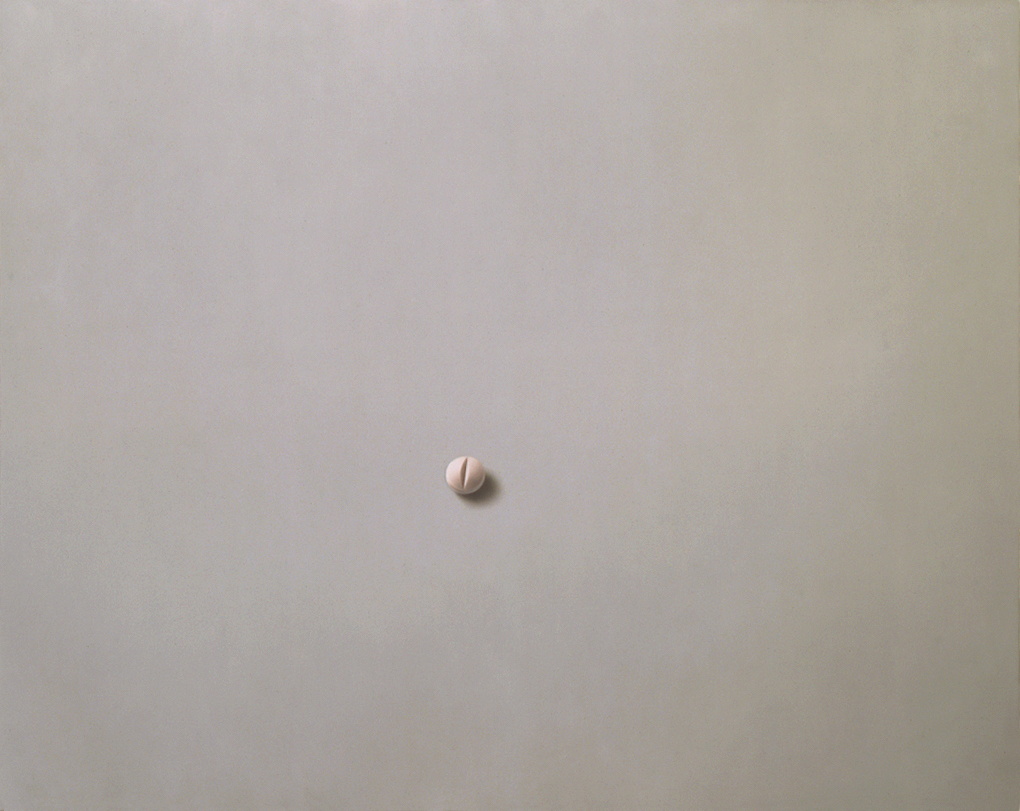
Beginning of page[p. 392]A notable example is Christoph Breuer’s painting Kontaktpflege 2 (2006), which presents a pill in the form of a minimalist still life (Figure 1). Realistic and enraptured at the same time, its proportions are difficult to estimate. The empty space surrounding it recalls an endless nirvana, while the increased size of the pill, which is about that of an apple, appears to be floating and fixed at the same time. With his particularly subtle style, presenting objects with close attention and stillness, Breuer challenges our viewing habits. Realistically depicted yet transfigured, it dominates a vast sky-like space that looks tiny at the same time. In the tradition of the trompe l’oeil painting, Breuer’s still life is linked to the concept of vanitas. The pill appears to be exempt from transience and simultaneously serves as a reminder of it. Like a promise of happiness, it seems to fall from a leaden sky and yet remain firmly anchored to it. If there is such a thing as a colour for the everyday, it is this background.
Can the trompe l’oeil fantasy of the isolated or lost pill be understood as a deliberately crafted alternative to the tangible reality of everyday life, or does it suggest a deceptive sense of permanence and immortality? Breuer’s hyperrealist painting explores a conceptual tension between perception, imagination, and reality, and is at the same time reminiscent of close-up shots in films. At the point when we realize that the everyday is fleeting and that we ourselves are subject to transformation and decay, it is the hallucinatory precision of the pill that offers us the recurring promise of relaxation, cure, and relief from pain.
Silke Schwarz, another artist in the exhibition, took pictures of various people in New York, as well as of their apartment interiors. These works were created during a residency in New York City fourteen years ago. The series comprises eighteen portraits, eighteen corresponding interiors, and eighteen letters, written by the individuals featured. The artist met her subjects by chance and was particularly Beginning of page[p. 394] interested in people who, like many in New York, were not originally from there, but had come to pursue their version of the American Dream, of building a new and successful life for themselves. Schwarz wanted to capture this specific mood, and her photographic project was guided by the questions: How do the interiors and the individuals’ daily lives evolve in line with their dreams and aspirations? What role do everyday life and personal circumstances play in the context of New York’s promises of happiness and success?

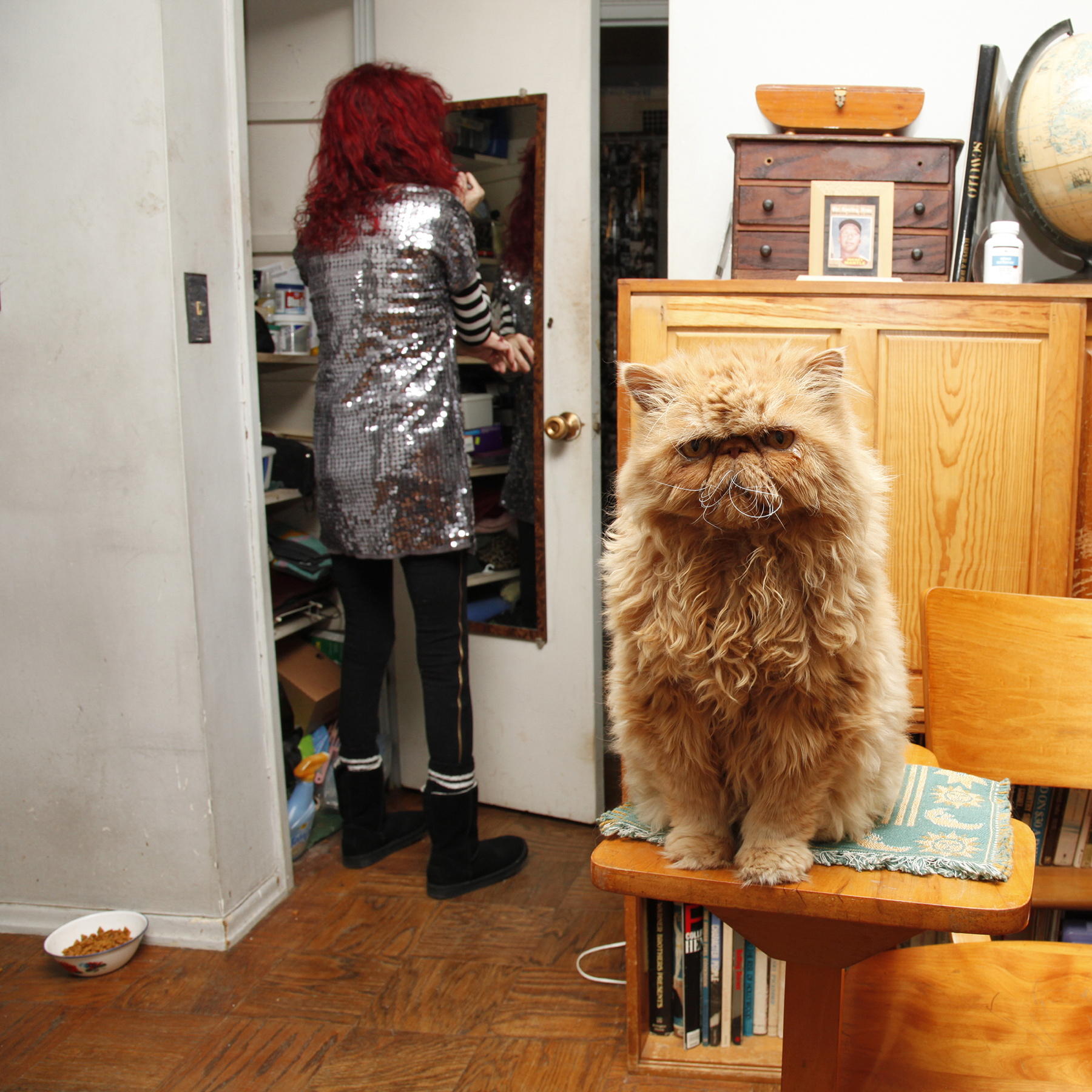
The two works selected for the exhibition, Home (Ruby Portrait) and Home (Ruby Interior), offer a glimpse into the domestic situation of Ruby: the first (Figure 2) shows a human figure seen from behind and a cat seen from the front; the second shows a window with a view of a building across the street. In Home (Ruby Portrait), the cat is in the foreground, appearing larger than Ruby herself. The composition reveals conflicting lines of sight, the standing figure contrasting with the seated cat. Attention is also drawn to the edges of the furniture, especially of the table and cabinet but also of other objects in the room, which can be read as evidence of a plot. It seems as though the presence of the photographer is sensed as part of the scenery. We are seeing Ruby from behind, as she stands next to the open cupboard and looks into the mirror in front of her (though we can’t see her reflection and therefore her face). We are also looking into the eyes of the cat on the table, and the composition is divided internally between the two figures. Ruby does not seem very invested in being photographed and minds her own business in her glamourous outfit, while the cat seems in control of what is happening and appears as the main character, whose gaze not only reveals the photographer as an invisible presence but also captivates the viewer. In an oscillation between anonymity and intimacy, front and back, human and animal, turning away and turning towards the viewer, different ideas come to the fore within a single shot.
The second picture, Home (Ruby Interior), incorporates the outside world — as a vague notion — behind the plant, serving as an intimate backdrop to Ruby’s daily life (Figure 3). There are two plants and one amethyst fossil on the windowsill. One plant is centred within the frame, while the other is placed at the bottom right, with the fossil on the left. The branch of a large Ficus benjamina covers the top of the window, making it much harder to distinguish between the interior Beginning of page[p. 396] and the nebulous exterior, and for a moment the two seem to merge into one another. This tension between interior and exterior is also manifested in other details: the branch of the large ficus has the dimensions of an outdoor tree while the shape of the tiny plant on the windowsill is that of a proper tree. Both compositions combine activity and passivity as well as a play with proportion by focusing on details — in this photo, of the plants and objects on the windowsill and the view, and in the first photo, the interplay between the cat’s fancy fur and Ruby’s glamorous dress, in each case details that, at the same time, are not the main focus of attention.
Anna R. Winder’s sculptural piece, a tiny red couch (Figure 4), is a tribute to Hazel Brown, the she-dandy protagonist of Lisa Robertson’s semi-autobiographical novel The Baudelaire Fractal.33 The object’s shape, colour, and velvety materiality seem of great importance in Winder’s romantic piece, as it reveals a very soft, almost fleshy texture.
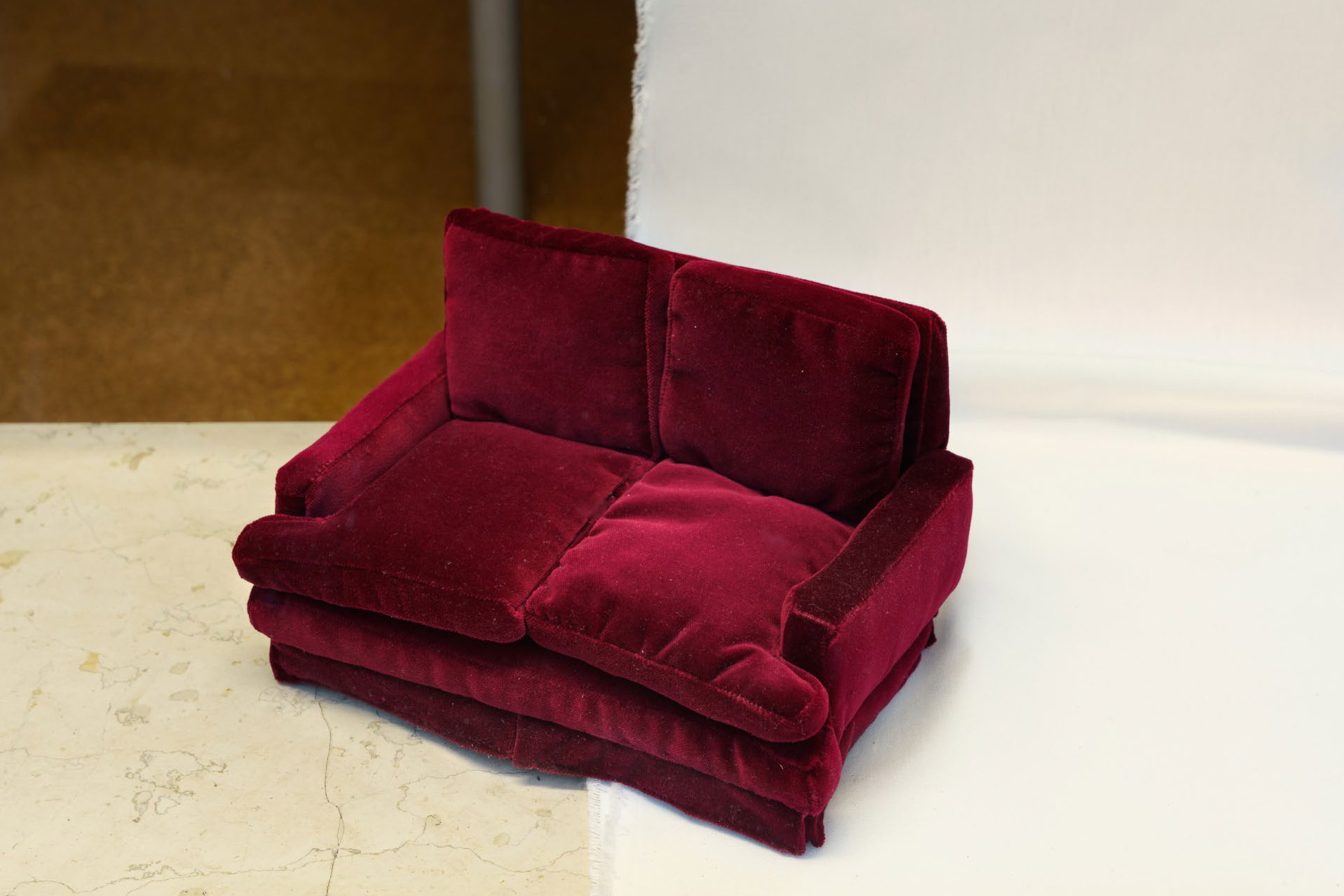
Winder mentions in an interview that she had a similar couch in her studio, which she thought of as a special place for reflection. It somehow enabled her to think differently than at her desk, perhaps because of the couch’s connection to psychoanalysis, where it is supposed to help elicit free association. Before the work’s first exhibition, she found an old pinhole photograph, a self-portrait she had taken at the age of nineteen at her first art school, which reminded her of the uncompromised ideas about art and being an artist that she had at the time. When she then read about Hazel Brown, who in Robertson’s book travels to Paris to lead an artistic life in the style of Baudelaire, whilst harbouring the megalomaniacal idea that she is the author of Baudelaire’s entire body of work, she thought, that’s me, with my romantic and slightly grand artistic notions. The miniature sculpture A Couch for Hazel Brown therefore seems to function as a condensation, loaded with various strands of artistic endeavours, and its intimacy almost becomes phantasmagorical. As Jack Davy and Charlotte Dixon suggest, there is an ongoing ‘dissonance that lies at the heart of miniaturization’. While we intuitively understand ‘that they are not quite of our own reality’, miniature objects are at the same time able to trigger the imagination, ‘for there is an intrinsic desire to play with these tiny Beginning of page[p. 397] objects, to manipulate and rearrange them and to imagine ourselves, impossibly, inside or alongside them’.34
Winder’s red velvet couch was accompanied in the exhibition by a photograph of it, revealing how difficult it is to gauge the actual size of an object from a photograph and the important role that imagination plays in the act of viewing. A comparison only works when two objects are placed side by side — that is, when a small object is placed next Beginning of page[p. 398] to a life-size one — or when an object is measured against a human body. Just as giant objects can make us feel small, miniature objects can make us feel gigantic. Linda Conze, curator of the exhibition ‘Size Matters: Scale in Photography’, which engaged with similar themes to ‘The Everyday in Dramatic Closeness’, writes that ‘changes in size significantly influence perception’:35
Any tinkering with size in an image is bound to alter our perception of it completely: objects are accentuated, plucked out of context, magnified and reinterpreted. They draw closer, inviting scrutiny, or dissolve into a blur before our eyes.36

The two photographs I contributed to the exhibition close in on a similar experience. One of these (Figure 5) depicts a group of soybean sprouts in a hydroponic cabinet, illustrating the ‘farm-to-table’ trend from a few years ago, when many restaurants grew herbs or salad greens within the dining room, usually under artificial light. The close-up shot of soybeans conveys an eerie, somewhat menacing sci-fi atmosphere reminiscent of the macrophotography of insects, where the reproduced subject is much larger than actual size.
On one hand, enlargement greatly contributed to photography’s reputation as a tool of revelation. Things too small to be seen by the naked eye could be made visible, and images circulating in private circles could be made large enough to enter the public sphere. On the other hand, miniaturization played an equally central role as an agent of knowledge: by reducing and accumulating data, it allowed for a new condensation and availability of information.37
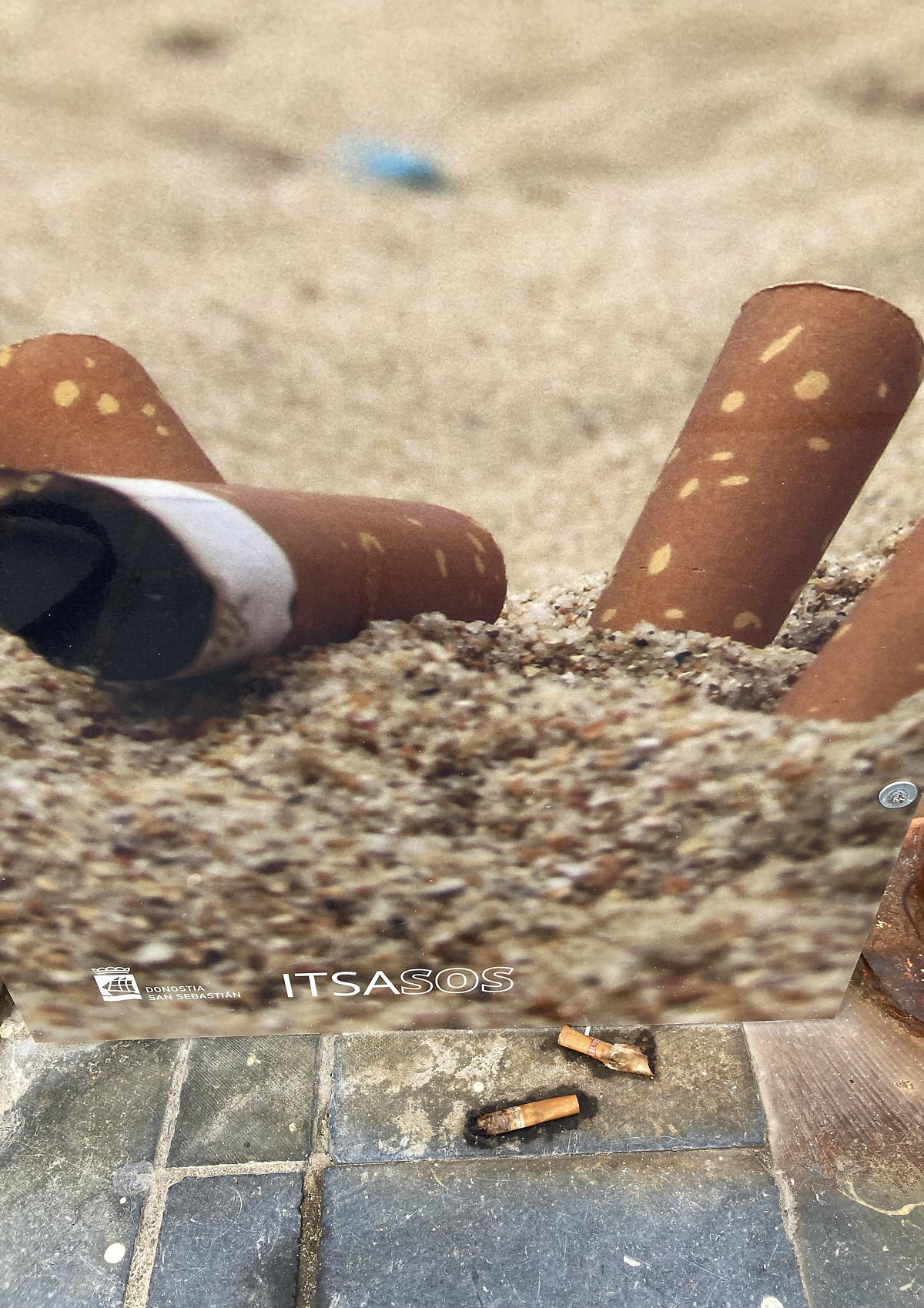
The second photograph (Figure 6) is, in part, a reproduction of a poster that was used as part of a waste prevention campaign to keep Beginning of page[p. 399] the beaches in the Basque city of Donostia/San Sebastián clean.38 Itsa is the Basque word for ‘sea’; combined with the ‘SOS’, it signals that the sea is in distress and calling out for help. Two enormous cigarette butts are shown; their exaggerated contrast with the actual life-size butts littering the beach promenade serves the campaign, and also illustrates the indifference of some beachgoers towards it. Do the oversize butts Beginning of page[p. 401] fail to persuade beachgoers not to throw away their own butts on account of their unrealistic size? Is there something about the scale that seems too fictional or toy-like to make people realize that they are being addressed? Here, a tension arises once again between unremarkable everyday life and the dramatic closeness that results from the act of zooming in to focus on individual elements.
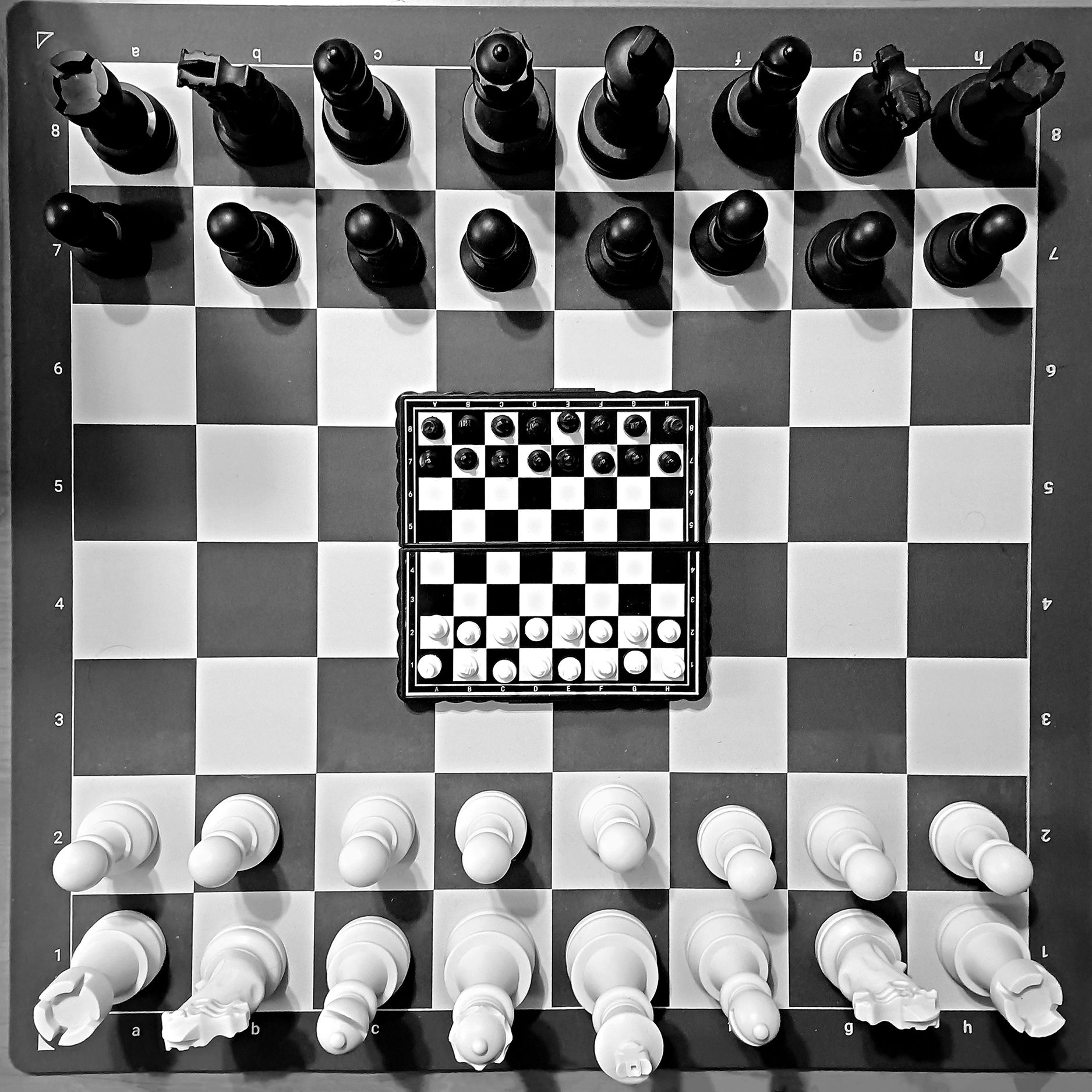
This overview closes with the work of Yuri Di Liberto and its ambivalent take on scale and lived experience (Figure 7). Di Liberto’s photograph creates a sense of tension through its depiction of chessboards and their pieces in two different sizes, the duplication operating as a form of direct comparison. While playing chess, Di Liberto realized that some activities — like games — take place within the limits of established rules and are less sensitive to enlargement or reduction than others. He refers to what Gilles Deleuze and Félix Guattari called ‘striated space’,39 that which is delineated, rationalized, and partitioned, and he states that, in chess, ‘the rules are so structured that the game is immune to changes in the physical medium on which it takes place, such as an increase or decrease in the size of the board or the chess pieces. In fact, chess can be played entirely in your head.’ Here, chess reveals its duality at the intersection of mental engagement and embodied presence, between the individual and the social, that is reminiscent of the indeterminacy inherent in everyday life — the unstable space that it occupies. However, I would argue that the size of a chessboard and its pieces can influence the game if the pieces are much bigger than usual — as with giant outdoor chess sets — so that one cannot see the whole board at once. In this case, the unusual dimensions may also play a part in making the game seem less serious. Indeed, resizing may lead to defamiliarization and disadvantage insofar as some players might overlook things if the size of the chessboard does not match that of the board they normally use. With particularly large pieces and boards, it might be harder to play due to a loss of overview and, thereby, the ability to keep track of the game. Beginning of page[p. 403]
The aim of ‘The Everyday in Dramatic Closeness’ was to inspire curiosity in order to develop a greater awareness towards our everyday physical environment, and to show how much our perception owes to scale. Standardized body height is part of the spatial scale and a key reference dimension in architecture and daily life with which most people are familiar, when it comes, for example, to planning interiors or sitting comfortably on a plane. The exhibition aimed to show how a change of parameters — such as viewpoint, degree of distortion, or field of view — can have major effects on how we perceive the complexity of everyday objects and environments, and that these effects can, at the same time, serve as a site of tension between alienation and appropriation.40 Sontag once suggested that ‘an aesthetic distance seems built into the very experience of looking at photographs’.41 Similarly, Gil Hochberg states that ‘the gaze of the spectator in meeting the image and rendering it aesthetically […] is considered key to the performativity of the medium’.42 ‘The Everyday in Dramatic Closeness’ sought to explore this imaginative appropriation and to consider what is needed in order to intensify the viewing experience, to be surprised, and to thereby gain new insights into this supposedly stable yet fleeting notion of the everyday, which one can only encounter ‘at the fringes of consciousness’43 — to embrace ambiguity and the transformative potentiality of the everyday until it becomes a mystery again.
Notes
- Konrad Paul Liessmann, ‘Die schönen Dinge. Über Ästhetik und Alltagserfahrung’, lecture delivered at the conference ‘Ästhetik und Alltagserfahrung: VII. Kongress der Deutschen Gesellschaft für Ästhetik’ (Friedrich-Schiller-Universität, Jena, 29 September 2008), p. 1; my translation with the help of DeepL <https://www.dgae.de/wp-content/uploads/2008/09/Konrad_Paul_Liessmann.pdf> [accessed 29 July 2026]. ↵
- The film The Florida Project (dir. by Sean Baker, USA, 2017) details how the daily lives of the protagonists, a mother and her daughter, slowly fall apart due to restrictions imposed upon them by the employment office. See Claudia Peppel and Clio Nicastro, ‘Essen, beiläufig — Anmerkungen zu Sean Bakers The Florida Project’, in Ernährung und Identität, ed. by Jennifer Grünewald and Anja Trittelvitz (ibidem, 2019), pp. 295–309. ↵
- Henri Lefebvre, ‘The Everyday and Everydayness’, trans. by Christine Levich, Yale French Studies, 73 (1987), pp. 7–11 (p. 10) <https://doi.org/10.2307/2930193> (repr. in Julie Mehretu and Henri Lefebvre, The Everyday and Everydayness (Afterall Books, 2021)). ↵
- Louise Wolthers, ‘Autographing: Digitized Self-Imagery’, in Auto: Self-Representation and Digital Photography, ed. by Hans Hedberg and others (Art & Theory Publishing, 2014), pp. 57–81 (p. 70). ↵
- Tina M. Campt and others, ‘Introduction’, in Imagining Everyday Life: Engaging with Vernacular Photography, ed. by Campt and others (Steidl), pp. 11–16 (p. 11). ↵
- Lefebvre, ‘The Everyday and Everydayness’, p. 11. ↵
- I owe this point to Ben Nichols and I am grateful for his astute comments. ↵
- Michael Sheringham, Everyday Life: Theories and Practices from Surrealism to the Present (Oxford University Press, 2006), p. 193. ↵
- Minna Salmi, ‘Autonomy and Time in Home-Based Work’, in Gendered Practices in Working Life, ed. by Liisa Rantalaiho and Tuula Heiskanen (Macmillan, 1997), pp. 101–16 (p. 114). ↵
- Susan Sontag, The Volcano Lover (Penguin, 1992), p. 4. ↵
- Nikos Papastergiadis, Spatial Aesthetics: Art, Place, and the Everyday (Institute of Network Cultures, 2010), p. 22 <https://www.networkcultures.org/_uploads/tod/TOD%235.pdf> [accessed 7 September 2026]. ↵
- Ibid., p. 21. ↵
- Rosa Barotsi, Time and the Everyday in Slow Cinema, Cultural Inquiry, 34 (ICI Berlin Press, 2025), p. 165 <https://doi.org/10.37050/ci-34>. ↵
- This is to name only a few of the most prominent French theorists and writers. Sheringham provides a great overview, especially of the everyday in French culture in the last four decades of the twentieth century. See Sheringham, Everyday Life, especially chapter 5 on Roland Barthes, ‘All that Falls: Barthes and the Everyday’, pp. 175–207. Another great overview is offered in Barotsi, Time and the Everyday in Slow Cinema, pp. 161–224. ↵
- Sheringham, Everyday Life, p. 194. ↵
- Papastergiadis, Spatial Aesthetics, p. 22. ↵
- Here I draw on an observation made by John Searle regarding the creation of lists. See John Searle, ‘The Storm over the University’, The New York Review of Books, 6 December 1990 <https://www.nybooks.com/articles/1990/12/06/the-storm-over-the-university/> [accessed 21 July 2026]. ↵
- Lefebvre, ‘The Everyday and Everydayness’, p. 9. ↵
- Powers of Ten, dir. by Charles and Ray Eames (USA, 1977) <https://www.eamesoffice.com/the-work/powers-of-ten/> [accessed 8 September 2026]. ↵
- For more on the so-called cosmic zoom in Powers of Ten, see the introduction to this volume by Christoph F. E. Holzhey and Marietta Kesting, p. 3. Many thanks to Christoph F. E. Holzhey and Marietta Kesting for their careful reading of this text and for their thought-provoking and most helpful comments. ↵
- See Nick Hall, The Zoom: Drama at the Touch of a Lever (Rutgers University Press, 2018), p. 15: ‘the term zoom has been adopted by scholars in other disciplines and by journalists in the wider media landscape as a flexible metaphor for concepts including magnification, bending, and the focusing of attention on a subset within a whole.’ ↵
- Paul Joannides, ‘The Aesthetics of the Zoom Lens’, Sight & Sound, 40.1 (1970), pp. 40–42 (pp. 40, 41). ↵
- Colson Whitehead, Harlem Shuffle (Anchor Books, 2021), p. 145. The line follows the narrator’s observation, ‘Everybody was talking about Polaroid and their instant film, it was the new thing. In the Polaroid Pathfinder display, a white family enjoyed a picnic by a deep blue lake.’ ↵
- Papastergiadis, Spatial Aesthetics, p. 14. ↵
- See Willem Popelier, ‘Digital Narcissism: This Is Willem Popelier — An Introduction’, in Auto: Self-Representation and Digital Photography, pp. 25–55 (p. 30). ↵
- Sheringham, Everyday Life, p. 85. ↵
- For Messager’s explorations of the everyday, see, for example, the works Mes trophées (1987) and Histoire des petites effigies (1990), featured in Sheryl Conkelton and Carol S. Eliel, Annette Messager (Los Angeles County Museum of Art and The Museum of Modern Art, 1995), pp. 16, 32 <https://assets.moma.org/documents/moma_catalogue_471_300063148.pdf> [accessed 7 September 2026]. ↵
- Ali Smith, ‘“Never Take Anything for What It Appears to Be”: Ali Smith on Mona Hatoum’, Tate Etc., 37 (2016), pp. 78–81 <https://www.tate.org.uk/tate-etc/issue-37-summer-2016/never-take-anything-what-it-appears-be-ali-smith-on-mona-hatoum> [accessed 7 September 2026]. ↵
- See ‘Réalisations’, Jean-François Fourtou https://www.jffourtou.com/fr/realisations#2007 [accessed 29 July 2026]. ↵
- Lewis Carroll, Alice in Wonderland: Authoritative Texts of ‘Alice’s Adventures in Wonderland’, ‘Through the Looking-Glass’, ‘The Hunting of the Snark’, Backgrounds, Essays in Criticism, ed. by Donald J. Gray, 2nd edn (Norton, 1992), p. 14. ↵
- Kristine Somerville, ‘Extremes: The Power of Scale in Art’, The Missouri Review, 41.3 (2018), pp. 17–33 (p. 24) <https://doi.org/10.1353/mis.2018.0030>. ↵
- ‘The Everyday in Dramatic Closeness’ (3 December 2025 – 21 January 2026), ICI Berlin <https://www.ici-berlin.org/events/the-everyday-in-dramatic-closeness/> [accessed 7 September 2026]. The exhibition was a group endeavour. The curators, Filippo Bosco, Christoph Breuer, Louisa Elderton, Claudia Peppel, Jasmine Pisapia, Silke Schwarz, Verónica Stedile Luna, and Anna R. Winder, are grateful to the ICI Berlin for the generous support and would like to thank again all the contributing artists, Filippo Bosco, Christoph Breuer, Delfina Cabrera, Neta Choli-Avidan, Y. Ariadne Collins, Yuri Di Liberto, Sarath Jakka, Claudia Peppel, Jasmine Pisapia, Silke Schwarz, Verónica Stedile Luna, and Anna R. Winder, for their amazing works. Besides the selection featured in this essay, some works are now part of individual chapters within this volume. See Jasmine Clotilde Pisapia, ‘Dust, Death, and the Body of the Earth: Notes on the Scales of Ecological Disaster’, in this volume (pp. 405–27); and Verónica Stedile Luna, ‘Editorial Writings from a Scalar Perspective: Reduction and Expansion as Publishing Procedures’, in this volume (pp. 453–83). Photos of the opening are available on the ICI Berlin website; see ‘A Night for the Everyday’, ICI Berlin <https://www.ici-berlin.org/events/a-night-for-the-everyday/> [accessed 7 September 2026]. ↵
- Lisa Robertson, The Baudelaire Fractal (Coach House Books, 2020). ↵
- Jack Davy and Charlotte Dixon, ‘What Makes a Miniature? An Introduction’, in Worlds in Miniature: Contemplating Miniaturisation in Global Material Culture, ed. by Jack Davy and Charlotte Dixon (UCL Press, 2019), pp. 1–17 (p. 1) <https://doi.org/10.14324/111.9781787356481>. ↵
- Linda Conze, ‘Size Matters: Scale in Photography’ (1 February – 20 May 2024), Kunstpalast, Düsseldorf <https://www.kunstpalast.de/en/press-event/presslounge-size-matters/> [accessed 7 September 2026]. ↵
- Linda Conze, ‘Size Matters: Scale in Photography’ (1 February – 20 May 2024), Kunstpalast, Düsseldorf <https://www.kunstpalast.de/en/event/sizematters/> [accessed 7 September 2026]. ↵
- Olivier Lugon, ‘Photography and Scale: Projection, Exhibition, Collection’, Art History, 38.2 (2015), pp. 386–403 (p. 387) <https://doi.org/10.1111/1467-8365.12155>. ↵
- ‘ITSASOS project for the prevention of waste on the beaches of Donostia-San Sebastián’, Ados Sostenibilidad y Clima (2025) <https://adossc.eus/en/portfolio-item/itsasos-project-for-the-prevention-of-waste-on-the-beaches-of-donostia-san-sebastian/> [accessed 7 September 2026]. ↵
- See Gilles Deleuze and Félix Guattari, ‘1440: The Smooth and the Striated’, in Deleuze and Guattari, A Thousand Plateaus: Capitalism and Schizophrenia [1980], trans. by Brian Massumi (University of Minnesota Press, 1987), pp. 474–500. ↵
- Sheringham, Everyday Life, p. 360. ↵
- Susan Sontag, On Photography [1977] (Picador, 2001), p. 21. ↵
- Gil Hochberg, ‘Performance and Transformation: Photographic (Re)visions of Subjectivity’, in Imagining Everyday Life, ed. by Campt and others, pp. 195–99 (p. 195). ↵
- Sheringham, Everyday Life, p. 20. ↵
Bibliography
- , Time and the Everyday in Slow Cinema, Cultural Inquiry, 34 (ICI Berlin Press, 2025) <https://doi.org/10.37050/ci-34>
- , Alice in Wonderland: Authoritative Texts of ‘Alice’s Adventures in Wonderland’, ‘Through the Looking-Glass’, ‘The Hunting of the Snark’, Backgrounds, Essays in Criticism, ed. by Donald J. Gray, 2nd edn (Norton, 1992)
- , Annette Messager (Los Angeles County Museum of Art and The Museum of Modern Art, 1995) <https://assets.moma.org/documents/moma_catalogue_471_300063148.pdf>
- , ‘Size Matters: Scale in Photography’ (1 February – 20 May 2024), Kunstpalast, Düsseldorf <https://www.kunstpalast.de/en/event/sizematters/> [accessed 7 September 2026]
- Davy, Jack, and Charlotte Dixon, eds, Worlds in Miniature: Contemplating Miniaturisation in Global Material Culture (UCL Press, 2019) <https://doi.org/10.14324/111.9781787356481>
- , , A Thousand Plateaus: Capitalism and Schizophrenia [1980], trans. by Brian Massumi (University of Minnesota Press, 1987)
- The Florida Project, dir. by Sean Baker (USA, 2017)
- , The Zoom: Drama at the Touch of a Lever (Rutgers University Press, 2018) <https://doi.org/10.2307/j.ctt22rbjsk>
- , ‘Performance and Transformation: Photographic (Re)visions of Subjectivity’, in Imagining Everyday Life: Engaging with Vernacular Photography, ed. by Tina M. Campt and others (Steidl, 2020), pp. 195–99.
- , ‘The Aesthetics of the Zoom Lens’, Sight & Sound, 40.1 (1970), pp. 40–42
- , ‘The Everyday and Everydayness’, trans. by Christine Levich, Yale French Studies, 73 (1987), pp. 7–11 <https://doi.org/10.2307/2930193>
- , ‘Die schönen Dinge. Über Ästhetik und Alltagserfahrung’, lecture delivered at the conference ‘Ästhetik und Alltagserfahrung: VII. Kongress der Deutschen Gesellschaft für Ästhetik’ (Friedrich-Schiller-Universität, Jena, 29 September 2008) <https://www.dgae.de/wp-content/uploads/2008/09/Konrad_Paul_Liessmann.pdf> [accessed 29 July 2026]
- , ‘Photography and Scale: Projection, Exhibition, Collection’, Art History, 38.2 (2015), pp. 386–403 <https://doi.org/10.1111/1467-8365.12155>.
- , , The Everyday and Everydayness (Afterall Books, 2021)
- , Spatial Aesthetics: Art, Place, and the Everyday (Institute of Network Cultures, 2010) <https://www.networkcultures.org/_uploads/tod/TOD%235.pdf> [accessed 7 September 2026]
- , , ‘Essen, beiläufig – Anmerkungen zu Sean Bakers The Florida Project’, in Ernährung und Identität, ed. by Jennifer Grünewald and Anja Trittelvitz (ibidem, 2019), pp. 295–309
- , ‘Digital Narcisssism: This is Willem Popelier — An Introduction’, in Auto: Self-Representation and Digital Photography, ed. by Hans Hedberg and others (Art and Theory Publishing, 2014), pp. 25–55
- Powers of Ten, dir. by Charles and Ray Eames (USA, 1977) <https://www.eamesoffice.com/the-work/powers-of-ten/> [accessed 8 September 2026]
- , ‘Autonomy and Time in Home-Based Work’, in Gendered Practices in Working Life, ed. by Liisa Rantalaiho and Tuula Heiskanen (Macmillan, 1997), pp. 101–16 <https://doi.org/10.1007/978-1-349-25285-5_7>
- , Everyday Life: Theories and Practices from Surrealism to the Present (Oxford University Press, 2006) <https://doi.org/10.1093/oso/9780199273959.001.0001>
- , ‘Never Take Anything for What It Appears to Be: Ali Smith on Mona Hatoum’, Tate Etc., 37 (2016) <https://www.tate.org.uk/tate-etc/issue-37-summer-2016/never-take-anything-what-it-appears-be-ali-smith-on-mona-hatoum> [accessed 7 September 2026]
- , ‘Extremes: The Power of Scale in Art’, The Missouri Review, 41.3 (2018), pp. 17–33 <https://doi.org/10.1353/mis.2018.0030>
- , On Photography [1977] (Picador, 2001)
- Sontag, SusanThe Volcano Lover (Penguin, 1992)
- , Harlem Shuffle (Anchor Books, 2021)
- , ‘Autographing: Digitized Self-Imagery’, in Auto: Self-Representation and Digital Photography, ed. by Hans Hedberg and others (Art and Theory Publishing, 2014), pp. 57–81
© by the author(s)
Except for images or otherwise noted, this publication is licensed under a Creative Commons Attribution-ShareAlike 4.0 International License.© 2026 ICI Berlin Press