
(subject in parentheses)
Abstract
This essay takes the figure of brackets or parentheses as a starting point for reflecting — in dialogue with Rebecca Comay, Hollis Frampton, Yvonne Rainer, Ian White, Theodor Adorno, Jacques Derrida, Doris Lessing, Roland Barthes, Georges Bataille, Marina Vishmidt, Theresa Hak Kyung Cha, Alex Farrar, and others — on links between form, social relations, and the subject. Beginning from a minor detail of textual infrastructure, it thinks across scales, from the grammatological one of the tiny mark to discursive, psychological, and social scales.
Keywords: punctuation; form; brackets; infrastructure; gaps; writing; metalanguage; translation
(Parentheses in US English or brackets in British English: the curved, rounded punctuation marks:‘()’.1 There is also the rhetorical figure of the parenthesis: a supplementary phrase or sentence inserted into a passage of text or speech. A parenthesis may be bracketed by parentheses, but not necessarily, since commas or dashes can serve for this too. By convention, a parenthesis can be removed without damage to the ‘main’ text. In that sense it is secondary, less important. It implies a hierarchy, we could say a scale, of significance or value. It seems to identify and draw a distinction between central and marginal, essential and inessential, major and minor. (I was told as an undergraduate that if an idea is really important, it should not be in brackets.) A parenthetical remark may be a prime candidate for deletion if a text is overlength; hence it may be on its way out of a text. Or it may be an irruption into a text, squeezed in later, but an irruption contained or minimized by the bars that keep it in place. Such bars are minimal marks, not grammar, not words, on the edge of language. They seem entirely dependent on words but at the same time, paradoxically, provide the infrastructure of discourse. (The most proximate etymology of ‘brackets’ is architectural: ‘braggets’, a term for curved supports in building, attested in English from the sixteenth century, a connection that survives in Beginning of page[p. 230] calling shelf supports ‘brackets’ too.) As Rebecca Comay and Frank Ruda point out, punctuation marks are frequently not translatable, not because they are too difficult to translate, but because they don’t seem to require translation at all. They seem ‘to be a job for the typesetter rather than the task of the translator’.2 In one respect, they are akin to what Barbara Cassin calls an ‘untranslatable’: as with Aufhebung, logos, or différance, they are commonly carried between texts in different languages without being put through the machinery of translation. Yet in another respect, they are exactly the inverse of Cassin’s description of an untranslatable: whereas an untranslatable is that which we cannot stop retranslating, the translation of such marks never seems to begin.3 Aufhebung, for example, is the site of such a richly specific overdetermination that any attempt to render it via a substitute in the networks of another language is painfully unsatisfactory (and yet we keep trying). A bracket in itself, though, is almost devoid of meaning, blank and underdetermined. It is too little rather than too much. Attending to parentheses, as with any punctuation mark, entails seeing the habitually overlooked in writing, listening to what cannot be heard in speech. Tarrying with that which is not usually considered important. Comay and Ruda describe their interpretation of Hegel on the basis of his use of dashes as emerging from ‘a stupid little observation’. Their wildly original and wide-ranging book emerges from the small and trivial.4 Meanwhile, to describe the paradox of untranslatables and the repeated, productive failure they set in train, Cassin has recourse to two small but strategically placed marks enabling a double reading: untranslatables are ‘what one keeps on (not) translating’.5 One could imagine a reading protocol that considers only what is in brackets in a text, these fragments being its semantic and conceptual unconscious. For Freud, the prefacing Beginning of page[p. 231] of information by the assertion that it is unimportant or irrelevant is a sign precisely of its significance and of the patient’s resistance.6 But such attention to the not-usually-considered-important should not merely seek to elevate it to the status of the important. This would retain importance as norm. Rather, what is proposed is a reading that at once acknowledges this hierarchy as its condition, and dissolves or overcomes it. It will certainly be said by some — notice the scalar metaphors — that such ‘close’ reading is disproportionate, even paranoid, that it constitutes ‘overreading’. Yet to deny that a minor detail can be the trace of an entire history, whether geopolitical or subjective, including a history of violence, would be to censor that history.7)
(titles)
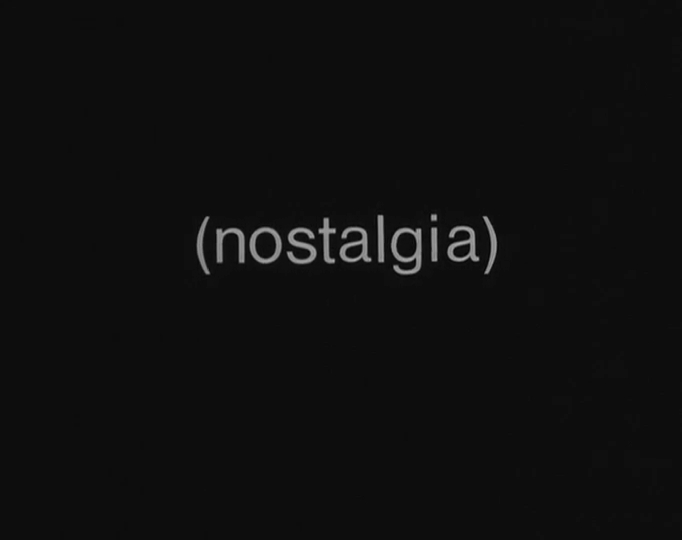
Hollis Frampton insisted on the peculiar format of the title of his 1971 film (nostalgia): ‘Lower case, with parentheses’.8 The filmmaker’s explanation for this was that whereas his films before (nostalgia) typically contained their titles in the films themselves, he decided around this time that ‘the use of main titles [was] irreconcilable with photographic images’. With his films after (nostalgia), names do not appear at the beginning of the films themselves.9 The title ‘(nostalgia)’ is a vanishing mediator: for this transitional film, Frampton kept a title at the beginning (see Figure 1), but, as Rachel Moore writes, it was downgraded, ‘humbled by parentheses and a lower-case initial letter’.10
(nostalgia) is a main title that is a little embarrassed to be a main title, somewhat like when the subject heading in an email is left blank and the application fills the void with ‘(no subject)’. The accidental Beginning of page[p. 232] psychoanalytic connotations of the phrase ‘no subject’ are revealing here. For more than any other of his works, (nostalgia) seems to be a film on the subject (of) Hollis Frampton. The film is made up of static shots of photographs, the majority of which were taken by Frampton a decade or so before; the soundtrack, delivered in the first person, apparently from the filmmaker’s perspective, describes these photos and the context of their making. This is about a filmmaker who up to this point in his work had, as Frampton himself puts it, ‘practiced rigorous self-effacement’.11 Frampton’s work has regularly been filed under the category of ‘structural film’, a term he bridled at but nevertheless seems to have been permanently saddled with, a mode of experimental film characterized by epistemological investigations into a thing called ‘film’, analogous in aims and methods to the Minimalism and Conceptual Beginning of page[p. 233] art happening alongside it in the US. In contrast, with (nostalgia) Frampton seemingly enters the realm of autobiography. And by narrating his self in parentheses, narrating himself in parentheses, the film evokes a diminutive subject.
Yet such an account is misleading, or at least incomplete. The film’s formal, indeed structural, games — the displacement of word and image, the way the photos are burned in each shot, the fact that it is not actually Frampton reading the voiceover, but another filmmaker, Michael Snow — lead most critics to acknowledge (nostalgia)’s autobiographical basis but treat the film as foremost a sophisticated meditation on history and temporality. In this, most critics take Frampton’s own account of his work as authoritative — ironically, given that such accounts are usually based in modernist notions of impersonality and the strict separation between artist and artwork.12 In his remarks on the film, Frampton is at pains to establish a distance between himself and the film’s principal ‘character’. He refers to the younger Frampton as ‘my subject’. (Note the double meaning: subject as that which is subject to investigation, and as that which acts, experiences, is. Here the latter only appears through the former, described as a kind of property distinct from the filmmaker-self: my subject.) He says that ‘he had once been myself’.13 The effect of autobiography is a snare, merely a clever trick of form: the film is ‘a series of aesthetic postures […] disguised as a series of accounts of my life, my youth’.14 Without here denying that both the self and the first-person grammatical form with which it is often conflated are multiple, split, fluid, and ephemeral, or that an ‘I’ that speaks now is logically and often biographically distinct from a ‘myself’ in the past, Frampton appears to protest too much against his present implication in the film’s subject matter with his blunt denial: ‘The film is not about me.’15Beginning of page[p. 234]
In Frampton’s statements the personal is negatively coded: ‘The last thing I had the slightest interest in was diaristic memoir, with its drastically confessional tone’; he refers to (nostalgia) as ‘a bottomless pit of maudlin sentiment’, as though pre-empting criticism on this basis. If at first glance the title could be an instance of the subject as small or reduced, the kind that narrates its experience but humbly leaves space for others, perhaps it is more the case that the Hollis Frampton-subject can only be allowed to appear when made into someone else, sufficiently split off from the filmmaker-who-makes-the-film that the latter is not read as the subject of the film, at least by sophisticated viewers. Frampton brackets out Hollis Frampton the person, allowing Hollis Frampton the artist — a figure whose socially coded characteristics (let us say, class, gender, or skin colour, to begin) are not worth mentioning — to be all the more effective and powerful. Parentheses here signal less a modest but determined reclaiming of the subjective in a context where it was commonly perceived as unimportant, and more a desire to keep the biographical in its (subordinate) place, while nevertheless letting it — the person(al), the subject(ive) — appear in limited form. A controlled dose of subjectivity, as inoculation; parenthetical marks used as medical gloves to hold hazardous or contagious material.
We cannot overlook, in this regard, the film’s historical context. It is made a couple of years after the explosion of the women’s movement in North America. The women’s movement showed personal matters to be significant, indeed political. Frampton disparages the ‘confessional’ and ‘diaristic’ (historically feminine-coded). He frames his subject in terms of ‘nostalgia’, which he stresses is not ‘mere’ longing or Sehnsucht, instead citing an elevated male referent: the wounds Odysseus receives as he returns to Ithaca.16 Yet the burning of photographs from the past surely invokes a feminized genre and gesture: melodrama and the histrionic throwing of old photos in the fire. Like Frampton, critics have preferred to read this act in more prestigious and universalist terms — Moore recruits Gaston Bachelard’s philosophical account of fire, for example. It is instructive here to compare the film to two contemporaneous works made by women associated Beginning of page[p. 235] with Minimalism and Conceptual art that show the effects of feminism: Lucy Lippard’s novel I See / You Mean, written in the first half of the 1970s and published in 1979, in which autobiography eventually destroys the carefully drawn structures of the early part of the book (Lippard described becoming a feminist as she wrote it), and Yvonne Rainer’s film Lives of Performers (1972), where such distancing devices hold out until the end, but where one perceives the strain they are put under by a background sense, one that is not clearly articulated, that intimate interactions play out social antagonisms at a ‘lower’ scale (Rainer described not yet being a feminist when making the film).17 In its name, Lives of Performers makes apparent how it allows these concerns in, but still keeps them in check: its subtitle is ‘(A Melodrama)’, in parentheses.
Another model for the subject in parentheses appears in the work of artist, curator, and writer Ian White, for whom Rainer is a recurring reference point, and her phrase ‘lives of performers’ something like a maxim for rehearsing relations between subjects, the social, and art. White treats punctuation marks as counters that can be freely placed in different configurations on a game board (the page) to shift the meaning of the existing pieces (words). Or as though they were mobile, exchangeable props that give a stage tableau a new sense. They do not so much introduce contingency as show that it was there all along. White’s is a formalism that has discovered context (herein lies its politics), and he uses brackets to continually draw and redraw boundaries between work and world. This is in accordance with the notion that ‘LIMIT IS MATERIAL’.18 Brackets mark the suppressed terms of oppositions in titles such as ‘Film Art Life (Death, Sex, Social History): David Wojnarowicz’ and, with sharp irony, ‘F R E E (Prisons 2)’. The terms in brackets must be negated so that what is outside them can be. ‘F R E E’ enjoys its space to breathe; ‘Prisons’ is imprisoned. Beginning of page[p. 236]
In ‘(I am) For the Birds’, however, brackets seem to do something different. The text was written in 2013, the year White died of cancer. The triumphant climax of modernity’s cogito is scaled down in his title. Perhaps this is conditioned by White’s illness, and his entanglement in Britain’s increasingly privatized, coalition-government-era health system. In posts on his blog Lives of Performers in the year leading up to his death, White cites the Cartesian syllogism more than once: ‘I AM ILL therefore I see/I think/I hear’, and ‘it gets on my nerves, bloody joke, therefore I am’.19 Idiomatically, to be ‘for the birds’ means to be unimportant; it could also signal an awareness that White does not have much time left. He will soon be for the birds. To be ‘for the birds’ could also be an offering, a gift. The brackets allow one to take or leave the subject and its verb, the self-possessing subject of capitalist modernity. This take it or leave it — but not in a hostile way; it is generous, an invitation — is a typical White structure of feeling. For example: ‘I am looking, but I need not be’; ‘it does not need to be done by me and it is being done by me’; and ‘I am writing this. You must be reading this, but you don’t have to’.20 You can read what is in brackets, but you don’t have to. Buried somewhere deep here is Rainer’s Trio A (1966) — the withheld gaze at the audience. In the title ‘(I am) For the Birds’, subject as ground is gently erased, fostering a different sense of self: ‘I am here by chance’; ‘I am not’. The ‘therefore’ of propositional logic, which advances thought from premise to conclusion, is swerved. I am (there) for the birds; I am, (therefore) the birds. Non-sequiturs and conjunctions that don’t specify the nature of relations abound across the two pages of White’s text. Instead of logical inference, there is co-presence: ‘They’ve got their own thing going on, birds’; ‘we are not asking each other for anything’.21Beginning of page[p. 237]
(Comay and Ruda write that punctuation ‘is bound neither to speech nor to writing but operates at the extremities of both. It introduces phrasing into the sentence and is thus even closer to the voice than a letter of the alphabet: it tells us to breathe. It remains an unpronounceable mark and is thus even closer to writing than a logographic sign: it forces us to look. At once pure writing and pure voice, punctuation points to another region of language.’22 Adorno and Derrida’s views on punctuation could be said to each correspond to one of these two poles. For Adorno, the signs of punctuation ‘are marks of oral delivery’.23 For Derrida, in contrast, they are ‘the best example of a nonphonetic mark within writing’.24 Adorno states that it is in punctuation that language most closely approximates music.25 Punctuation marks rhythm and cadence. In this conception, all written language is a score. We have a sense from this of the connection the motions of Adorno’s writing have to music — philosophical discourse has to be played through. In its marking of rhythm and cadence, breath and tone, punctuation signals ‘an interplay that takes place in the interior of language’. One can eliminate punctuation marks, but not punctuation, though one should not want to anyway: punctuation marks are ‘friendly spirits whose bodiless presence nourishes the body of language’.26 Despite this description, there is a fundamental ambivalence in Adorno’s ‘Punctuation Marks’. Adorno is anxious about their overuse. He worries that, granted free rein, these cute spirits turn into mischievous termites, hollowing out the text from within. In Negative Dialectics, Adorno asserts that the ‘presentation of philosophy is not an external matter of indifference to it but immanent to its idea’.27 So too in ‘Punctuation Marks’ he says that prose is not just the ‘recording of facts’; rather, grammar and punctuation ‘articulate and shape’ ideas. Yet in the next paragraph he slips into calling punctuation marks a ‘mere device’, which should not be recruited to do Beginning of page[p. 238] that which ‘only language and subject matter can accomplish’. Failing to follow through on the implications of his claim about the immanence of presentation to idea, he seems reluctant to extend full philosophical status to his friendly spirits. Adorno’s particular hostility to brackets is significant here. Only Proust, he says, could be trusted with them; other writers are advised to stick to dashes. The problem is that parentheses ‘create enclaves’ that are ‘unnecessary to the overall structure’.28 Yet Adorno presumes his conclusion here. In principle, nothing in a philosophical text can be said to be superfluous. And it is acts of reading that are decisive in this regard. As Comay and Ruda put it in relation to Hegel’s notion of the ‘speculative sentence’, ‘[t]o read philosophically is to suspend every prior judgment as to which words have conceptual density and which are meaningless — in other words, to entertain the possibility that any word might be speculative (or not) at any moment.’29 Any word… and any mark. Adorno is constantly worried about punctuation violently forcing ‘linguistic expression’, and therefore thought, against its intrinsic nature (Marx and Engels’s sarcastic inverted commas anticipate the totalitarian uses to which their writings would be put, he worries at one point).30 But his argument does its own forcing when it treats punctuation as a priori external to linguistic expression, relegating it to the lowly, pre-philosophical level of the typographical. If non-coercive thinking must ‘abide with minutiae’, ally itself with particulars ‘without advance assurance to the thought’, then by his own philosophical morality Adorno is practising coercive thinking here.31 His solution to the ambiguous status he has given punctuation is unsatisfying and flagrantly undialectical, a matter of (bourgeois) taste: good writers punctuate with ‘tactful sensitivity’.32 Although Derrida would doubtless criticize Adorno’s opposition between punctuating spirits and bodily language as metaphysical, he shares Adorno’s view that punctuation is interior to language, and deploys a similar binary. Punctuation is, like the ‘pause’, ‘blank’, or ‘interval’, what makes meaning possible.33 Deconstruction is concerned with ‘making “apparent” the fact that the experience of the indiscernible Beginning of page[p. 239] limit on which speech is spaced (the experience of the impossible) is the eccentric centre of all thinking’,34 and this last phrase, ‘eccentric centre’, seems to evoke precisely that position of an aside that is also inside that characterizes parentheses, something both incorporated and ejected. We could say that punctuation embodies différance, if différance were something that could be embodied. The ‘silent play’ of punctuation, like the ‘a’ in the word différance, cannot be heard,35 though we can sometimes, as Peter Szendy says, hear ‘the differences [these marks] imprint on the pronunciation of the words they surround and demarcate’.36 Throughout ‘Différance’, Derrida makes reference to the fact that he is speaking and that his audience cannot perceive whether he is saying différence or différance, so he must add an explanatory, parenthetical ‘(with an e)’ or ‘(with an a)’, although the parentheses themselves can still only be perceived in the written text.37 He writes the two together as differ( )nce. The parentheses mark out a space for substitution or doubling.38 A reading that overlooks punctuation can hardly be called a reading, Derrida thinks, and reading itself may be understood as a process of (re)punctuating a text, of re-spacing and re-voicing it, drawing out contours or inflections.39 Far from Adorno’s tendency to take parentheses at face value, obsequious units of signification that keep to their assigned subordinate place, for Derrida they embody a logic of the supplement, instances of ‘in other words’ that do not lock down meaning but rather slyly imbue the words around them with a ‘capacity for skidding’.40 It is as though every time we try to manoeuvre an idea Beginning of page[p. 240] into its right place with a parenthetical comment, we simply get our hands more dirty. Indeed, at the end of ‘Punctuation Marks’ Adorno is forced to admit the ‘logical-semantic autonomy’ of punctuation marks that Derrida so strongly underscores, an autonomy that brings them ‘into conflict with their own mimetic nature’.41 Yet we can say that Adorno holds fast to something that Derrida neglects in his suspicion of origins and his logic of the ‘always already’: history. ‘History has left its residue in punctuation marks, and it is history, far more than meaning or grammatical function, that looks out at us, rigidified and trembling slightly, from every mark of punctuation.’42 These tiny marks are the potshards of writing, by means of which entire layers of discourse can be dated.)
(compartments)
The protagonist of Doris Lessing’s 1962 novel The Golden Notebook is a writer. Anna Wulf has published one successful novel but has vowed not to publish a second. Simultaneously, she writes in multiple notebooks organized according to subject matter. There is a public novel and a series of private notebooks, but the superior valuation that some might read into the former’s circulation in the public sphere is reversed: Anna is dissatisfied with her novel, which she regards as clichéd and false; a much more complex and rich picture of social and psychological life emerges in her notebooks. At one point, she is interrogated about the latter by the grown-up son of her best friend:
‘Why do you write things in different kinds of handwriting? And you bracket bits off? You give importance to one kind of feeling and not to others? How do you decide what’s important and what isn’t?’
‘I don’t know.’
‘That isn’t good enough. You know it isn’t. Here you’ve got an entry, it was when you were still living in our house. “I stood looking down out of the window. The street seemed miles down. Suddenly I felt as if I’d flung myself out of the window. I could see myself lying on the pavement. Then I seemed to be standing by the body on the pavement. I was two people. Blood Beginning of page[p. 241] and brains were scattered everywhere. I knelt down and began licking up the blood and the brains.”’
He looked at her, accusingly, and Anna was silent. ‘When you had written that, you put heavy brackets around it. And then you wrote: “I went to the shop and bought a pound and a half of tomatoes, half a pound of cheese, a pot of cherry jam, and a quarter of tea. Then I made a tomato salad and took Janet to the park for a walk.”’
‘Well?’
‘That was the same day. Why did you put brackets round the first bit, about licking up the blood and the brains?’
‘We all have mad flashes about being dead on the pavement, or cannibalism, or committing suicide or something.’
‘They aren’t important?’
‘No.’
‘The tomatoes and the quarter of tea is what is important?’
‘Yes.’43
At first glance this could be Anna’s attempt to downgrade fantasy in favour of ‘the real world’, and, concomitantly — since Anna is a writer — her preference for a literary mode that, rather than privileging psychological interiority (seen as ‘individualistic’ in the Communist Party milieu in which the book is set), is a forthright, event-driven realism (‘social’). More subtly, though, by refusing to place in parentheses her daily tasks as a middle-class, post-war single mother, the social-reproductive labour of shopping and childcare, Anna highlights the everyday as a space of self-making.
Still, there’s something seemingly anxious about Anna’s use of brackets around her violent dream. She edits herself. When asked why she must divide her writing into categories and use brackets, she says that if not there would be ‘chaos’. Like Frampton’s (nostalgia), Anna wants to contain the disturbance of the subjective, using brackets to mark out the boundary of some inner self, to keep it under control. The mess of blood and brains — described significantly as ‘scattered everywhere’ on the payment — needs to be put back inside. When they are incorporated into another part of her, this is abject: she kneels Beginning of page[p. 242] down and laps them up like a dog. Both examples involve the artist bracketing out a version or part of themselves from another version or part of themselves. There is something obscene or at least inappropriate about this stuff. Perhaps it is not coincidental that the architectural term ‘braggets’ itself derives from an item of clothing said to have the same shape: a ‘braguette’ — a codpiece. The term ‘brackets’ is part of the same etymological family as ‘breeches’: trousers or pants or underwear. Who would want to see a writer or filmmaker open their brackets and reveal the private things they have in there? It’s not decent.
Bracketing out might be a means, though, for navigating a capitalist world characterized by exploitation, oppression, and violence. Witness the following poem by Yvonne Rainer:
that elicit mawkish sighs
or at least a gulp
in some cerebral throats
like “my father”
(forget mother)
or cobblestone
(forget Kosovo)
or raging hormones
(forget East Timor)
or interpellate
(forget food stamps)
in any case
the simple trick
is not to pause
but shun the corpse
and — nimble-witted —
outflank the rollicking
nightly news44
The narrator is encouraged to practise disavowal: inconvenient or unpleasant things, whether distant from her (‘Kosovo’, ‘East Timor’) or nearby (‘food stamps’), are not be looked at but rather forgotten and hidden away in psychological parenthesis, like a box at the back of the wardrobe. In this respect, bracketing out is a coping strategy, an element of what Henrike Kohpeiß calls ‘bourgeois coldness’, an ‘affective Beginning of page[p. 243] social technique’ for navigating a world where the subject has negligible agency,45 and where they are continually bombarded by violence. In the case of male, white, bourgeois, Western subjects, this is primarily symbolic violence in the form of media images and sounds, as well as the very visible social violence of the urban environment, and the subject is more commonly a witness to it than its direct object; the quantum of material, potentially fatal violence the subject is exposed to increases the further one gets from this privileged exception. (Rainer’s ‘nimble-witted’ narrator is at the better-off end of this spectrum — for others, the technique of ‘outflanking’ can only have limited purchase.) Put in other terms, bracketing out is a technique for dealing with what Mattin calls ‘social dissonance’, the non-fit between — for example — capitalist ideologies of individual autonomy, meritocracy, and fulfilment with the daily demonstration of a reality structured according to coercion, hierarchy, and injustice.46 Undoubtedly, such dissonance is a frequently disavowed feature of left-wing intellectual circles too: the production of political-theoretical discourse signalled by the word ‘interpellate’ takes place at the expense of dealing with the blunt reality of ‘food stamps’. Bracketing out seeks to confine our dissonance-producing knowledge of things like the latter. Again, some subjects have the luxury of this more than others. But in any case, the price of the affective social technique of bracketing out is emotional isolation, atomization, depoliticization, and the death of solidarity.
All this evokes contemporary pop-psychological discourses on ‘boundaries’. While no doubt some compartmentalization and individuation is necessary to survive in the world, let alone thrive — again underscoring the way the possibilities for these are differentially distributed across subjects according to numerous vectors of social hierarchy — much of this discourse promotes what Lily Scherlis calls a ‘Tupperware container’ version of the self, in which a healthy self neatly boxes up its various aspects and relations, and ultimately itself as a whole to protect it from others. As Scherlis puts it, such a model imagines that ‘everyone in the world is mindlessly wandering toward your vulnerable core, and if you don’t tell them where to turn back, you Beginning of page[p. 244] might get trampled’.47 While in this regard it makes the self seem weak, a little snail in need of a strong shell, boundary discourse’s governing metaphor is the self as property owner, drawing and policing invisible lines of demarcation. Such a model has a centuries-long tradition in the West, contemporaneous with capitalist modernity itself and its processes of enclosure of common land, and is inherently racialized. As Kohpeiß describes, ‘[p]roperty can be understood as one of the concepts that separates the bourgeois subject from the racialised subject’, behind the latter of which lurks slavery.48 Bourgeois subjects may own property, whereas slaves are property; bourgeois subjects own themselves, whereas enslaved people are owned by others. The bourgeois subject with its interiority is, according to that class’s own ideology, a sovereign, autonomous one, who ‘constantly pursues new delimitations to protect its sovereignty against everything socially and aesthetically alien’. In contrast, their racialized antithesis is a subject without ‘clear contours’.49
The self imagined by contemporary boundary discourse repeats this bourgeois Major Subject in a minor key, defensive rather than triumphant, emphasizing contraction rather than expansion, in keeping with a historical moment of Western imperial crisis rather than accelerated growth. Self-help boundary discourse thus has significant homologies with a more violent boundary discourse whose growth has paralleled it, that of contemporary fascism. Indeed, as Alberto Toscano argues, there is a profound overlap between contemporary fascist imaginaries of the ‘domestic’ (in both familial and national senses) and the geopolitical, in that both are ‘sutured by all kinds of practices of bordering, at once bodily and territorial’.50 As Kohpeiß’s description implies, the fascist subject is not a radical break with the liberal one Beginning of page[p. 245] described above but continuous with it. Nevertheless, in fascism this bourgeois subject becomes pathological. The Freikorps men analysed by Klaus Theweleit saw themselves as frozen up like icicles, as fixed entities holding fast against the floods of femininity and communism, as ‘hard, solid ships, incapable of experiencing mingling with another body as a pleasurable expansion and reordering of boundaries’.51 The little divider of the subject in parentheses becomes the armour of the Körperpanzer. Yet, to reiterate, we should not see this armoured subject as merely a distant historical aberration, given the expansion of practices of social — and therefore psychological — bordering in the present, in the guise of increasingly violent migration regimes around geographic territories, of bureaucratic, police, and judicial apparatuses enforcing the border within nation states, of social-media based cults (often conspiracy-theory allied) of the physically fit body and of hygiene, and of ideological demarcations made between good others and unassimilable barbarians rejected by the social body.
(‘The subject of the analysis (the critic, the philologist, the scholar) cannot in fact, without bad faith and smugness, believe he is external to the language he is describing. His exteriority is only quite provisional and apparent: he too is in language, and he must assume his insertion […] without having recourse to the hypocritical distance of a fallacious metalanguage […] all in all, it is the whole of criticism (as a discourse held “on” a work) which is outdated.’52 Roland Barthes’s statements in ‘Theory of the Text’ (1973) lay out two defining traits of a historically and geographically specific moment of thought that we may, for convenience, call ‘poststructuralism’, namely the critique of ‘metalanguage’ and the insertion of the subject into theoretical discourse, traits that are closely tied to one another and that Barthes exemplifies with more candour and transparency, perhaps naivety, than any other writer. The two logics that Barthes identifies and finds problematic here — verticality (‘a discourse held “on” a work’) and interiority/exteriority (‘[t]he subject of the analysis’ who mistakenly believes himself ‘external to the language he is describing’; see Beginning of page[p. 246] also his declaration in his ‘Inaugural Lecture’ at the Collège de France that ‘every relation of exteriority of one language to another is, in the long run, untenable’)53 — could be mapped onto the hierarchization and compartmentalization associated with parentheses. Barthes’s is a way of thinking that, metaphorically speaking, wants to put nothing in parenthesis, even if such writing may be replete empirically with the punctuation marks in question. Calling something a parenthesis takes on a derogatory tone. We see it elsewhere, for instance when Rosalind Krauss (later one of Barthes’s translators), criticizing the supposed isolation from the movement of history she claims as characteristic of video, describes the position of video artists as one ‘centered between two machines that are the opening and closing of a parenthesis’.54 Or when Jean-Paul Fargier declares that, ‘in the class struggle nothing is irrelevant, nothing can be put in PARENTHESES’.55 Parentheses here signal dehistoricization and depoliticization, blockage, effacement, or repression. In contrast to the verticality of metalanguage, late Barthes texts like A Lover’s Discourse (1977) seek ‘a horizontal discourse’ in which sentences are not integrated ‘into a higher level’.56 There is a tendency towards the fragment in this late writing, since this form reduces the degree to which ideas or sections appear to be gathered into a ‘higher’ unity, and a shift of dispositional allegiance away from analytical models — Barthes had described structuralism in 1964 as the extraction of models from texts — towards actualized units of discourse: focusing on the radical singularity of every enunciation, attacking the notion of paraphrase, and so on.57 However, analogous to the Derridean logic of the supplement, parenthesis actually holds an ambivalent relationship with verticality. For while on the one hand there is the conventional association of lesser importance Beginning of page[p. 247] with spatial lowness, and the frequent use of brackets for examples (examples being something gathered ‘under’ a concept), on the other hand brackets are often used for explanatory comments, and in this regard seem to be an instance of what Roman Jakobson would call ‘glossing’, which is to say metalanguage.58 Parenthetical remarks do not simply stay on one level of the discursive ladder, but have the capacity to swing above and below a ‘primary discourse’. Barthes’s late writing does not merely set itself against forms of writing characterized by a kind of metalingual authoritarianism (that is, discourses which take it upon themselves to explain what other discourses mean, situating themselves in a superior position), but exhibits a valorization of ‘primary language’ as such, a desire for a discourse that is performative rather than referential, ‘dramatic’ rather than ‘epistemological’, as exemplified in the ‘figures’ of A Lover’s Discourse (which he compares, tellingly, to the movements of gymnasts or dancers).59 It is not coincidental, though, that these claims track an increasingly unpolitical, even anti-political, movement in his writing.60 In the face of the supposed tyranny of metalanguage, Barthes has recourse to two problematic solutions: the turn to merely arbitrary principles for organizing fragments of discourse (alphabetical order in A Lover’s Discourse or a random statistical table in The Neutral) and a return to, indeed celebration of, individual whim.61 Metalanguage in a certain reduced manner remains, but as an element of style, style understood not just as an option of textual form but in the late Foucauldian sense of a making of the self, an ethics. This is the way Barthes carries through the earlier understanding, in his own work and that of others, that the problem of metalanguage is intimately bound up with that of the subject, since metalanguage — read also here ‘science’ — excludes the latter from its discourse. It is not coincidental that Georges Beginning of page[p. 248] Bataille’s notion of heterology became important in this context. As Jean-Louis Baudry describes the Bataillean account of the limits of science with reference to sociology, ‘sociology as science’ cannot ‘gain access [to the subject] since the object that it studies can only be totally revealed through the alteration of the subject that produces it — a requirement that sociology could not allow without destroying the objectivity that sustains it as a science and, consequently, without destroying itself’. Heterology is a science of the ‘heterogeneous subject, the subject of the heterogeneous’, a paradoxical science that destroys itself as science, ultimately leading to ‘a “beyond science” […] that is not a renunciation of science but a transformation’.62 The subject of traditional science on this model is a subject in parenthesis, a transcendent subject which ‘guarantees the validity of science since it isolates itself from the articulated whole of different practices’. In contrast, for heterology, for revolutionary politics as understood in the milieu of the modernist literary journal Tel Quel, with which Baudry (and Barthes, Derrida, Philippe Sollers, and Julia Kristeva) were affiliated, in the last instance ‘practices can be thought only through the recognition of the real subject, taken in the whole of its drives and of its relationship, and that of its drives, to social practices’.63 Barthes winds up jettisoning science and delighting in an absolute subjectivism that is science’s inversion (subjectivity becomes diffused through the entirety of the lover’s discourse), illustrating Adorno’s point that ‘[t]he more reification there is, all the more subjectivism there will be’;64 heterology, on the contrary, is dialectical, although it is a dialectic that radicalizes the negative moment, what Derrida called Bataille’s ‘Hegelianism without reserve’ and what Sollers called Bataille being ‘Hegel’s “devil”’.65 One heterological example in this context is Julia Beginning of page[p. 249] Kristeva’s semanalyse. Kristeva confronts a similar problem to Barthes: ‘[h]ow to separate “linguistic-reality” from that which the linguist-subject thinks about it, from that which it knows about it, since it is inside?’66 But the response is not to trade science for the subject, but to try to articulate the ensemble of relations in which the subject is held in different signifying practices. In the texts where Kristeva does this, scientific concepts are, appropriately, subjected to extraordinary torsions — yet without being cast away. In the analyses presented there, metalanguage is defined as a signifying practice where the subject is ‘foreclosed’, or where it ‘draws its position, its isolation within the signifying process, from the reduction of the negative’67 (in Bataillean terminology, the reduction of the heterogeneous). Whereas poetic language puts in play a ‘subject in process’, which is to say both subject to transformation and ‘on trial’,68 the relation of linguistic science to the subject is one of ‘[k]nowledge conditioned by that about which knowledge wants to know nothing — the site of linguistics is where the most powerful repression and the most momentary and most piercing lucidity meet’.69 This simultaneity of admission and effacement is characteristic not of a subject that is in process but, precisely, one that is in parentheses.)
(gaps)
The fascist subjects Theweleit discusses fantasize themselves, both individually and as a collective, as ‘gapless blocks’.70 As Marina Vishmidt develops this idea, the biopolitical vision of the ‘solid, impermeable front’ that sutures ‘gender normativity and political reaction’ makes Beginning of page[p. 250] negatively apprehensible a radical, emancipatory counter-politics of gaps. Gaps are ‘the errancy of a system — the negativity at the core of its positive appearance or structural integrity in the world’. This system maybe a psyche, a body, a state, an infrastructure.71 When gaps are seen to condense the conceptual and political, I see this as arriving at something like what Trinh T. Minh-ha calls an ‘elsewhere(-within here)’, internal exclusions that are at once figures of thought and indexed to social actuality. Trinh signals this relation parenthetically.72 The internal exclusion described here is akin, too, to Stefano Harney and Fred Moten’s description of fugitivity in the university as a position ‘in but not of’.73 Infrastructural critique as described by Vishmidt uses the negativity of gaps as a resource, ‘forcing […] gaps or cuts in the existent that might provide not just glimpses of but access to other possibilities’. Gaps are where we can cut across unexpectedly within or between systems, within or between bodies, within or between collectivities. They are punctures in the fabric of actuality ‘where new knowledge could get in’, entry and exit points.74 Vishmidt distinguishes between a ‘gap’, which ‘subsists in relation’ and is ‘in time, or in Beginning of page[p. 251] language’, remaining negative, and a ‘void’, which ‘hypostatizes its emptiness and completeness […] aspiring to the status of an object’, thus wanting to positivize itself. In practice, though, Vishmidt uses both terms, and her description of a gap as a ‘spacing’, with its Derridean associations, as well as her use of the Afropessimist figure of the ‘prison-slave’ as one example of a ‘terminal’ gap (‘the death or deprivation enabling any project of plenitude or development’), evoking as she does so another Derridean figure, the supplement, lend an ontological weight to her discussions of gaps too. Thus it may be better to see gaps and voids not as two distinct things — which would already place us in allegiance with the ontological emphasis of the void — but as two different tendencies of the same (no/non-)thing, tendencies that may be amplified or underscored according to the needs of a situation. In fact, Vishmidt’s further specification of a difference between the aforementioned ‘terminal’ gaps and what she calls ‘speculative’ gaps, which are ‘space[s] incubating possible forms in all their virtual actuality’, seems to reflect these two tendencies.75
Parentheses are handy tools for the making of little gaps. At the end of Ian White’s essay ‘Performance, Audience, Mirror’, after a series of sections with the parenthetical subheadings ‘One (Cinema)’, ‘Two (Theatre)’, ‘Three (The Idea of the Live)’, the final section is headed ‘Four (____)’.76 In Mike Sperlinger’s description, we are met here with an ‘underlined blank’ where one ‘might expect the final term to appear, the “solution” to the question of cinema/theatre/liveness (the ultimate term to unify all those disparate concepts’.77 Underlining, typically a way of drawing attention and emphasizing importance, here underscores a blank, a gap. Theory, if we may call White’s writing by this name, becomes here that space mentioned by Trinh where categories are voided, emptied out, as much as made.78 This is done, in the first instance, through an act of strategic withdrawal and/or withholding (I am seduced here by the co-presence in these two words of the Middle Beginning of page[p. 252] English etymology of ‘with’, meaning move away, depart from, leave; and its apparently opposed, more current and quotidian sense of hold near and accompany) — the end of the previous section of White’s essay is about Lee Lozano’s 1969 General Strike Piece, in which Lozano stopped participating in artworld events. White’s blank section begins, ‘The body is a promise. Removing it — its likeness — is a political act. Political cinema, political theatre are live. What is this — .’79 The blank performs and doesn’t perform, enacts and doesn’t enact. It presents itself — the extended underscore is a tiny stage, the brackets its wings — and by definition is not (a) presence. Removing something, White makes apprehensible frame or conditions, the empty dispositif or apparatus (the beginning of White’s essay has a diagram of a theatre, the end a photograph of the Cesky Krumlov Baroque Theatre in Prague, with a scenography that creates an effect of infinite regress) — a question of infrastructure. Withdrawal here is not quietism or retreat. After all, one of White’s recurring gestures is the attempt to think ‘expanded cinema’ as a figure for a practice that constantly trespasses and shifts the boundaries between the social and the artistic, in a manner similar to how Vishmidt thinks of infrastructural critique. Expanded cinema is ‘abnormal, social, physical, personal-political’, architectural; it has ‘visible apparatus and operators’; it is ‘plural’ and Marxist, or in White’s rendering, ‘(Marxist!)’.80 By not forcing onto the scene an ‘ultimate term to unify all those disparate concepts’, but instead presenting us with a non-actor, a gap, withdrawal paradoxically produces multiplication, as the last section of White’s essay manifests as an initially bewildering series of capitalized terms:
SOCIAL
PHYSICAL
PERSONAL
EXISTENCE
SPACE
VISIBLE Beginning of page[p. 253]
REALITY
PLURAL
ACTION
IMMATERIAL
THEATRICAL
WITHDRAWAL.81
Thus White’s blank sets in play Vishmidt’s notion of ‘gaps or cuts in the existent that might provide not just glimpses of but access to other possibilities’. Via, to appropriate a phrase from Harney and Moten, ‘hole[s] in the fence’,82 an improvised route traverses and mixes up fields (media such as film and theatre, with their policed boundaries, even in the case of experimental film) and scales (the particular performance, the art institution, the subject, the social, metalanguage, poetic language).
Gaps, such as parentheses, do not have to be filled. They may mark a potential, but we should not imagine that the political goal is always to fill the absence, and that once something or some name or concept sits in a formerly empty place, work is done. If an empty parenthesis is ‘a promise’, as White calls the body, this promise can be fulfilled, but it doesn’t have to be. In one of the fragments of Minima Moralia titled ‘Gaps’, Adorno criticizes thought that is afraid of gaps, the demand for philosophy to reveal its working out from premise to conclusion through a series of logical steps, each causal link accounted for. For Adorno, such a demand fails to recognize that the value of thinking increases in inverse proportion to its familiarity. Repetition wears grooves in language through which the wheels of thought smoothly turn, the common sense and cliché of ideology; working one’s way out of this requires some breaking of language, the creation of holes and fissures. Philosophical discourse characterized by progression, lucidity, and wholeness can hardly be adequate to the contradictory and fundamentally ‘damaged’ nature of existence. Gaps are the wounds of damaged life. Gapless thought is a model schoolboy, the teacher’s pet who has ticked every box, filled in every answer, solved all the maths Beginning of page[p. 254] problems, received full marks and graduated. Validated by the educational institution, such a schoolboy never criticizes the institution, its terms and conditions, never asks awkward questions about what is excluded from the curriculum or how it connects to what is outside the school’s walls, or why only some children get to go to school. Theory that presents itself as a continuous discourse is stifling, distorting, and dishonest. In short, ideological. It suffocates the reader and leaves no space — as Adorno’s remark that thought waits ‘to be transformed into teaching’ suggests — for practice.83 Emancipatory thought, in contrast, is a broken promise.
We could speculate that each parenthesis is a discourse meeting a limit. This limit may be significant or not. When we must traverse a text through a dense thicket of these and other punctuation marks — such as in the work of White, Trinh, Stephen Heath, Philippe Sollers, Theresa Hak Kyung Cha — then we can surmise that this text is repeatedly running up against and trying to overcome limits. In Cha’s work, parenthetical figures form part of a fundamental concern with how ‘space[s] of loss’ can also be ‘space[s] of possibility’, to use Katie Kirkland’s formulation. Like the gaps of damaged life, language in Cha is ‘the noisy excess of a speech that is broken by, and breaks through, centuries of violent interdiction’.84 Punctuation, that which is present but cannot be voiced, becomes charged here. At the beginning of Dictée (1982), the text’s dicteuse (she is not really a narrator; ‘speaker-inscriber’ is closer to the mark) provides an object lesson in différance. Undermining colonial language by taking it absolutely as its word, when the teacher says point in French, the dicteuse writes ‘period’ rather than marking ‘.’. When the dictator says ‘virgule’ she writes ‘comma’, not ‘,’.85 Cha’s aesthetic and political refrain of the gap is signalled across her work in titles such as ‘Temps Morts’, ‘long interval of silences’, ‘The Missing Page’, and the vide (French for ‘void’) of Vidéoème (1976). Jesse Chun’s artwork O, through a withdrawal of surrounding material, Beginning of page[p. 256] draws attention to the repeated figure of the () or O in Cha’s work, which is perhaps a zero, perhaps a small vessel: the ellipsis of an open mouth, a ring of people, a redacted page from the catalogue of the 2001 retrospective of Cha’s work The Dream of the Audience, which leaves behind only words in brackets, subtitles like ‘(Ailleurs)’, ‘(Hand hearing)’, and ‘(Awakened in the Mist)’.86
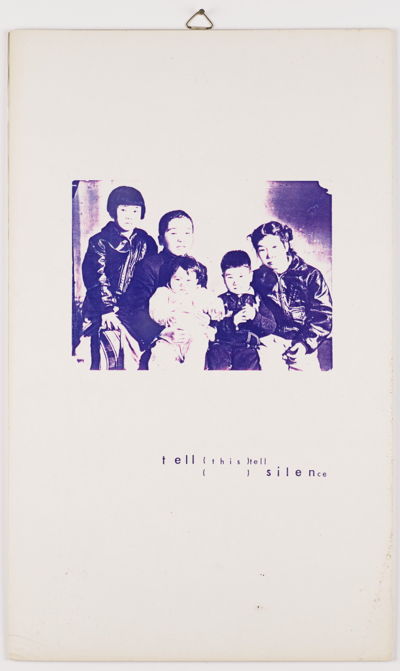
In Chronology (1977), empty brackets figure something known to be there but not enunciable, the repressed of patriarchy and colonialism. Chronology is a series of photographs of Cha’s family mounted on pressboard printed with short captions or phrases. Both words and images are printed in violet-indigo. One reads, ‘tell (this)tell | ( ) silence’ (Figure 2). This, something that can be pointed to deictically but ‘not be named’, has to be told, but how can one tell silence? The curve of the brackets here is like an elliptical orbit showing the gravitational field of an object that cannot be seen directly, that is perceptible only in its effects (before it meant the three dotted punctuation marks, ‘ellipsis’ meant what falls short, what isn’t there).87 The same shape appears in Faire-Part, a 1976 work composed of empty, unaddressed envelopes (Figure 3). Their emptiness is underlined by the appearance on them of words like manqué (missing), vide (empty, void), muet (mute), of zeros and of empty parentheses. The empty parentheses here mimic the support on which they are inscribed. Both are empty envelopes. They can contain something, but they don’t have to. There is something almost tender here: parentheses carefully holding something like two cupped hands, an instance of what Trinh, taking up a phrase from another Cha work, Commentaire (1981), calls the ‘twohold’ that recurs across Cha’s work. The ‘twohold’, Trinh proposes, is not ‘vertically imposed’, and each is an interval, recess, or pause.88 If this twohold that gently cradles something or, for want of speech or content, simply holds fast to making that gesture anyway, is something small — smaller say, than the structures called ‘patriarchy’ or ‘colonialism’ — it cannot simply be Beginning of page[p. 257] arrayed on a lower rung of the same scale. It cannot be nested because, even if it is contained in brackets, it is also something or somewhere else, ‘(Ailleurs)’, ‘(Anything at all.)’89Beginning of page[p. 258]

(In one of his last lecture courses, Fredric Jameson described a defining trait of post-war ‘French theory’ as a fascination with ‘what in French is called the schiz, the gap, the béance, the opening, the distance between, the crack, the cut’, such that there ‘is never a fullness’. For thinkers from Lacan to Althusser to Derrida to Foucault, he remarks, ‘there isn’t being. There are only gaps in being.’90 The aim of my discussion here has been, though, not to retrace this canonized moment in the history of Western thought, but to try to draw on some of these resources to make a link between the tiny marks of the type that brackets represent and social form. This linking process can begin from textual structure; however, the route out that I am proposing is ultimately not deconstructive but infrastructural. Vishmidt’s examples of gaps always relate to social content: Achille Mbembe’s necropolitics or Frank Wilderson’s ‘prison-slave’.91 Indeed, form on this understanding is ‘sedimented’ (social, historical) content.92 In the account given by Vishmidt and Kerstin Stakemeier, both art and reproductive labour are ‘systematically detached and externalized from within capital’,93 that same parenthetical structure I have been talking about, that the passage from The Golden Notebook points up so clearly, and that I also find alluded to in one of the gendered oppositions of Rainer’s poem: ‘“my father” / (forget mother)’. Art’s potential as gap relates to the possibility of what Stakemeier calls ‘autonomisation’, but this is not the modernist autonomy represented by, say, Frampton, because, seemingly paradoxically, ‘the only hope for autonomy in contemporary art is for art to understand itself in relation to reproductive labour.’94 In other words, as both subordinated and autonomous at the same time, the two characteristics bound together. This peculiar status of being both immanent and externalized can be weaponized. The production of these autonomizations is a practice of negativity, of generating what, in another context, Benjamin Noys calls ‘immanent ruptures’.95 I see this as, Beginning of page[p. 259] to return to Adorno’s ‘Gaps’, a termite practice that hollows out from within and compromises the structural integrity of ideology or infrastructure. The conceptual practices of artists like Andrea Fraser ‘lay open and expand internal systemic non-simultaneities, excesses, and breaches’, Stakemeier writes.96 In light of this, the poststructuralist thematic of gaps and limits — as in Sollers’s search for a practice of écriture that enacts ‘the experience of limits’, or deconstruction as (in Düttmann’s words) the attempt to render apprehensible ‘the indiscernible limit on which speech is spaced’97 — can here be more explicitly inscribed into, and made effective in, the social. In White, this involves situating activity at the ‘productive limit or dialectical location’,98 which Sperlinger glosses as the point where ‘[t]he limit becomes productive […] when we become conscious of the limits imposed on our experience by framing, of whatever kind, [so that] those limits can be made into the material (content) of our experience’.99 Implied here is that, as in Stakemeier’s dense theoretical description, ‘[f]orm is employed as a weapon of real-time concretisation, of the autonomisation of forms of life against the real abstraction of contemporary crisis-ridden capitalist society’. Moreover, in something like a materialist, left-communist rewriting of the poststructuralist rhetoric of the avant-garde text’s mimetic production of a fractured, non-bourgeois subjectivity, Stakemeier speaks of practices such as those of White — I would add here Cha — where ‘artistic self-deployment’ operates but ‘recedes, bearing a developing repertoire of autonomisations, establishing a set of practices, of discernible gestures and discrete forms, that commands an arsenal open to collectivisations, quotes, and shared authorships’. Subjectivity is legible not as modernist ‘expressive genius’ but as ‘a socialised component of its own productions’, as a series of ‘affective points of concentration which do not expose a representative subjectivism. These artists do not appear as champions of the discourses into which they intervene, but as the cause of breaks within them. Crudeness, affects, desires, insecurities, and minor predicates are brought full circle instead of becoming part of a larger whole.’100 I hear strong echoes here Beginning of page[p. 260] of the ideas driving Baudry’s Bataille-influenced statement that ‘practices can be thought only through the recognition of the real subject, taken in the whole of its drives and of its relationship, and that of its drives, to social practices’. Stakemeier goes on to say that ‘[h]ere, singularisations lose their developmental sense and spiral back into individuations; they do not strive for completion, but for expanding specification — autonomisations that want no functional, discursive place within contemporary catastrophic capitalism.’101 Parentheses are something undigested, not fully metabolized by their host text. Holes in the infrastructure. If, for some thinkers, parentheses have signalled a detachment or insularity that ties them to depoliticization and dehistoricization, when otherwise potentialized, either by artistic production or by a mode of reading, parentheses can be a figure for social gaps or autonomizations, whether large-scale historical ruptures or small but intransigent negations.)
w(h)imper

Comay and Ruda contrast the dash, which may appear singly or mark a rhetorical parenthesis, with brackets and quotation marks, which always come in pairs and therefore produce the expectation that they will close.102 Alex Farrar’s Wimper is a book of riso-printed eyelashes, no more than one per page.103 At first sight they could be accidental pencil marks (Figure 4). Wimper is the Dutch and German word for ‘eyelash’; it could also be a misspelling of the English word ‘whimper’, the opposite of going out with a bang. I see these eyelashes as little brackets. Erasmus called brackets ‘lunula’ because they look like miniature crescent moons. Little brackets, withdrawn or liberated from the expectation to close (thus from linear temporality), withdrawn or liberated from the directionality of the line, withdrawn or liberated from the aspiration to be a letter and falling back instead to mere graphic mark and fragment and trace of bodies. They fail to close, to gather together, to climax, instead lying scattered on the verge of disappearance, of being brushed away as unimportant. Then they are carefully picked up to leave their shadow on a page: body as matter become Beginning of page[p. 261] page as matter. Mute material drawn back towards text, but not fully. Unlike those fascist subjects who are ‘hard ships’, who fortify bodily and psychological boundaries pathologically and cannot mingle their self with others, here the body is always falling apart. This is the body as unfinished parenthesis, as broken promise of closure. So
(for JR)
Notes
- This essay began as a presentation at the workshop ‘my little i’, organized by Angelica Stathopoulos at ICI Berlin on 27 May 2025. ↵
- Rebecca Comay and Frank Ruda, The Dash — The Other Side of Absolute Knowing (MIT Press, 2018), p. 53 <https://doi.org/10.7551/mitpress/10877.001.0001>. While it is not true to say that there no differences in punctuation between languages, there is significant consistency across European languages. Moreover, many non-Latin scripts have incorporated European punctuation marks. ↵
- Barbara Cassin, ‘Introduction’, in The Dictionary of Untranslatables: A Philosophical Lexicon, ed. by Barbara Cassin, trans. ed. by Emily Apter, Jacques Lezra, and Michael Wood (Princeton University Press, 2014), p. xvii. See also Emily Apter, ‘Preface’, in the same volume, p. vii. ↵
- Comay and Ruda, The Dash, p. 6. In fact, for Comay and Ruda, ‘—’ will turn out to be one possible translation of the untranslatable Aufhebung. ↵
- Cassin, ‘Introduction’, p. xvii. ↵
- For example, Sigmund Freud, ‘On Dreams’, in The Standard Edition of the Complete Psychological Works of Freud, trans. by James Strachey, ed. and trans. by Anna Freud, 24 vols (Vintage, 2001), v: 1900–1901, pp. 633–85 (p. 636); and ‘Psycho-analysis and the Establishment of the Facts in Legal Proceedings’, in The Standard Edition of the Complete Psychological Works of Freud, ix: 1906–1908, pp. 97–114 (p. 109). ↵
- See Adania Shibli, Minor Detail, trans. by Elisabeth Jaquette (Fitzcarraldo, 2020). ↵
- Hollis Frampton, Letter to Sally Dixon, 28 November 1970, cited in Rachel Moore, Hollis Frampton: (nostalgia) (Afterall, 2006), p. 18. ↵
- Hollis Frampton, ‘Three Talks at Millennium’, Millennium Film Journal, Fall/Winter 1986–87, nos. 16–18, pp. 274–94 (p. 275), cited in Moore, Hollis Frampton: (nostalgia), p. 7. ↵
- Moore, Hollis Frampton: (nostalgia), p. 7. ↵
- Hollis Frampton, ‘Notes on (nostalgia)’, in On the Camera Arts and Consecutive Matters: The Writings of Hollis Frampton, ed. by Bruce Jenkins (MIT Press, 2015), p. 224 <https://doi.org/10.7551/mitpress/7851.001.0001>. ↵
- For example, compare the Frampton statements that follow with Phillips’s description of ‘Frampton’s calculated manipulation of the confessional mode’ and its status as a ‘device’. See Christopher Phillips, ‘Word Pictures: Frampton and Photography’, in Hollis Frampton, ed. by Michael Zryd (MIT Press, 2022), pp. 47–64 (p. 59) <https://doi.org/10.7551/mitpress/14371.001.0001>. ↵
- Frampton, ‘Notes on (nostalgia)’, p. 224. ↵
- Peter Gidal, ‘Interview with Hollis Frampton’, October, 32 (1985), pp. 93–117 (p. 108); my emphasis. ↵
- Hollis Frampton, ‘Interview with Scott MacDonald’, in A Critical Cinema, ed. by Scott MacDonald (University of California Press, 1988), pp. 21–77 (p. 62). ↵
- Frampton, ‘Interview with Scott MacDonald’, p. 60. ↵
- For the latter, see Siona Wilson, ‘Structures of Feeling: Yvonne Rainer circa 1974’, October, 152 (2015), pp. 3–25 <https://doi.org/10.1162/OCTO_a_00214>, especially pp. 5–6, where Wilson describes Annette Michelson’s reading of Rainer’s work as one that works according to precisely those terms suspicious of ‘the personal’ that tutor Frampton’s description of (nostalgia). ↵
- Ian White, ‘F R E E (Prisons 2)’, in Here is Information. Mobilise, ed. by Mike Sperlinger (LUX, 2016), pp. 299–308 (p. 306). See also Mike Sperlinger, ‘Inevitably Making Sense: An Introduction to the Writing of Ian White’, in the same volume, pp. 9–22. ↵
- Ian White, ‘1. What can be said’, Lives of Performers, 7 October 2012 <https://livesofperformers.wordpress.com/2012/10/07/what-can-be-sai/> [accessed 9 July 2026]; and ‘Lube’, Lives of Performers, 13 November 2012 <https://livesofperformers.wordpress.com/2012/11/13/lube/> [accessed 9 July 2026]. ↵
- The first two come from Ian White, ‘(I am) For the Birds’, in Here is Information. Mobilise, ed. by Sperlinger, pp. 333–36 (pp. 333, 334). The third comes from Ian White, ‘Yes But If But If But Then But Then: Peter Gidal’, pp. 53–56 (p. 54), in the same volume. ↵
- White, ‘(I am) For the Birds’, pp. 333–34. ↵
- Comay and Ruda, The Dash, p. 59. ↵
- Theodor W. Adorno, ‘Punctuation Marks’ [1956], in Adorno, Notes to Literature, trans. by Rolf Tiedemann and Shierry Weber Nicholsen (Columbia University Press, 2019), pp. 106–111 (p. 106). ↵
- Jacques Derrida, Of Grammatology [1967], trans. by Gayatri Chakravorty Spivak (Johns Hopkins University Press, 1997), p. 227. ↵
- Adorno, ‘Punctuation Marks’, p. 107. ↵
- Ibid., p. 106. ↵
- Theodor W. Adorno, Negative Dialectics [1966], trans. by E. B. Ashton (Routledge, 2004), p. 18. ↵
- Adorno, ‘Punctuation Marks’, p. 110. ↵
- Comay and Ruda, The Dash, p. 56. ↵
- Adorno, ‘Punctuation Marks’, p. 109. ↵
- Adorno, Negative Dialectics, p. 33. ↵
- Adorno, ‘Punctuation Marks’, p. 111. ↵
- Derrida, Of Grammatology, p. 68. ↵
- Alexander García Düttmann, ‘Nothing to See, Nothing to Do’, in Jean-Luc Nancy, Derrida, Supplements, trans. by Anne O’Byrne (Fordham University Press, 2023), pp. 175–84 (p. 180). ↵
- Jacques Derrida, ‘Différance’, in Margins of Philosophy [1972], trans. by Alan Bass (University of Chicago Press, 1982), pp. 1–28 (p. 5). ↵
- Peter Szendy, Of Stigmatology: Punctuation as Experience, trans. by Jan Plug (Fordham University Press, 2018), p. 53. ↵
- Derrida, ‘Différance’, p. 8. ↵
- Ibid., p. 5. ↵
- See Derrida’s variants on the phrase ‘Who’s talking about living’, which include not only changes in punctuation but typological changes, i.e. the use of italics, in Jacques Derrida, ‘Living On: Border Lines’, trans. by James Hulbert, in Harold Bloom and others, Deconstruction and Criticism (Continuum, 1979), pp. 75–176 (pp. 80–81). See also Jacques Derrida, ‘Choreographies’, interview by Christie V. McDonald, Diacritics, 12.2 (1982), pp. 66–76 (p. 69); and Szendy, Of Stigmatology, pp. 54–55. ↵
- Derrida ‘Living On’, p. 75. See also Jacques Derrida, ‘Limited Inc a b c…’, trans. by Samuel Weber, in Derrida, Limited Inc (Northwestern University Press, 1988), pp. 29–110 (p. 100). ↵
- Adorno, ‘Punctuation Marks’, p. 111. ↵
- Ibid., p. 107. ↵
- Doris Lessing, The Golden Notebook [1962] (Fourth Estate, 2014), p. 246. ↵
- Yvonne Rainer, Poèmes (Trente-trois morceaux, 2021), p. 107. ↵
- Henrike Kohpeiß, Bourgeois Coldness, trans. by Grace Nissan (Divided, 2025), p. 2. ↵
- Mattin, Social Dissonance (Urbanomic, 2022). ↵
- Lily Scherlis, ‘Boundary Issues’, Parapraxis, 10 July 2023 <https://www.parapraxismagazine.com/articles/boundary-issues> [accessed 9 July 2026]. ↵
- Kohpeiß, Bourgeois Coldness, p. 135. For the relation between the development of this view of the self and historical capitalist processes of enclosure, see Klaus Theweleit, Male Fantasies, trans. by Stephen Conway in collaboration with Erica Carter and Chris Turner, 2 vols (University of Minnesota Press, 1987–89), i: Women, Floods, Bodies, History (1987), pp. 301–02. ↵
- Kohpeiß, Bourgeois Coldness, pp. 5, 150–51. ↵
- Alberto Toscano, ‘Fragments for a Theory of the Late Fascist Body’, in Dagmar Herzog, The New Fascist Body (Wirklichkeit Books, 2025), pp. 97–110 (p. 87). ↵
- Theweleit, Male Fantasies, i, pp. 244, 322. ↵
- Roland Barthes, ‘Theory of the Text’, trans. by Ian McLeod, in Untying the Text: A Post-Structuralist Reader, ed. by Robert J. C. Young (Routledge and Kegan Paul, 1981), pp. 31–47 (p. 44). ↵
- Roland Barthes, ‘Lecture in Inauguration of the Chair of Literary Semiology, Collège de France, January 7, 1977’, trans. by Richard Howard, October, 8 (1979), pp. 3–16 (p. 13) <https://doi.org/10.2307/778222>. ↵
- Rosalind Krauss, ‘Video: The Aesthetics of Narcissism’, October, 1 (1976), pp. 50–64 (p. 52) <https://doi.org/10.2307/778507>. ↵
- Jean-Paul Fargier, ‘Parenthesis or Indirect Route’, trans. by Diana Mathias, Screen, 12.2 (1971), pp. 131–44 (p. 131) <https://doi.org/10.1093/screen/12.2.131>. ↵
- Roland Barthes, A Lover’s Discourse: Fragments, trans. by Richard Howard (Hill and Wang, 1978), p. 7. ↵
- Roland Barthes, ‘The Structuralist Activity’, trans. by Richard Howard, in Barthes, Critical Essays (Northwestern University Press, 1972), pp. 213–20 (pp. 214–15); Roland Barthes, ‘Writers, Teachers, Intellectuals’, in Image Music Text, ed. and trans. by Stephen Heath (Fontana, 1977), pp. 190–215 (pp. 193–94). ↵
- Roman Jakobson, ‘Linguistics and Poetics’, in Jakobson, Language in Literature, ed. by Krystyna Pomorska and Stephen Rudy (Harvard University Press, 1987), pp. 62–94 (p. 69). ↵
- Barthes, ‘Lecture in Inauguration of the Chair of Literary Semiology’, p. 7; Barthes, A Lover’s Discourse, pp. 3–4. ↵
- See, for instance, the following words: ‘If, by some unimaginable excess of socialism or barbarism, all but one of our disciplines were to be expelled from our educational system […]’ (Barthes, ‘Lecture in Inauguration of the Chair of Literary Semiology’, p. 6). ↵
- Roland Barthes, The Neutral: Lecture Course at the Collège de France (1977–1978), trans. by Rosalind E. Krauss and Denis Hollier (Columbia University Press, 2005), p. 12. ↵
- Jean-Louis Baudry, ‘Bataille and Science: Introduction to Inner Experience’, trans. by Leslie Anne Boldt-Irons, in On Bataille: Critical Essays, ed. by Leslie Anne Boldt-Irons (State University of New York Press, 1995), pp. 265–81 (pp. 271, 273). The essay was originally presented at a 1972 colloquium on Bataille and Antonin Artaud in which Barthes and Kristeva also participated, the papers of which were published in 1974. See Philippe Sollers, ed., Bataille (10/18, 1974). ↵
- Baudry, ‘Bataille and Science’, p. 278. ↵
- Theodor W. Adorno, In Search of Wagner, trans. by Rodney Livingstone (Verso, 1981), p. 74, cited in Fredric Jameson, Late Marxism: Adorno or The Persistence of the Dialectic [1990] (Verso, 2007), p. 70. ↵
- Jacques Derrida, ‘From Restricted to General Economy: A Hegelianism without Reserve’, in Derrida, Writing and Difference [1967], trans. by Alan Bass (Routledge Classics, 2001), pp. 317–50; Philippe Sollers, Writing and the Experience of Limits [1968], ed. by David Hayman, trans. by Philip Barnard (Columbia University Press, 1983), p. 108. ↵
- Julia Kristeva, ‘On the Subject in Linguistics’, trans. by Anna Strelis, Graduate Faculty Philosophy Journal, 31.1 (2010), pp. 61–89 (p. 72). The essay was first published in 1971 and reprinted in Polylogue (1977), though it was not included in the abridged English translation of the latter. ↵
- Kristeva, ‘On the Subject in Linguistics’, p. 69; Julia Kristeva, Revolution in Poetic Language, trans. by Margaret Waller (Columbia University Press, 1984), p. 94. ↵
- Julia Kristeva, ‘A Question of Subjectivity — an Interview’, in Modern Literary Theory: A Reader, ed. by Philip Rice and Patricia Waugh (Arnold, 1989), pp. 131–36 (pp. 128–29). ↵
- Kristeva, ‘On the Subject in Linguistics’, p. 72. ↵
- Danny Hayward, ‘“Language Is for Fucking Idiots”: On Porpentine Charity Heartscape’, in Hayward, Wound Building: Dispatches from the Latest Disasters in UK Poetry (Punctum Books, 2021), pp. 165–81 (p. 179). ↵
- Marina Vishmidt, ‘Basement Jazz: Dora Budor’, Mousse Magazine, 28 September 2022 <https://www.moussemagazine.it/magazine/dora-budor-marina-vishmidt-2022-2/> [accessed 9 July 2026]. ↵
- Trinh T. Minh-ha, ‘Cotton and Iron’, in Trinh, When the Moon Waxes Red: Representation, Gender and Cultural Politics (Routledge, 1991), pp. 11–26 (p. 15). Think also of Althusser’s ‘necessary absence[s]’ or ‘inevitable absence[s] revealed by symptomatic reading (Louis Althusser and others, Reading Capital: The Complete Edition, trans. by Ben Brewster and David Fernbach (Verso, 2015), pp. 27–28); or the notion of suture developed around the same time by Althusser’s student Jacques-Alain Miller, which Miller calls ‘the general relation of lack to the structure of which it is an element’. Jacques-Alain Miller, ‘Suture (elements of the logic of the signifier)’, trans. by Jacqueline Rose, Screen, 18.4 (1977), pp. 24–34 (p. 26) <https://doi.org/10.1093/screen/18.4.24>. ↵
- Stefano Harney and Fred Moten, The Undercommons: Fugitive Planning and Black Study (Minor Compositions, 2013), p. 26. ↵
- I am reminded here of Étienne Balibar’s description of the effects of the fact that Althusser’s famous 1970 essay ‘Ideology and Ideological State Apparatuses (Notes towards an investigation)’ was extracted from two different sections of a larger manuscript without explaining how these two sections were invented, merely inserting an ellipsis. Instead of an account of the connection between the two, there was an ‘absence’ or ‘void’. For Balibar, the unexpected result was that readers had to invent possible connections in the gap, thus rendering the text paradoxically more productive. See Étienne Balibar, ‘Foreword’, in Louis Althusser, On the Reproduction of Capital: Ideology and Ideological State Apparatuses, trans. by G. M. Goshgarian (Verso, 2014), pp. vii–xviii (pp. xii–xiii). ↵
- Vishmidt, ‘Basement Jazz: Dora Budor’. ↵
- White, ‘Performance, Audience, Mirror: Cinema, Theatre and the Idea of the Live’ in Here is Information. Mobilise, pp. 261–78 (p. 274). ↵
- Sperlinger, ‘Inevitably Making Sense’, pp. 21–22. ↵
- Trinh T. Minh-ha, ‘The Totalizing Quest of Meaning’, in Trinh, When the Moon Waxes Red, pp. 29–50 (p. 31). ↵
- White, ‘Performance, Audience, Mirror’, p. 274. ↵
- Ibid., p. 271. ↵
- Ibid., p. 274. ↵
- Harney and Moten, The Undercommons, p. 26. ↵
- Theodor W. Adorno, Minima Moralia: Reflections from Damaged Life [1951], trans. by E. F. N Jephcott (Verso, 2020), pp. 86–87. ↵
- Katie Kirkland, ‘Re Dis Appearances: Theresa Hak Kyung Cha’s White Dust from Mongolia’, in Film Undone: Elements of a Latent Cinema, ed. by Philip Widmann (Archive Books, 2024), pp. 173–85 (p. 174). ↵
- Theresa Hak Kyung Cha, Dictée (Third Woman Press, 1995), p. 1. ↵
- Jesse Chun, ‘O’, in She Follows No Progression: A Theresa Hak Kyung Cha Reader, ed. by Juwon Jun and Rachel Valinsky (Wendy’s Subway, 2024), pp. 167–83. ↵
- Jean-Luc Nancy, ‘Elliptical Sense’, in Derrida, Supplements, pp. 5–26 (p. 6). ↵
- Trinh T. Minh-ha, ‘White Spring’, in The Dream of the Audience (Theresa Hak Kyung Cha, 1951–1982), ed. by Constance M. Lewallen (University of California Press, 2001), pp. 33–50 (p. 40). ↵
- Cha, Dictée, p. 3. ↵
- Fredric Jameson, The Years of Theory: Postwar French Thought to the Present, ed. by Carson Welch (Verso, 2024), pp. 183–84. ↵
- Vishmidt, ‘Basement Jazz: Dora Budor’. ↵
- Marina Vishmidt, Speculation as a Mode of Production: Forms of Value Subjectivity in Art and Capital (Brill, 2019), p. 160. ↵
- Marina Vishmidt and Kerstin Stakemeier, Reproducing Autonomy: Work, Money, Crisis and Contemporary Art (Mute, 2016), p. 65. ↵
- Ibid., p. 47. ↵
- Benjamin Noys, The Persistence of the Negative: A Critique of Contemporary Continental Theory (Edinburgh University Press, 2010), p. 17. ↵
- Vishmidt and Stakemeier, Reproducing Autonomy, p. 25. ↵
- Düttmann, ‘Nothing to See, Nothing to Do’, p. 180. ↵
- White, ‘Performance, Audience, Mirror’, cited in Sperlinger, ‘Inevitably Making Sense’, p. 18. ↵
- Sperlinger, ‘Inevitably Making Sense’, p. 18. ↵
- Vishmidt and Stakemeier, Reproducing Autonomy, pp. 26–28. ↵
- Ibid., p. 28. ↵
- Comay and Ruda, The Dash, p. 55. ↵
- Alex Farrar, Wimper (Mulberry Tree Press, 2019). ↵
Bibliography
- , In Search of Wagner, trans. by Rodney Livingstone (Verso, 1981)
- Adorno, Theodor W.Minima Moralia: Reflections from Damaged Life [1951], trans. by E. F. N Jephcott (Verso, 2020)
- Adorno, Theodor W.Negative Dialectics [1966], trans. by E. B. Ashton (Routledge, 2004)
- Adorno, Theodor W.‘Punctuation Marks’ [1956], in Theodor W. Adorno, Notes to Literature, trans. by Rolf Tiedemann and Shierry Weber Nicholsen (Columbia University Press, 2019), pp. 106–111
- , , Reading Capital: The Complete Edition, trans. by Ben Brewster and David Fernbach (Verso, 2015)
- , ‘Foreword’, in Louis Althusser, On the Reproduction of Capital: Ideology and Ideological State Apparatuses, trans. by G. M. Goshgarian (Verso, 2014), pp. vii–xviii
- , A Lover’s Discourse: Fragments, trans. by Richard Howard (Hill and Wang, 1978)
- Barthes, RolandThe Neutral: Lecture Course at the Collège de France (1977–1978), trans. by Rosalind E. Krauss and Denis Hollier (Columbia University Press, 2005)
- Barthes, Roland‘The Structuralist Activity’, trans. by Richard Howard, in Barthes, Critical Essays (Northwestern University Press, 1972), pp. 213–20
- Barthes, Roland‘Theory of the Text’, trans. by Ian McLeod, in Untying the Text: A Post-Structuralist Reader, ed. by Robert J. C. Young (Routledge and Kegan Paul, 1981), pp. 31–47
- Barthes, Roland‘Writers, Teachers, Intellectuals’, in Image Music Text, ed. and trans. by Stephen Heath (Fontana, 1977), pp. 190–215
- , ‘Bataille and Science: Introduction to Inner Experience’, trans. by Leslie Anne Boldt-Irons, in On Bataille: Critical Essays, ed. by Leslie Anne Boldt-Irons (State University of New York Press, 1995), pp. 265–81
- Cassin, Barbara, ed., The Dictionary of Untranslatables: A Philosophical Lexicon, trans. ed. by Emily Apter, Jacques Lezra, and Michael Wood (Princeton University Press, 2014) <https://doi.org/10.1515/9781400849918>
- , Dictée (Third Woman Press, 1995)
- , ‘O’, in She Follows No Progression: A Theresa Hak Kyung Cha Reader, ed. by Juwon Jun and Rachel Valinsky (Wendy’s Subway, 2024), pp. 167–83
- , , The Dash — The Other Side of Absolute Knowing (MIT Press, 2018) <https://doi.org/10.7551/mitpress/10877.001.0001>
- , ‘Choreographies’, interview by Christie V. McDonald, Diacritics, 12.2 (1982), pp. 66–76 <https://doi.org/10.2307/464681>
- Derrida, Jacques‘Différance’, in Margins of Philosophy [1972], trans. by Alan Bass (University of Chicago Press, 1982), pp. 1–28
- Derrida, Jacques‘From Restricted to General Economy: A Hegelianism without Reserve’, in Derrida, Writing and Difference [1967], trans. by Alan Bass (Routledge Classics, 2001), pp. 317–50
- Derrida, Jacques‘Limited Inc a b c…’, trans. by Samuel Weber, in Jacques Derrida, Limited Inc (Northwestern University Press, 1988), pp. 29–110
- Derrida, Jacques‘Living On: Border Lines’, trans. by James Hulbert, in Harold Bloom and others, Deconstruction and Criticism (Continuum, 1979), pp. 75–176
- Derrida, JacquesOf Grammatology [1967], trans. by Gayatri Chakravorty Spivak (Johns Hopkins University Press, 1997)
- , ‘Nothing to See, Nothing to Do’, in Jean-Luc Nancy, Derrida, Supplements, trans. by Anne O’Byrne (Fordham University Press, 2023), pp. 175–84 <https://doi.org/10.5422/fordham/9781531503376.003.0018>
- , ‘Parenthesis or Indirect Route’, trans. by Diana Mathias, Screen, 12.2 (1971), pp. 131–44 <https://doi.org/10.1093/screen/12.2.131>
- , Wimper (Mulberry Tree Press, 2019)
- , ‘Interview with Scott MacDonald’, in A Critical Cinema, ed. by Scott MacDonald (University of California Press, 1988), pp. 21–77
- Frampton, Hollis‘Notes on (nostalgia)’, in On the Camera Arts and Consecutive Matters: The Writings of Hollis Frampton, ed. by Bruce Jenkins (MIT Press, 2015), p. 224 <https://doi.org/10.7551/mitpress/7851.001.0001>
- Frampton, Hollis‘Three Talks at Millennium’, Millennium Film Journal, Fall/Winter 1986–87, nos. 16–18, pp. 274–94
- , Letter to Sally Dixon,
- , ‘On Dreams’, in The Standard Edition of the Complete Psychological Works of Freud, trans. by James Strachey, ed. and trans. by Anna Freud, 24 vols (Vintage, 2001),v: 1900–1901, pp. 633–85
- Freud, Sigmund‘Psycho-analysis and the Establishment of the Facts in Legal Proceedings’, in The Standard Edition of the Complete Psychological Works of Freud, trans. by James Strachey, ed. and trans. by Anna Freud, 24 vols (Vintage, 2001), ix: 1906–1908, pp. 97–114
- , , The Undercommons: Fugitive Planning and Black Study (Minor Compositions, 2013)
- , ‘“Language Is for Fucking Idiots”: On Porpentine Charity Heartscape’, in Danny Hayward, Wound Building: Dispatches from the Latest Disasters in UK Poetry (Punctum Books, 2021), pp. 165–81 <https://doi.org/10.53288/0332.1.00>
- , ‘Linguistics and Poetics’, in Jakobson, Language in Literature, ed. by Krystyna Pomorska and Stephen Rudy (Harvard University Press, 1987), pp. 62–94
- , Late Marxism: Adorno, or, The Persistence of the Dialectic [1990] (Verso, 2007)
- Jameson, FredricThe Years of Theory: Postwar French Thought to the Present, ed. by Carson Welch (Verso, 2024)
- , ‘Re Dis Appearances: Theresa Hak Kyung Cha’s White Dust from Mongolia’, in Film Undone: Elements of a Latent Cinema, ed. by Philip Widmann (Archive Books, 2024), pp. 173–85
- , Bourgeois Coldness, trans. by Grace Nissan (Divided, 2025)
- , ‘Video: The Aesthetics of Narcissism’, October, 1 (1976), pp. 50–64 <https://doi.org/10.2307/778507>
- , ‘On the Subject in Linguistics’, trans. by Anna Strelis, Graduate Faculty Philosophy Journal, 31.1 (2010), pp. 61–89 <https://doi.org/10.5840/gfpj20103116>
- Kristeva, Julia‘A Question of Subjectivity — an Interview’, in Modern Literary Theory: A Reader, ed. by Philip Rice and Patricia Waugh (Arnold, 1989), pp. 131–36
- Kristeva, JuliaRevolution in Poetic Language, trans. by Margaret Waller (Columbia University Press, 1984)
- , The Golden Notebook [1962] (Fourth Estate, 2014)
- , Social Dissonance (Urbanomic, 2022)
- , ‘Suture (elements of the logic of the signifier)’, trans. by Jacqueline Rose, Screen, 18.4 (1977), pp. 24–34 <https://doi.org/10.1093/screen/18.4.24>
- , Hollis Frampton: (nostalgia) (Afterall, 2006)
- , The Persistence of the Negative: A Critique of Contemporary Continental Theory (Edinburgh University Press, 2010) <https://doi.org/10.3366/edinburgh/9780748638635.001.0001>
- , ‘Word Pictures: Frampton and Photography’, in Hollis Frampton, ed. by Michael Zryd (MIT Press, 2022), pp. 47–64 <https://doi.org/10.7551/mitpress/14371.001.0001>
- , Poèmes (Trente-trois morceaux, 2021)
- , ‘Boundary Issues’, Parapraxis, 10 July 2023 <https://www.parapraxismagazine.com/articles/boundary-issues> [accessed 9 July 2026]
- , Minor Detail, trans. by Elisabeth Jaquette (Fitzcarraldo, 2020)
- , Writing and the Experience of Limits, ed. by David Hayman, trans. by Philip Barnard (Columbia University Press, 1983)
- Sollers, Philippeed., Bataille (10/18, 1974)
- , ‘Inevitably Making Sense: An Introduction to the Writing of Ian White’, in Here is Information. Mobilise, ed. by Mike Sperlinger (LUX, 2016), pp. 9–22
- , Of Stigmatology: Punctuation as Experience, trans. by Jan Plug (Fordham University Press, 2018) <https://doi.org/10.2307/j.ctt1xhr652>
- , Male Fantasies, trans. by Stephen Conway in collaboration with Erica Carter and Chris Turner, 2 vols (University of Minnesota Press, 1987–89), i: Women, Floods, Bodies, History (1987)
- , ‘Fragments for a Theory of the Late Fascist Body’, in Dagmar Herzog, The New Fascist Body (Wirklichkeit Books, 2025), pp. 97–110
- , When the Moon Waxes Red: Representation, Gender and Cultural Politics (Routledge, 1991)
- Trinh T. Minh-ha‘White Spring’, in The Dream of the Audience (Theresa Hak Kyung Cha, 1951–1982), ed. by Constance M. Lewallen (University of California Press, 2001), pp. 33–50
- , ‘Basement Jazz: Dora Budor’, Mousse Magazine, 28 September 2022 <https://www.moussemagazine.it/magazine/dora-budor-marina-vishmidt-2022-2/> [accessed 9 July 2026]
- Vishmidt, MarinaSpeculation as a Mode of Production: Forms of Value Subjectivity in Art and Capital (Brill, 2019) <https://doi.org/10.1163/9789004384774>
- , , Reproducing Autonomy: Work, Money, Crisis and Contemporary Art (Mute, 2016)
- , ‘1. What can be said’, Lives of Performers, 7 October 2012 <https://livesofperformers.wordpress.com/2012/10/07/what-can-be-sai/> [accessed 9 July 2026]
- White, IanHere is Information. Mobilise, ed. by Mike Sperlinger (LUX, 2016)
- White, Ian‘Lube’, Lives of Performers, 13 November 2012 <https://livesofperformers.wordpress.com/2012/11/13/lube/> [accessed 9 July 2026]
- , ‘Structures of Feeling: Yvonne Rainer circa 1974’, October, 152 (2015), pp. 3–25 <https://doi.org/10.1162/OCTO_a_00214>
© by the author(s)
Except for images or otherwise noted, this publication is licensed under a Creative Commons Attribution-ShareAlike 4.0 International License.© 2026 ICI Berlin Press